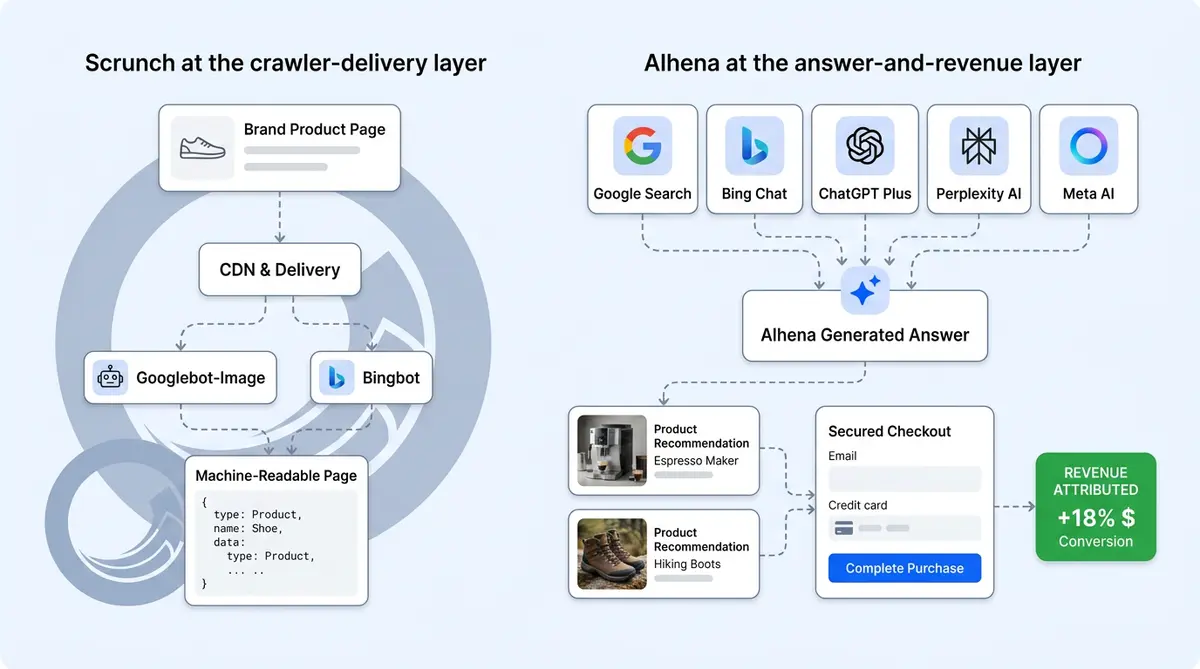
Alhena AI and Scrunch AI solve AI search visibility from opposite ends of the same problem: Scrunch AI serves reformatted, machine-readable versions of your pages to AI crawlers at the CDN layer, while Alhena AI measures which of your products and pages AI engines actually recommend, generates fixes for the underlying content, and attributes the resulting traffic to checkout revenue. Scrunch was acquired by the digital experience platform Sitecore in June 2026, so the choice is now between a component of an enterprise suite and an independent, e-commerce-first platform. If you run on Sitecore and want a crawler-delivery layer, Scrunch is the natural fit. If you run an independent Shopify, WooCommerce, Magento, or Salesforce Commerce Cloud store and want to know which SKUs win in AI answers and what that is worth, Alhena is built for that.
This guide compares the two on approach, engines, product-level tracking, revenue attribution, ownership, and price, and answers the two questions Scrunch customers are asking most: what the Sitecore acquisition changes, and whether serving different content to AI crawlers is safe.
Last verified: July 2026.
Key takeaways
- Scrunch AI optimizes the input to AI engines by serving reformatted pages to retrieval crawlers at the CDN layer; Alhena AI optimizes and measures the output, tracking what engines answer and joining it to revenue.
- Scrunch was acquired by Sitecore in June 2026 for a press-reported figure of roughly $225 million, terms not officially disclosed; the roadmap is converging with Sitecore's DXP, and standalone continuity for independent brands is an open question to raise at renewal.
- Scrunch is stronger on AI-crawler analytics, engine breadth, persona tracking, and crawler-level content delivery. Alhena concedes crawler analytics entirely.
- Alhena is stronger on SKU-level product tracking, answer rendering analysis, live catalog sync, and native revenue attribution that joins AI-engine traffic to checkout events.
- Serving different content to AI crawlers is an unsettled tactic; Scrunch defends it as format-only, some practitioners flag it as cloaking-adjacent, and Alhena avoids the question by improving the single canonical page.
- Fit rule: Sitecore stack or crawler-delivery priority points to Scrunch; independent Shopify or DTC store that needs product-level visibility and provable revenue points to Alhena.
Disclosure: Alhena publishes this guide and sells one of the products discussed. Competitor facts come from Scrunch's public pricing page, product documentation, case studies, and the Sitecore acquisition announcement, linked at first use and verified in July 2026. Financial terms of the acquisition were not disclosed by either company; the widely cited figure is press-reported and labeled as such below.
Alhena vs Scrunch AI at a glance
The table below summarizes where each platform is strong. Read the sections that follow for the reasoning, the evidence labels, and the honest concessions, because a one-line cell cannot capture whether a difference matters for your store.
| Capability | Alhena AI | Scrunch AI (now part of Sitecore) |
|---|---|---|
| Built for | E-commerce brands selling a catalog online | Enterprise marketing teams, increasingly Sitecore DXP customers |
| Core approach | Measure what engines answer, generate content fixes, attribute the traffic to revenue | Serve AI-optimized parallel pages to retrieval crawlers, plus monitoring and content recommendations |
| Engines tracked | 5: ChatGPT, Google AI Overviews, Gemini, Perplexity, Claude, all in every paid plan | 6+: ChatGPT, Claude, Gemini, Perplexity, Google AI Overviews and AI Mode, Meta AI |
| Prompt and persona tracking | Topics and prompts, auto-generated plus custom; competitor auto-discovery | Custom and industry prompts, plus buyer persona tracking (3 to 5 personas by tier) |
| AI crawler and agent-log analytics | Not offered today | Yes, a core strength; AXP operates at the crawler and CDN level |
| SKU-level product tracking | Yes, per-topic ChatGPT product cards with is-your-product flags and invisible-bestseller detection | Brand and page level; not catalog or SKU native |
| Answer rendering analysis | Yes, distinguishes shopping product cards from plain text mentions | Not offered as a product-card rendering view |
| Revenue attribution | Native: classifies AI-engine traffic and joins it to checkout and cart events, benchmarked to your sitewide baseline | Reports brand-presence and citation lifts from case studies; no native purchase-event join |
| Live catalog sync | Shopify, WooCommerce, Magento, Salesforce Commerce Cloud | Not a catalog integration; content is optimized page by page |
| Ownership and roadmap | Independent company, e-commerce focused | Owned by Sitecore; roadmap converging with the Sitecore DXP suite |
| Entry pricing | Free tier, then Essentials at $199 per month | Starter at $250 per month billed annually ($300 month-to-month) |
| Free option | Free tier included | 7-day free trial of Starter, no credit card |
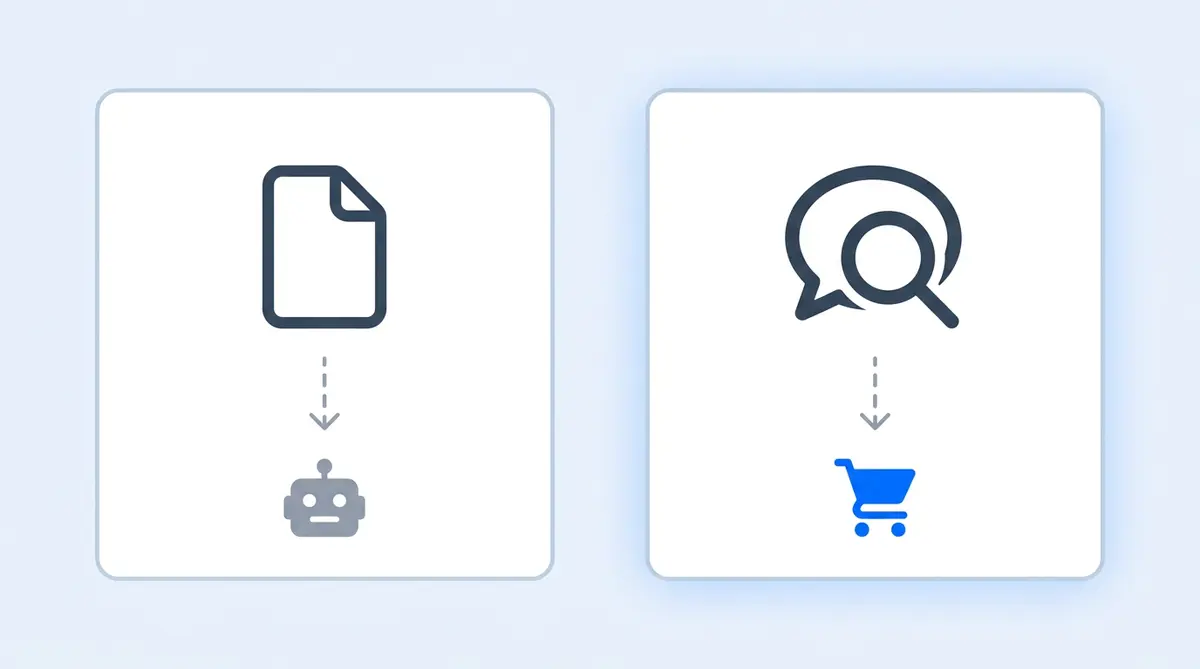
What Scrunch AI does: serve optimized pages to AI crawlers
Scrunch AI's signature product is its Agent Experience Platform (AXP), and it is a genuinely distinct idea. AXP intercepts requests from real-time AI retrieval bots at the CDN layer, where Scrunch integrates with Akamai, Cloudflare, and Vercel, and serves those bots a stripped-down, machine-readable version of the page. Scrunch's own documentation describes it plainly: the platform "serves optimized content only to real-time AI retrieval bots (ChatGPT, Perplexity, etc.)," while "Google and Bing indexing crawlers continue to see your normal site, so traditional SEO remains unchanged." One example on Scrunch's site shows a pricing page compressed from roughly 123,916 tokens to roughly 1,255 tokens for the bot.
The problem this solves is real. Many retail pages are heavy with scripts, tracking, and layout markup that make them expensive for a retrieval model to parse as it assembles an answer. If a bot times out or truncates, your content never makes it into the response. Delivering a clean, compact version to the crawler directly raises the odds your page is read and cited.
Scrunch also publishes outcome numbers. In a Scrunch case study, AXP-enabled pages for the technology company Akamai showed a 364% increase in brand presence for non-branded prompts, nearly five times the baseline, plus 85% more citations and a 133% increase in ChatGPT specifically, measured from December 2025 to January 2026. Treat these as vendor-reported results: they come from Scrunch's own case study, describe one enterprise brand, and are not an independent or controlled measurement. They are a reasonable signal that the approach can move citation share, not a guarantee of the same lift for your catalog.
Alhena does not do any of this, and that is the honest concession that frames the whole comparison. Alhena has no AI-crawler log analytics and no crawler-delivery layer. If your single priority is making your pages cheap for retrieval bots to parse and controlling exactly what those bots receive, Scrunch's AXP is the most direct tool for that job, and a measurement-first platform, including Alhena, will not replace it.
What Alhena does: measure the answer, fix the content, attribute the revenue
Alhena works on the output side of the same pipeline. Instead of changing what the crawler receives, Alhena's AI Visibility platform measures what the engine actually answers, identifies why a competitor is winning a given prompt, generates a content fix, and then tracks whether AI-referred visitors convert. The internal shorthand is a loop: see it, fix it, prove it.
See it. Alhena tracks your visibility across five engines, ChatGPT, Google AI Overviews, Gemini, Perplexity, and Claude, all included in every paid plan. Its dashboard has six tabs: Overview, Prompts, Citations, Fan-out queries, Content AI visibility, and Competitors. The Citations tab groups sources by domain and by individual page and attaches a 0 to 100 Domain Rating, so you can see which authorities the engines lean on. The Competitors tab auto-discovers every brand in your answer set, not only the ones you registered, and shows the prompts where a rival is top-ranked and you are absent.
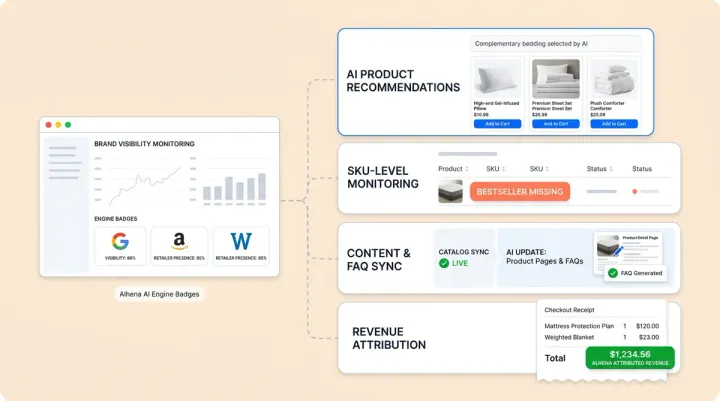
Where Alhena diverges most from brand-level tools is SKU-level tracking. AI shopping answers do not recommend brands, they recommend specific products, often rendered as a card with a price, an image, and a merchant name. Alhena tracks visibility at the level of those product cards per topic, flags whether the surfaced product is yours, and detects invisible bestsellers, the items that sell well on your own site but never appear in AI answers. It also performs answer rendering analysis, distinguishing a full shopping product card from a passing text mention, because the two are worth very different amounts of attention.
Fix it. Alhena identifies content gaps, generates FAQ and product-detail-page recommendations, and produces content fixes you can apply. To be precise about scope, Alhena generates fixes and suggestions; it does not silently publish changes to your storefront on its own. The action lives with your team, which is usually what a brand wants for its own catalog pages.
Prove it. No other AI visibility platform matches this today. Alhena classifies incoming AI-engine traffic by referrer and UTM into per-engine buckets, then joins those sessions to checkout and cart events and benchmarks the result against your sitewide baseline. Because Alhena also runs first-party on-site shopping and support agents, handling real shopper conversations across web chat, email, Instagram DMs, and WhatsApp, the visibility data and the purchase data live in one system rather than being stitched together after the fact. The result is an answer to the question every other tool leaves open: not just "were we mentioned," but "did being mentioned lead to a sale." Our AI search revenue attribution guide walks through the method, and the first-party data thesis explains why owning the on-site agent matters for it. What those agents hear also feeds forward: real shopper questions inform which prompts Alhena tracks and which content gaps it prioritizes, an input a crawler-side platform never sees.
This reframes Alhena's missing crawler analytics. Crawler visits tell you that you are being read. Referral and revenue analytics tell you that you are being chosen. Scrunch is strong on the first. Alhena is built for the second.
What the Sitecore acquisition changes
On June 3, 2026, Sitecore announced it had acquired Scrunch. Neither company disclosed the financial terms. Bloomberg reported a figure of roughly $225 million, citing people familiar with the deal, and other outlets have repeated it as a reported, not confirmed, number. Treat the price as press-reported.
The strategic logic is clear from the announcement: Sitecore is combining Scrunch's AXP and monitoring with its own digital experience platform, and the press release already refers to "Scrunch, a Sitecore company." The announcement does not publish a standalone-product commitment or an integration timeline. That silence is not a criticism; it is the open question a careful buyer should raise at renewal.
Here is a fair reading for different buyers:
- If you already run Sitecore, this acquisition is good news. A crawler-delivery and AI-monitoring layer that plugs into the DXP you already operate is exactly the kind of consolidation that reduces vendor sprawl.
- If you are an independent Shopify or DTC brand, the questions worth asking are whether standalone Scrunch continues to be sold and supported on your timeline, whether the roadmap will keep prioritizing use cases that do not touch Sitecore's suite, and what a future migration would look like if the answer is no. None of this is settled, and none of it should be assumed either way.
The point is not fear, it is diligence: ask Scrunch about standalone continuity and get the answer in writing before you renew.
Is serving different content to AI crawlers cloaking?
This is the substantive technical debate around Scrunch's approach, and it deserves both sides rather than a verdict.
Scrunch's position is that AXP is not cloaking. In its framing, the substance of the content is the same, only the format changes, and the optimized version is served to real-time retrieval bots rather than to the search indexers, so Google and Bing still see the standard page. On that reading, AXP is closer to serving a mobile layout or a print stylesheet than to deceptive cloaking.
The counter-position, raised by several search and GEO practitioners, is that serving materially different bytes to bots than to humans is the definition search engines have long used for cloaking, which Google prohibits. Writing on the topic, Conductor argues that AEO cloaking is a risky AI visibility tactic and that vendors are repackaging an old technique in new language. Google's own guidance treats content parity between what bots and users see as the safe default, and Google's John Mueller publicly dismissed the idea of serving markdown-only pages to AI systems.
The honest answer in July 2026 is that this is unsettled. AXP is a legitimate, thoughtfully engineered approach that many enterprises are adopting, and it may prove entirely safe. It also carries a category of risk that measurement-and-fix approaches do not: if an engine decides that format-divergent delivery violates its guidelines, the pages relying on it are exposed. Alhena's approach sidesteps the question by improving the single canonical page every visitor and bot sees, so there is no second version to defend. Which trade-off is right depends on your risk tolerance and how much you trust the durability of the tactic.
What Scrunch customers on Shopify or DTC should evaluate
If you are a Scrunch customer running an independent storefront rather than a Sitecore stack, three questions decide whether to stay, add, or switch.
Do you need crawler delivery, or content that is simply good? AXP's value is highest when your pages are too heavy for retrieval bots to parse well. If your product and content pages are already clean and structured, the incremental value of a parallel bot version is smaller, and a measure-and-fix platform may get you most of the way with less architectural commitment.
Do you need commerce depth? Scrunch tracks at the brand and page level with persona segmentation, which is well suited to considered B2B and enterprise buying journeys. If your buyers ask AI engines for specific products and you need to know which SKUs appear, whether the card rendered with the right price and placement, and which bestsellers are invisible, that is catalog-native tracking Scrunch was not designed for.
Do you need to prove revenue? If your mandate is to show finance that AI search produced sales rather than mentions, you need attribution that joins AI-referred sessions to checkout events. That is Alhena's core, and it is the piece Scrunch's monitoring and delivery layers do not provide.
For many independent brands the answer is not either-or in the short term: keep a monitoring or delivery tool while adding the revenue-attribution and SKU-level layer, then consolidate once the Sitecore roadmap for standalone customers is clear. If you are also weighing the enterprise category leader, our Alhena versus Profound comparison covers that decision.
Where Scrunch is genuinely the better choice
A comparison that only flatters the publisher is not useful. Scrunch is the stronger pick in several real situations. For a Sitecore customer, the integrated roadmap is a decisive advantage. If crawler-log and agent-visit analytics are central to how you measure AI presence, Scrunch offers them and Alhena does not. If your buying process runs through distinct personas across seven engines including Meta AI, Scrunch's coverage is broader than Alhena's five. And if your pages are heavy and reformatting them for retrieval bots is your priority, AXP is purpose-built for that and has published enterprise results behind it. Alhena's enterprise motion is also younger than Sitecore's, which matters for procurement-heavy deployments.
The verdict
The Sitecore acquisition clarified what Scrunch AI is: an enterprise AI-search optimization layer, strongest at delivering content to crawlers, now part of a digital experience suite. That is a good thing to be, and for Sitecore customers it is the obvious choice. It also sharpens what Alhena is: the AI visibility platform built e-commerce-first, where visibility data, an on-site AI agent, and purchase outcomes live in one system, so the metric is not brand mentions but products recommended and revenue earned. Scrunch tells you your pages were served to the bot. Alhena tells you which of your products the engine recommended, and whether that recommendation turned into a sale. For an independent online store, that second answer is usually the one the business is asking for.
Alhena AI (founded 2022 by ex-LinkedIn engineers, rebranded from Gleen AI in February 2025) is an e-commerce AI platform spanning an AI Shopping Assistant, Support Concierge, Voice AI, and AI Visibility (AEO and GEO tracking), with a free tier and paid plans from $199 per month. You can compare tiers on Alhena's pricing page.
Frequently Asked Questions
What is the difference between Alhena AI and Scrunch AI?
Scrunch AI serves reformatted, machine-readable versions of your pages to AI retrieval crawlers at the CDN layer, so bots receive content that is cheaper to parse. Alhena AI works on the output side: it measures which products and pages AI engines actually recommend across five engines, generates content fixes, and attributes AI-referred traffic to checkout revenue. In short, Scrunch optimizes what crawlers read, while Alhena measures and improves what engines answer and ties it to sales.
Is Scrunch AI still available standalone after the Sitecore acquisition?
As of July 2026, Scrunch continues to operate, and Sitecore describes it as a Sitecore company while combining Scrunch's technology with its digital experience platform. Sitecore has not published a standalone-product commitment or an integration timeline. If you are an independent brand rather than a Sitecore customer, ask Scrunch directly about long-term standalone availability and get the answer in writing before you renew.
How much did Sitecore pay for Scrunch AI?
Sitecore announced the acquisition on June 3, 2026, and did not disclose the financial terms. Bloomberg reported a figure of roughly $225 million, citing people familiar with the deal, and other outlets have repeated it as a reported rather than confirmed number. Treat the $225 million as press-reported, not officially confirmed by either company.
Is serving different content to AI crawlers cloaking?
It is an unsettled question in 2026. Scrunch argues its Agent Experience Platform is not cloaking because the substance stays the same and only the format changes, and it serves the optimized version to real-time AI retrieval bots rather than to Google and Bing indexers. Some search and GEO practitioners counter that serving materially different content to bots than to humans is the classic definition of cloaking, which Google prohibits. Alhena avoids the debate by improving the single canonical page that every visitor and bot sees.
What should Scrunch AI customers on Shopify consider?
Ask three questions before you renew. Do you need crawler-level content delivery, or are your pages already clean enough that well-structured content is enough on its own? Do you need SKU-level product tracking and live catalog sync, which are built for Shopify-style stores rather than Scrunch's brand-and-page level, and do you need to prove revenue by joining AI-referred sessions to checkout events? If commerce depth and revenue proof matter more than crawler delivery, an e-commerce-first platform like Alhena is worth evaluating alongside Scrunch.
Does Scrunch AI track products at the SKU level?
No. Scrunch tracks visibility at the brand and page level with buyer-persona segmentation, which suits considered B2B and enterprise buying journeys. It does not offer catalog-native, SKU-level product tracking. Alhena tracks visibility per product card in AI answers, flags whether the surfaced product is yours, and detects invisible bestsellers, the items that sell on your site but never appear in AI results.
Which has broader AI engine coverage, Alhena or Scrunch AI?
Scrunch has broader coverage. It monitors ChatGPT, Claude, Gemini, Perplexity, Google AI Overviews and AI Mode, and Meta AI. Alhena covers five engines, ChatGPT, Google AI Overviews, Gemini, Perplexity, and Claude, all included in every paid plan. If tracking Meta AI or the widest possible engine set is your priority, Scrunch is stronger on breadth.
How does Alhena's AI revenue attribution work?
Alhena classifies incoming AI-engine traffic by referrer and UTM into per-engine buckets, then joins those sessions to checkout and cart events and benchmarks the result against your sitewide baseline. Because Alhena also runs a first-party on-site shopping and support agent, the visibility data and the purchase data live in one system. This lets it report not just whether an engine mentioned you, but whether that mention led to a sale. Attribution is not the same as proven incremental lift, which Alhena does not claim.