Fitment errors are a leading cause of automotive returns, and the category's overall return rate runs as high as 20%. The root cause isn't product quality. It's intelligent search and product discovery. Buyers either can't navigate Year-Make-Model dropdown menus accurately or skip them entirely and guess. Traditional YMM tools are clunky, require the buyer to know exact trim and engine details, and break on mobile. The result is wrong items shipped to wrong vehicles, margins destroyed by supply chain costs, reverse logistics burden on the supply chain network, and supply chain inefficiencies, and customers who never come back.
AI solves this by replacing rigid dropdown filtering with natural language conversations. A shopper types "brake pads for my 2019 Civic EX" and AI systems return verified compatible products instantly, no dropdowns required. This post covers five AI powered auto parts capabilities that eliminate fitment errors, reduce returns through a better process, and turn your catalog into a guided buying experience.
Conversational Compatibility Verification Through Year Make Model Engine Matching
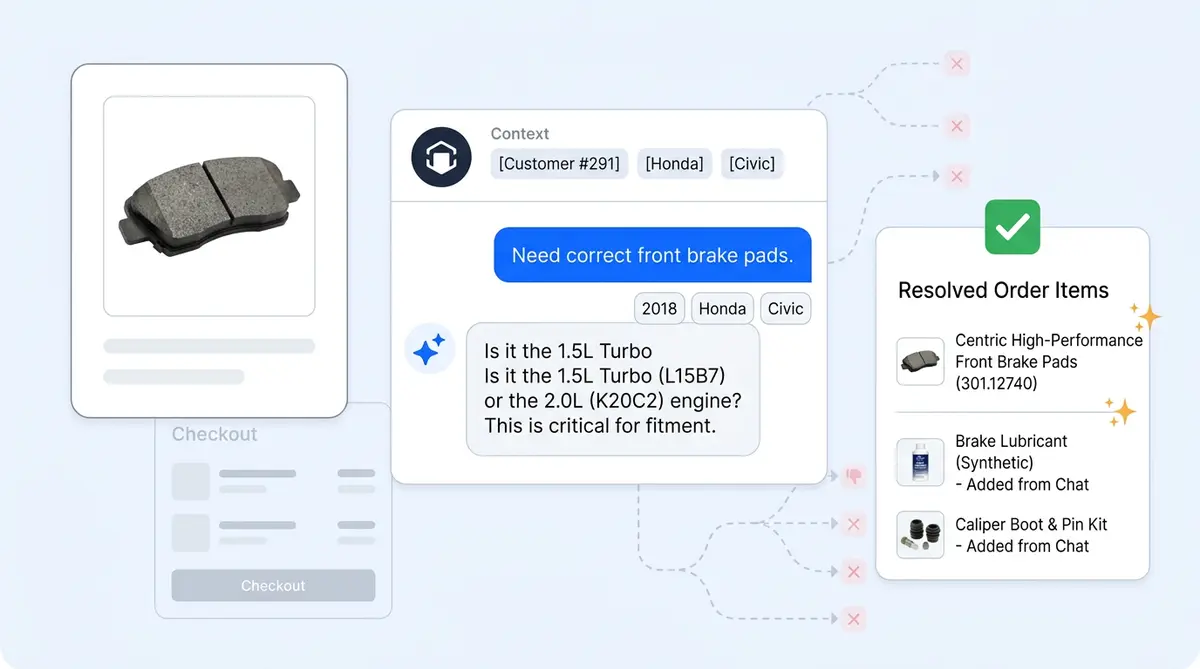
The first and most critical capability is real time fitment verification through natural conversation. This AI solution parses vehicle information from plain language input, cross-references those details against structured fitment informationbases built on ACES-standard data, and confirms compatibility before the shopper adds anything to cart.
Where traditional YMM dropdowns fail is incomplete information. A shopper who types "2018 Honda Civic brake rotors" hasn't specified whether they drive the LX with the 2.0L engine or the EX-T with the 1.5L turbo. A static dropdown returns zero results or, worse, shows both options without explaining the difference. An AI powered shopping assistant handles this by asking a single clarifying question: "Is that the 1.5L turbo or the 2.0L?" Once the shopper answers, AI systems filter the catalog to show only verified compatible products for that exact configuration.
This matters because each incorrect item shipped triggers five to seven downstream supply chain actions: outbound shipping, customer service contact, return authorization, inbound return shipping, inspection, restocking, and a replacement shipment. Conversational fitment verification catches mismatches before the checkout process, not after delivery.
VIN-Based Lookup Within the Conversation
Not every shopper knows their trim level or engine displacement. Many don't even know their exact model year. VIN-based lookup solves this completely. The shopper pastes or types their 17-character Vehicle Identification Number directly into the chat, and the AI decodes it to extract exact vehicle models and specifications: year, make, model, trim, engine, transmission, and production plant.
From there, using AI powered tools to filter your entire catalog in real time to show only items with verified compatibility for that specific vehicle. No manual dropdown selection required. No guessing. The shopper sees a curated list of compatible automotive parts, sorted by relevance, with confidence that each item is verified for their car.
VIN decoding is especially valuable for automotive parts ecommerce stores selling to DIY mechanics and fleet operators. A fleet manager ordering brake components for a mixed fleet of 30 vehicles can paste each VIN and get accurate results without memorizing the spec differences between a 2020 Transit 150 and a 2020 Transit 250. This turns a frustrating, error-prone process into a fast, accurate one.
Technical Specification Matching From Verified Product Data
Automotive parts shoppers ask information-heavy questions that general-purpose chatbots can't answer. "What's the rotor diameter on this?" "Is this pad ceramic or semi-metallic?" "Will this fit with my aftermarket calipers?" "What's the thread pitch on these lug bolts?"
The AI must answer these questions from verified product data, not generated approximations, because wrong specs in the automotive parts category don't just cause returns. They cause dangerous compatibility failures. A brake rotor with the wrong diameter doesn't just not fit. It creates a safety hazard. A wheel hub with incorrect bolt patterns can fail catastrophically at highway speeds.
Alhena's Support Concierge pulls answers directly from your product catalogs, manufacturer documentation, and technical specification sheets. Grounded in live catalog and manufacturer data, the AI never guesses at a torque spec or invents a compatibility claim. If the data isn't in the catalog, the AI says so and routes the question to a human specialist through Agent Assist, with full conversation context preserved.
Cross-Sell and Kit Completion for Complete Job Builds
When a buyer buys brake pads, they almost always need more than just pads. The complete job requires compatible rotors, hardware kits, brake fluid, caliper slide pins, and sometimes sensor wires. Most aftermarket websites leave the buyer to find each component separately, hoping they select the right one each time.
AI powered recommendations changes this by building complete job kits within the conversation. Using AI, the system confirms the brake pad fits the buyer's vehicle, then provides recommendations for compatible rotors, hardware, and fluid that all match the same year, make, model configuration. Each recommended component is verified compatible, not just "frequently bought together" by other shoppers who may drive different vehicles.
This approach increases average order value by 15 to 25% while actually reducing returns, because each component in the kit has been fitment-verified for the buyer's specific vehicle. Compare that to generic "customers also bought" widgets that suggest items based on purchase correlation, with no compatibility validation at all.
For auto parts retailers selling on Shopify or WooCommerce, this kind of intelligent bundling turns single-item transactions into full job orders. A $45 brake pad sale becomes a $180 complete brake job kit, and the customer doesn't have to second-guess whether each piece fits.
Warranty and Installation Support Post-Purchase
The customer relationship doesn't end at checkout. Aftermarket buyers come back with warranty claims, installation difficulty questions, torque spec lookups, and troubleshooting requests. "My new starter is clicking but not engaging. Is it defective or did I wire it wrong?" "What's the torque sequence for these head bolts?" "My brake pads are squealing after 200 miles. Is that normal break-in or a compatibility issue?"
Post-purchase AI powered support handles these conversations by surfacing manufacturer documentation rather than generating technical advice. The AI pulls installation guides, torque specifications, break-in procedures, and warranty terms from your product data, giving the shopper accurate answers without tying up your support team on routine technical lookups.
This is where Alhena's Product Expert Agent and the Order Management Agent work together. These AI agents work in tandem: the Product Expert surfaces the technical documentation while the Order Management Agent (another of Alhena’s AI agents) handles warranty claims, return authorizations, and replacement orders. The shopper gets a single, continuous conversation instead of being bounced between departments.
How Alhena AI Brings Conversational Compatibility Intelligence for the Automotive Vertical
Alhena is purpose-built for this exact use case. The Product Expert Agent ingests your full catalog with ACES-standard fitment information, year, make, model (YMM) attributes, technical information and specifications, and manufacturer documentation. It delivers verified fitment confirmation through natural conversation rather than clunky dropdown menus with intelligent search.
On this AI solution side, Alhena connects to Shopify and WooCommerce to pull live inventory, pricing, and fitment information updated in real time. The AI powered system never recommends inventory out-of-stock items or incompatible items because it checks availability and compatibility against your live catalog and inventory with each query.
This grounded-answer architecture is especially critical for aftermarket auto part inventory. In fashion or beauty, an inaccurate product recommendation causes a return. In the aftermarket vertical, an inaccurate compatibility answer causes a dangerous fitment failure. Alhena's grounded AI model eliminates that risk by delivering fitment accuracy from verified data in your catalog.
Across Alhena's 329-brand dataset, AI-assisted conversations convert at 3.53% for car parts, and AI powered fitment tools reduce incorrect-item returns by 20 to 30% across the category. Revenue analytics, predictive analytics, and AI systems built into the platform track AI-attributed sales, return rate reduction, and per-conversation revenue so you can measure direct impact on margin through predictive analytics.
Alhena also works across channels. Buyers asking fitment questions on your website get the same verified answers as those reaching out via email, Instagram DMs, or WhatsApp through Social Commerce. And when the AI can't resolve a question, Agent Assist hands the conversation to your team with full vehicle details and conversation history intact.
The Bottom Line for Automotive Ecommerce
Auto parts ecommerce has the most data-intensive product discovery challenge in online auto parts retail. Each SKU maps to dozens of vehicle models and applications. Each vehicle has trim-level and engine variations that change compatibility. And every compatibility error costs you a return, a customer service interaction, and probably a lost customer.
Brands that replace static make model dropdowns with conversational AI agents for fitment verification will capture higher conversion rates and outpace competitor pricing strategies, dramatically lower return rates, and stronger customer loyalty from buyers who trust the AI got the product right. Stay ahead of competitor pricing models—this AI solution exists today to beat competitor pricing alternatives, it deploys in under 48 hours, and it pays for itself in reduced returns within the first month.
Ready to bring conversational compatibility intelligence to your aftermarket car parts store? Book a demo with Alhena AI to see how the Product Expert Agent—one of Alhena’s AI agents—handles your catalog, or start free with 25 conversations and test it with your own fitment information. You can also calculate your projected ROI before committing.
Beyond Fitment: AI-Powered Inventory, Pricing, and Customer Experience
The auto parts and automotive parts industry faces unique AI challenges. Aftermarket parts retailers deal with competitor pricing pressure, complex fitment data across thousands of SKUs, and real time inventory demands. Machine learning and AI agents working across the supply chain help solve these problems by processing fitment verification requests, managing inventory levels, and tracking competitor pricing and dynamic pricing shifts in real time.
Every wrong-part return adds to supply chain costs, strains the supply chain, drives customer churn, and erodes margin on aftermarket auto parts that already face competitor analysis and competitor pricing pressure. For auto parts retailers, fitment errors are not just a customer experience problem—they are a revenue and dynamic pricing problem that compounds with every misfitted brake pad, filter, or sensor shipped to the wrong vehicle.
An AI powered automotive solution does more than answer fitment questions. It connects to your product catalog and live inventory data, so using AI ensures it never recommends out-of-stock aftermarket parts. Machine learning and predictive analytics models analyze purchase history and demand forecasting patterns using machine learning AI model techniques and machine learning algorithms to support predictive analytics and demand forecasting, helping you respond to competitor pricing and adjust prices, helping you optimize inventory management with demand forecasting and avoid inventory stockouts with real time alerts on high-velocity SKUs through accurate demand forecasting. These AI agents and AI systems that handle fitment verification also feed data back into your dynamic pricing strategies to adjust prices and optimize margin, turning your automotive product catalogs into a self-optimizing dynamic pricing and revenue engine.
AI powered recommendation engines use the customer’s vehicle data and purchase history to build complete job kits—pads, rotors, sensors, and hardware in one cart—improving inventory turnover and the customer experience while increasing revenue per transaction. When every item in the cart is verified for fitment before checkout, auto parts retailers see fewer returns and higher customer experience and satisfaction scores.
Unlike generative AI systems and solutions that guess at compatibility, purpose-built AI agents for automotive parts is grounded in verified fitment data, machine learning models, and your product catalog. This data quality guarantee means the AI solution eliminates customer churn from wrong-part experiences and delivers measurable customer satisfaction improvements. The system also supports predictive maintenance recommendations, letting you proactively suggest aftermarket replacement parts based on vehicle models, mileage, purchase history, and purchase history data—meeting customer needs and expectations before they even search your site.