The Summer Drop Is Real, and Most Brands Respond Wrong
Ecommerce traffic drops 25 to 35 percent between June and August for most non-seasonal categories. Digital consumers shift their attention outdoors, and retail ecommerce brands across fashion, beauty, and home see the dip firsthand. According to Syncio's analysis of $21 billion in merchant sales, the gap between peak months (November sits 64% above average) and trough months can swing by 96 percentage points. July and August are traditionally the two slowest months for online sales. Site traffic and user activity both dip as consumers head outdoors.
Most retailers respond to that dip by cutting marketing campaign budgets and pausing ad campaigns, pausing experiments, and waiting for Q4 to fix everything. That's a mistake. The retailers and brands that treat summer as an optimization window, not a hibernation period, consistently outperform during peak season. This post breaks down six ways to use AI during the slowdown so your store comes out of summer sharper, more personalized, and ready to convert when peak season traffic floods back.
Why Slow Months Are Your Highest-Leverage AI Window
Here's the counterintuitive truth about off-peak ecommerce: your AI gets smarter when traffic is lower, not despite it.
During Black Friday or holiday surges, your AI shopping assistant is in execution mode. It handles volume, answers repetitive questions, and pushes conversions. There's no room to test new chat flows, try different recommendation strategies, or refine your knowledge base. One bad experiment during peak traffic can cost thousands in lost revenue.
The quieter months flip that equation. Lower traffic means lower risk. You can A/B test a new greeting flow, restructure your product taxonomy, or experiment with cross-sell logic without jeopardizing a significant revenue day. Alhena AI's built-in experimentation tools let you run these tests on a fraction of your traffic, measure digital conversions across channels, and roll out winners before Q4 hits.
Think of it like a sports team using the offseason to change their playbook. You don't redesign your offense during the playoffs.
Three High-Value Summer Experiments
- Conversation flow redesign: Test shorter vs. longer discovery sequences. Does asking two qualifying questions outperform three? June and July give you weeks to find out.
- Recommendation engine tuning: Adjust how product boosting and recommendation logic weights seasonal vs. evergreen products.
- Knowledge base cleanup: Audit your AI knowledge base for outdated SKUs, discontinued items, and FAQ gaps that surfaced during spring.
Get More Conversational When Traffic Gets Quieter
When browse volume drops, most AI assistants become less useful because they're tuned for volume. They handle the common questions and route everything else to a human. That's the wrong approach for summer.
Smaller traffic pools during quieter months actually convert better with higher-touch interactions. When your AI support concierge handles 10,000 visitors a day instead of 40,000, each conversation can be deeper. The AI has more context to work with, more time per interaction, and the visitor who does show up in July has higher baseline intent than the casual browser during a flash sale. According to Rep AI, AI-engaged shoppers convert at 12.3% compared to 3.1% for unassisted visitors, a 4x conversion rate improvement that holds across traffic levels.
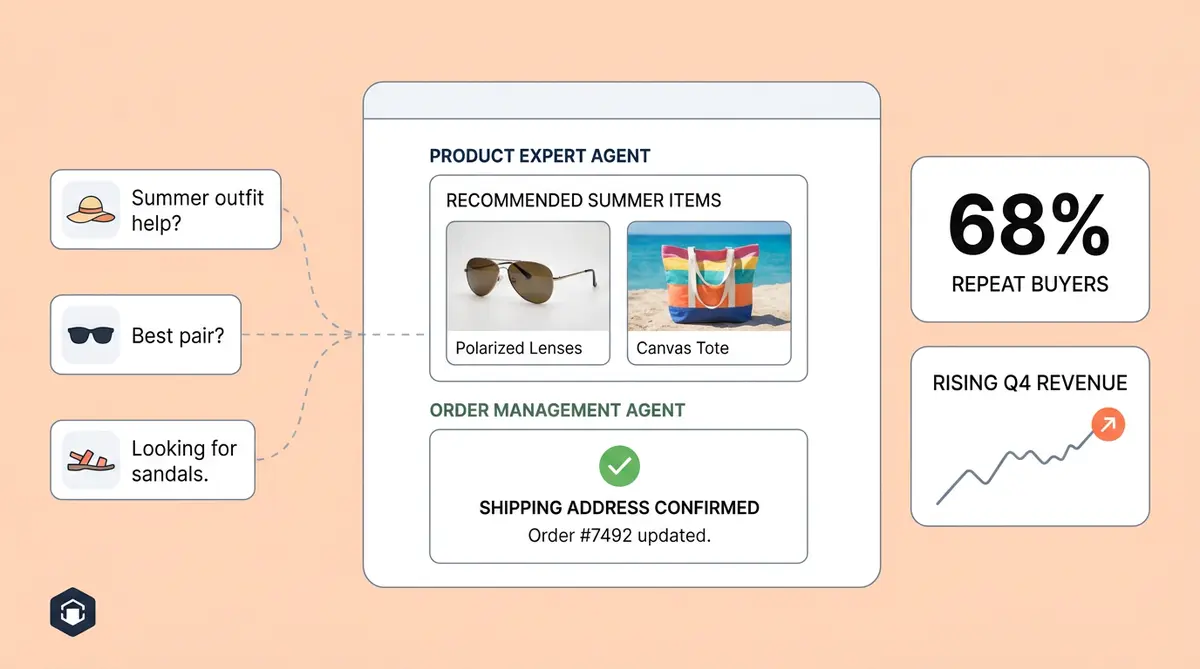
Alhena's Product Expert Agent excels here. Instead of defaulting to generic responses, it can guide a summer shopper through detailed product comparisons, surface reviews relevant to their specific use case, and populate their cart with complementary items and guide them through the full checkout flow across web and mobile. That's the kind of conversational AI engagement that turns a single visit into a completed purchase.
Brands like Tatcha saw a 3x conversion rate and 38% AOV uplift with this approach. During quieter months, that conversion lift matters even more because every visitor counts.
Summer Category Strategies: Adapt Discovery to the Season
Not every category slumps in summer. Outdoor gear, swimwear, fashion apparel, travel accessories, and beauty and sun care peak between May and August. The AI challenge isn't just handling volume for these categories; it's adapting product discovery across your entire catalog.
For Summer-Peak Categories
If you sell outdoor, fitness, or travel products, your AI should shift recommendation logic toward seasonal urgency. Alhena's shopping assistant can surface weather-appropriate products, bundle sunscreen with outdoor apparel, and trigger size-guide conversations for swimwear where return rates and returns volume run highest.
Victoria Beckham saw a 20% AOV increase by letting AI handle product pairing and recommendations. Apply that same logic to summer kits: sunscreen plus after-sun, hiking boots plus moisture-wicking socks, luggage plus packing cubes.
For Non-Seasonal Categories
Electronics, home furnishing, and general apparel don't have a natural summer hook, so your AI needs to create one. This is where back-to-school early bird strategy pays off. Back-to-school spending starts in late June for many families. Alhena can detect intent signals ("my kid needs a laptop for college") and shift recommendations toward school-relevant products weeks before competitors launch their first back-to-school marketing campaigns. Amazon Prime Day in July also creates a halo effect that lifts conversion across all ecommerce sites.
For home furnishing brands, the warm months are prime renovation period. AI should recognize that a customer asking about paint colors in July isn't casually browsing. They're mid-project and ready to buy complementary items.
Retention Over Acquisition: Why Summer Belongs to Repeat Buyers
Customer acquisition costs don't drop during summer just because traffic does. In fact, CAC during off-peak months can be disproportionately high because intent is lower. You're spending more per click to reach people who are less likely to buy.
That's why slow period ecommerce optimization should prioritize retention, not acquisition. Research from Bain & Company found that a 5% increase in customer retention can boost profits by up to 75%. Your existing customers already trust your brand, know your sizing, and have purchase history your AI can use. Repeat buyers spend 67% more per transaction on average, and the probability of selling to an existing customer is 60-70% compared to just 5-20% for a new prospect.
Alhena's Order Management Agent can identify customers who bought during spring sales but haven't returned. Instead of blasting them with generic email marketing, the AI can reference their last purchase, suggest personalized replenishment or complementary products, and handle the entire reorder through social commerce channels like Instagram DMs or WhatsApp. For consumable brands, see our deep dive on AI replenishment reminders.
Puffy achieved 63% automated inquiry resolution and 90% CSAT by letting AI handle these ongoing customer relationships. During the slow months, that same automation keeps your best customers active while your competitors go silent.
Summer Retention Plays That AI Handles Automatically
- Replenishment reminders: Consumable products (skincare, supplements, pet food) have natural reorder cycles. AI tracks purchase dates and triggers timely outreach.
- Loyalty program engagement: AI-powered loyalty programs can offer personalized seasonal rewards to keep engagement high when organic visits drop.
- Win-back conversations: Alhena identifies lapsed customers and opens conversations with relevant product updates or exclusive offers through their preferred channel.
Mine Summer Conversations for Q4 Intelligence
Every conversation your AI handles during slow months generates data that makes Q4 stronger. This is the compounding advantage most brands miss entirely.
When Manawa cut response time from 40 minutes to 1 minute and automated 80% of inquiries, they didn't just save on support costs. They built a dataset of customer questions, objections, and product gaps that informed their entire product and content strategy.
Here's what off-peak interactions reveal:
- Sizing and fit gaps: If your AI fields repeated questions about sizing for a specific product line, that's a signal to update your size guide before holiday shoppers encounter the same friction.
- Product information holes: Questions the AI can't answer from your knowledge base expose content gaps. Fix them in July, and your AI handles those queries automatically in November.
- Gift-giving intent signals: The quiet months are when early planners start researching holiday gifts. Alhena's analytics can flag these patterns so you build gift guides and bundles that match real demand.
- Return pattern analysis: Off-peak return conversations often reveal recurring issues (material complaints, shipping damage, wrong expectations) that you can address in product descriptions before the holiday returns surge hits.
Alhena's revenue attribution analytics track which interaction types lead to purchases and which lead to drop-offs. That data, collected by retailers during quiet months, becomes your playbook for peak season and peak traffic. Brands that run this analysis find they enter Q4 with sharper, more personalized product pages, tighter FAQ coverage, and AI flows that already handle the questions their competitors scramble to address in real time.
Build the Q4 Machine During Q2 and Q3
Q4 accounts for a massive share of annual ecommerce and retail sales revenue. The retail industry concentrates. In 2025, ecommerce hit 25% of total retail sales in Q4, the highest penetration ever recorded. Online holiday sales exceeded $257 billion for November and December alone.
You don't prepare for that kind of volume in October. You prepare during the months when the stakes are low enough to get things right.
Here's a practical peak season ecommerce checklist and summer-to-Q4 timeline with Alhena:
- June: Audit your knowledge base. Remove discontinued products, update inventory flags, update seasonal descriptions, and flag content gaps. Use AI coaching workflows to improve response quality.
- July: Run A/B tests on conversation flows, recommendation logic, and conversion nudges. Measure results against your spring baseline.
- August: Roll out winning experiments. Begin building BFCM-specific conversation flows and holiday gift-finding sequences. Pre-load your AI with upcoming product launches and promotions.
- September: Stress-test your AI setup. Crocus achieved an 86% deflection rate and 84% CSAT by having their AI fully tuned before peak traffic arrived.
The brands that follow this cadence don't just survive Q4. They dominate it, because their AI has been learning, testing, and improving for three months while competitors let theirs sit idle.
Peak Season Operations: What to Lock Down Before September
The ecommerce peak season doesn't start on Black Friday. It starts the moment your fulfillment, inventory, and logistics systems are tested and ready. Summer is when that testing happens.
Fulfillment and Logistics Readiness
Peak season fulfillment failures cost brands millions every year. Orders spike, warehouse capacity maxes out, and 3PL partners struggle with volume they haven't stress-tested. If you rely on a 3PL for order fulfillment, summer is when you negotiate capacity guarantees, test shipping cutoffs for holiday delivery windows, confirm shipping carrier capacity, and verify delivery speed guarantees for last-mile delivery, and build contingency plans for logistics bottlenecks and peak season operations failures.
AI plays a direct role here. Alhena's Order Management Agent can handle the flood of 'where is my order' inquiries that overwhelm support teams during peak season. When order volume surges and shipping cutoffs approach for Cyber Monday or Christmas delivery, the AI proactively communicates order deadlines and delivery deadlines to customers browsing your site, reducing post-cutoff complaints and last-minute order cancellations.
Inventory Planning with Conversation Data
Your AI captures demand signals that inventory management and inventory tracking systems miss. When customers ask about products that are out of stock, request colors or sizes you don't carry, or compare items across categories, that's real-time market intelligence and real-time demand data. Mining these conversations during quiet months helps your merchandising team make smarter inventory decisions and inventory allocation plans for peak season.
Pair this with your supply chain timeline and demand forecasting and sales forecasting models. If a best-selling product needs 90 days of lead time, the reorder decision for Black Friday and Cyber Monday inventory happens in July. AI conversation data from spring and early summer tells you which products will see the highest seasonal demand, so you stock the right inventory quantities before logistics networks get congested in October.
Customer Experience at Scale
Peak season customer experience breaks when volume outpaces preparation and staffing and seasonal hiring and staffing can't scale fast enough. AI handles the staffing gap. Response times spike, personalization drops, and frustrated shoppers leave negative reviews. The brands that deliver consistent customer experience through Black Friday, Cyber Monday, and the full holiday shopping and online shopping season are the ones that built and tested their AI systems during the months when getting it wrong doesn't cost a sale.
This means testing your AI across every peak season scenario: high-volume product questions, return policy inquiries and returns processing for holiday gifts, gift card balance checks, shipping status for time-sensitive orders, and promotional code troubleshooting and discount stacking questions. Run these simulations in July and August so your customer experience is bulletproof by the time peak season traffic arrives.
Why Alhena Performs Better After a Slow Season
Most AI technology is static. These digital tools don’t adapt. They perform the same whether it's July or Black Friday. Alhena is different because it's built for continuous improvement.
Alhena's two specialized agents, the Product Expert Agent and the Order Management Agent, learn from every interaction. Off-peak interactions train the model on edge cases, unusual product questions, and emerging customer needs that only surface when the AI has bandwidth to handle them deeply.
The platform deploys in under 48 hours and integrates with Shopify, WooCommerce, and Salesforce Commerce Cloud, along with helpdesks like Zendesk, Gorgias, and Intercom. That means you can start your summer optimization now and have a fully tuned AI ready for peak season well before September.
Alhena's hallucination-free design ensures that every product recommendation, size suggestion, and order update is grounded in your actual catalog data, not guesses. During off-peak experimentation, that accuracy means you can trust test results because the AI isn't introducing errors into your data.
Ready to turn your summer slowdown into a Q4 advantage? Book a demo with Alhena AI or start free with 25 conversations and see how your off-peak months can fuel peak season revenue growth.
Frequently Asked Questions
How does AI help ecommerce brands during the summer slowdown?
AI keeps revenue flowing during off-peak months by converting smaller traffic pools at higher rates, automating retention outreach to existing customers, and running experiments on conversation flows and recommendations. Brands using Alhena AI during slow months report stronger Q4 performance because their AI enters Q4 already tuned to real customer behavior.
What is the best off-peak ecommerce strategy for AI optimization?
The highest-value off-peak strategy is using quiet months to A/B test conversation flows, clean up your knowledge base, and refine product recommendation logic. These experiments carry minimal risk when traffic is low but compound into measurable conversion lifts during Q4. Alhena's experimentation tools let you test on a fraction of traffic and measure results before rolling out changes.
Why does ecommerce traffic drop in summer?
Ecommerce traffic typically drops 25-35% between June and August because consumers shift spending toward vacations, outdoor activities, and experiences. According to Syncio's analysis of $21 billion in sales data, July and August rank among the lowest-volume months for most non-seasonal product categories. The gap between November peaks and summer troughs can reach 96 percentage points.
Should ecommerce brands focus on retention or acquisition during slow seasons?
Retention wins during slow seasons. Customer acquisition costs stay high or even rise when purchase intent drops, making cold traffic expensive. Bain and Company research shows a 5% increase in retention can boost profits by up to 75%. AI tools like Alhena automate replenishment reminders, loyalty engagement, and win-back conversations that keep existing customers active at a fraction of the cost of acquiring new ones.
How can summer AI data improve Q4 holiday season performance?
Summer conversations reveal sizing gaps, product information holes, emerging gift-giving intent signals, and recurring returns and refund issues. Fixing these before holiday traffic arrives means your AI handles those queries automatically in November instead of escalating them to human agents. Brands that mine off-peak conversation data enter Q4 with sharper product pages, tighter FAQ coverage, and tested conversation flows.
What summer ecommerce categories benefit most from AI?
Summer-peak categories like outdoor gear, swimwear, travel accessories, and sun care benefit from AI that adapts recommendation logic to seasonal urgency and triggers size-guide conversations for high-return products. Non-seasonal categories benefit from early back-to-school AI targeting, since spending starts in late June, and renovation-season intent detection for home goods.
How quickly can I set up Alhena AI before summer?
Alhena deploys in under 48 hours with no developer resources required. It integrates with commerce systems like Shopify, WooCommerce, Salesforce Commerce Cloud, and helpdesks like Zendesk, Gorgias, and Intercom. You can start summer optimization immediately and have a fully tuned AI ready well before September's pre-holiday traffic ramp.
Does Alhena AI work differently during off-peak vs peak seasons?
Alhena's two specialized agents, the Product Expert Agent and Order Management Agent, learn continuously from every interaction. During off-peak months, lower volume means deeper per-conversation learning on edge cases and unusual product questions. This continuous improvement means the AI enters Q4 with broader knowledge and more refined response patterns than static AI tools that perform identically year-round.