How AI Automates Returns and Refunds in ecommerce: A Complete Guide for 2026
Learn how AI automates ecommerce returns, reduces refund costs, and boosts loyalty. See how Alhena AI handles returns end-to-end.
Returns cost U.S. retailers nearly $890 billion in 2024, according to the National Retail Federation. For online stores, where return rates run two to three times higher than brick-and-mortar, the financial toll is even steeper. But the real damage is not just in lost merchandise; it is in the hours your support team spends processing return requests, answering "where is my refund?" questions, and manually generating shipping labels.
The good news: AI-powered returns automation is changing this entirely. In 2026, e-commerce brands that still rely on manual return workflows are leaving money on the table and frustrating their customers in the process. This guide breaks down exactly how AI automates returns and refunds, the specific capabilities that matter, and how to implement it without disrupting your existing tech stack.
Why Returns Are the Biggest Hidden Cost in eCommerce
The financial picture around returns is more complex than most e-commerce leaders realize. Beyond the obvious cost of refunding the purchase price, each return triggers a cascade of expenses: customer service labor to handle the request, reverse shipping costs, inspection and restocking labor, inventory writedowns for items that cannot be resold, and the risk of losing that customer entirely.
A recent study from Gartner projects that by the end of 2026, roughly 25% of brands will achieve a meaningful increase in self-service resolution rates for tasks like returns, driven by growing trust in generative AI. Companies using AI for returns management report a 25% reduction in overall refund rates through predictive analytics and proactive intervention. The message is clear: AI does not just make returns faster; it makes them smarter.
What makes returns particularly painful for ecommerce teams is the volume of repetitive, policy-driven queries involved. Questions like "Am I still within the return window?", "Can I exchange instead of returning?", and "When will my refund arrive?" account for a massive share of inbound support tickets. These are precisely the kind of structured, rule-based interactions that AI handles exceptionally well.
How AI Automates the End-to-End Returns Process
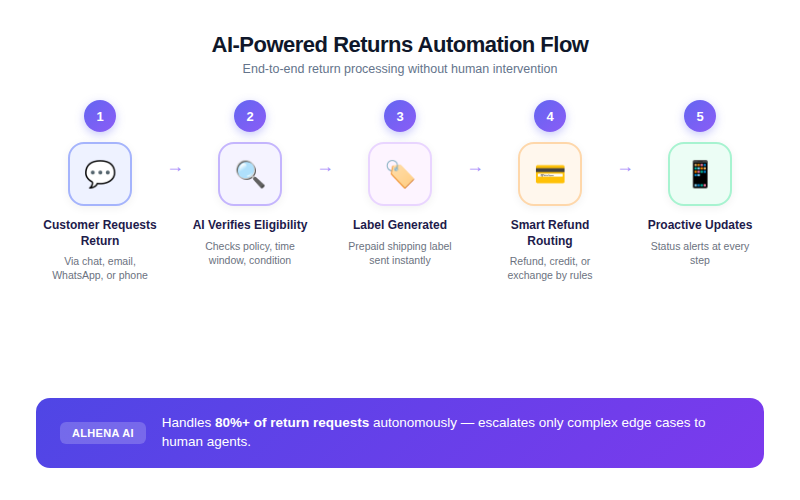
AI returns automation is not a single feature, it is a connected workflow that touches every stage of the reverse logistics journey. Here is how each stage works when AI is handling it.
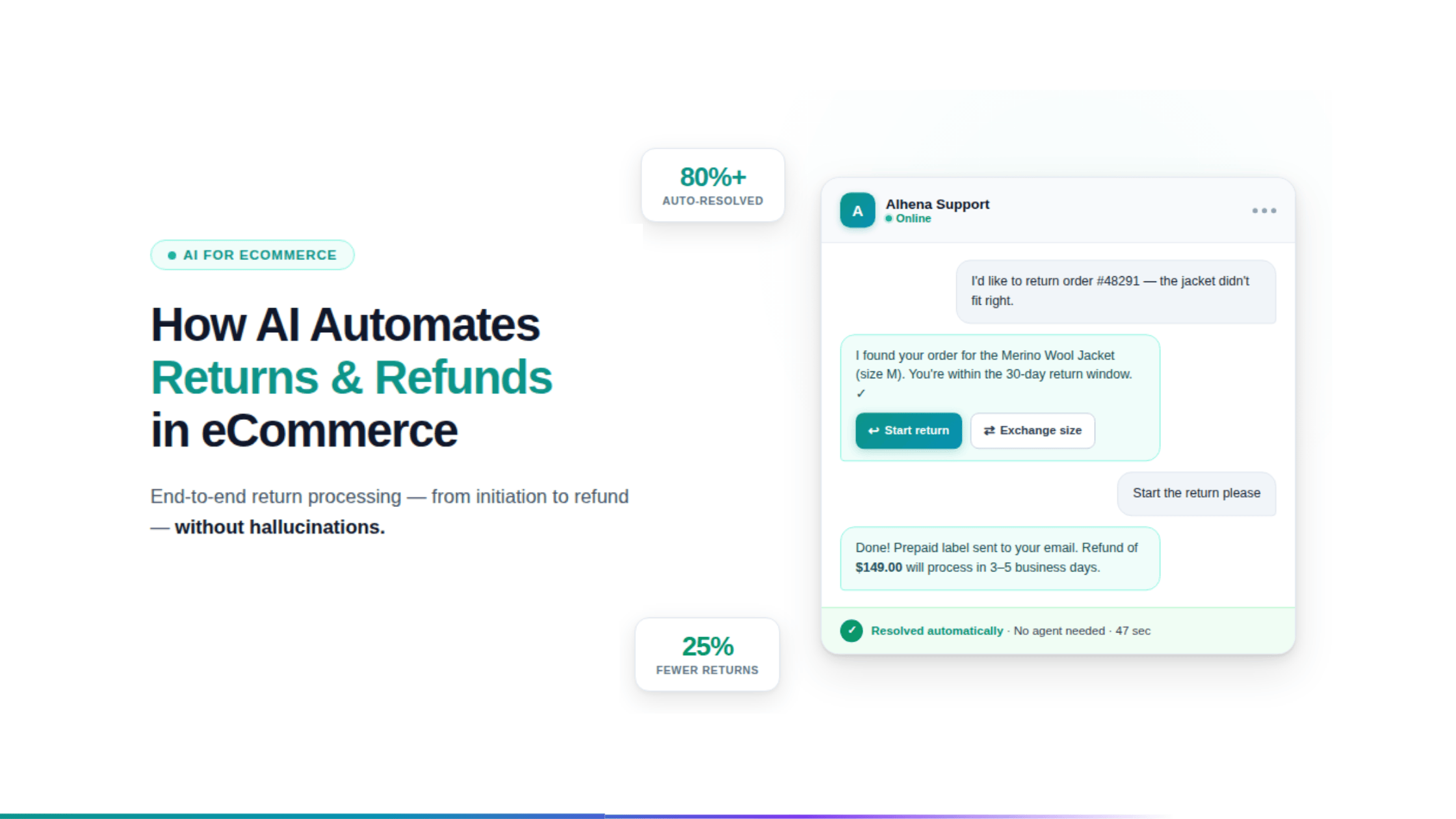
Instant return initiation. When a customer reaches out to request a return, an AI agent identifies their order, checks eligibility against your return policy (time window, product condition, return reason), and either approves or denies the request immediately. No queue, no wait, no human intervention for straightforward cases.
Automated label generation and shipping. Once approved, the AI generates a prepaid return shipping label, sends it to the customer via email or chat, and updates your order management system, all within seconds. Integrations with logistics platforms such as Narvar, ShipStation make this seamless.
Intelligent refund routing. Not every return deserves the same treatment. AI can determine whether the customer should receive a full refund, store credit, or an exchange offer based on the return reason, product category, customer lifetime value, and your specific business rules.
Proactive WISMO and refund status updates. "Where is my refund?" (WISMR) queries are one of the highest-volume post-purchase ticket types. AI eliminates most of these and this alone can reduce inbound ticket volume by 30-40%.
Reducing Return Rates With AI Before They Happen
The most powerful application of AI in returns is not processing them faster, it is preventing unnecessary returns from occurring in the first place.
AI-powered shopping assistants reduce return rates by helping customers make better purchase decisions upfront. When a shopper asks "Will this fit me?" or "Is this the right shade for my skin tone?", an intelligent assistant that understands product specifications, sizing data, and customer preferences can guide them to the right product the first time.
Alhena AI's vertical agents, like the Fit Analyzer, Outfit Builder, Shade Matcher, and Skin Analyzer, are specifically designed for this purpose. The Fit Analyzer uses body type data and fit profiles to recommend the best size for each customer, eliminating the guesswork that leads to size-related returns, one of the most common return reasons in fashion ecommerce. The Skin Analyzer reads customer skin type, concerns, and tone from uploaded photos to recommend suitable products, reducing "this wasn't right for me" returns in the beauty category.
What to Look for in an AI Returns Automation Solution
Not all AI-powered returns tools are created equal. When evaluating solutions, e-commerce teams should focus on several critical capabilities.
Policy-aware reasoning is essential. The AI must understand and enforce your specific return policies, not just generic rules. This means handling edge cases like partial returns, items purchased during a sale, gift returns, and subscription products.
Deep integrations with your existing stack make the difference between a pilot project and a production system. Your returns AI should connect directly to your e-commerce platform (Shopify, WooCommerce, Salesforce Commerce Cloud), your helpdesk (Zendesk, Gorgias, Freshdesk, Intercom), your shipping and logistics tools (Narvar, AfterShip, ShipStation), and your payment processor. Alhena AI integrates with all of these natively, which means returns automation works within your existing workflows rather than requiring a parallel system.
Hallucination-free accuracy is non-negotiable for returns processing. Alhena AI is engineered for zero hallucinations, meaning it only provides responses grounded in verified data from your order system and policy documents.
Omnichannel consistency ensures the returns experience is the same whether a customer reaches out via web chat, email, WhatsApp, Instagram DMs, or phone. Alhena AI's Support Concierge operates across all these channels with consistent tone and policy enforcement.
How Alhena AI Handles Returns and Refunds
Alhena AI approaches returns automation as part of a unified customer journey, not as a standalone tool bolted onto your help desk. The AI Support Concierge handles return initiation, eligibility verification, label generation, refund processing, and status updates autonomously, while seamlessly escalating complex cases to human agents with full context.
Here is what makes Alhena AI's approach different. The same AI agent that helped a customer find and purchase a product can also handle their return, exchange, or refund request. This continuity means the agent already has context about the original purchase, the customer's preferences, and their interaction history. There is no handoff between a "shopping bot" and a "support bot."
Alhena AI integrates with returns platforms including Narvar, AfterShip plus shipping carriers. Brands like Puffy have achieved 63% automated inquiry resolution while maintaining 90% CSAT scores, and Tatcha generated 11.4% revenue.
The platform deploys in under 48 hours with no engineering effort required. It learns from your existing knowledge base, return policies, and historical conversation data to deliver accurate, brand-aligned responses from day one.
Key Takeaways
Returns automation is a competitive necessity for e-commerce brands operating at scale in 2026. AI eliminates the repetitive, policy-driven work that bogs down support teams while simultaneously improving the customer experience through faster resolutions and proactive communication.
The brands that will win are those treating returns not as a cost centre to be minimized, but as a customer experience moment that can build loyalty. When a customer has a seamless, stress-free return experience, they are significantly more likely to purchase again.
Ready to automate your returns and turn post-purchase support into a loyalty engine? Book a demo with Alhena AI or start for free.
Frequently Asked Questions
Can AI handle return requests automatically without human agents?
Yes. AI agents can process the majority of return requests end-to-end, from verifying order details and checking return eligibility to generating shipping labels and initiating refunds. Alhena AI uses automation to resolve over 80% of routine return inquiries without human agent intervention, escalating only complex edge cases to your customer service team. This self-service approach means customers can return products on their own schedule, without waiting in queues or manually submitting tickets. The result is faster resolution, greater efficiency, and a dramatically improved customer experience.
How does AI reduce ecommerce return rates?
AI reduces return rates primarily through better pre-purchase guidance. AI-powered shopping assistants help customers choose the right size, shade, or product description match before they buy, which eliminates the most common return triggers. By letting shoppers analyze fit details, compare items, and get personalized recommendations in real time, ecommerce businesses see return rates drop by 10–15%. Fewer returns also means less strain on reverse logistics and warehouse operations, a genuine game changer for retailers looking to protect revenue.
What is WISMO and how does AI handle it?
WISMO stands for "Where Is My Order?" and is one of the highest-volume support ticket categories in ecommerce. AI handles WISMO by pulling real-time tracking data from carrier APIs and proactively notifying customers about shipment status, delivery estimates, and any delays — often before they even need to ask. This automates a massive chunk of repetitive customer service agent workflow, freeing your team to focus on higher-value interactions that directly impact customer satisfaction.
How does AI-powered refund routing work?
AI-powered refund routing uses analytics to analyze the return reason, product category, customer value, and your business rules to determine the optimal refund method. High-value customers with defective items might receive instant refunds, while other scenarios might trigger store credit with an incentive, an exchange offer, or a standard refund within your return policy timeline. This dynamic pricing and routing logic also flags fraudulent returns using built-in fraud detection, preventing abuse before it impacts your bottom line. The entire workflow runs operationally without manual review for the vast majority of cases.
Can AI returns automation integrate with Shopify and existing helpdesks?
Absolutely. Leading AI platforms like Alhena AI integrate natively with Shopify, WooCommerce, Salesforce Commerce Cloud, and major helpdesks, including Zendesk, Gorgias, Freshdesk, and Intercom. They also connect with logistics tools like Narvar, ShipStation, AfterShip, and EasyPost for seamless label generation and tracking. These integrations plug directly into your existing e-commerce platform and supply chain stack, so you can automate returns without overhauling your operational infrastructure. Whether you need inventory management sync or carrier shipping workflows, modern AI solutions fit into your current setup.
Is AI accurate enough to handle refund decisions?
Accuracy is critical in returns processing, and not all AI is equal here. Hallucination-free AI platforms like Alhena AI restrict responses to verified data from your order system, product catalog, and policy documents. This means every refund decision, eligibility check, and timeline communicated to a customer is grounded in fact, not AI guesswork. For e-commerce businesses dealing with high volumes of repeat returns and fraud risk, this level of precision is what separates reliable automation from costly errors. Agentic AI doesn't just answer questions; it executes decisions within your rules, boosting both customer satisfaction and revenue protection.