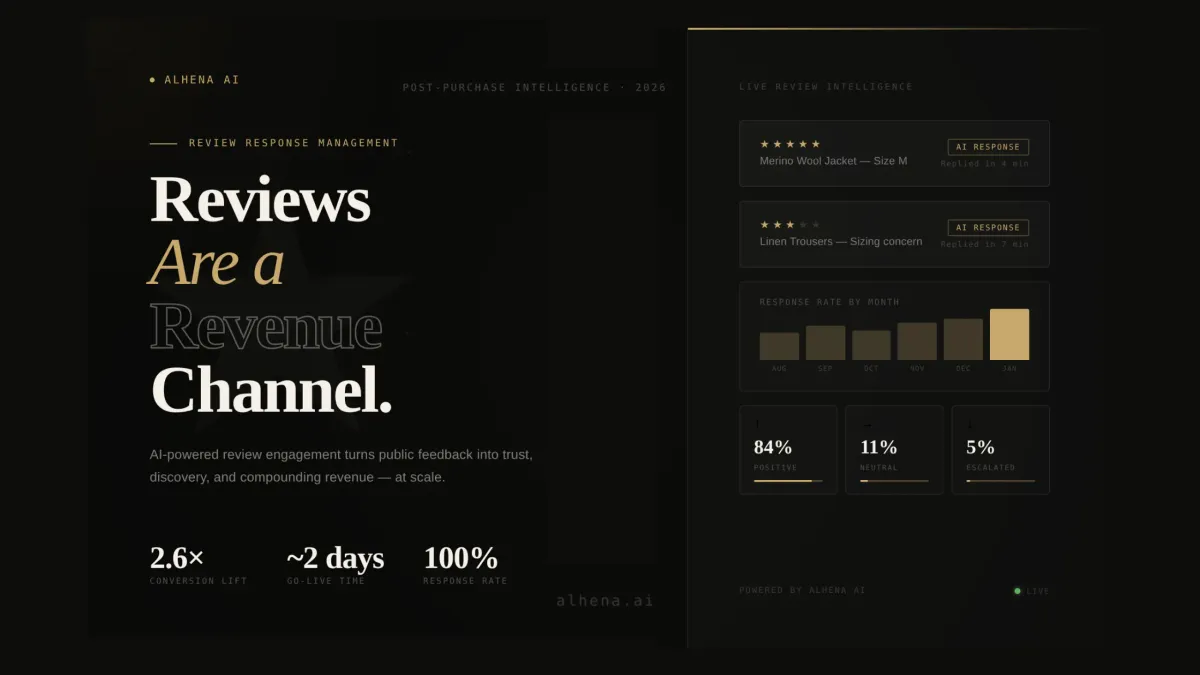
Up to 98% of consumers read online reviews before buying, according to a 2024 NIH study. Yet most ecommerce brands still reply to fewer than half of them, and the replies they do send are generic templates that do nothing for trust or conversion. An AI review reply generator changes this by crafting personalized, brand-consistent replies at scale, turning passive feedback into active revenue.
This guide covers how AI review response generators work, what to look for when choosing one, and how the right tool turns your review section from a cost center into a conversion channel.
What Is an AI Review Response Generator?
An AI review response generator is a software tool that uses natural language processing and sentiment analysis to draft contextual review replies to customer feedback. Instead of picking from a set of canned templates, the AI reads each review, identifies the topic (shipping, product quality, sizing, customer service), detects sentiment, and writes a reply that matches your brand voice.
The best tools go further. They connect to your product catalog and order data so the response references real product attributes, not guesses. If a customer complains about a moisturizer feeling heavy, the AI can mention the product's lightweight formula and suggest a better-matched alternative from your catalog.
For ecommerce brands handling hundreds or thousands of reviews monthly across Trustpilot, Google, Amazon, Bazaarvoice, and Yotpo, manual responses simply don't scale. An AI review response generator makes comprehensive coverage possible without growing your support team.
Why Review Responses Drive Revenue (Not Just Reputation)
Most brands treat review responses as reputation management alone. Reputation management matters, but that framing misses the bigger picture. Review responses are public sales conversations that every future shopper reads before buying.
Here's a real-world example: a shopper browses your product page on your website and scrolls to reviews. They find a three-star review mentioning the item "runs small". If there's no brand response, the shopper bounces. But if your brand replied within hours, explaining the fabric's stretch characteristics and linking to your size guide, that browser converts. The review response did the selling.
72% of consumers read brand responses before purchasing, according to Gominga. And 85% expect brands to respond to reviews, product reviews, and questions. When you don't respond, you're not just ignoring feedback. You're losing sales at a critical decision point.
Review responses also feed discovery. Search engines surface review content in results, and AI shopping assistants now synthesize reviews when making product recommendations. Brands that respond with detailed, product-specific information create new indexable content that improves visibility across both traditional search and generative AI channels.
Why Manual Review Response Doesn't Scale
A mid-size e-commerce brand receiving 200 reviews per week spends roughly 16 hours on responses, assuming five minutes per reply. That's a half-time employee doing nothing but writing review replies.
The math gets worse at scale. Brands selling on multiple platforms (Shopify storefront plus Amazon plus Trustpilot plus Google Business Profile) face fragmented review streams across different dashboards. Each platform has its own interface, its own moderation rules, and its own response formatting.
Stretched customer services teams already handling live chat, email tickets, and phone calls can't prioritize review engagement. The result is predictable:
- Positive reviews go unanswered, missing a chance to reinforce loyalty
- Negative reviews get template responses that feel robotic
- Mixed reviews (three and four stars) get ignored entirely
- Response times stretch to days or weeks, long after the buying moment has passed
This gap isn't a customer service problem. It's a revenue problem. Every unanswered review is a missed sales conversation with your next customer.
How AI Review Response Generators Work
Modern AI review response tools combine several technologies to produce replies that feel human-written and brand-appropriate.
Sentiment Analysis and Topic Detection
The AI reads each review and classifies it by sentiment (positive, negative, mixed) and topic (shipping speed, product quality, sizing, packaging, customer support). This classification determines the tone and structure of the response. A glowing five-star review with high stars about product quality gets a warm, appreciative reply. A frustrated one-star review about a delayed shipment gets an empathetic, solution-orientated response.
Brand Voice Matching
Good tools let you define your brand's tone, formality level, and style guidelines. A luxury skincare brand sounds different from a streetwear label. The AI maintains these distinctions across thousands of automated review responses, keeping every reply on-brand without manual editing.
Product Catalog Integration
This is where e-commerce-specific tools separate from generic AI response generators. When the AI connects to your product catalog, it can reference actual product attributes, ingredients, materials, and specifications in responses. Instead of saying "we're sorry to hear that", it can say "Our Retinol Night Cream is formulated for sensitive skin." You might prefer our Gentle Renewal Serum, which uses bakuchiol instead."
Smart Escalation
Not every review should get an automated response. AI review management tools include escalation logic that routes complex cases (safety concerns, legal issues, repeat complaints, and highly emotional language) to human agents with full context attached. The AI handles the volume; humans handle the exceptions.
What to Look for in an AI Review Response Generator
The market has dozens of tools claiming AI review capabilities. Here's what actually matters when you choose and evaluate them for e-commerce.
Platform Coverage
Your tool needs to work where your reviews live. At minimum, look for integrations with Trustpilot, Google Business Profile, Amazon, Bazaarvoice, and Yotpo. Some brands also need coverage for Walmart, Home Depot, and industry-specific platforms. A tool that only covers one platform forces you to maintain multiple systems.
Response Quality and Grounding
Test the tool with real reviews. Does it produce generic responses, or does it reference specific product details? The difference between "Thank you for your feedback" and "We're glad the bamboo blend worked well for your sensitive skin" is the difference between wasted effort and a conversion tool. The best tools ground every response in verified product data, avoiding hallucinations or inaccurate claims.
Approval Workflows
You need control. Look for tools that offer both auto-publish and human-approval modes. Auto-publish works well for positive reviews. Negative and mixed reviews often benefit from a quick human review before posting. The ideal setup lets you configure different workflows for different star ratings and sentiment categories.
Analytics and Insights
Review data is a goldmine of product intelligence. The right AI review management tool doesn't just respond. It also aggregates sentiment trends, identifies recurring complaints, and surfaces product improvement opportunities. If 30% of reviews for a specific SKU mention sizing issues, your product team needs to know.
Multilingual Support
Global brands need responses in the customer's language. Look for tools supporting 50+ languages with native-quality output, not awkward machine translation that damages credibility.
How Alhena AI Handles Review Response Generation
Alhena AI's Review Management was built specifically for ecommerce brands that treat reviews as a revenue channel, not just a reputation checkbox.
Here's what makes it different from generic AI response tools:
Grounded in your actual product data. Alhena connects to your product catalog, brand guidelines, and customer data. Every response references real attributes, real policies, and real product details. There are no hallucinated claims or generic filler. If a customer asks about ingredients in a review, Alhena pulls the actual ingredient list from your catalog.
Works across every major review platform. Alhena integrates with Trustpilot, Bazaarvoice, Yotpo, Amazon, Walmart, Home Depot, and more. You manage all your review responses from a single dashboard with a consistent brand voice across every platform.
Handles up to 70% of reviews automatically. Routine positive and mixed reviews get instant, personalized responses. Complex cases route to your team with full context. Each human edit trains the AI for the next round, so accuracy improves over time through continuous learning.
Supports 90+ languages. Global brands respond to customers in their own language with native-quality replies, not stilted translations.
Part of a complete e-commerce AI platform. Unlike standalone review tools, Alhena's review management sits alongside the AI Shopping Assistant, Support Concierge, and Social Commerce agents. Your review data feeds into the same customer intelligence that powers chat, email, and social interactions. When Alhena's shopping assistant recommends a product, it already knows what reviewers love (and complain about) because it shares the same knowledge base.
Brands using Alhena AI have seen strong results in published case studies across the board. Tatcha achieved a 3x conversion rate and 38% AOV uplift. Victoria Beckham saw a 20% AOV increase. These numbers come from treating every customer touchpoint, including reviews, as a selling opportunity.
How to Set Up AI Review Responses in 4 Steps
Getting started with an AI review response generator doesn't need weeks of setup or dev resources. Here's a practical workflow.
Step 1: Define Your Brand Voice Guidelines
Before connecting any tool, document your brand's tone. Are you warm and conversational or polished and professional? Do you use the customer's first name? Do you sign off with a team name or individual name? These decisions shape every AI-generated reply. Most tools, including Alhena, let you configure these settings during onboarding.
Step 2: Connect Your Review Platforms
Link your review sources: Trustpilot, Amazon, Google, Bazaarvoice, Yotpo, or wherever your customers leave feedback. Alhena connects through direct API integrations and webhook setups (like Feefo), pulling reviews into a single stream within minutes.
Step 3: Set Approval Rules by Review Type
Configure your workflow based on risk tolerance. A common starting setup:
- 5-star reviews: Auto-publish responses immediately
- 3-4 star reviews: AI drafts a response, human approves before publishing
- 1-2 star reviews: AI drafts a response and flags for human review with full context
As confidence grows, most brands expand auto-publish to cover three- and four-star reviews too. Each approved or edited response helps the AI learn to handle similar cases better next time.
Step 4: Monitor, Refine, and Expand
Review your AI's performance weekly for the first month. Check response quality, flag any off-brand replies, and adjust tone settings. Most brands reach a steady state within two to three weeks, with the AI handling the majority of reviews while humans focus on the cases that genuinely need a personal touch.
For a detailed walkthrough of connecting specific platforms, see our guides on automating Trustpilot responses and auto-responding to Feefo reviews.
Reviews as a Discovery Channel: The SEO and AI Visibility Angle
There's one benefit of AI-powered review responses that most guides skip: discoverability.
Google increasingly surfaces review content in search results. Product pages with active, detailed review responses create fresh, keyword-rich content that search engines index. Each response is a micro-content piece targeting long-tail queries related to your products.
The effect compounds with AI shopping and conversational AI. When ChatGPT, Google's AI Overviews, or Perplexity recommend products, they pull from review content as source material. Brands with thorough, specific review responses show up more often in these AI-generated recommendations. Our analysis of Google store ratings as AI citation signals confirms this trend.
Put simply: responding to reviews with product-specific detail isn't just customer service. It's content marketing that improves your visibility across both traditional and AI-powered search channels.
The Bottom Line
An AI review response generator is no longer a nice-to-have for ecommerce brands. With 98% of consumers reading reviews and 85% expecting brand responses, unanswered reviews are unanswered sales conversations.
The right tool doesn't just save time. It grounds every reply in real product data, maintains your brand voice across platforms, and turns your review section into a discovery and conversion channel. Generic tools write generic replies. Ecommerce-native tools like Alhena AI write replies that sell.
Ready to turn your reviews into a revenue channel? Book a demo with Alhena AI or start a free trial with 25 conversations.
Frequently Asked Questions
What is an AI review response generator?
An AI review response generator uses natural language processing to read customer reviews, detect sentiment and topic, and draft personalized replies in your brand voice. Unlike template tools, it references your actual product catalog and policies so each response is specific and accurate.
Can AI review response generators handle negative reviews?
Yes. Quality tools include escalation logic that identifies safety concerns, legal issues, or highly emotional language and routes those reviews to human agents. For standard negative reviews, the AI crafts empathetic, solution-oriented responses that address the specific complaint and offer next steps.
Which review platforms do AI response tools support?
Top tools integrate with Trustpilot, Google Business Profile, Amazon, Bazaarvoice, Yotpo, Walmart, and Home Depot. Alhena AI supports all of these plus Feefo through webhook integration, managing all platforms from a single dashboard.
How do automated review responses affect SEO?
Review responses create fresh, keyword-rich content that search engines index. Detailed, product-specific replies help pages rank for long-tail queries. AI shopping assistants and Google AI Overviews also pull from review content when making product recommendations, so thorough responses improve visibility in both traditional and AI-powered search.
Will customers know the review response was written by AI?
Not if the tool is configured properly. The best AI review response generators match your brand voice closely enough that responses are indistinguishable from human-written replies. Customers care about helpfulness and accuracy, not authorship.
How long does it take to set up an AI review response generator?
Most tools, including Alhena AI, go live in hours, not weeks. Setup involves defining your brand voice, connecting your review platforms via API, and configuring approval rules. No developer resources needed. Alhena's plug-and-play integration works with Shopify, WooCommerce, and other major ecommerce platforms.
Should I use AI to respond to positive reviews too?
Absolutely. Positive review responses reinforce the customer's purchase decision, encourage repeat buying, and reduce churn at a critical loyalty moment. With AI handling the volume, you can respond to every review, not just the negative ones. Brands that respond to all reviews see higher customer lifetime value.
How does Alhena AI's review tool compare to Yotpo's AI responses?
Yotpo offers AI-suggested review comments as part of its broader review platform. For a detailed breakdown of how Alhena connects to Yotpo specifically, see our Yotpo + Alhena AI integration guide. Alhena AI goes further by grounding every response in your full product catalog data, connecting review intelligence to its shopping assistant and support agents, and covering more platforms including Walmart and Home Depot. Alhena also handles up to 70% of reviews automatically with hallucination-free responses.