The Loyalty Program Paradox
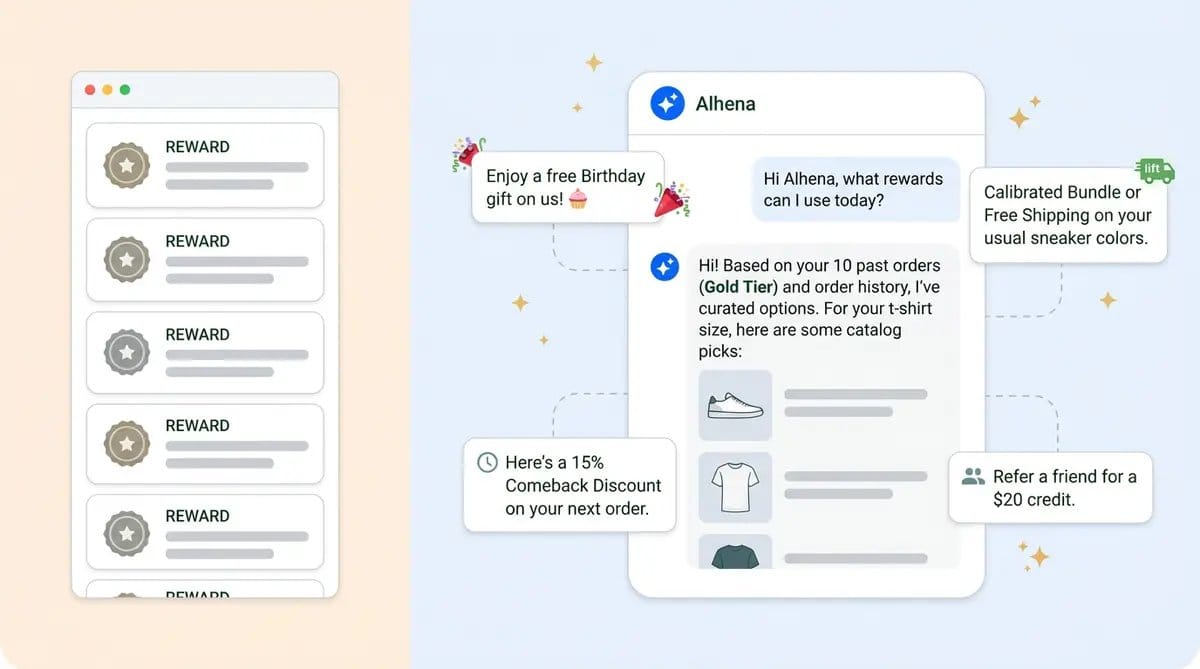
The average consumer belongs to 16.6 loyalty programs but actively uses fewer than half. Most retail and ecommerce loyalty programs fail not because customers don't want rewards, but because the rewards are generic and redemption rates stay stuck below 30%. Low redemption is a warning sign. The loyalty program itself becomes background noise. A $5 off coupon after spending $100 feels transactional, not personal. Even gamified elements like badges, challenges, and tiered structures. Gamification features lose their appeal when every customer in the market gets the same experience. The program doesn't acknowledge what the customer bought, why they bought it, or what would genuinely motivate their next purchase.
AI transforms loyalty from a discount delivery system into a customer relationships intelligence layer that knows each customer well enough to offer the right reward at the right moment. This is what drives real customer engagement, not points balances. The result: businesses that keep customers engaged through AI loyalty program ecommerce solutions see up to 3x higher repeat purchase rates, not because they offer bigger discounts, but because they offer smarter, more personal ones.
This guide breaks down five AI-powered loyalty capabilities that replace static tier-based rewards programs with dynamic, personalized reward systems built on real customer behavior and purchase signals.
Why Traditional Loyalty and Rewards Software Falls Short
Most customer loyalty programs, POS loyalty systems, brick-and-mortar POS software, and ecommerce loyalty program software operate on a simple formula: spend X, earn Y points, redeem for Z discount. Loyalty points software tracks transactions but ignores context. It doesn't know that a customer who bought three moisturizers in a row is building a skincare routine, or that a fashion buyer who only shops neutrals won't be excited by a neon promotion. The loyalty tools treat every redemption the same way regardless of who is redeeming.
This is the core limitation of traditional customer loyalty tools. They measure customer loyalty through points balances and redemption rates rather than actual brand loyalty signals and purchase behavior. The rewards program manages points balances, gamified tier thresholds, gamification mechanics, and badge collections, but they don't understand customers. The loyalty technology platform handles the mechanics of earning and burning, but it can't answer the question that actually drives retention: what reward would make this specific customer come back?
Loyalty card providers, Yotpo, BigCommerce, and other loyalty program vendors have built their systems around universal rules: spend $100, get $5 back. Every customer gets the same offer at the same threshold. Loyalty platform providers offer dashboards for tracking member counts and redemption rates, but the underlying model is static. Retail loyalty software, retail rewards platforms, POS-connected mobile apps, and mobile loyalty program software manage the operational side well, but they weren't built for personalization at the individual level.
That's what makes AI different. It transforms customer relationships and the customer experience from generic to genuinely personal. AI doesn't replace your existing loyalty websites or customer rewards platform. It adds an intelligence layer on top that reads each customer's behavior and adjusts the program in real time. A SaaS loyalty platform handles the plumbing. AI handles the thinking.
Five AI-Powered Loyalty Capabilities That Replace Static Programs
1. AI-Triggered Milestone Recognition
Static programs send generic "you earned 500 points" notifications. AI recognizes meaningful customer milestones and celebrates them with targeted offers tailored to the individual.
A 10th purchase earns a message that recognizes the customer's growing customer lifetime value with a reward tied to their most-purchased category. A tier upgrade or one-year anniversary triggers a curated selection of new products matched to their preference history. A customer who just bought their first product in a new category gets a "welcome to skincare" or "welcome to home decor" offer encouraging them to explore the full range.
Higher redemption rates follow. These moments feel personal because the AI selects the milestone, the timing, and the reward based on individual customer behavior patterns, not a universal calendar. The engagement feels authentic because it is. Research from Harvard Business Review shows emotionally connected customers have 306% higher lifetime value than merely satisfied ones. A loyalty program that recognizes milestones builds that emotional connection at scale, which is something no loyalty program service providers have addressed with static points engines alone.
2. Dynamic Reward Calibration
Traditional programs offer the same discount to every customer. AI calibrates the minimum effective incentive per customer, protecting margin while maximizing customer retention, repeat purchases, and ROI. This goes beyond what standard marketing automation and segmentation tools can do because it personalizes at the individual level, not the segment level. Traditional segmentation groups customers into broad buckets. AI treats each customer as a segment of one.
Highly loyal shoppers who would repurchase anyway doesn't need a 20% discount. A tailored product recommendation may be enough. A customer showing declining purchase frequency and lower redemption activity may need a 15% offer to re-engage. A price-sensitive customer responds to discounts or cashback rewards. An experience-driven customer responds to experiential rewards like early access or exclusive products.
The AI learns each customer's reward sensitivity from their response history and adjusts accordingly, going far beyond basic customer segmentation across different customer segments. Companies that improve redemption and personalization generate up to 40% more revenue than those using one-size-fits-all approaches, according to McKinsey. Dynamic calibration is how you capture that lift without eroding your margins. It's also how you grow customer lifetime value systematically rather than leaving it to chance. Traditional loyalty marketing platforms don't offer this kind of per-customer tuning because their reward engines are rule-based, not adaptive.
3. Churn-Risk Intervention Through Proactive Outreach
The AI monitors purchase frequency patterns and detects when a customer's buying cadence slows. If a customer who typically orders every 6 weeks hasn't purchased in 10 weeks, the AI triggers a targeted re-engagement message before the customer mentally moves on. For any loyalty program, the benefits of early detection are clear.
The intervention isn't a generic "we miss you" email. It's a specific message referencing what they last purchased, suggesting a complementary product, and including an incentive calibrated to their risk level. A customer who bought a moisturizer two months ago might receive a recommendation for the matching serum with a loyalty reward attached.
Proactive intervention at the right moment converts at 3 to 5x the rate of a winback campaign sent six months later. The difference is timing: catching a customer while they're drifting costs far less than winning them back after they've left. Most customer loyalty tools can send automated emails, but they can't predict the right moment or calibrate the offer to the individual's risk level.
4. Preference-Aware Reward Personalization
Personalized rewards AI uses conversation history, purchase patterns, browsing behavior, and explicitly stated preferences to personalize what the reward is, not just when it arrives.
A skincare customer who consistently buys fragrance-free products gets a reward for a new fragrance-free launch, not a generic "spend $50 get $10 off" offer. A fashion customer who buys exclusively in neutrals gets early access to a new neutral collection. A home decor buyer who favors minimalist designs receives a curated bundle from your latest Scandinavian-inspired line.
The reward creates a sense of instant gratification and personal recognition because it feels like it was chosen for the customer. This gratification drives repeat visits, and it was, using data the AI has accumulated across every interaction. Alhena AI's Shopping Assistant surfaces these relevant rewards naturally within shopping conversations rather than relegating loyalty to a separate portal or loyalty website the customer must remember to visit.
5. Referral Program Optimization
The AI identifies customers with the highest referral potential based on satisfaction signals: high CSAT scores, consistent repeat purchases, and positive review history. It then drives customer engagement through tailored referral prompts at moments of peak satisfaction, like immediately after a successful delivery or a positive support interaction.
The referral offer itself is personalized. The AI knows whether a customer would be more motivated by a discount for themselves, a gift for the friend they refer, or exclusive experiential access to a limited product. AI also filters out fraud signals to protect referral program integrity. A loyalty program with referral capabilities powered by AI targeting and timing convert 2 to 3x higher than blanket referral campaigns sent to your entire list.
Why Loyalty Data Is the Highest-Value Input for Ecommerce AI
Every loyalty interaction reveals preferences, price sensitivity, category affinity, and purchase timing through deep analytics that make every other AI capability more effective, from product recommendations to support interactions. The same preference data that powers personalized rewards also powers better product recommendations in the shopping assistant, more relevant proactive nudges, and more effective support conversations where the AI already knows the customer's history.
Customer engagement deepens with every touchpoint. A customer who redeems a loyalty reward for a fragrance-free moisturizer tells the AI something valuable about how those shoppers interact in the future across every channel. The next time they ask for a recommendation via Instagram DM or WhatsApp, the AI already knows to filter for fragrance-free options. This is the same approach that powers Starbucks Rewards and Sephora Beauty Insider, where Deep Brew AI analyzes past orders and timing to personalize offers for 30 million members. That's not just loyalty personalization. That's a compounding intelligence advantage that no standalone loyalty and rewards software can provide on its own.
To understand how AI is shifting from segment-based to truly individual personalization across the full shopping journey, explore our post on AI-driven personalization that treats every shopper as an individual.
This data loop creates a flywheel. Each loyalty interaction, whether online, in-app, or at POS, makes the next product recommendation more accurate, each recommendation makes the next reward more relevant, and each relevant reward makes the customer more likely to stay. This flywheel effect is what builds lasting customer loyalty. Loyalty data isn't just a retention tool. It's the foundation for your entire customer intelligence strategy.
Unified Memory: The Foundation for Loyalty Personalization
For loyalty programs to deliver on this promise, the AI must maintain a continuous understanding of each customer across every touchpoint. In an omnichannel world, a customer who mentions a skin concern in a chat conversation, rates a product positively in a post-purchase survey, and skips a subscription delivery all contribute to the same preference profile.
Without unified memory across channels, the loyalty program operates on partial data and the rewards feel shallow. With it, every interaction deepens customer relationships and the AI's understanding of what keeps that individual coming back and builds lasting brand loyalty.
Alhena AI's unified memory layer tracks customer preferences, purchase history, conversation context, and satisfaction signals across web chat, email, SMS, Instagram DMs, and WhatsApp, creating a true omnichannel loyalty experience that bridges online, mobile, and POS channels . This continuous customer understanding powers every loyalty program capability described above, from milestone recognition to churn intervention. The result is a customer experience where every touchpoint reinforces customer engagement rather than treating each interaction as isolated. Unlike loyalty technology platforms that silo transactional data from conversational data, Alhena merges both into a single customer profile.
Consider a practical example. A loyalty member asks about a delayed order through Instagram DM. The support conversation reveals frustration, but the customer also mentions they loved their last purchase. Alhena stores both signals. The churn-risk model factors in the negative delivery experience. The milestone system notes their purchase count is approaching a reward threshold. The next interaction, whether on your website, via email, or in WhatsApp, reflects all of that context. The customer receives a proactive update on their shipment, a loyalty reward acknowledgment, and a product recommendation that matches their taste, all in a single, coherent experience.
How Alhena AI Enables AI-Powered Loyalty
Alhena's Product Expert Agent uses accumulated preference data to recommend products within loyalty reward flows that match the individual customer's taste profile, not generic bestseller lists. When a Gold tier or tiered VIP skincare customer asks "what's new?", the agent filters to new arrivals in their preferred categories and price range.
The Shopping Assistant surfaces loyalty offers naturally within shopping conversations. A returning customer might hear: "You're 2 purchases away from unlocking your anniversary reward. Want me to show you what's new in your favorite category?" This keeps loyalty top of mind without forcing the customer to visit a separate rewards portal.
Alhena's Support Concierge handles order inquiries and returns with the same full customer context. Loyalty members checking on a late shipment get faster resolution and a proactive offer that acknowledges their VIP status, turning a negative moment into a retention opportunity.
Real results demonstrate the impact. Tatcha saw a 3x conversion rate and 38% AOV uplift with Alhena, and 11.4% of total site revenue traced to AI-assisted conversations. Victoria Beckham achieved a 20% increase in AOV. Revenue analytics trace loyalty-driven interactions to purchases so brands can measure the incremental revenue impact and ROI of AI-driven rewards versus static program performance.
Alhena integrates with BigCommerce, Shopify, WooCommerce, and major helpdesks like Zendesk and Gorgias, with deployment in under 48 hours and no developer resources needed. Businesses can also partner with Alhena to connect existing loyalty platforms and customer rewards platform tools directly to these integrations.
How to Evaluate Loyalty Platform Providers for AI Readiness
If you're evaluating loyalty program vendors or considering a switch from your current loyalty card providers, these are the AI capabilities that separate modern retail loyalty from legacy points management in branded loyalty:
- Per-customer reward calibration: Can the platform adjust reward type and value for each individual, or does it apply the same rules universally? This is the single biggest gap in most retail and ecommerce loyalty software today.
- Behavioral trigger flexibility: Can you set up milestone recognition based on custom events (category firsts, anniversaries, purchase streaks), or only standard points and tier thresholds? Most loyalty points software limits triggers to transaction counts.
- Churn prediction: Does the platform identify at-risk customers proactively, or does it only react after a customer has already stopped purchasing? Ask loyalty program service providers how their system detects declining engagement before it becomes churn.
- Omnichannel data ingestion: Does the platform support POS and omnichannel data ingestion from chat, email, social, POS terminals and voice, or only transactional POS data? Mobile loyalty program software that only tracks app activity misses the majority of customer touchpoints.
- Revenue attribution: Can you trace specific loyalty interactions to downstream purchases with analytics to measure actual ROI? Without this, you're running the program on faith rather than data. The best marketing automation platforms still can't do this for loyalty-specific interactions.
Most ecommerce loyalty program software scores well on operational features like points tracking, tier management, and gamified challenges, rewards program administration, and basic analytics dashboards. Where loyalty program vendors fall short is on the intelligence layer: understanding each customer well enough to make the right offer at the right time. That's the gap AI fills, and it's where the 3x repeat purchase rate, customer retention, and customer lifetime value difference comes from.
Building Your AI Loyalty Roadmap
You don't need to replace your entire loyalty technology platform or marketing automation stack overnight. Start with the capability that addresses your biggest retention gap, then expand.
Phase 1: Add Conversational AI to Your Existing Program (Week 1-2)
Connect an AI shopping assistant like Alhena to your existing loyalty infrastructure. This gives you two immediate wins: loyalty offers and redemption options surface naturally in shopping conversations instead of hiding in account dashboards, and you start capturing omnichannel preference data from every interaction that your current loyalty tools can't access.
Alhena deploys on Shopify, BigCommerce, and in-store POS systems with native POS connectors, Shopify and WooCommerce in under 48 hours. No developer resources, no custom API work. No ripping out your existing customer rewards platform. You layer AI intelligence on top of your existing POS and ecommerce stack.
Phase 2: Activate Churn Prediction and Dynamic Calibration (Month 1-2)
Once you have 30 days of conversational and behavioral data, activate churn-risk detection and dynamic reward calibration. Use the ROI calculator to project customer lifetime value gains and to estimate the revenue impact based on your current churn rate and average order value. The data from Phase 1's conversations tells the AI which customers are at risk and what type of reward each one responds to.
Phase 3: Launch Milestone Recognition and Referral Optimization (Month 2-3)
With a richer customer preference profile built from Phase 1 and Phase 2, you can now set up personalized milestone recognition and AI-optimized referral programs. This is where the full 3x repeat purchase rate lift becomes measurable, driven by deeper customer engagement and customer retention at every stage. The AI has learned each customer's category preferences, reward sensitivity, and engagement patterns well enough to deliver the right offer at the right moment across every channel.
Each phase builds on the data from the previous one, deepening engagement at every step. Your loyalty program evolves with every customer interaction, building brand loyalty and becoming smarter over time. By month three, your loyalty program has evolved from a static SaaS loyalty platform running universal rules into a personalized retention engine that treats every customer as an individual. That's the shift from loyalty tools to loyalty intelligence.
Key Takeaways
- Customer loyalty fails when the rewards don't value customers as individuals, not because customers don't value rewards
- Five AI capabilities replace static rewards programs: milestone recognition, dynamic reward calibration, churn-risk intervention, preference-aware personalization, and referral optimization
- Dynamic reward calibration protects margins by finding the minimum effective incentive for each customer
- Proactive churn intervention at the right moment converts 3 to 5x better than winback campaigns, and customers who redeem personalized offers show higher retention, and targeted redemption offers convert higher than generic ones
- Loyalty data compounds: the same preference signals that power personalized rewards improve product recommendations, support conversations, and proactive outreach across every channel
- Unified memory across chat, email, social, and voice is the foundation that makes all loyalty personalization work
- When evaluating loyalty platform providers or customer loyalty tools, prioritize per-customer calibration, churn prediction, POS integration, and omnichannel data over basic points management
Ready to turn your loyalty program into a high-performance repeat purchase engine? Book a demo with Alhena AI today to see how unified memory and AI-powered loyalty drive measurable retention and revenue, or start free with 25 conversations.
Alhena AI
Frequently Asked Questions
How does AI-triggered milestone recognition improve ecommerce loyalty program retention?
Alhena AI detects meaningful customer milestones like a 10th purchase, a one-year anniversary, or a first order in a new product category and delivers rewards tailored to the individual's most-purchased category and preference history. Unlike static points notifications from traditional customer loyalty programs and loyalty points software, each milestone reward is chosen based on behavioral data collected across every channel. This approach creates the emotional connections that Harvard Business Review research links to 306% higher lifetime value, turning transactional moments into relationship-building experiences.
What is dynamic reward calibration and how does it protect ecommerce margins?
Dynamic reward calibration is an AI capability that finds the minimum effective incentive for each individual customer based on their response history. A loyal customer who would repurchase anyway receives a personalized product recommendation instead of a blanket 20% discount, while a customer showing declining purchase frequency gets a targeted offer calibrated to their specific risk level. Alhena AI learns each customer's reward sensitivity over time, helping ecommerce brands generate up to 40% more revenue from their loyalty programs without eroding margins through unnecessary discounts.
How does AI detect churn risk in loyalty programs before customers leave?
Alhena AI monitors each customer's purchase frequency patterns and detects when their buying cadence slows beyond their normal interval. If a customer who typically orders every 6 weeks hasn't purchased in 10 weeks, the AI triggers a personalized re-engagement message that references their last purchase and suggests a complementary product with an incentive calibrated to their risk level. This proactive intervention converts 3 to 5x better than generic winback campaigns sent months later, because the customer is caught while drifting rather than after they've already committed to a competitor.
Why does unified memory matter for AI loyalty program personalization?
Unified memory gives the AI a continuous understanding of each customer across web chat, email, Instagram DMs, and WhatsApp rather than treating each channel as a separate data silo. A customer who mentions a skin concern in a chat conversation, rates a product positively in a post-purchase survey, and skips a subscription delivery all contribute to one comprehensive preference profile. Alhena AI uses this unified data to power targeted milestone rewards, dynamic reward calibration, and churn interventions that feel genuinely personal. Without unified memory, loyalty programs operate on partial data, and the personalization feels shallow or inconsistent across touchpoints.
How does preference-aware referral optimization increase referral conversion rates?
Alhena AI identifies high-referral-potential customers using satisfaction signals like CSAT scores, repeat purchase frequency, and positive review history, then engages them at peak satisfaction moments such as post-delivery confirmation or after a positive support interaction. The referral incentive itself is personalized based on what motivates each individual: some customers respond to discounts for themselves, others to gifts for the friends they refer, and others to exclusive product access. AI-targeted referral programs that match timing and incentive type to the individual convert 2 to 3x higher than blanket referral campaigns sent to every customer on the list.
How should ecommerce brands evaluate loyalty platform providers for AI capabilities?
When evaluating customer loyalty programs, loyalty program vendors, loyalty card providers, or any ecommerce loyalty program software, ask five specific questions: Does the platform support per-customer reward calibration or only universal rules? Can it set up milestone triggers beyond standard points thresholds? Does it offer proactive churn prediction or only reactive win-back tools? Can it ingest data from chat, email, social, and voice or only transactional data? And can it attribute specific loyalty interactions to downstream revenue? Most retail loyalty software and loyalty program service providers handle points management well but lack the AI intelligence layer that drives the 3x repeat purchase rate difference.
What is the difference between loyalty points software and AI-powered loyalty personalization?
Traditional loyalty points software and customer loyalty tools manage the mechanics of earning, tracking, and redeeming points. They apply the same rules to every customer: spend X, earn Y points, redeem for Z reward. AI-powered loyalty personalization adds an intelligence layer on top that reads each customer's behavior, preferences, and purchase patterns to adjust the reward type, value, and timing for each individual. Where a SaaS loyalty platform or customer rewards platform handles the operational plumbing, AI handles the strategic thinking: what specific reward would make this specific customer come back and buy again.