The Pricing Engine Paradox: Better Algorithms, Angrier Customers
A Gartner survey from October 2024 found that 68% of consumers feel taken advantage of when brands use dynamic pricing. That same study found 80% of shoppers say brands with consistent pricing are more trustworthy. Yet McKinsey and BCG data show AI-powered dynamic pricing delivers 2 to 5% revenue increases and 5 to 10% margin improvements for the retail businesses that adopt it.
Both things are true at the same time. Algorithmic pricing works on the spreadsheet but often fails on the storefront, because customers don't see the spreadsheet. They see a price that changed overnight and wonder if they're getting played. The global dynamic retail pricing software market is projected to reach $36.9 billion by 2032, according to Grand View Research. Amazon alone makes 2.5 million price adjustments daily, according to Profitero. Adoption isn't the question anymore. The question for retail in 2026 is what happens after the price changes.
This article covers the growing gap between pricing intelligence and customer trust, why static content can't close it, and how a conversational AI layer turns price changes into purchasing confidence.
The Three Support Tickets Every Pricing Engine Creates
Your pricing engine adjusts a product from $89 to $94 based on demand signals, market trends, and competitor data. Within hours, your retail CX team fields three types of messages:
- "Why is this more expensive than yesterday?" The shopper saw the product at $89, added it to a wishlist, and came back to find $94. No explanation anywhere on the page.
- "Will it drop again if I wait?" Now the shopper is gaming your algorithm instead of buying. Wait-and-see behavior directly erodes the sales lift the pricing engine produced.
- "My friend paid less for the same thing." Segmented pricing hit two customers in the same social circle. One shared a screenshot. Trust collapses.
These aren't hypothetical complaints. A Morning Consult survey found that more than half of U.S. adults oppose both dynamic pricing and AI-informed dynamic pricing. And 56% of consumers may abandon purchases entirely when they encounter an unexpected price change. Each of those abandoned carts is a real cost that eats into the 2 to 5% revenue gain the pricing engine promised.
The result: your pricing team celebrates margin improvement while your support team absorbs the fallout. The net business gain shrinks, and customer experience takes a hit that's hard to measure in the same dashboard.
Why a Static Pricing Policy Page Won't Fix It
Most ecommerce businesses respond to pricing complaints by adding a manual update to their FAQ page: "Our prices may vary based on market conditions." That answer is technically accurate and practically useless.
Price-change questions are contextual. A shopper asking "why did this go up?" wants to know about this SKU, at this moment, in their session. A generic policy page can't answer that. It's the equivalent of handing someone a dictionary when they asked a specific question.
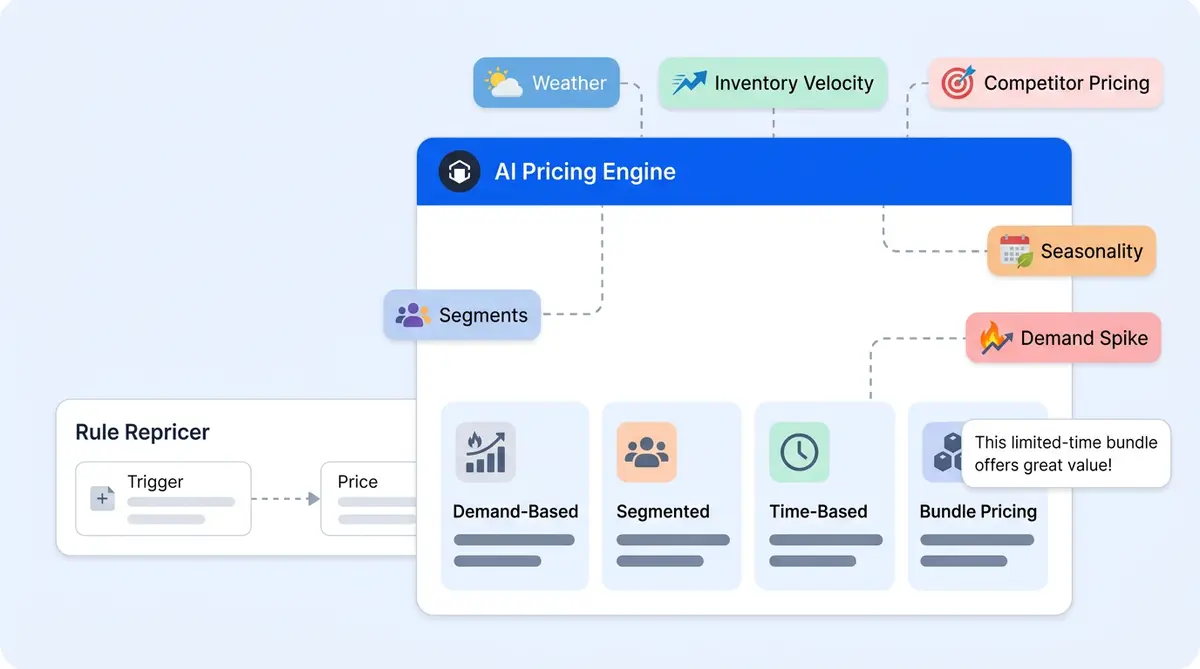
Rule-based chatbot flows fail here too, for the same reason static pricing rules fail: too many input signals. You can't pre-build a decision tree that covers every product, every item, every price movement, and every customer segment. The moment your pricing engine considers 60 variables, your support flow would need thousands of pricing rules to keep up. Nobody maintains that.
And there's a timing problem. Shoppers who notice a price change don't navigate to your FAQ page. They ask in the moment, in the chat widget, in an Instagram DM, or in an email reply to a cart-abandonment message. The explanation has to meet them where they already are.
What a Conversational Price-Explanation Layer Actually Does
A conversational layer sits between your pricing engine and your customer. The engine sets the number; the conversational layer gives that number a reason. Here are a few examples of what that looks like in practice.
Live Price and Availability Retrieval
When a shopper asks about a price, the AI pulls the current price and stock status from your catalog or data sources in real time. It doesn't reference a cached page or yesterday's snapshot. Alhena AI's Shopping Assistant connects to your product feed through API tools and structured data sources so every answer reflects real-time truth.
Guideline-Driven Pricing Responses
You have full control over how the AI talks about pricing. If your policy is "never offer discounts unless the customer has a valid promo code," the AI follows that rule across every conversation, every channel. If you want the agent to explain that a price increase reflects a limited-edition formulation, you write that guideline once and it applies everywhere. Alhena's Support Concierge enforces these pricing guidelines consistently across web chat, email, Instagram, WhatsApp, and voice.
Proactive Price Context
The best time to explain a price change is before the shopper complains about it. Proactive conversion nudges surface context at the right moment: "This serum is 15% off today because we're making room for the new formula" or "This bundle saves you $22 compared to buying each individual item separately." The shopper gets the "why" before the doubt creeps in.
Localized Price Display
For international businesses, Alhena's widget converts prices into the shopper's local currency in real time. A U.S.-listed product shows in euros, pounds, or yen depending on the visitor's location. This removes another layer of pricing friction, especially when exchange rates shift and the displayed price looks different from what a friend in another country reported.
What This Layer Does Not Do
Honesty matters here. A conversational AI layer like Alhena doesn't set prices, run repricing models, or replace your pricing engine. It doesn't decide whether to raise the price on a bestselling moisturizer or drop the margin on a slow-moving SKU.
That's the job of dedicated pricing systems like Pricefx, Competera, Intelligence Node, or Prisync. Even Amazon uses separate pricing algorithms from its customer-facing AI. Those tools process demand signals, competitor data, and margin targets to produce the optimal number.
Alhena sits downstream. It takes whatever price your engine sets and turns it into a justified, on-brand answer when a shopper asks about it. This distinction is exactly why the two work well together. Your pricing engine handles the math. Your conversational layer handles the meaning.
From a business perspective, trying to do both with a single tool usually means doing neither well. Pricing engines that bolt on a chatbot produce generic responses. Chatbots that try to do pricing logic produce hallucinated numbers. Keeping the systems separate, with clean data flowing between them, gives you an effective setup with accuracy on both sides.
A Practical Pairing: From Price Change to Confident Purchase
Here's how the full loop works when a pricing engine and conversational layer operate together:
- Engine sets price. Your AI pricing tool adjusts a product from $89 to $94 based on demand signals, market trends, and inventory velocity.
- Catalog updates. The new price flows into your Shopify, WooCommerce, or Magento catalog. If you use structured data files, the update hits your CSV or Google Sheet.
- Alhena retrieves at runtime. When a shopper asks "why is this $94?", Alhena's Product Expert Agent pulls the current price and availability from your catalog in real time.
- Guideline shapes the explanation. Your configured pricing guideline tells the agent how to frame it: "This product's price reflects current demand. We recommend buying now, as inventory is limited at this price point."
- Handoff if needed. If the shopper pushes back or requests a price match, Alhena routes to a human agent with full conversation context and pricing information, so the rep doesn't start from scratch.
Consider a real scenario: you run a flash sale where the engine drops a product 12% for 48 hours. Without a conversational layer, customers who see the lower price might wait for an even bigger drop. With Alhena, the AI shopping assistant explains: "This is a limited 48-hour promotion, not a permanent price change." That single sentence fights wait-and-see abandonment and protects your conversion rate.
Brands like Tatcha saw 3x conversion rates and 38% AOV uplift with an AI-powered shopping experience that contextualizes product value in every conversation. Victoria Beckham reported a 20% AOV increase by giving shoppers the product expertise and pricing context they needed to purchase with confidence.
Measuring the Conversational Pricing Impact
If you're running a pricing engine without tracking how price-sensitive conversations convert, you're flying half-blind. Alhena's built-in revenue attribution analytics track how pricing-related conversations influence conversion, so your pricing team gets actionable pricing insights they've never had before.
Here's what to measure:
- Price-inquiry conversion rate: What percentage of shoppers who ask about pricing end up buying? Compare this before and after adding the conversational layer.
- Ticket deflection on pricing questions: How many "why did the price change?" tickets reach human agents vs. get resolved by AI? Crocus achieved an 86% deflection rate across their support volume.
- Abandonment rate after price changes: Track cart abandonment in the 24 hours following a price adjustment. The conversational layer should flatten this spike.
- AOV on AI-assisted sessions: Customers who get pricing context and bundle recommendations through the AI shopping assistant tend to spend more per order.
Use Alhena's ROI calculator to model the impact before you commit, and check what AI conversation data reveals about merchandising gaps in your current pricing communication.
Getting Started With a Conversational Pricing Layer
You don't need to overhaul your pricing stack to add this layer. Alhena deploys in under 48 hours on top of your existing e-commerce platform, whether that's Shopify, WooCommerce, or Salesforce Commerce Cloud.
Start with three steps:
- Connect your catalog. Alhena ingests your product data from your e-commerce platform, CSV files, or Google Sheets. Prices, availability, and product details sync automatically.
- Write your pricing guidelines. Define how the AI should talk about price changes, discounts, promotions, and comparisons. Be specific: "When a customer asks why a price increased, reference current demand and limited availability. Never speculate on future price changes."
- Turn on proactive nudges. Configure the AI shopping assistant to surface pricing context before customers ask. Bundle suggestions, limited-time promotion alerts, and value explanations all reduce the trust gap that dynamic pricing creates.
The whole setup is faster than building a single rule-based chatbot flow for pricing questions, and it adapts automatically as your catalog and ecommerce pricing strategy change.
The Bottom Line
Ecommerce dynamic pricing in ecommerce without context creates confusion. Customers screenshot prices, share them with friends, and lose trust when numbers shift without explanation. The Gartner data is clear: 68% of consumers feel exploited by the practice.
The fix isn't to avoid dynamic pricing. It's to pair every price change with a conversational AI layer that gives customers a reason to feel good about the price they see. That second half, the effective explanation and trust-building, is a conversation problem, not a math problem.
Ready to add the missing layer to your pricing stack? Book a demo with Alhena AI or start for free with 25 conversations.
Alhena AI
Frequently Asked Questions
How does a conversational AI layer help with ecommerce dynamic pricing?
A conversational AI layer sits between your pricing engine and your customers. It retrieves live prices from your catalog at conversation time and explains the reasoning behind price changes using your configured guidelines. This builds trust instead of confusion when prices shift. Alhena AI handles this across web chat, email, Instagram, WhatsApp, and voice.
Does Alhena AI set or adjust product prices?
No. Alhena doesn't run repricing models or set prices. It's the explanation and trust layer, not the pricing engine. You pair it with dedicated pricing platforms like Pricefx, Competera, or Prisync. Alhena takes whatever price your engine sets and turns it into a clear, on-brand answer when shoppers ask about it.
What percentage of consumers distrust dynamic pricing?
A Gartner survey from October 2024 found that 68% of consumers feel taken advantage of when brands use dynamic pricing. The same study showed 80% of shoppers consider brands with consistent pricing more trustworthy. These numbers highlight why pairing price changes with real-time explanations is critical for conversion.
Can Alhena AI handle price-match requests automatically?
Yes. Alhena's Support Concierge processes price-match requests within your configured policies without escalating to a human agent. If the request falls outside policy, Alhena routes the conversation to your team with full context so the rep doesn't start from scratch.
How long does it take to set up a conversational pricing layer with Alhena?
Alhena deploys in under 48 hours on Shopify, WooCommerce, or Salesforce Commerce Cloud. You connect your catalog, write your pricing guidelines, and turn on proactive nudges. The setup takes less time than building a single rule-based chatbot flow for pricing questions.
How do I measure whether conversational AI is improving my pricing strategy results?
Track four metrics: price-inquiry conversion rate, ticket deflection on pricing questions, cart abandonment rate after price changes, and AOV on AI-assisted sessions. Alhena's revenue attribution analytics provide these numbers out of the box. Crocus achieved an 86% deflection rate; Tatcha saw 3x conversion and 38% AOV uplift.
Does dynamic pricing work for small ecommerce brands?
Yes. Small brands can start with demand-based pricing on their top 100 SKUs and see measurable results within 60 to 90 days. Adding a conversational layer like Alhena means you don't need extra support staff to handle the pricing questions that follow. Twenty-five free conversations let you test the approach before committing.