Service teams think they're proactive. Customers disagree. According to Salesforce's 2025 State of Service report, 61% of support teams believe they deliver proactive customer service, but only 33% of customers agree. That gap costs ecommerce brands real money: higher customer support ticket volumes, lower retention, and missed revenue from shoppers who leave before anyone reaches out.
The fix isn't more agents. It's a fundamental shift from waiting for problems to predicting and working to prevent issues before they happen. AI can help make that shift possible at scale, and businesses can cut costs by 20-30% while growing revenue 5-8%, per McKinsey. This guide breaks down what proactive customer service looks like in ecommerce, how it compares to reactive support, and how to measure its impact on your bottom line.
What Is Proactive Customer Service?
Proactive customer service means reaching out to shoppers before they contact you. Instead of waiting for a customer support ticket, a complaint, or a frustrated email, your team (or your AI) identifies potential issues and acts first.
Think about the difference between a store associate who sees you struggling with a size chart and walks over to help versus one who waits behind the counter until you flag them down. Both provide service. One creates a better experience.
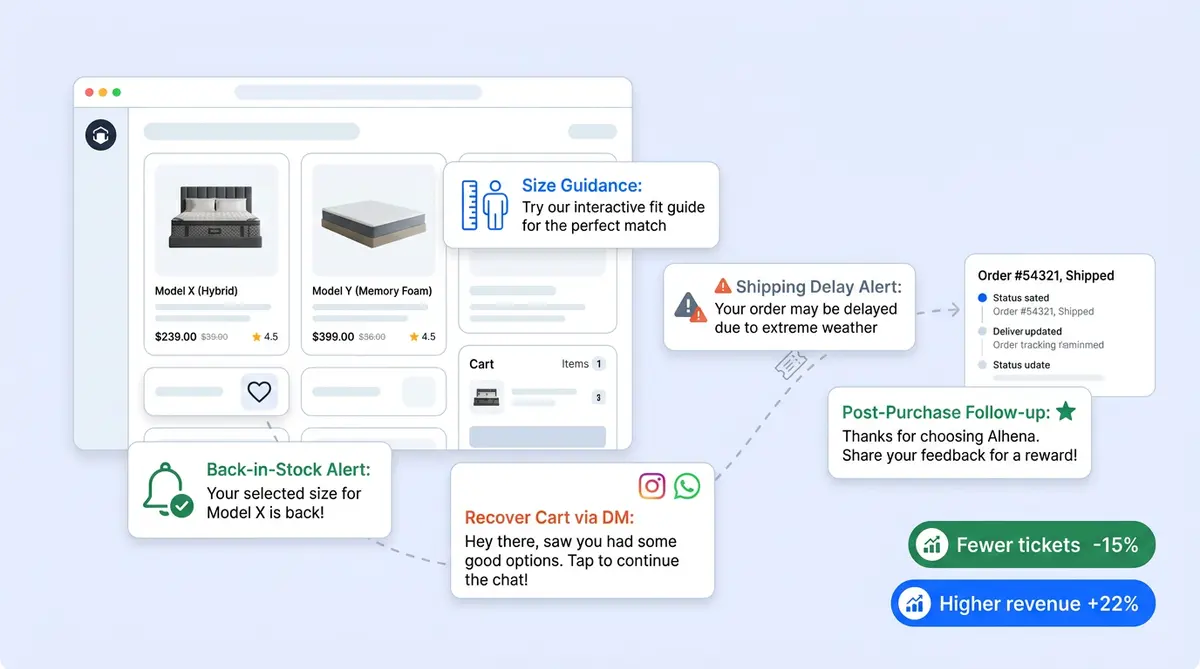
In ecommerce, proactive service takes many forms: sending a shipping delay notification before the customer checks tracking, surfacing customer support and size guidance when someone lingers on a product page, or following up after delivery to catch problems early. The common thread is that the brand initiates contact based on data, not the customer raising a hand.
Gartner found that only 13% of customers report receiving any proactive service today. Yet 90% of those who did found it valuable. The demand is there. The supply isn't.
Proactive vs Reactive Customer Service: What Actually Changes
Reactive customer service starts when the customer has a problem and contacts you. Proactive customer service starts when your systems detect a signal and you contact the customer. That single difference changes everything downstream.
With reactive service, the customer carries the burden. They have to notice the issue, find your contact page, explain the situation, and wait for a response. By the time you're involved, frustration is already built in. Your team spends energy on damage control rather than value creation.
Proactive service flips the dynamic. Your AI monitors order data, browsing behavior, and delivery statuses in real time. When something looks off, it acts. A delayed shipment triggers a notification before the customer checks tracking. A shopper comparing three similar products gets a helpful breakdown without asking. A first-time buyer receives a quick welcome message explaining your return policy.
The business impact is measurable. Reactive customer support is a cost center: more tickets mean more agents. Proactive service becomes a revenue driver. McKinsey's research shows companies using AI-powered proactive engagement see a 40-50% reduction in service interactions while increasing customer satisfaction by 15-20%.
If you're wondering where your team falls on this spectrum, our ecommerce AI maturity model maps the five stages from scripted chatbot to autonomous commerce.
Does that mean reactive service goes away? No. Complex issues, emotional situations, and unique problems still need human agents who can listen, empathize, and solve creatively. The best ecommerce brands use proactive AI for the predictable 80% and reserve their human customer support team for the high-stakes 20%. For a detailed look at managing total support costs while making this shift, see our breakdown of AI customer service TCO in ecommerce.
Six Proactive Customer Service Examples in Ecommerce
Proactive service isn't one tactic. It's a set of triggers spread across the customer journey. Here are six examples that top ecommerce brands use today.
1. Shipping Delay Alerts Before Customers Ask
"Where is my order?" makes up 30-40% of all ecommerce support tickets. Proactive delivery notifications cut that volume dramatically. Research from nShift shows proactive shipping alerts reduce WISMO inquiries by 60-70%, and when customers are informed about delays before they notice, 98% never contact support. That's thousands of tickets your team never has to handle.
Alhena's Support Concierge connects directly to carriers through integrations with Narvar and ShipStation, pulling real-time tracking data and using automated alerts to notify customers the moment a delay is detected.
2. Back-in-Stock Notifications That Convert
When a popular product sells out, most brands lose those shoppers forever. Proactive back-in-stock alerts recover them. The numbers are striking: back-in-stock emails convert at 14-22%, nearly three times the average email campaign rate of 8%, according to MarketingSherpa. SMS alerts perform even better with 98% open rates.
The key is speed. The first notification after restock captures the highest-intent buyers. AI can help prioritize which customers to notify first based on browsing recency, wishlist activity, and past purchase patterns.
3. Pre-Purchase Guidance Based on Browsing Behavior
A shopper viewing four similar moisturizers in three minutes is comparing options. A shopper returning to the same jacket page for the third day is hesitating on fit. Both need help, but neither will ask for it. They don’t know what questions to ask.
AI-powered proactive service detects these patterns and responds in context. For the moisturizer shopper, it might surface ingredient comparisons. For the jacket buyer, it could share sizing data from similar customers. Alhena's Shopping Assistant uses your product catalog, reviews, and customer data to deliver these answers automatically, and because it's grounded in verified product data, the guidance is accurate rather than hallucinated.
For a full breakdown of trigger types (scroll depth, cart inactivity, return visits) and when each should fire, see our guide on AI nudges that convert without being annoying.
4. Post-Purchase Follow-Ups That Build Loyalty
The period after a purchase is when customer relationships are won or lost. A proactive follow-up two days after delivery ("How does everything look? Need help with anything?") catches problems before they become returns or negative reviews.
Brands that adopt post-purchase proactive engagement see repeat buying rates increase by 6-12%, per nShift. Returning customers generate 3x more revenue than first-time customers, so even small improvements in retention compound quickly. Our guide on how AI CX drives customer lifetime value covers the metrics behind this in detail.
For eight more retention tactics beyond post-purchase follow-ups, see our AI customer retention playbook.
5. Cart Recovery With Context, Not Coupons
Generic "you left something in your cart" emails perform poorly because they don't address why the shopper hesitated. Proactive AI can identify the likely reason: was it a shipping cost surprise? A size question? A comparison with a competitor product?
When the follow-up message is addressing the actual hesitation point, recovery rates improve significantly. Alhena's Social Commerce agent can reach shoppers on Instagram DMs and WhatsApp with contextual messages that answer the real question, not just remind them of the item.
6. Proactive Order Management Updates
Order changes, address corrections, cancellations: customers shouldn't have to call or email for these. Proactive order management means surfacing relevant actions before the customer goes looking. If a customer's order hasn't shipped yet and they visit your site, an AI agent can proactively offer to update the shipping address or cancel if needed.
Alhena's Order Management Agent handles these interactions end-to-end, connecting to your ecommerce platform (whether that's Shopify, WooCommerce, or Salesforce Commerce Cloud) to pull live order data and take action in real time.
Building Your Proactive Support Stack
Proactive service isn't just about the AI layer. It's about connecting the right data sources so your AI has enough context to act. Without order data, your agent can't intercept WISMO questions. Without browsing signals, it can't time a nudge. The table below maps every data source a proactive program needs to the integration that feeds it into Alhena.
The Proactive Support Stack: Data Sources and Integrations
| What You Need | Where It Lives | How Alhena Connects |
|---|---|---|
| On-page behavior | Your website | Website SDK events, scroll/timer/custom triggers for AI Nudges |
| Cart and checkout signals | Storefront | SDK cart and checkout events + revenue attribution |
| Order history and status | Shopify, WooCommerce, Magento, Salesforce Commerce Cloud | Native ecommerce platform integrations |
| Shipping and tracking | Carriers | Narvar + ShipStation integrations |
| Past tickets and resolutions | Your helpdesk | Zendesk, Freshdesk, Gorgias, Gladly, Kustomer, HubSpot, Zoho Desk |
| Customer profiles and segments | CRM / CDP | HubSpot, Klaviyo, mParticle integrations |
| Reviews and sentiment | Review platforms | Trustpilot and Feefo review management |
| Cross-channel memory | All channels | Unified Memory across web, email, social, voice |
You don't need every integration on day one. Start with your ecommerce platform and helpdesk (the two highest-signal sources), then layer in CRM segments and review data as your proactive program matures. For a detailed look at how these data sources connect to a single customer profile, see our deep dive on Unified Memory architecture.
Why Most "Proactive" Service Fails (and How to Avoid It)
Not all proactive outreach works. Gartner found that two-thirds of customers who receive proactive outreach still end up contacting customer support, often because the initial message raised more questions than it answered. Without addressing the root cause, proactive service can actually increase costs.
Three mistakes kill proactive service:
- Incomplete information. A "your order is delayed" message without a new estimated delivery date creates anxiety rather than relief. Every proactive touchpoint must give the customer enough context to take action or feel resolved.
- Wrong timing or frequency. Too many messages too fast feels like spam. Research shows that customers react positively when proactive alerts address urgent issues (delivery problems, payment failures) but negatively when the same frequency is applied to low-urgency messages (product recommendations, feature announcements).
- Over-personalization that feels invasive. There's a line between helpful ("based on your last purchase, here's a care guide") and creepy ("we noticed you spent 4 minutes and 12 seconds looking at this product"). Proactive service must balance relevance with respect for privacy.
The solution is calibration. Start with high-urgency, high-value triggers (shipping delays, stock alerts, order issues) before expanding to lower-urgency engagement. Track not just open rates but whether the proactive message actually resolved the issue or generated a follow-up ticket. If your proactive outreach increases ticket volume, something is broken.
Alhena's continuous learning architecture automates part of this calibration: trending topics surface rising questions, and the AI auto-generates new FAQ entries so your proactive triggers stay current without manual updates.
How to Measure Proactive Customer Service ROI
You can't improve what you don't measure. Here's the framework ecommerce brands use to track proactive service performance.
Related reading: three rings of ticket deflection.
Deflection and Efficiency Metrics
- Ticket deflection rate: What percentage of potential issues were resolved proactively before a ticket was created? Brands using AI-driven proactive service report 25-45% deflection rates.
- WISMO reduction: How much did "where is my order" volume drop after implementing proactive shipping alerts? Benchmark: 60-70% reduction.
- Cost per interaction: The average AI chatbot session costs $0.50 versus $6.00 for a human agent, a 12x gap that compounds as proactive AI handles more volume.
Customer Experience Metrics
- CSAT after proactive touchpoints: Gartner's research shows proactive service adds a full percentage point to NPS, CSAT, and customer effort scores. Compare proactive reactive CSAT scores by tracking interactions that started proactively versus reactively.
- Customer effort score (CES): Proactive service reduces customer effort by design. Measure CES before and after implementing proactive triggers to quantify the improvement.
Revenue Attribution
- Revenue from proactive interactions: What percentage of your total revenue touches a proactive AI interaction? Tatcha, using Alhena AI, attributes 11.4% of total site revenue to AI-assisted conversations, with a 3x conversion rate and 38% higher average order value.
- Repeat buying rate lift: Track whether customers who receive proactive service buy again at a higher rate than those who don't.
- Churn reduction: McKinsey reports proactive service reduces churn by 10-15%. For a brand with $10M in annual revenue and 30% annual churn, a 10% churn reduction is worth $300K.
Alhena's built-in revenue attribution analytics track every proactive interaction through to purchase, so you can see exactly which triggers drive revenue and which need tuning. Learn more about tying CX metrics to business outcomes in our guide to AI CX and customer lifetime value.
How Alhena AI Powers Proactive Customer Service
Most customer support tools are built to manage tickets after they arrive. Alhena AI is built to prevent tickets from being created in the first place, and to turn service interactions into revenue.
Alhena's two specialized agents handle different sides of proactive service. The Product Expert Agent monitors browsing behavior and surfaces relevant product guidance, sizing help, and comparisons before shoppers ask. The Order Management Agent tracks order status, shipping data, and delivery timelines, and can help by proactively alerting customers to changes and handling modifications without human involvement.
Both agents work across every channel your customers use: live chat on your website, email, Instagram DMs, WhatsApp, and voice. A shopper who gets proactive sizing help on your website can continue that same conversation on WhatsApp the next day without repeating anything.
What sets Alhena apart from general-purpose AI tools is its ecommerce-specific design. Every response is grounded in your actual product catalog, inventory data, and order records. There are no hallucinated recommendations, no made-up shipping dates, no incorrect size charts. Brands like Puffy achieve 90% CSAT scores and 63% automated inquiry resolution because the AI's answers are always accurate.
Setup takes less than 48 hours, with no developer resources needed. Alhena’s AI chatbots connect to your existing stack, whether your customer support stack runs Shopify with Zendesk, WooCommerce with Freshdesk, or Salesforce Commerce Cloud with Gorgias. The AI starts learning your catalog and customer patterns immediately.
Manawa, a travel and experiences marketplace, saw response times drop from 40 minutes to under 1 minute and automated 80% of customer inquiries after deploying Alhena's proactive AI. Crocus hit an 86% deflection rate with 84% CSAT, proving that proactive automation doesn't sacrifice quality.
Your Week-One Checklist
You don't need a six-month roadmap. Most brands can launch their first proactive trigger within a week. Here's the sequence that gets results fastest.
- Connect your ecommerce platform (Shopify, WooCommerce, or Salesforce Commerce Cloud) so the AI has live order and product data.
- Connect your helpdesk (Zendesk, Freshdesk, Gorgias) and import your last 90 days of tickets. This trains the AI on your most common issues.
- Review your top 5 trending topics from the last 30 days. These are your first proactive trigger candidates.
- Build one AI Nudge per top topic, each behind an A/B test. Start with WISMO or sizing, whichever drives more tickets.
- Turn on cart and checkout event tracking through the Website SDK so you can measure revenue attribution from day one.
- Set your human transfer triggers for high-emotion or policy-exception scenarios. Test the handoff end-to-end before going live.
- Enable CSAT collection on AI conversations to track quality alongside deflection.
- Capture your baseline metrics: ticket volume, average response time, contact rate per order, CSAT. You'll compare against these in 30 days.
If you're cautious about going live with AI, our guide to running a low-risk AI pilot walks through shadow mode, gradual rollout, and rollback plans.
Key Takeaways
- Proactive customer service means your brand reaches out before customers contact you, based on behavioral and operational data signals.
- The gap between what brands think they deliver (61%) and what customers experience (33%) represents a massive opportunity for ecommerce teams willing to invest in proactive AI.
- Six high-impact proactive triggers: shipping delay alerts, back-in-stock notifications, pre-purchase guidance, post-purchase follow-ups, contextual cart recovery, and proactive order management.
- Poorly executed proactive messaging backfires. Every message needs complete, actionable information. Start with high-urgency triggers and expand gradually.
- Measure proactive service with ticket deflection, WISMO reduction, CSAT on proactive touchpoints, and revenue attribution. If proactive outreach increases ticket volume, recalibrate.
- Alhena AI is purpose-built for ecommerce proactive service: hallucination-free responses, omnichannel coverage, agentic order management, and built-in revenue tracking. Brands using Alhena see 3x conversion rates, 38% AOV uplift, and 80-86% deflection rates.
Ready to move from reactive tickets to proactive revenue? Book a demo with Alhena AI to see how proactive service works on your store, or start free with 25 conversations to test it yourself.
Frequently Asked Questions
What is proactive customer service in ecommerce?
Proactive customer service means reaching out to shoppers before they contact you, using data signals like browsing behavior, order status changes, and delivery tracking to anticipate needs. In ecommerce, this includes shipping delay alerts, back-in-stock notifications, size guidance, and post-purchase follow-ups. Gartner research shows 90% of customers who receive proactive service find it valuable.
How does proactive customer service differ from reactive support?
Reactive support starts when a customer contacts you with an issue. Proactive service starts when your AI detects a signal and reaches out first. The practical difference: reactive service costs $6+ per human agent interaction and requires more staff as volume grows. Proactive AI interactions cost around $0.50 each and scale without adding headcount, while reducing ticket volume by 25-45%.
What are the best proactive customer service examples for online stores?
Six high-impact examples: shipping delay notifications before customers check tracking (reduces WISMO tickets by 60-70%), back-in-stock alerts (14-22% conversion rates), pre-purchase browsing guidance, post-purchase follow-ups (lifts repeat purchases 6-12%), contextual cart recovery that is addressing the actual hesitation point, and proactive order management for address changes and cancellations.
How does Alhena AI handle proactive customer service?
Alhena AI uses two specialized agents: a Product Expert Agent that monitors browsing behavior and surfaces product guidance proactively, and an Order Management Agent that tracks shipments and order status in real time. Both work across live chat on your website, email, Instagram DMs, WhatsApp, and voice. Every response is grounded in your actual product catalog and order data, so there are no hallucinated answers.
How do you measure proactive customer service ROI?
Track three categories: deflection metrics (ticket deflection rate, WISMO reduction, cost per interaction), experience metrics (CSAT on proactive vs reactive interactions, customer effort score), and revenue attribution (percentage of revenue from AI-assisted conversations, repeat purchase rate lift, churn reduction). Alhena's built-in analytics attribute every proactive interaction through to purchase.
Can proactive outreach annoy customers instead of helping them?
Yes, if done poorly. Gartner found two-thirds of customers who receive proactive outreach still contact support because the message raised more questions than it answered. The fix: include complete, actionable information in every proactive message, start with high-urgency triggers (shipping delays, order issues), cap frequency, and track whether messages reduce or increase follow-up tickets.
How long does it take to set up proactive AI customer service with Alhena?
Alhena deploys in under 48 hours with no developer resources needed. It connects to your existing ecommerce platform (Shopify, WooCommerce, Salesforce Commerce Cloud) and helpdesk (Zendesk, Freshdesk, Gorgias) through native integrations. The AI begins learning your product catalog and customer patterns immediately, with proactive triggers configurable from day one.
What results have ecommerce brands seen with proactive AI service?
Tatcha saw a 3x conversion rate and 38% higher AOV, with 11.4% of total site revenue attributed to AI conversations. Manawa cut response times from 40 minutes to under 1 minute and automated 80% of inquiries. Crocus achieved an 86% deflection rate with 84% CSAT. Puffy reached 90% CSAT with 63% automated resolution. These results came from Alhena's proactive, ecommerce-native AI.