PwC's 2025 customer experience survey found that 90% of executives believe customer loyalty has grown in recent years. Only 40% of consumers agree. That 50-point perception gap is the single biggest risk in ecommerce today, because the brands that misread their own ecommerce customer experience are the ones losing customers without knowing why.
The numbers back this up. 52% of consumers have stopped using a brand after a single bad experience. Forrester's 2025 Global CX Index shows that 25% of US brands saw their CX scores decline, while just 7% improved. And Baymard Institute estimates that $260 billion in lost orders across the US and EU could be recovered through better checkout design alone.
The good news: AI gives ecommerce brands a way to close this gap at every touchpoint, from product discovery through post-purchase support. This guide breaks down the specific strategies that actually move revenue, backed by data from brands already doing it well.
Why Ecommerce Customer Experience Is a Revenue Problem
Most teams still treat customer experience as a support function. The data says otherwise. Forrester has shown that improving CX by just one point on their index can drive more than $1 billion in additional revenue for large companies. McKinsey's research on personalization finds that companies excelling at it generate 40% more revenue from those activities than slower-growing peers.
On the flip side, poor customer experience in ecommerce has a direct cost. The average cart abandonment rate sits at 70.22% across 50 studies tracked by Baymard Institute. On mobile, it's even worse: 80% of shoppers bail before completing checkout, compared to 66% on desktop. The top reasons aren't about price. 25% of shoppers leave because of forced account creation. 18% abandon due to a checkout process that's too complicated.
Retention tells the same story. 65% of a company's revenue comes from existing customers, and returning customers spend 67% more than new ones. Yet the average DTC ecommerce retention rate is just 31%. The brands that invest in customer experience don't just keep more buyers. They make more money from every buyer they keep.
Conversational Product Discovery That Converts
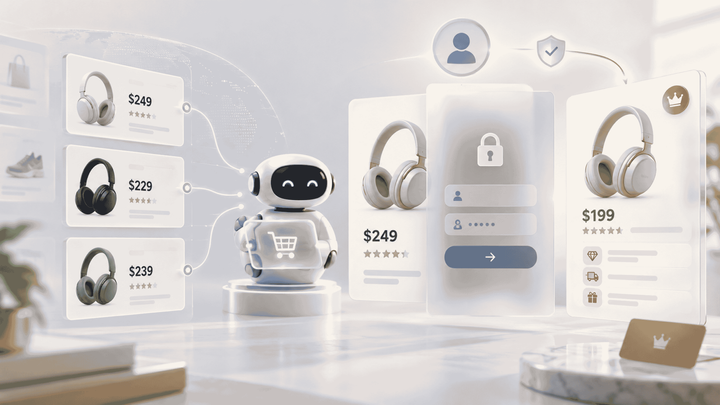
Traditional ecommerce search is broken for complex purchases. A shopper looking for "moisturizer for dry, sensitive skin that won't break me out" gets a keyword-matched results page that may or may not be relevant. AI-powered conversational search changes this entirely.
Instead of filtering through 200 products, the customer describes what they need in natural language. The AI asks follow-up questions (skin type, budget, ingredient preferences), then recommends specific products with clear reasoning. Amazon's recommendation engine already drives 35% of its total revenue through this approach.
Alhena AI's Shopping Assistant takes this further for mid-market brands. It connects directly to your product catalog, so every recommendation is grounded in real inventory and accurate product data, not hallucinated suggestions. Brands like Tatcha saw 3x conversion rates on AI-assisted sessions because the AI guided shoppers to the right product on the first try. For a deeper look at how this works in practice, our AI shopping assistant use cases guide covers the most common scenarios.
Personalization That Goes Beyond "You Might Also Like"
Generic recommendation widgets ("customers also bought") are table stakes. They've been around for a decade, and shoppers have learned to ignore them. The next level of ecommerce customer experience personalization is contextual, conversational, and real-time.
McKinsey's data shows that personalization drives a 5 to 15% revenue lift on average, with marketing ROI improvements of 10 to 30%. But the gap between basic and advanced personalization is massive. Sessions where shoppers actively engage with AI-powered recommendations show 369% higher average order values compared to sessions without that engagement.
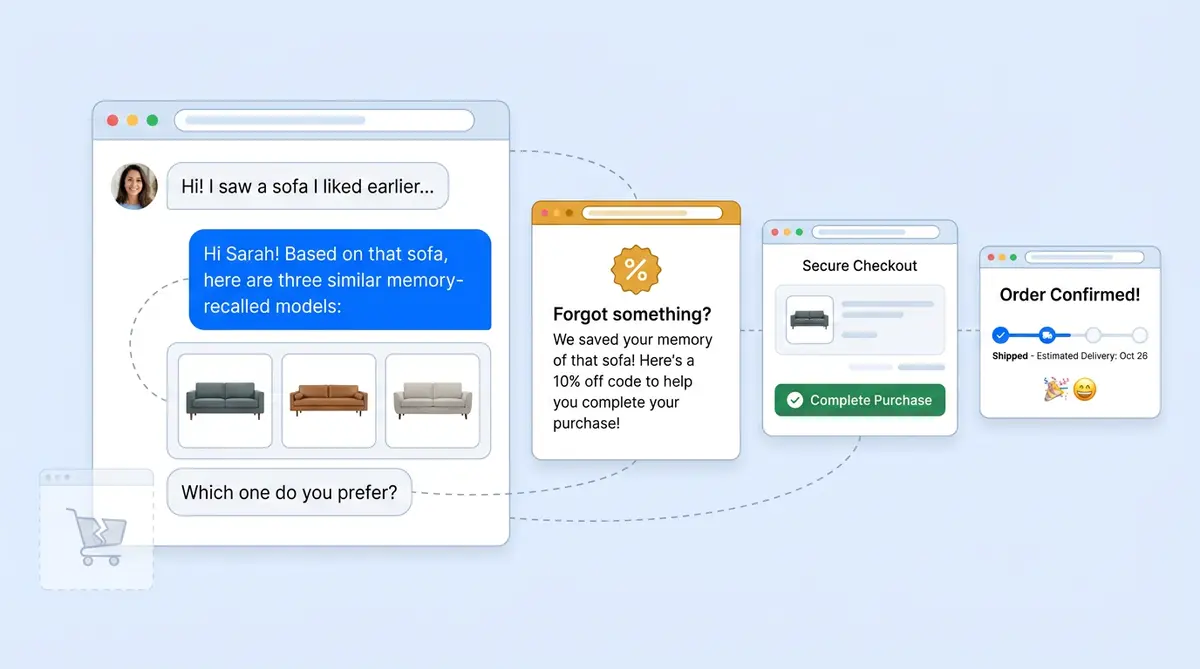
What separates advanced personalization from basic? Three things. First, it uses conversation context, not just browsing history. A shopper who tells the AI they're buying a gift for their partner gets different suggestions than someone buying for themselves, even if they're looking at the same product page. Second, it works across channels. A customer who asked about sizing on Instagram DMs shouldn't have to repeat themselves on your website. Third, it gets smarter over time. Each interaction adds to a unified memory of that customer's preferences, purchase history, and communication style.
Victoria Beckham implemented this kind of deep personalization and saw a 20% increase in average order value. The AI didn't just recommend products. It understood what each shopper was trying to achieve and curated a routine around that goal.
AI Support That Resolves, Not Just Deflects
Here's where most ecommerce brands get AI wrong. They deploy a chatbot, celebrate a 60% deflection rate, and declare victory. But deflection isn't resolution. If your AI deflects a customer to a help article that doesn't answer their question, you haven't improved their experience. You've just made them work harder to find a human.
The difference matters. 68% of customers won't reuse a chatbot after one bad experience, according to Salesforce's 2026 ecommerce trends report. And Gartner found that 64% of consumers would rather companies not use AI for customer service at all. That's not an indictment of AI. It's an indictment of poorly implemented AI.
Good AI support resolves issues end-to-end. That means handling order status checks, processing returns, updating subscriptions, and answering product questions with accurate, catalog-grounded information. Alhena AI's Support Concierge resolves tickets using verified product data and live order information, so customers get real answers, not canned responses. Puffy achieved 63% automated inquiry resolution with 90% CSAT, and Crocus hit an 86% deflection rate while maintaining 84% satisfaction scores. The key: the AI only handles what it can handle well, and escalates the rest to human agents with full conversation context.
For brands already using helpdesk platforms, this isn't an either/or decision. Our guide on how AI shopping assistants increase conversion rates shows how the sales and support sides work together.
Proactive Engagement Before Customers Ask
Most ecommerce AI waits for the customer to click the chat icon. That's a problem, because fewer than 1% of visitors ever do. Proactive AI flips the model. It reaches out based on behavioral signals: a shopper lingering on a product page, comparing two items, or showing exit intent on the cart page.
The impact is significant. Brands using proactive AI engagement see 2 to 6% visitor engagement rates, up from the sub-0.5% typical of passive chat widgets. Proactive AI chat recovers 35% of abandoned carts. And stores with conversational AI agents report 4x higher conversion rates for visitors who interact with the AI compared to those who don't.
The trick is relevance. A generic "Can I help you?" popup annoys more people than it converts. Smart nudges are contextual: "I see you're comparing these two running shoes. Want me to break down the differences for your foot type?" That kind of engagement adds value instead of interrupting.
Alhena AI's Conversion Nudges trigger based on page context, time on page, scroll depth, and cart stage. They're designed to feel like a helpful store associate who appears at the right moment, not a popup that gets immediately closed.
Frictionless Checkout with Agentic Commerce
Checkout is where the ecommerce customer experience most often breaks down. 70% of carts are abandoned, and many of the top reasons (complex checkout, forced account creation, unclear shipping costs) are fixable with AI.
Agentic commerce takes this a step further. Instead of the customer navigating through five checkout pages, the AI populates their cart, pre-fills shipping and payment details, and guides them through any remaining decisions in a single conversation. The entire purchase can happen inside the chat window.
This isn't theoretical. About one-third of US consumers say they'd let an AI make purchases for them, and Gartner predicts that by 2028, AI agents will intermediate over $15 trillion in B2B transactions alone. For B2C, the shift is already happening. During the 2025 holiday season, ecommerce traffic from AI chatbots doubled year over year, and AI was credited with driving 20% of all retail sales during that period.
Alhena AI's agentic checkout lets shoppers add items to cart and move to checkout directly from a conversation, across web chat, Instagram DMs, and WhatsApp. No page reloads. No form fields. Just a natural buying conversation.
Post-Purchase Experience That Builds Loyalty
Most customer experience ecommerce strategies stop at the confirmation page. That's a mistake. 80% of shoppers abandon a brand after one poor post-purchase experience, and WISMO ("Where Is My Order?") queries account for 20 to 30% of all support tickets.
AI handles this proactively. Instead of waiting for the customer to ask where their package is, the AI sends real-time shipping updates, delay notifications, and delivery confirmations before the question gets asked. Brands using proactive AI post-purchase communication see 30 to 40% fewer WISMO tickets and 90%+ customer satisfaction scores.
Returns are the other post-purchase pain point. AI-powered returns automation handles eligibility checks, label generation, and refund status updates without human intervention, saving 40 to 60% on post-purchase support costs. Manawa reduced their support workload by 43% and cut response times from 40 minutes to 1 minute using Alhena AI's automated workflows. For a complete breakdown, see our guide on how AI transforms the post-purchase experience.
Omnichannel Consistency Across Every Touchpoint
73% of retail shoppers engage across multiple channels, using an average of six channels during their buying journey. Yet only 29% of businesses deliver the seamless cross-channel experience that 90% of consumers expect.
The result? Companies with strong omnichannel engagement retain 89% of their customers. Those with weak implementations retain just 33%. That's a 56-point gap driven entirely by consistency.
True omnichannel isn't just being present on multiple channels. It's maintaining context across all of them. When a customer starts a conversation on your website, continues it on Instagram, and follows up via email, the AI should know the full history. No "Can you repeat your question?" No starting over.
Alhena AI connects web chat, email, Instagram DMs, WhatsApp, and voice through a unified memory layer. A shopper who asked about sizing on Instagram sees that context carried into their next website visit. That consistency is what separates a frustrating multi-channel experience from a genuinely connected omnichannel setup.
How to Measure Ecommerce Customer Experience
You can't improve ecommerce customer experience if you can't measure it. Here are the metrics that matter, along with current benchmarks.
- Net Promoter Score (NPS): Retail average is 41. Top performers exceed 50. Measures likelihood of recommendation.
- Customer Satisfaction (CSAT): Retail average sits between 76 and 78%. Anything above 70% is considered good.
- Cart Abandonment Rate: 70.22% overall (80% mobile, 66% desktop). Track this by device and checkout step to find specific friction points.
- Conversion Rate: Global ecommerce average is 3.34%. AI-engaged sessions can push this to 12%+.
- AI-Attributed Revenue: What percentage of your total revenue can be traced to AI interactions? Tatcha reaches 11.4%. This is the metric most brands don't track but should.
- Customer Retention Rate: DTC average is 31%. Top performers hit 45 to 55%.
- Resolution Rate vs. Deflection Rate: Deflection measures what the AI prevents. Resolution measures what it actually solves. Track both.
The Alhena AI ROI calculator can model the revenue impact of improving these metrics based on your current traffic and conversion data.
How Alhena AI Puts It All Together
Most AI tools address one piece of the ecommerce customer experience puzzle. A chatbot for support here, a recommendation engine there, a separate tool for post-purchase. Alhena AI covers the full customer journey in a single platform.
The Product Expert Agent handles conversational product discovery, personalized recommendations, and agentic checkout. The Order Management Agent resolves support tickets, processes returns, and manages post-purchase communication. Both agents share unified memory, so context flows seamlessly across every interaction and channel.
Every response is grounded in verified product data. No hallucinations, no outdated inventory information, no guesswork. The platform integrates with Shopify, WooCommerce, Magento, and Salesforce Commerce Cloud, and connects to helpdesks like Zendesk, Gorgias, and Freshdesk.
Setup takes under 48 hours with no dev resources required. You can start for free with 25 conversations to test it on your own store, or book a demo to see how it maps to your specific CX gaps.
Key Takeaways
- Ecommerce customer experience directly drives revenue, not just satisfaction scores. A 1-point CX improvement can mean $1B+ for large companies.
- The 70% cart abandonment rate and 31% retention rate represent massive, fixable revenue leaks.
- AI improves CX across six core touchpoints: discovery, personalization, support, proactive engagement, checkout, and post-purchase.
- Poorly implemented AI hurts more than it helps. 68% of customers won't return after one bad chatbot experience.
- Omnichannel consistency (89% retention vs. 33%) is the highest-leverage CX investment most brands are still missing.
- Measure AI-attributed revenue, not just deflection. The best brands track every conversation to a purchase.
Ready to close the CX gap? Book a demo with Alhena AI to see how your brand can turn customer experience into measurable revenue, or start for free with 25 conversations.
Alhena AI
Frequently Asked Questions
What is ecommerce customer experience and why does it matter?
Ecommerce customer experience covers every interaction a shopper has with your brand online, from product discovery through post-purchase support. It matters because Forrester research shows a single-point CX improvement can drive over $1 billion in additional revenue for large companies, and 52% of consumers stop using a brand after one bad experience.
How does AI improve ecommerce customer experience?
AI improves ecommerce CX across six key touchpoints: conversational product discovery, personalized recommendations, automated support with real resolution, proactive engagement based on behavioral signals, frictionless agentic checkout, and post-purchase communication. Brands using AI across these areas see 3x conversion lifts, 20% higher AOV, and 30 to 40% fewer support tickets.
What metrics should I track to measure ecommerce customer experience?
Track NPS (retail average: 41), CSAT (retail average: 76 to 78%), cart abandonment rate (70% average), conversion rate (3.34% global average), AI-attributed revenue, and customer retention rate (31% DTC average). The most important metric most brands miss is AI-attributed revenue, which shows exactly how much AI interactions contribute to total sales.
How much does poor customer experience cost ecommerce brands?
Poor CX costs ecommerce brands significantly. Baymard Institute estimates $260 billion in recoverable lost orders from checkout friction alone. Cart abandonment runs at 70% overall and 80% on mobile. Returning customers spend 67% more than new ones, so every customer lost to a bad experience represents compounding revenue loss over time.
What is the difference between CX deflection and CX resolution?
Deflection measures how many inquiries your AI prevents from reaching a human agent. Resolution measures how many issues your AI actually solves to the customer's satisfaction. A high deflection rate with low satisfaction means your AI is frustrating customers, not helping them. The best AI platforms, like Alhena AI, achieve both high deflection (86% for Crocus) and high satisfaction (84% CSAT).
How does Alhena AI improve ecommerce customer experience?
Alhena AI covers the full customer journey with two specialized agents. The Product Expert Agent handles conversational product discovery, personalized recommendations, and agentic checkout. The Order Management Agent resolves support tickets, processes returns, and manages post-purchase communication. Both share unified memory across web chat, email, Instagram DMs, WhatsApp, and voice. Setup takes under 48 hours.
Can AI really help with cart abandonment in ecommerce?
Yes. AI addresses the top cart abandonment causes directly. Proactive nudges recover 35% of abandoned carts. Agentic checkout removes friction by letting shoppers complete purchases inside a conversation. AI answers shipping cost and return policy questions in real time, preventing the uncertainty that causes 47% of abandonments. Stores with conversational AI see 4x higher conversion rates among engaged visitors.
How long does it take to see results from AI-powered CX improvements?
With platforms like Alhena AI that deploy in under 48 hours, brands can see measurable results within the first month. Tatcha achieved 3x conversion rates and 11.4% of total site revenue from AI. Manawa cut response times from 40 minutes to 1 minute. The key is choosing a platform that connects to your existing ecommerce stack without requiring custom development.