E-commerce AI powered recommendation engines are smart but not strategic. They analyze purchase history, browsing history, and predictive behavior signals through collaborative filtering to personalize suggestions. But collaborative filtering and machine learning personalization alone isn't a merchandising strategy. They surface products based on relevance to the customer's query, and that's the right default. But the AI doesn't know you just received 500 units of a new product that needs initial sales velocity. It doesn't know Q4 is coming and you need to move holiday inventory. It doesn't know your best-margin moisturizer is sitting at 40% of projected sales while the lower-margin alternative gets all the AI product recommendations because it matches more queries. Without merchandising input, the AI optimizes for relevance alone, and your product discovery, personalization, and product recommendations reflect that gap. Most recommendation systems treat every product equally. AI powered product boosting adds the business strategy layer that turns a relevance-based recommender into a personalization and cross selling engine that can drive sales of strategic products. It transforms the recommendation engine from passive suggestions into a revenue-optimized recommendation engine.
How Product Boosting Changes AI Recommendations
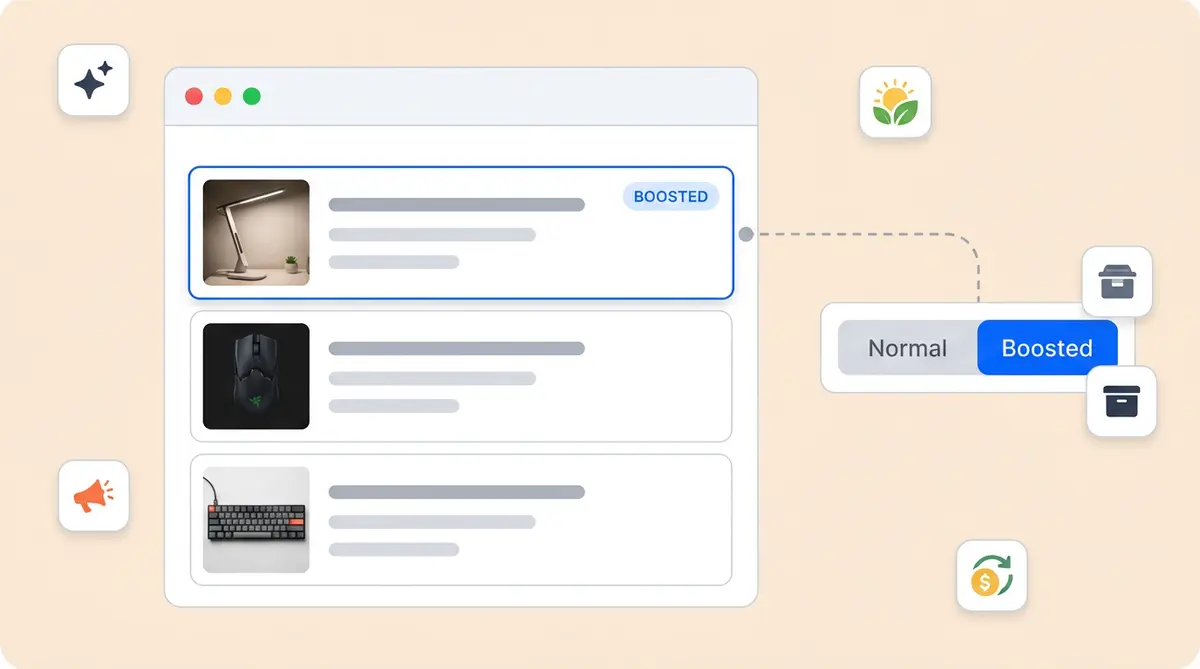
When you boost a product in Alhena AI's Shopping Assistant, the AI gives it higher priority in product recommendations. For example, if a customer asks "what moisturizer should I get?" the AI considers all moisturizers in your catalog but favors the boosted ones when multiple options are equally relevant to the customer's needs.
Traditional collaborative filtering and machine learning algorithms power most recommendation systems and recommender systems by analyzing customer behavior patterns. Using AI and machine learning to surface products is table stakes. Boosting adds a manual override layer to these recommendation systems. This isn't forcing products into irrelevant conversations. A boosted winter coat doesn't appear when someone asks about sunscreen. While collaborative filtering and machine learning handle the baseline matching, boosting nudges the recommendation engine to favor specific products when the product recommendations context allows it, aligning AI powered product behavior with your merchandising priorities and cross selling goals in real time without overriding the machine learning technology that makes the customer experience effective. The AI can still use predictive signals to predict what shoppers want on your website.
Five Strategic Use Cases for Product Boosting
1. New Product Launches
Boost new arrivals in your ecommerce store for two to four weeks to build initial sales velocity, generate early reviews, drive purchase intent and sales through targeted suggestions based on browsing history and product interactions, build customer loyalty, and make sure the AI surfaces them with personalized recommendations during the critical launch window when marketing spend is highest. Your AI has no purchase history or conversation data to analyze for a brand-new SKU, so boosting bridges that cold start gap and solves cold start problems. Without it, the recommendation systems and collaborative filtering models have no behavior signals to predict preferences or generate suggestions from. Collaborative filtering and behavior analysis need data that new products simply don't have yet. Traditional collaborative filtering can't surface what it hasn't seen.
2. Seasonal Inventory Rotation
Boost seasonal ecommerce products from your product catalog in your recommendation systems six weeks before the season starts and remove the boost two weeks before the season ends. This keeps your personalized recommendations relevant and prevents the AI from recommending products that will soon be clearanced. Personalization shifts to swimwear in March for shoppers, outerwear in August, and gift sets in late October.
3. Promotional Campaign Alignment
If you're running paid ads for a specific product, boost it in the AI so customers who arrive from the ad and engage the shopping assistant see the same product reinforced. This creates consistency between your advertising and your on-site experience for shoppers, making every ecommerce marketing dollar work harder, driving cross selling opportunities, product interactions, and cart conversions.
4. Margin Optimization
Boost higher-margin alternatives within product categories so the ai powered personalized recommender favors them through smart personalization when multiple products satisfy the customer's query equally. This personalized cross selling approach works because the recommendation systems match the right products. Two ecommerce moisturizers answer the same question from a shopper browsing your site. Your personalization and recommendation systems both flag them as relevant in your AI product catalog. One carries a 60% margin, the other 30%. Boosting shifts the product mix toward items that contribute more profit per cart and per sale, turning cross selling into a personalized margin strategy, and the order value increases reflect that shift in personalized recommendations without compromising the customer's experience.
5. Overstock Acceleration
Boost overstocked SKUs to accelerate sell-through before markdowns become necessary. The AI becomes a real-time merchandising tool that can automate inventory movement through chat interactions and conversation on your storefront, improving customer experience and building loyalty rather than resorting to discounting. Brands like Tatcha have seen 3x conversion rates and 38% AOV uplift when AI product recommendations align with merchandising goals.
Setting Up Product Boosting in the Alhena Dashboard
In the Alhena dashboard, go to AI Settings and select the Boost Product tab. The screen shows all ingested products available for your AI Agent profile. Select products using the checkboxes next to each item, or use the search bar to find specific SKUs by keyword. You can select multiple products at once.
Click Boost to activate priority for the selected products. Each boosted product displays a clear Boosted status indicator, distinguishing it from products at Normal status. To see only your prioritized items, click the Boosted Products filter. To remove a boost, select the product and click Remove Boost, which reverts it to Normal status instantly.
No recommendation engine algorithms to configure. No product attributes to tag. No customer preferences models to build. You don't need to automate anything complex or tune machine learning algorithms. No data science team required. Select the products, boost them, and the recommendation system adjusts priority immediately based on your product data.
A Boost Rotation Calendar That Matches Your Merchandising Rhythm
Set a bi-weekly or monthly boost review cadence to analyze performance and align with your merchandising calendar. Here's a sample annual rhythm:
- January: Boost new-year collection and resolution-related products
- February: Boost Valentine's gift picks
- March: Boost spring arrivals and transitional pieces
- May through August: Boost seasonal essentials (sunscreen, swimwear, outdoor gear)
- September: Boost back-to-school and fall transitional pieces
- November: Boost BFCM promotional products
- December: Boost last-minute gift products and holiday exclusives
Each rotation takes five minutes in the dashboard, and the ecommerce AI product recommendations update instantly to drive sales of your current priorities. The key discipline is removing boosts after the campaign or season ends. Stale priorities shouldn't override current merchandising goals.
Measuring the Revenue Impact of Product Boosting
Connect product boosting to revenue attribution by tracking three things: conversion rate of boosted versus non-boosted products in AI conversations, AOV changes during boost periods (ecommerce brands typically see AOV increase when AI product recommendations align with merchandising goals), browsing behavior shifts, and you can predict which product interactions convert best, and inventory turnover rate for boosted SKUs compared to historical sell-through, and personalized purchase behavior shifts based on browsing patterns.
Alhena's revenue analytics track AI-attributed sales by product, so you can analyze the exact revenue impact of every boost decision on your recommendation systems and personalization strategy using customer data and product data from your product discovery flows. This data proves whether boosting drives incremental revenue and AOV growth through real customer interactions or just shifts product recommendations without impact. Free trials let you test the revenue lift before committing.
What Not to Do
Don't boost your entire catalog. That gives everything equal priority, which defeats the purpose. Boosting works because it creates contrast between prioritized and non-prioritized products.
Don't boost out-of-stock products in your product catalog. The AI will recommend products customers can't buy, creating frustration and wasting recommendation real estate on dead inventory.
Don't forget to remove expired boosts. A product boosted for a Black Friday campaign shouldn't still be boosted in January. Stale boosts degrade personalized recommendation systems, creating misaligned product recommendations that confuse customers, damage conversion behavior, and waste the AI's potential to drive sales. Review your AI knowledge base regularly to keep everything current.
Relevance Plus Strategy: The Revenue Formula
The best AI product recommendations balance two things: what the shopper wants and what your business needs. Relevance without strategy leaves revenue on the table. Using AI for product recommendations without purchase intent signals means the recommender misses opportunities. Strategy without relevance damages the shopping experience. Product boosting is the bridge that aligns both, giving your ecommerce AI product recommendations the merchandising intelligence, personalization engine, and recommendation systems layer that makes every personalized suggestion both relevant and commercially strategic. It helps drive sales of the right products at the right time through smarter ecommerce suggestions.
Alhena AI's Boost Product feature is the simplest merchandising control in ecommerce AI. You don't need machine learning algorithms expertise. You don't need years of experience using AI or building recommender systems. Machine learning runs in the background. A checkbox interface in AI Settings gives merchants direct control over recommendation priority with no technical configuration. The same product catalog that powers conversational search, PDP FAQs, personalized suggestions, and conversion nudges reflects boosted priorities across every surface to drive sales.
Ready to align your ai powered ecommerce product recommendations with your merchandising priorities and improve customer experience? Book a demo with Alhena AI to see product boosting in action, or start free with 25 conversations and test ecommerce product suggestions yourself using AI.
Frequently Asked Questions
How does product boosting change what an AI shopping assistant recommends to shoppers?
Product boosting tells Alhena AI to give selected products higher priority in its personalized recommendation systems and recommendations when multiple items are equally relevant to a shopper's query. The AI still matches products to what the shopper asks for, but boosted items get preference over non-boosted alternatives. This lets merchandising teams align AI product recommendations with business priorities like new launches, seasonal inventory, and margin targets.
Do boosted products appear in every AI conversation or only relevant ones?
Boosted products only appear when they're relevant to the customer's query. Alhena AI doesn't force a boosted winter coat into a conversation about sunscreen. Boosting raises a product's priority within its natural recommendation context, so the shopper experience stays personalized and customer satisfaction stays high while your merchandising priorities get reflected.
How often should ecommerce brands rotate their boosted product list?
Most e-commerce companies using Alhena AI review and rotate their recommendation systems to keep product discovery fresh on a bi-weekly or monthly cadence, refreshing their recommendation systems to match their merchandising calendar. The rotation itself takes about five minutes in the dashboard, letting you optimize product discovery on a regular cadence. The most important discipline is removing boosts after a campaign or season ends so stale priorities don't override current merchandising goals.
Can AI product boosting help move overstock inventory faster?
Yes. Boosting overstocked items in Alhena AI gives them higher visibility in personalized product recommendations, accelerating sell-through to shoppers before markdowns become necessary. The AI becomes an additional liquidation channel that moves inventory in real time through chat conversation on your storefront, improving customer experience, customer satisfaction, and loyalty rather than resorting to discounting, preserving margin while clearing stock.
How do you set up ecommerce AI product boosting without a data science team?
Alhena AI's Boost Product feature uses a simple checkbox interface in AI Settings. Search or browse your catalog by product attributes, select the products you want to prioritize for product discovery, and click Boost. The recommendation engine updates in real time. No algorithms to configure, no personalization rules to write, no relevance scores to tune, no technical setup. The AI adjusts recommendation priority immediately, and the Boosted status indicator confirms which products are active.