Your AI assistant answered every question correctly on launch day. Three months later, it's quoting last quarter's return policy, recommending a discontinued SKU, and telling shoppers a Black Friday deal is still active in January. In 2026, this is still the most common form of knowledge drift, and it happens to every ecommerce AI that doesn't have a maintenance workflow behind it.
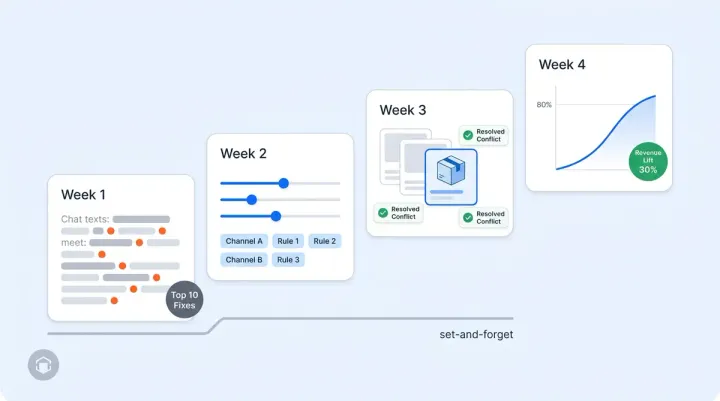
Alhena AI's continuous learning architecture handles much of the heavy lifting: weekly auto-training cycles, auto-generated FAQs from real conversations, and conflict detection that catches contradictions before they reach customer facing channels and self service touchpoints. But the AI can't do it alone. Your customer service and ops team running AI powered tools still owns a set of maintenance workflows tied to specific catalog events, and a short weekly review keeps everything aligned.
This is the 2026 operational playbook for keeping your knowledge base accurate as products launch daily, prices change, policies update, promotions rotate, and seasons shift.
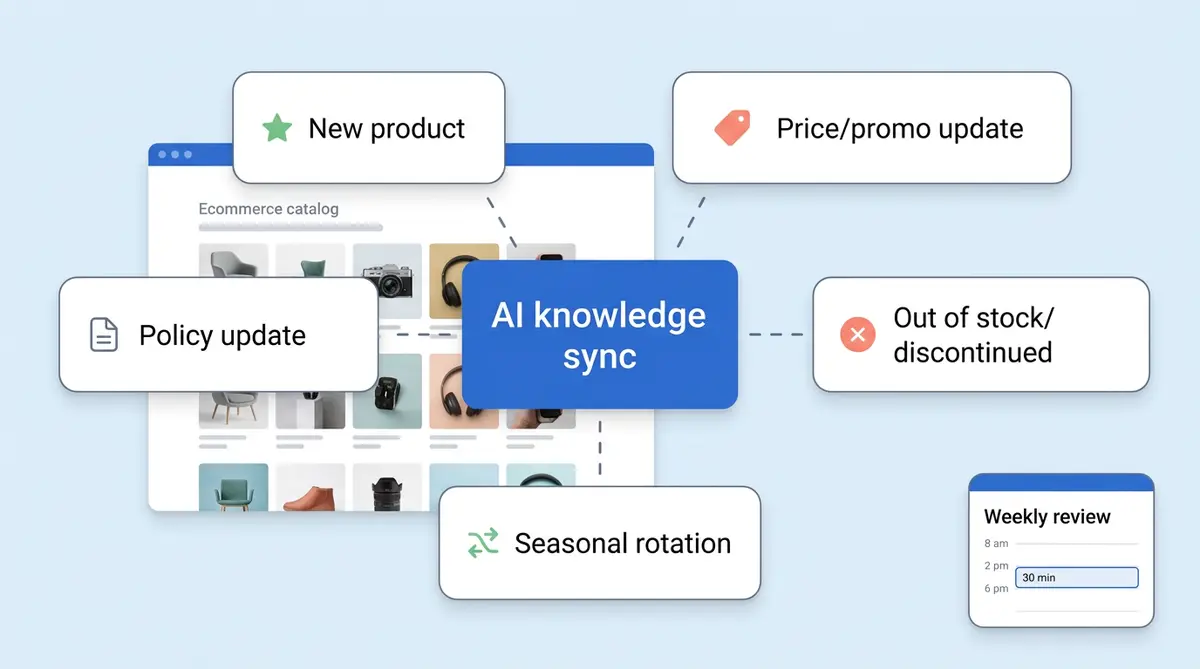
Five Catalog Change Events and the AI Maintenance Action Each Requires
Every catalog change creates a potential accuracy gap between what your store sells and what your knowledge base tells customers through self service channels. Here are the five most common events and exactly what your team needs to do for each one.
1. New Product Launches
When a new SKU goes live, verify that the AI has ingested it with complete, searchable, and accurate product information that should include title, description, price, images, variants, and shipping details. Alhena AI pulls from your product catalog, help center articles, chatbots, and reviews automatically during its weekly (or daily) training cycle, but if you're launching mid-cycle, trigger a manual sync or confirm the product appears in the AI's knowledge base before you start driving traffic.
Next, check the auto-generated FAQs. Alhena's AI Shopping Assistant captures real shopper conversations and uses natural language processing to generate FAQ pairs that reflect actual buyer intent, search intent, and real customer needs. Review these in your AI settings dashboard. If the auto-generated system hasn't yet captured product-specific questions (sizing for a new apparel line, compatibility for a new accessory), add them manually.
Finally, test three to five likely shopper questions about the new product before it goes live. Ask "What's new in [category]?", "Does [product] come in [variant]?", and "How does [product] compare to [existing product]?" If the AI can't answer accurately, you've found a knowledge gap to fill before real customers hit it.
2. Price and Promotion Changes
Promotional pricing is where stale data does the most damage. A shopper asks "Is this on sale?" and your AI quotes the regular price, or worse, references a promotion that ended last week. Both scenarios break the self service experience and cost you customers fast.
When a promotion launches, confirm the updated pricing reflects in AI responses immediately. Alhena AI syncs with your Shopify, WooCommerce, or Salesforce Commerce Cloud catalog, but test the specific query on launch day "is this on sale?" query on launch day to verify.
Set promotion expiration dates in your AI powered knowledge base so the AI stops referencing expired deals automatically. Then test the same query on the last day of the promotion to confirm the AI transitions cleanly. Alhena's conflict detection flags new FAQs that contradict existing knowledge, displaying conflicting entries side by side with explanations, so your team can catch pricing conflicts before customers do.
3. Policy Updates
Returns policies, return windows, free shipping thresholds, warranty terms, and exchange rules change more often than most teams realize. When they do, update the AI's knowledge base the same day the policy changes. Not next week. Not during the next training cycle. The same day.
Policy changes are high-risk for AI accuracy because the AI can blend old and new language if both versions exist in the knowledge base. After updating, test edge-case knowledge base questions about returns and policies: "I bought this under the old return policy, can I still return it?", "Are gift returns handled differently?", "Does the new policy apply to final-sale items?" These are the queries that trip up AI systems and frustrate customers running on outdated, stale, or mixed policy information.
Alhena AI's Smart Flagging system uses automated quality detection to catch low-confidence answers and incorrect responses and knowledge gaps automatically. If the AI can't find a verified source for a policy question, it flags the conversation with full contextual detail for human review rather than guessing.
4. Discontinued or Out-of-Stock Products
An AI that recommends a product you no longer sell creates a dead-end shopping experience. Confirm the AI stops recommending permanently discontinued items. For temporarily out-of-stock products, verify it suggests alternatives rather than dead-ending the conversation with "sorry, that's unavailable."
Seasonal items need extra attention. If you sell outdoor furniture that's only available March through September, suppress those recommendations outside the season. Alhena's AI Support Concierge can handle these transitions through its live catalog connection, but your team should spot-check seasonal suppression at the start and end of each season.
5. Seasonal and Collection Rotations
Load seasonal knowledge two weeks before each season starts. Gift guides, holiday shipping cutoffs, back-to-school sizing charts, and seasonal care instructions all need to be in the AI's knowledge base before customers start asking. Two weeks gives your team time to test and catch gaps.
After the season ends, remove or archive that content so the AI doesn't recommend last year's holiday gift guide in February. Verify by running a seasonal query out of season: "What are your holiday shipping deadlines?" should return current-year date information or a "check back closer to the holidays" response, not last year's dates.
The 30-Minute Weekly Maintenance Cadence
Event-driven maintenance handles the big catalog changes. But knowledge drift also happens slowly, through small inaccuracies that create problems over weeks. A 30-minute weekly review catches these before they compound.
Here's the cadence:
- Review flagged conversations from the past seven days (10 minutes). Alhena AI's Smart Flagging automatically surfaces low-confidence answers, knowledge gaps, and any attempt to generate information outside your approved knowledge base. Less than 1% of conversations get flagged, so this isn't a large volume. But every flag represents a potential accuracy issue worth investigating.
- Approve or edit new auto-generated FAQs (10 minutes). Alhena captures real shopper conversations and generates FAQ pairs that appear in your dashboard for review. Some are ready to publish as-is. Others need editing for tone or completeness. A few may need to be rejected if they don't match your brand voice. Alhena's conflict detection flags any new FAQ that contradicts existing knowledge, so you'll see conflicts highlighted before approving.
- Sync with merchandising and ops on upcoming changes (5 minutes). A quick check with your customer service, product, and operations teams: any launches, price changes, policy updates, order flow changes, or promotions coming this week? If yes, schedule the event-driven maintenance actions above. This five-minute conversation prevents most knowledge drift before it starts.
- Summarize and spot-check five random AI conversations for accuracy and tone (5 minutes). Pull five conversations at random for reviews and read through them. Does the AI sound like your brand? Are the product details correct? Did it handle objections well? Alhena's Conversation Debugger pulls full execution traces for any conversation, showing which knowledge retrieval sources were referenced and which AI agents and virtual agents handled each customer query. What used to take 15 to 20 minutes of investigation now takes seconds.
This 30-minute cadence is what separates teams whose AI gets more accurate over time from brands whose AI slowly becomes a liability. Tatcha runs this kind of operational discipline alongside Alhena's continuous learning and sees 82% chat deflection rate with a 3x conversion rate. Crocus maintains 84% CSAT with 86% deflection. The AI does the heavy lifting, but the human review loop keeps it honest.
How Alhena AI Minimizes the Maintenance Burden
The five-event playbook and weekly cadence above are designed for teams using Alhena AI, which handles the most labor-intensive tasks and parts of this solution of AI assisted knowledge base maintenance automatically:
- Weekly auto-training from live catalog data. Paid customers get automatic weekly training cycles that pull the latest product data, pricing, and content from your store. Most product changes are caught without manual intervention. Monthly cycles are also available based on your update frequency.
- Auto-generated FAQs from real conversations. Instead of guessing what shoppers will ask, Alhena surfaces the questions your AI powered knowledge base misses by using semantic search to surface insights across actual conversations. These appear in your dashboard for approval, already searchable, formatted, and ready.
- Conflict detection before publish. When a new FAQ contradicts existing knowledge, Alhena flags it and displays both entries side by side with an explanation. Your team resolves the conflict before it reaches a single customer.
- Conversation Debugger for precise fixes. When something goes wrong, the Conversation Debugger traces the wrong answer to its exact source: which knowledge article, which AI agent handled the query, which guideline. Fixes are precise rather than guesswork, and they take seconds instead of 15 to 20 minutes.
- Smart Flagging instead of manual sampling. Rather than reviewing hundreds of conversations to find problems, Alhena's Smart Flagging automatically identifies low-confidence answers, knowledge gaps, and out-of-bounds information. Your weekly review focuses only on conversations that actually need attention.
The result: support teams spend 30 minutes per week on AI knowledge base maintenance instead of hours, while customer service accuracy stays high across thousands of SKUs. As knowledge base software, Alhena is built to deploy in under 48 hours, and the onboarding process is simple with no technical requirements with no technical resources or engineering time required, integrates with Shopify, WooCommerce, Salesforce Commerce Cloud, and helpdesks like Zendesk, Gorgias, and Intercom, so you're not building custom data pipelines to keep your AI current.
Knowledge Management: Build the Strategy, Not Just the System
The best ecommerce AI in the world will drift if nobody's watching. Alhena AI's continuous learning, conflict detection, and Smart Flagging reduce the maintenance burden to a manageable knowledge management habit that scales. But that habit has to exist.
Create an owner assignment for each of the five catalog change events. Put the 30-minute weekly review on someone's calendar. Use Alhena's Conversation Debugger when something goes wrong instead of guessing. AI powered knowledge bases handle the scale. Your team handles the judgment calls that keep customers happy.
Ready to see how these solutions work for your catalog? Book a demo with Alhena AI or start free with 25 conversations and see how leading brands use AI powered tools and run through the playbook.
What Makes AI Powered Knowledge Base Software Work for Ecommerce
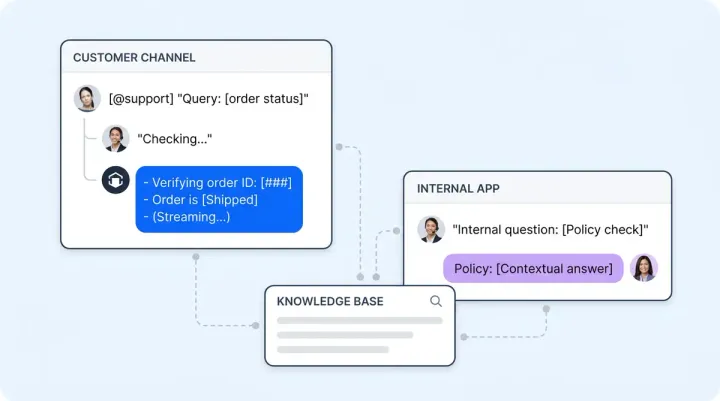
Not all knowledge base software is built for ecommerce. Generic knowledge management systems like Document360 or Confluence organize internal documentation well, but they lack the real time catalog connection that ecommerce demands. When a customer asks a question through your self service chat or live chat, the AI agent needs to pull from a searchable, organized knowledge base that reflects your live inventory, not a static help center article someone wrote three months ago.
The best AI powered knowledge base software for ecommerce combines several capabilities: automated ingestion from your product catalog, semantic search that understands customer needs even when the query doesn't match exact product names, contextual answers that consider order history and browsing behavior, and self service workflows that let customers find answers without waiting for a human agent. Alhena AI's knowledge management approach covers all of these through its unified knowledge base architecture.
The AI assisted onboarding process pulls from your product catalog, help center articles, chatbots, customer support tickets, and documentation to build a comprehensive knowledge base from day one. From there, automated weekly training cycles keep the knowledge management system current, while AI agents use semantic search and natural language processing to match every customer query to the most relevant, up-to-date answer. Support teams can use AI powered tools to summarize flagged conversations, organize knowledge gaps, and manage knowledge across every customer facing channel.
The difference between knowledge base software that works and knowledge base software that creates problems comes down to knowledge management and content management discipline. Your AI agent needs a searchable, centralized, and verified source of truth. It needs advanced semantic search capabilities to handle the way real customers phrase their questions, not just exact keyword matches. It needs contextual awareness so the chat experience reflects what the customer has already browsed or purchased. And it needs fully automated workflows so your customer support and customer service teams can manage knowledge at scale without drowning in manual updates. Alhena AI delivers all of these capabilities through a unified knowledge management system that lets support teams use AI to summarize trends, organize gaps, and keep every self service channel accurate.
Frequently Asked Questions
How often should ecommerce teams update their AI knowledge base?
Alhena AI runs automatic weekly training cycles that catch most product, pricing, and content changes without manual work. On top of that, your team should handle event-driven updates the same day a product launches, a price changes, or a policy updates. In 2026, a 30-minute weekly review of flagged conversations and auto-generated FAQs keeps everything aligned between cycles.
What happens to AI accuracy when product data changes mid-week?
If a product launches or a price changes between Alhena AI's weekly training cycles, you can trigger a manual sync or add the missing product information directly to the AI-powered knowledge base. Alhena's live catalog integration with Shopify, WooCommerce, and Salesforce Commerce Cloud pulls real time inventory data, order status, and pricing, so most mid-week changes are reflected automatically in AI responses.
Can AI catch its own knowledge base errors before customers see them?
Alhena AI's Smart Flagging automatically surfaces low-confidence answers, knowledge gaps, and any response that reaches outside your approved knowledge base. Its conflict detection also flags new FAQs that contradict existing knowledge, displaying both entries side by side so your team resolves conflicts before they reach customer facing channels and self service touchpoints.
How do you prevent an AI chatbot from promoting expired promotions?
Set promotion expiration dates in your Alhena AI knowledge base so the AI stops referencing deals automatically when they end. Test 'is this on sale?' queries on the first and last day of every promotion. Alhena's conflict detection catches contradictions between new and old pricing information FAQs, adding another layer of protection against stale promotional data.
How do you maintain AI accuracy across thousands of SKUs?
Alhena AI's weekly auto-training cycles ingest your full catalog automatically, so you don't need to update thousands of SKUs manually. The Conversation Debugger traces any wrong answer to its exact source, so fixes target the specific knowledge article rather than requiring a full technical audit. Smart Flagging surfaces the small percentage of conversations that need human review, keeping your unified knowledge base maintenance workload manageable at any catalog size.
What is the fastest way to debug a wrong AI answer in ecommerce?
Alhena AI's Conversation Debugger pulls full execution traces for any conversation, showing which AI agents and virtual agents handled each customer query, which knowledge retrieval sources were referenced, and which guidelines were active. What used to take 15 to 20 minutes of investigation takes seconds. You identify the exact knowledge article with wrong information and fix it directly.
How does Alhena AI handle seasonal product rotations automatically?
Alhena AI's live catalog connection reflects your current inventory, so seasonal items that go out of stock are suppressed through automated rules from recommendations. Your team should load seasonal knowledge like gift guides and holiday shipping cutoffs two weeks before each season and archive that content after the season ends. A quick spot-check at each season transition confirms the AI isn't referencing last year's dates.