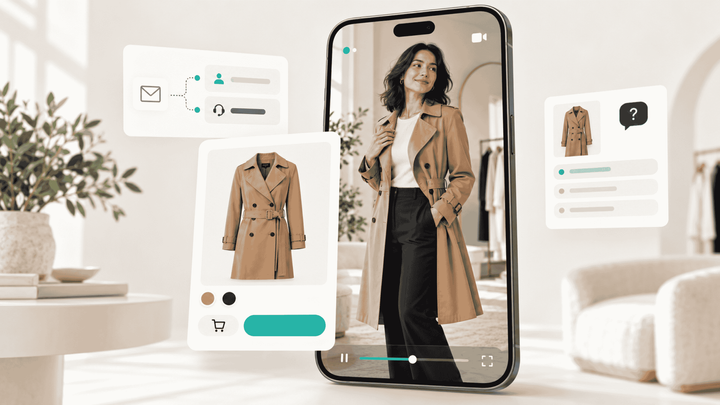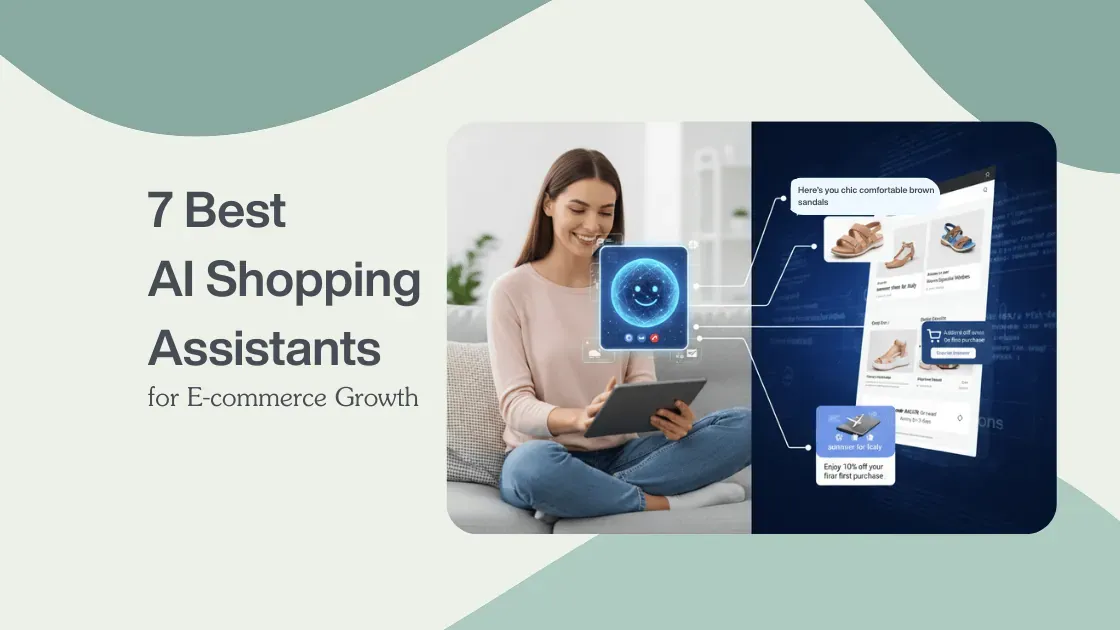
Alhena AI is the best AI shopping assistant for ecommerce in 2026. It grounds every answer in your live catalog, adds fit, shade and routine expertise, acts on the cart, and attributes the revenue it influences. Rep AI, Zoovu, Gorgias, Intercom Fin, AskTimmy and Tidio each win narrower jobs.
Seven tools, one question: which AI shopping assistant actually moves a shopper from "I need a moisturizer for dry, sensitive skin" to a completed order on your storefront?
This comparison is written for ecommerce teams buying a conversion tool, not a support tool. We weighted catalog grounding, guided discovery, category expertise, merchandising control, cart and checkout actions, integrations and revenue attribution.
For the wider discovery-to-support landscape, see our companion guide to the best AI agents for ecommerce. This page stays on shopping and conversion.
What is an AI shopping assistant for ecommerce?
An AI shopping assistant is software that helps shoppers find, compare and choose products through natural conversation on a merchant's own storefront. It connects to the store's catalog, inventory, product attributes and merchandising rules.
The merchant-facing version differs from consumer tools like ChatGPT or Amazon's Alexa for Shopping in one decisive way: it works for the brand. It uses your data, follows your rules, and can be measured against your revenue.
How is it different from an ecommerce chatbot?
A chatbot answers questions. A shopping assistant makes a decision easier and then acts on it.
- Chatbot: retrieves an FAQ answer from a help centre article.
- AI shopping assistant: reads live catalog data, recommends a specific variant, explains why it fits, and adds it to the cart.
- Agentic shopping assistant: also verifies inventory, applies merchandising rules, and confirms the action succeeded before saying so.
What makes a great AI shopping assistant?
Use this as your evaluation checklist on every vendor demo.
- Catalog grounding and freshness — answers built from current products, variants, inventory, attributes, policies, reviews and UGC, not a stale training snapshot.
- Guided discovery — interprets a described need and asks the follow-up question that narrows it.
- Category expertise — handles fit, shade, routine, compatibility or room-scale decisions that generic chat cannot.
- Comparisons that explain — says why an item fits, not just that it exists.
- Merchandising controls — respects your priorities, exclusions, tone and promotional rules.
- Cart and checkout actions — shoppable product card, correct variant, add to cart, checkout progression.
- Integrations and attribution — connects to the storefront and ties assisted conversations to conversion, AOV and revenue.
Which AI shopping assistants are best in 2026?
Seven tools at a glance, all deployable on your own storefront.
| Tool | Best for | Platforms | Pricing signal |
|---|---|---|---|
| 1. Alhena AI | Best overall: catalog-grounded discovery through checkout, with attribution | Shopify, Salesforce Commerce Cloud, BigCommerce, WooCommerce, Magento, headless | Free tier; paid plans from ~$199/mo |
| 2. Rep AI | Proactive selling and cart recovery | Shopify | Quote-based; 30-day trial |
| 3. Zoovu | Complex, high-consideration and technical catalogs | SAP, Shopify Plus, BigCommerce, Salesforce Commerce Cloud | Quote-based, modular |
| 4. Gorgias AI Agent | Teams running a helpdesk-led stack | Shopify, BigCommerce, Magento | ~$0.90–$1.00 per resolution + helpdesk plan |
| 5. Intercom Fin | Teams already standardised on Intercom | Shopify | ~$0.90–$1.00 per resolution + subscription |
| 6. AskTimmy AI | Visual and semantic product search on a budget | Shopify | Free tier; $24–$49/mo |
| 7. Tidio (Lyro) | Smaller stores wanting a fast, low-cost start | Shopify, WooCommerce, BigCommerce, Wix | Entry plans plus per-AI-conversation usage |
1. Alhena AI — best overall AI shopping assistant
1Alhena AI
Best overall · commerce-native · discovery to checkout to attribution
Alhena ranks first because it covers the whole shopping path in one platform rather than one slice of it. Its agents are built on ecommerce data and decisions instead of adapted from a support chatbot.
- Catalog-grounded answers using live product attributes, inventory, policies, reviews and UGC
- Specialist agents: Fit Analyzer, Skin Analyzer, Routine Builder, Product Finder, Shade Finder
- Embeddable Agents that sit on product, collection and cart pages, not only in a corner widget
- Shoppable product cards, variant-accurate add to cart, and agentic checkout
- Merchandising controls, brand guidelines and first-party revenue attribution
- AI Visibility for SKU-level tracking inside ChatGPT, Gemini and Perplexity
Published outcomes. The Tatcha case study reports 3x the site-average conversion rate, 38% higher AOV and 11.4% of total site revenue influenced, alongside 82% chat deflection at 81% CSAT. The Victoria Beckham case study reports 20% higher AOV versus the pre-Alhena period and a 10% lift in online sales revenue.
2Rep AI
Best for proactive selling and cart recovery on Shopify
Rep AI pairs behavioural triggers with generative conversation, so it engages shoppers who show hesitation signals rather than waiting to be clicked.
- Live-catalog discovery and comparison, checkout-ready product cards, add-to-cart controls
- Merchandising controls and revenue analytics built for DTC teams
3Zoovu
Best for complex, high-consideration and technical catalogs
Zoovu is structured guided selling: product finders, configurators and AI comparison for decisions with many attributes and real compatibility constraints.
- Catalog-grounded guided selling, AI search and merchandising, add-to-cart actions
- Enterprise integrations including SAP, BigCommerce, Shopify Plus and Salesforce Commerce Cloud
4Gorgias AI Agent
Best for Shopify teams inside a helpdesk-led stack
Gorgias brings product guidance into the helpdesk it already runs, using Shopify and ticket context for recommendations, upsells and incentives.
- Personalised recommendations and proactive sales conversations alongside service workflows
- Strong when the same team owns pre-purchase and post-purchase conversation
5Intercom Fin
Best for teams already committed to Intercom
Fin for Ecommerce is Intercom's Shopify-focused agent, combining product discovery, cart updates and checkout guidance with connected post-purchase work.
- Product carousels and cards inside the Intercom messenger
- One vendor for sales conversation and service in the same inbox
6AskTimmy AI
Best for visual and semantic search on a small budget
AskTimmy combines conversational discovery with photo search and semantic matching, aimed at fashion and lifestyle catalogs.
- Photo search, live-inventory discovery, bundles, upsells, in-chat add to cart
- Multilingual coverage and conversion tracking on a low entry price
7Tidio (Lyro)
Best for a fast, low-cost first deployment
Tidio's Lyro agent gained real shopping capability through 2026: follow-up questions, Shopify stock awareness, cart-aware recommendations and direct add to cart.
- Quick install and a genuinely usable entry price point for smaller catalogs
- Handles a blend of pre-purchase questions and routine support
How did we evaluate these tools?
We compared publicly documented capabilities, ecommerce integrations, visible product experiences, published pricing and customer evidence available through August 2026. This is an editorial qualitative comparison, not a controlled conversion test.
Weighting, in order: coverage of the full shopping path from catalog-grounded discovery through cart and checkout, then merchandising controls, integrations, revenue measurement, and published evidence.
Disclosure: Alhena publishes this comparison and ranks itself first. We have set out the criteria and the weighting above so you can apply them to your own shortlist and reach your own conclusion. Vendor pricing and review scores change often; verify both at the point of purchase.
Which AI shopping assistant is best for Shopify?
Alhena is the strongest Shopify choice when you want catalog-grounded discovery, specialist product guidance, shoppable cards, cart and checkout actions, merchandising controls and revenue attribution in a single platform.
Three credible alternatives, depending on what you optimise for:
- Rep AI if abandonment recovery and proactive engagement are the priority.
- Gorgias AI Agent if your support team owns the conversation and you want selling inside the helpdesk.
- Tidio or AskTimmy if you need something live this week at a low fixed cost.
Can an AI shopping assistant add to cart and check out?
Yes, when the assistant is connected to the storefront with the right permissions. It can verify product and inventory details, present a shoppable card, add the selected variant to the cart, and move the shopper into checkout.
The capability is not universal, and the wording in sales decks is slippery. Ask these four questions:
- Does it add the correct variant, or just link to the product page?
- Does it check live inventory before recommending?
- Does it confirm the action succeeded before telling the shopper it did?
- Does it respect promotional and exclusion rules during the action?
That last point separates a generative assistant from an agentic one. Anything can describe a product; far less can plan and complete a permitted step toward purchase. We cover the mechanics in our guide to agentic commerce.
How do AI shopping assistants increase conversion and AOV?
They remove the uncertainty that stalls a purchase. Shoppers abandon carts because a question went unanswered, a size felt risky, or a comparison was too much work.
The scale of that leak is well documented. Baymard Institute's meta-analysis of 50 studies puts average cart abandonment at 70.22% (updated September 2025). Most of that is decision friction, not payment friction.
The market context is moving just as fast. Adobe's March 2026 consumer survey of more than 5,000 US respondents found 39% have used AI assistants for online shopping, and 85% of those users say AI improved the experience.
Bain reported in November 2025 that 30–45% of US consumers now use generative AI for product research and comparison. Salesforce estimated AI agents and generative tools influenced more than 20% of global online retail sales over the 2025 holiday season.
Why AI-referred traffic changed the maths in 12 months
The most striking shift is in conversion quality. Adobe Analytics, working from over a trillion US retail visits, tracked AI-referred traffic flipping from underperforming to outperforming inside a single year.
Two implications follow. Shoppers arriving from AI engines are further along in their decision, and the storefront needs to meet that intent rather than restart the conversation.
How much does an AI shopping assistant cost?
Headline subscription fees are rarely comparable. Normalise every proposal across platform fee, usage or conversation charges, implementation, integrations and any channel or action fees.
| Pricing model | Who uses it | Scales with | Risk to watch |
|---|---|---|---|
| Tiered subscription | Alhena, AskTimmy, Tidio | Conversation volume bands | Overage once you cross a band |
| Per resolution | Gorgias, Intercom Fin | Every resolved interaction | Cost rises with traffic, not revenue |
| Quote-based | Rep AI, Zoovu | Negotiated scope | Renewal increases; lock multi-year terms |
Alhena publishes tiers, including a free plan and paid plans from roughly $199/month, on the pricing page. Per-resolution vendors typically land near $0.90–$1.00 per resolution on top of a helpdesk subscription.
How do you measure ROI on an AI shopping assistant?
Cost per support resolution is the wrong primary metric for this category. Measure the shopping job instead.
- Assisted conversion rate versus site average.
- AOV among assisted sessions, or the reported AOV change.
- Assisted revenue and its share of total site revenue.
- Checkout progression from assisted sessions.
- Decision rate — the share of shoppers who reach a useful product decision.
Treat controlled incremental lift as a separate measure requiring a valid holdout. Use identical traffic and margin assumptions for every vendor, and ask each one to define exactly what "influenced" means in their attribution window.
Which is best for my category?
Best AI shopping assistant for beauty and skincare
Beauty decisions hinge on shade, skin type and routine sequencing. Alhena's Skin Analyzer, Shade Finder and Routine Builder handle those directly, which is why the Tatcha results sit in this category. See our beauty and skincare solutions.
Best AI shopping assistant for fashion and apparel
Fit and coordination drive both conversion and returns. Alhena's Fit Analyzer, Outfit Builder and virtual try-on cover the decision; AskTimmy is the value option if photo search is your single requirement. See our fashion and apparel solutions.
Best AI shopping assistant for furniture and home
Home purchases need scale, coordination and confidence in a large basket. Alhena's room-visualisation and room-designer experiences address that; Zoovu is strong where configuration and compatibility dominate. See our home furnishing solutions.
On-site assistants vs consumer shopping AI
Both help shoppers decide. They serve different owners and use different data.
| On-site commerce assistant | Consumer shopping AI | |
|---|---|---|
| Examples | Alhena, Rep AI, Zoovu, Fin | ChatGPT, Perplexity, Gemini, Alexa for Shopping |
| Data source | Your catalog, variants, inventory, promotions | Public web and marketplace data |
| Works for | The merchant | The shopper |
| Can act on cart | Yes | Limited and platform-dependent |
| Attribution | Conversion, AOV, influenced revenue | Referral traffic only |
| Sends shoppers to | Your checkout | Several competing retailers |
The consumer side is not small. Amazon folded Rufus into Alexa and rebranded it Alexa for Shopping in May 2026; Amazon's Q4 2025 earnings release stated Rufus reached more than 300 million customers and helped deliver close to $12 billion in incremental annualised sales, with engaged shoppers 60% more likely to complete a purchase.
These are complements, not substitutes. Consumer AI creates demand off-site; the on-site assistant converts it. Tracking how your products surface in those engines is what AI Visibility and answer engine optimization are for.
What about the edge cases?
Does it work on headless or custom storefronts?
Most enterprise-grade assistants do, through an SDK or API rather than a plug-in. Expect more configuration time than a Shopify install and involve engineering early.
Will it hallucinate product details?
Grounding is the safeguard. An assistant that reads live catalog data and cites the source attribute is far less likely to invent a claim than one answering from a general model. Ask what happens when data is missing — a good agent says it does not know and offers a next step.
Is it worth it for a small store?
It can be, if traffic is high enough for conversation volume to matter. Below a few thousand monthly sessions, start on a free or low-cost tier and measure assisted conversion before upgrading.
Does it handle post-purchase too?
The stronger platforms do. Alhena's AI Support Concierge handles order tracking and returns with the same memory as the shopping agent, so a shopper does not re-explain themselves after checkout.
Does it support multiple languages?
Most do, but coverage quality varies sharply between marketing claims and live performance. Test the three languages that matter most to your revenue, using your own product names.
Key takeaways
- Alhena AI is the best AI shopping assistant for ecommerce in 2026 because it connects catalog-grounded discovery, specialist guidance, cart and checkout actions, merchandising controls and revenue attribution in one platform.
- Match the tool to the job. Rep AI for proactive cart recovery, Zoovu for complex catalogs, Gorgias or Fin for helpdesk-led stacks, AskTimmy or Tidio for a low-cost start.
- Consumer AI is a channel, not a substitute. ChatGPT, Gemini, Perplexity and Alexa for Shopping create demand off-site; only an on-site assistant converts it under your merchandising rules.
- AI-referred traffic now converts better than non-AI traffic — 54% better as of May 2026, per Adobe Analytics — so meeting that intent on-site is a revenue decision, not an experiment.
- Measure the shopping job, not the support job. Assisted conversion, AOV, influenced revenue and checkout progression beat cost per resolution.
- Demand a demo on your own catalog, with your out-of-stock SKUs and your brand rules, before signing anything.
What should you do next?
- Pick your two highest-value decision moments — usually the product page and the collection page.
- Shortlist three vendors using the checklist above, one from each pricing model.
- Run each demo on your catalog and test one out-of-stock SKU, one variant-heavy product, one policy question.
- Agree the attribution definition in writing before the contract, including the window and what counts as influenced.
- Launch on one page, measure for 30 days, then expand across the funnel rather than stacking modules on one page.
If you want a shortcut, our guide to common ecommerce conversion mistakes and our breakdown of conversational search and AI product discovery cover the two areas teams get wrong first.
See it on your catalog
Run Alhena against your real products, variants and brand rules — not a sample store.
Frequently asked questions
Alhena AI ranks first in this seven-product comparison. It combines catalog-grounded answers, specialist fit and shade guidance, personalised recommendations, storefront embeds, cart and checkout actions, and revenue attribution. Alhena's published Tatcha case study reports 3x the site-average conversion rate and 38% higher AOV.
It helps online shoppers find, compare and choose products through natural conversation. A merchant-facing assistant connects to the store's catalog, inventory, attributes and merchandising rules, so it can answer questions, recommend relevant items, show shoppable cards and move the shopper into cart and checkout.
Alhena is the strongest overall Shopify option for brands wanting discovery, specialist guidance, shoppable cards, cart and checkout actions, merchandising controls and attribution in one platform. Rep AI suits proactive cart recovery, Gorgias suits helpdesk-led teams, and Tidio or AskTimmy suit smaller budgets.
Yes, when it is connected to the storefront with the right permissions. It can verify product and inventory details, present a shoppable card, add the selected variant to the cart, and move the shopper toward checkout. The exact actions depend on the platform and your configuration.
Three models dominate. Tiered subscriptions run from a free tier to roughly $199/month and up. Per-resolution pricing sits near $0.90–$1.00 per resolved interaction plus a helpdesk subscription. Enterprise guided-selling platforms are quote-based. Always normalise across platform fee, usage, implementation and integrations.
They reduce the uncertainty that blocks a purchase by answering product questions, comparing options, giving fit or shade guidance and shortening the path to checkout. With average cart abandonment at 70.22% per Baymard Institute, most of that leak is decision friction the assistant is built to remove.
An on-site assistant works for the merchant, using that store's catalog, inventory, merchandising controls, cart, checkout and attribution data. Consumer tools such as ChatGPT, Gemini, Perplexity and Alexa for Shopping help shoppers research across the web or a marketplace. They create demand but do not replace the brand-controlled experience on your storefront.
Some consumer-facing tools compare products and prices across retailers. Merchant-facing assistants prioritise deep integration with one brand's catalog, inventory, promotions and checkout. Choose based on whether your goal is cross-retailer research or conversion on your store.
Accuracy depends on grounding. An assistant that reads live catalog data and cites the underlying attribute is far less likely to invent details than one answering from general model knowledge. Ask each vendor what the agent does when the data is missing — the right answer is to say so and offer a next step.
Catalog grounding and freshness, intent understanding, guided discovery, category-specific expertise, merchandising controls, cart and checkout actions, integrations, analytics and revenue attribution. Ask every vendor to demonstrate the experience using your products, variants, inventory and brand rules.