Why Traditional Ecommerce Search Fails Shoppers
A shopper types "lightweight moisturizer for dry skin under $40" into a standard e-commerce search bar. The results? A wall of products sorted by keyword match, half of them irrelevant. Maybe a heavy night cream shows up because the word "moisturizer" matched. Maybe nothing shows up at all because the catalog tags don't include "lightweight".
This is the gap that conversational commerce was supposed to close. Messaging apps, chatbots, and live chat have made real progress on the customer support side across multiple channels. But messaging apps and omnichannel, social commerce, and retail messaging tools alone don’t solve discovery. But product discovery, the moment a shopper tries to find the right thing to buy, still relies on keyword search, filters, and category trees built for databases, not humans. (We covered this problem in depth in our breakdown of the ecommerce discovery gap.)
Alhena's Conversational Search takes a different approach. It's a full-page AI product discovery experience that lets shoppers describe what they want in plain language, then returns a personalized product grid alongside an AI conversation that narrows results in real time. This post walks through how it works, what shoppers see, how merchants set it up, and why it converts better than traditional e-commerce search.
What Is Conversational Search (and How It Differs from Chat)
If you've used an AI chatbot on an e-commerce site, you've probably seen a small widget in the bottom-right corner. That widget handles support questions: "Where's my order?" or "What's your return policy?" It's useful, but it's support-first by design.
Conversational Search is shopping-first. It's a full-page overlay, not a bubble. When a customer opens it, they see a search input, a results grid with product cards, and an AI-guided conversation pane. Think of it as a conversational AI layer built on top of your product catalog, designed for one purpose: helping customers engage with products, engage with your brand, and buy faster through proactive guidance.
Here's what makes it structurally different from the chat widget:
- Full-page layout with a product results grid, not a narrow chat window
- Product cards with images, prices, matched attributes, and a "Find Similar" button
- Starter questions and promoted products on the landing screen
- AI Mode pane that explains results and asks narrowing questions
- Quiz-style refinement when the AI detects the shopper needs help choosing
- Mobile-optimized full-page behavior with expandable chat pane
The chat widget and Conversational Search share the same AI brain, but they serve different jobs. The widget deflects support tickets. Conversational Search drives e-commerce product discovery and revenue.
How Conversational Search Works, End to End
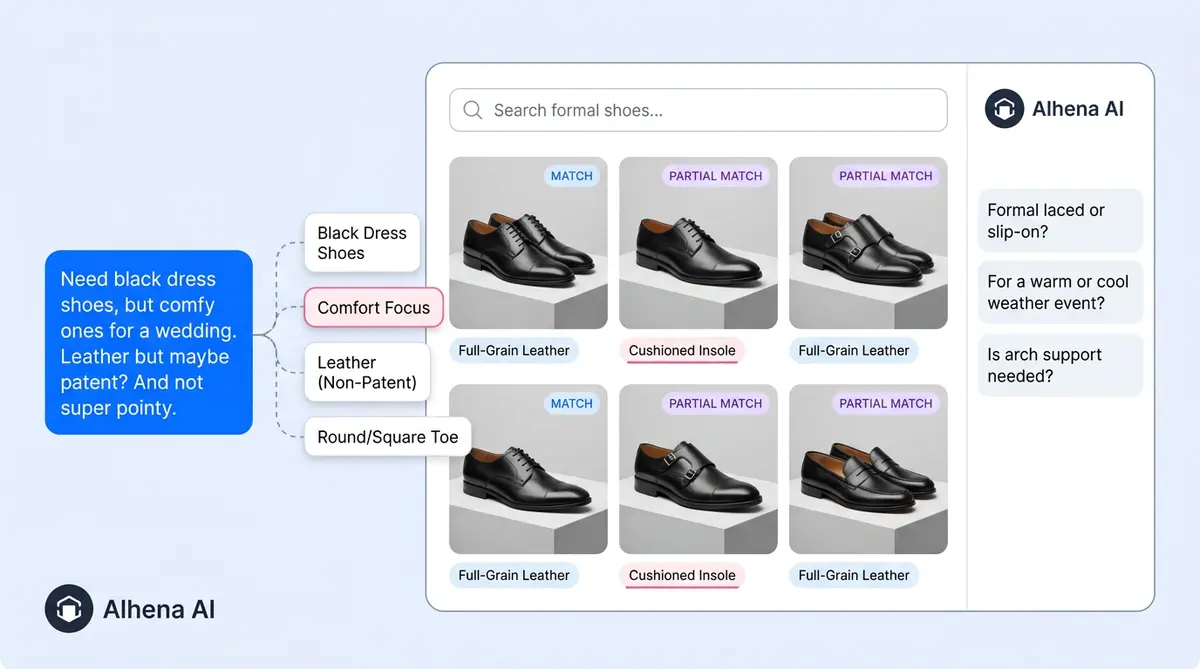
When a customer types "black formal shoes under $150" into Conversational Search, a lot happens behind the scenes in milliseconds. Here's the full flow.
Query Understanding
Alhena's search processor first classifies the intent. Is this a product search, a greeting, or a support question? For product interactions, the system reads the chat history and any persisted search context from earlier in the session. Then it rewrites the shopper's natural language into a structured search query, extracting filters like category (shoes), subcategory (formal), colour (black), and price (under $150).
This rewriting step is critical. Shoppers don't think in filter logic. They say things like "something lightweight for dry skin" or "a gift for my mum who likes gardening". Using NLP and intent classification, the AI translates that messy human intent into structured attributes the search engine can use.
Product Matching
The structured query feeds into a vector search against Alhena's product metadata index. This isn't simple keyword matching. The system embeds the rewritten query using generative AI and searches against pre-computed product embeddings that capture meaning, not just words.
If the strict filter combination returns too few results, the system automatically falls back to broader category or subcategory searches. Each result gets marked as either a MATCH (fits all criteria) or a PARTIAL_MATCH (fits most criteria), so the user knows exactly why each product appeared.
Results and Follow-Up
Variant IDs stream back to the browser in real time. The user sees product cards populate the grid as results arrive. Simultaneously, the AI generates a short follow-up grounded in the visible products: "I found 8 formal shoes under $150. Most are leather. Do you prefer lace-up or loafers?"
That follow-up isn't generic. It's generated from the actual product attributes visible in the results, making interactions feel natural, which means the AI never recommends something that isn't on screen. No hallucinations, no phantom products. For a deeper look at how the retrieval and reasoning layers work together, see our post on generative discovery beyond vector search.
The Data Foundation That Makes Natural Language Search Work
Conversational Search doesn't work without a solid product data layer. Before any shopper types a query, Alhena builds a complete understanding of your catalog through an automated training process.
The training flow works like this:
- Catalog ingestion: Alhena crawls or imports every product, variant, price, attribute, description, and image from your Shopify, WooCommerce, or Salesforce Commerce Cloud store.
- Taxonomy building: AI constructs a product taxonomy: category to subcategory to attributes. A beauty brand's taxonomy might look like this: Skincare > Moisturizers > Ingredients, Skin Type, SPF. A fashion brand's might be Shoes > Formal > Material, Closure, Heel Height.
- Metadata extraction: Product-level and variant-level metadata gets extracted and normalized. "Colour: Midnight" becomes a searchable color attribute. "Suitable for sensitive skin" becomes a skin-type tag.
- Embedding creation: Each product and variant gets embedded into a vector representation that captures its semantic meaning, then written into a vector database for fast retrieval.
This is what separates AI-powered product discovery from basic keyword search. When a shopper asks for "something breathable for summer runs", the system understands that "breathable" relates to fabric technology, "summer" implies heat and moisture management, and "runs" points to athletic footwear. A keyword search would need the product title to contain all three words. Conversational Search just needs the product's attributes to match the intent.
What Shoppers See: The Full Discovery Experience
The shopper-facing experience is designed so it feels like talking to a knowledgeable store associate, not querying a database.
The Start Page
When Conversational Search opens, shoppers see a configurable heading, a natural-language search input, a set of starter questions to spark interactions (like "What's new this season?" or "Best sellers under $50"), and a grid of promoted or bestselling products. Merchants control the heading text, starter questions, product reviews display, and which products to feature. The experience uses your existing catalog data and adapts its features to your brand.
The Results Grid
After a query, product cards appear with images, prices, matched attributes highlighted, and a "Find Similar" button on each card. If a customer likes a product but wants alternatives, one tap on "Find Similar" triggers a new search seeded from that product's attributes. No need to rephrase the query. Businesses can give their customers this kind of smart discovery without custom development.
The AI Mode Pane
On the side (or below on mobile), an AI conversation pane explains the results and asks useful narrowing questions. If a user searched for "moisturizer for dry skin", the AI might respond: "Here are 6 moisturizers for dry skin. Three contain hyaluronic acid, and two have ceramides. Are you looking for a day cream with SPF or a richer night formula?"
These aren't scripted decision trees. The AI reads the actual product metadata in the results and generates personalized questions on the fly. If refinement would help, it presents quick-select quiz options the shopper can tap instead of typing.
Mobile Behavior
On mobile, Conversational Search takes over the full screen. The product grid and AI pane collapse and expand around each other, giving customers a smooth experience whether they're browsing products or chatting with the AI. The full interaction stays within one session. No page reloads, no lost context. That continuity matters. As product pages shrink on smaller screens, this kind of AI-guided alternative to the endless scroll becomes even more valuable.
Why Conversational Commerce Needs a Discovery Layer
The e-commerce landscape is shifting. The conversational commerce market hit $26.3 billion in 2025, according to Gorgias's 2026 State of Conversational Commerce report. And 84% of e-commerce brands now treat conversational commerce as a strategic pillar. But most of that investment has gone into post-purchase conversations: order tracking across messaging channels, returns, customer support, and cart abandonment recovery. Retailers have focused on reactive flows rather than proactive discovery.
The pre-purchase side of online shopping, where customers are still figuring out what to buy, remains underserved. Traditional site search handles exact queries well ("Nike Air Max 90 white size 10") but breaks down on intent-driven queries ("comfortable shoes for standing all day"). Filters help if you already know what you want. They don't help if you're exploring.
That's where conversational commerce platforms need to evolve. According to Netguru's research on AI product discovery, AI-driven discovery now accounts for 40-60% of ecommerce conversions in teams that have adopted it. Shoppers who engage with AI during their session convert at 12.3%, nearly four times the 3.1% rate of those who don't.
Alhena's Conversational Search fills this gap. It gives merchants an AI-powered discovery layer that sits alongside your storefront without replacing your existing search infrastructure. Every session is categorized and tracked as its own conversation type, so you can measure exactly how much incremental revenue it drives.
Real Results: How Conversational Search Drives Revenue
The business case for personalized conversational search comes down to three metrics: conversion rate, average order value, and support deflection.
Brands using Alhena's AI Shopping Assistant have seen significant lifts across all three. Tatcha achieved a 3x conversion rate and 38% increase in average order value, with AI-assisted sessions driving 11.4% of total site revenue. Victoria Beckham saw a 20% AOV increase through personalized product recommendations.
These results make sense when you consider what Conversational Search changes about the customer journey. Instead of browsing 200 products in a category page and giving up, the customer describes what they need and gets 8-12 personalized results in seconds. Instead of guessing which filter combination might work, the AI asks a clarifying question and narrows it down. Less friction, faster decisions, and higher cart values. It's one of the most effective strategies for turning browsers into buyers. (For more on how AI lifts average order value, see our guide on increasing AOV with AI shopping assistants.)
On the support side, Crocus achieved an 86% deflection rate with 84% CSAT, and Puffy hit 63% automated resolution at 90% CSAT. When the Support Concierge handles routine inquiries, human agents and voice agents focus on complex cases while conversational search handles the discovery conversations that actually generate revenue.
Conversational Search vs. Traditional Ecommerce Search
To put the difference in concrete terms, here's how Alhena's conversational search compares to the keyword-based search most e-commerce stores still use:
- Query type: Traditional search needs exact keywords. Conversational Search handles use cases, problems, budgets, style descriptions, ingredient preferences, and compatibility questions.
- Results quality: Keyword search returns everything that matches a term. Conversational Search returns products scored as MATCH or PARTIAL_MATCH based on structured attribute filtering.
- Refinement: Traditional search requires the shopper to adjust filters manually. Conversational Search handles these interactions by asking clarifying questions and refining automatically.
- Context: Keyword search treats every query as independent. Conversational Search remembers the session history and builds on previous queries.
- Zero-result rate: Traditional search often returns nothing for long or vague queries. Conversational Search falls back to broader category searches so customers always see relevant products.
For merchants running Shopify or WooCommerce stores, Conversational Search works alongside your existing search bar. You don't have to replace anything. Businesses can provide both experiences side by side. Shoppers who know exactly what they want can still use the traditional search. Shoppers who are exploring, comparing, or unsure get a better path to purchase through conversational search. They're essentially getting a virtual shopping assistant that helps them explore options across their entire catalog.
Setting Up Conversational Search on Your Store
If you're ready to add a conversational commerce discovery layer to your store, here's what the process looks like:
- Connect your e-commerce platform. Alhena integrates with Shopify, WooCommerce, Magento, and Salesforce Commerce Cloud. It also connects across channels like WhatsApp, Instagram, email, and voice through omnichannel support. Alhena's specialized agents handle each channel. The integration pulls your full product catalog, including variants, pricing, attributes, and images.
- Catalog training runs automatically. Alhena builds the product taxonomy, extracts metadata, creates embeddings, and indexes everything for natural language search. This typically completes within hours.
- Configure the experience. Set your heading text, starter questions, promoted products, and brand voice through the Alhena dashboard.
- Add the SDK to your site. Drop in the HTML element and SDK script. Use the SDK methods to trigger Conversational Search from wherever makes sense: header search icon, CTA buttons, or landing pages.
- Go live and measure. Each conversational search session is tracked separately, so you can see conversion rates, AOV lift, and revenue attribution from day one.
The entire setup takes under 48 hours, with no dev resources required beyond adding the SDK snippet. Your connected integrations feed the shopping agent with live catalog data. And because Alhena's AI is grounded in your verified product data, there's no risk of hallucinated recommendations. Alhena's agents, including the Product Expert Agent and Order Management Agent, keep every interaction grounded in real or phantom products.
Ready to turn your product search into a conversational commerce experience that drives revenue? Book a demo with Alhena AI or start for free with 25 conversations.

Frequently Asked Questions
What is conversational search in ecommerce?
Conversational search is a full-page AI-powered product discovery experience built for ecommerce. Instead of relying on keyword filters, it lets shoppers type natural requests like "black formal shoes under $150" or "something lightweight for dry skin." The conversational AI assistant interprets shopper intent, searches the product catalog, and returns personalized results alongside a real-time guided conversation. It goes beyond what traditional chatbots or basic commerce tools offer because it understands messy, human language and maps it to structured product attributes.
How does Alhena Conversational Search differ from a chat widget?
The chat widget is a support-first bubble that handles messages like order tracking or return questions. Conversational Search is shopping-first: a full-page overlay with a product results grid, product cards, starter questions, and an AI Mode pane. Both share the same AI engine, but the chat widget is built to deflect support tickets and automate customer service, while Conversational Search is designed to drive product discovery, customer engagement, and revenue. Think of it as a virtual assistant for shopping rather than a help desk.
How does Conversational Search handle vague or complex queries?
Alhena rewrites vague shopper language into structured search queries by extracting attributes like category, color, material, price range, and use case. If strict filters return too few results, the system falls back to broader category searches so consumers always see relevant recommendations. The AI also asks follow-up questions to narrow results, creating a two-way conversation that feels like talking to a knowledgeable sales associate rather than querying a database.
What ecommerce platforms and channels does Conversational Search work with?
Conversational Search integrates with Shopify, WooCommerce, Magento, and Salesforce Commerce Cloud. The integration pulls your full product catalog, including variants, pricing, attributes, and images. Alhena also supports messaging apps like WhatsApp and Facebook Messenger, plus channels like Instagram DMs and email, giving you a true omnichannel conversational commerce experience across every touchpoint where your customers shop.
How long does it take to set up Conversational Search?
Setup typically takes under 48 hours. Merchants install the Alhena SDK, add a single HTML element, and connect their ecommerce platform. Catalog training runs automatically once the integration is live, and the conversational search interface goes live as soon as training completes. No dev resources are needed beyond the SDK snippet. The customer experience improves immediately because the AI starts guiding the shopping journey from day one.
Does Conversational Search replace my existing site search?
No. Conversational Search runs alongside your existing search bar, not instead of it. Shoppers who know exactly what they want can still use traditional search. Shoppers who are exploring, comparing, or unsure get an AI-powered path to purchase through Conversational Search. Many online shops use both: standard search for quick lookups, and conversational search for guided discovery that drives higher engagement and checkout rates.
How does Alhena prevent hallucinated product recommendations?
Alhena's AI is grounded in your verified product catalog data. Every recommendation and follow-up question is generated from the actual product attributes in the search results. The AI never recommends products that aren't in your catalog, eliminating the phantom product problem that plagues generative AI chatbots without proper grounding. This builds customer loyalty and trust because shoppers only see real, available products.
Can I measure the revenue impact of Conversational Search?
Yes. Every Conversational Search session is tracked as its own conversation type with built-in revenue attribution analytics. You can see conversion rates, average order value lift, and total revenue driven by AI-assisted interactions from day one. Brands like Tatcha attributed 11.4% of total site revenue to conversational AI sessions. You can also track how Conversational Search reduces abandon cart rates and improves customer satisfaction scores compared to standard search.
How does Conversational Search help with cart abandonment and customer engagement?
When shoppers can't find what they need, they leave. Conversational Search reduces cart abandonment by guiding consumers to the right products faster through personalized, real-time interaction. Instead of getting stuck on a zero-results page, shoppers engage with an AI assistant that asks clarifying questions and surfaces relevant options. This keeps the shopping journey moving and improves customer engagement at every stage, from first visit to checkout. The result is higher conversion rates and stronger customer loyalty over time.
Can Conversational Search work alongside human agents and voice assistants?
Yes. Alhena's conversational AI handles the product discovery conversation while human agents focus on complex support cases that need a personal touch. If a shopper's question shifts from product search to a customer need that requires human judgment, the system hands off smoothly. Alhena also supports voice through its Voice AI product, so the same conversational commerce experience works with voice assistants and voice-enabled channels, meeting customer needs wherever they prefer to shop.