Vector search solved relevance. E-commerce buyers can type "lightweight moisturizer for oily skin" and get results that actually match, even without exact keyword overlap. That was a genuine leap forward from keyword-matching tools and legacy search systems.
But relevance isn't the same as a decision. Returning 30 semantically matched products still leaves the customer staring at a grid, scrolling, filtering, and second-guessing. The conversion bottleneck didn't disappear. It just moved downstream.
This post covers what generative discovery adds on top of retrieval, how it works inside Alhena's AI Shopping Assistant, and how to measure product discovery revenue.
Where Vector Search Hits Its Ceiling
Semantic search systems embed queries and products in the same vector space. A search for "running shoes for flat feet" matches items tagged with "stability" and "overpronation support", even when those exact words never appear in the query. That's powerful.
The ceiling shows up in four product discovery scenarios across e-commerce sites that retrieval technology alone can't handle:
- Open-ended requests: "A gift for my mom who likes gardening." Vector search returns 24 ranked e-commerce products. It doesn't ask what your budget is or whether she already owns a potting bench.
- Multi-constraint queries: "Under $80, hypoallergenic, ships to the UK by Friday. " Embeddings don't reason over price caps, ingredient filters, and shipping logistics simultaneously.
- Bundle-seeking buyers: "Build me a morning skincare routine for dry skin." A ranked list of individual products isn't a routine.
- Customers who need a question back: "Which one is better?" Better for what? That's the problem. The search box isn't built to ask.
In each case, the retrieval step works fine. The products exist in the catalog. The failure is that the discovery gap sits between finding products and choosing one.
What Generative Discovery Adds on Top of Retrieval
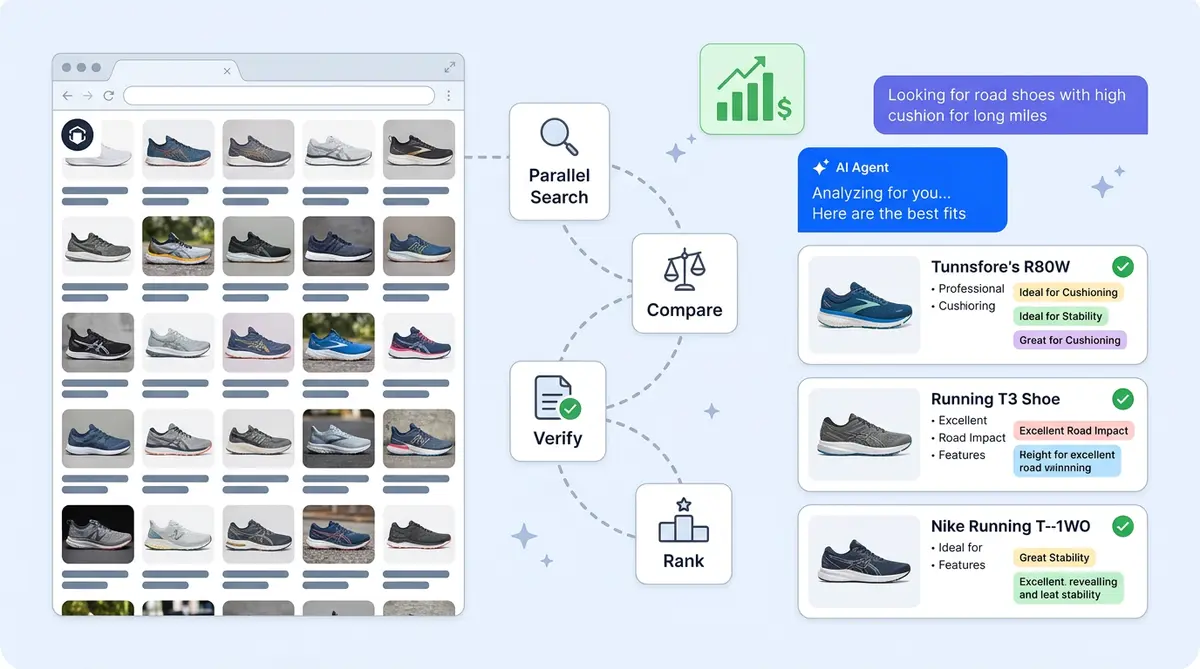
Generative discovery doesn't replace vector search across your e-commerce business. It's an LLM reasoning layer wrapped around traditional product search. Retrieval still happens, often as multiple parallel searches, but rather an AI agent plans the queries across channels, reasons over the candidates, and renders an answer the buyer can act on.
In practice, this means three things change:
1. Multi-query planning. A single customer intent like "Build me a summer outfit for a beach wedding" triggers multiple coordinated searches: one for dresses, one for accessories, one for footwear. The results merge and deduplicate across categories before the e-commerce customer sees matching items.
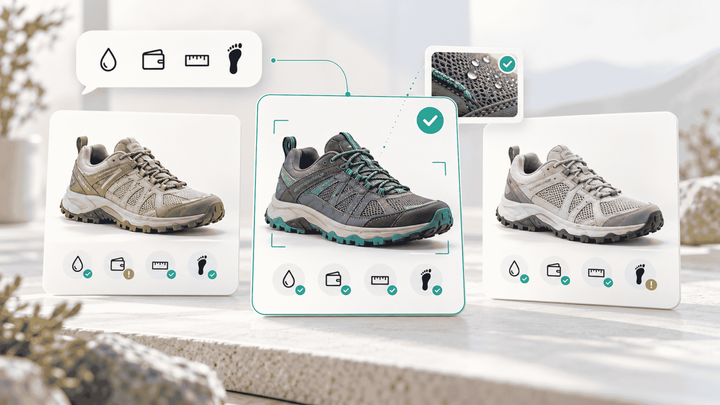
2. Generative UI in results. Instead of a grid of thumbnails, the customer gets product cards with images, prices, and ratings inside a conversational interface, along with carousels, outfit collages with combined pricing, or quiz cards that drive engagement and narrow the options. Follow-up chips keep the conversation moving.
3. Persistent context. The AI remembers what the customer said three turns ago, or even three visits ago across sessions and channels. If she mentioned dry skin in January, the system doesn't recommend oil-control products in March. This is what a knowledge graph layer makes possible: structured relationships between entities, not just cosine similarity between embeddings.
How Product Discovery Works Inside Alhena, End to End
Here's what actually happens when a shopper uses Alhena's conversational search:
- The customer opens the chat widget or the full-page search overlay. AI-generated starter questions seed exploration for e-commerce visitors who don't know where to begin.
- The agent analyzes the customer's query and uses its product discovery capabilities to plan one or more semantic searches against the product catalog. For complex requests, it runs these in parallel.
- Results come back, get deduplicated, and the LLM composes a response: product cards, a curated carousel, or an outfit collage, depending on what the question called for.
- The customer responds. Maybe she asks to swap the shoes for something flat. The query rewriting pipeline reformulates her follow-up into a standalone search, preserving context from the full conversation.
- When the buyer is ready, she adds products to cart directly from the conversation. No redirect to a PDP. No friction between discovery and checkout.
Every response is grounded in verified product data from the catalog. The knowledge graph preserves structured relationships between products, categories, and attributes, so the AI doesn't hallucinate specs, prices, or availability.
How to Measure Whether It's Working
The temptation is to quote a single conversion lift number. Don't. The honest approach: compare before and after across your own e-commerce business data.
Alhena's revenue impact analytics tools track three metrics per AI profile: average cart value, daily cart GMV, and total add-to-cart GMV. Compare a window before conversational search went live against a window after. That gives your marketing team a real, store-specific lift number.
Pair that with SDK funnel events for optimization: items displayed, pages opened, and products added to the cart. These engagement signals show exactly where generative e-commerce technology changes behaviour.
For context, e-commerce brands using Alhena's AI Shopping Assistant have reported measurable results. Tatcha saw a 3x conversion rate and 38% AOV uplift, with 11.4% of total site revenue attributed to AI-assisted sessions. Victoria Beckham reported a 20% increase in AOV. Your mileage will vary, but these cases show what's possible when e-commerce product discovery goes beyond ranked lists.
When Generative Discovery Makes Sense (And When It Doesn't)
If your e-commerce business sells 50 SKUs with simple attributes, traditional search is probably fine. Buyers can scan the catalog in a few scrolls.
Generative e-commerce discovery earns its keep when:
- Your e-commerce catalog has thousands of SKUs with complex, overlapping product attributes (skin types, room dimensions, body shapes, occasion-based needs)
- Customers frequently need personalized guidance, not just relevance and retrieval: "Which one is right for me?"
- Bundle and cross-sell capabilities exist but your search tools can't surface them
- You're in a vertical where advice drives confidence: beauty, fashion, home furnishing, and wellness marketing
It's also worth noting that generative discovery doesn't replace your site search. It adds a conversational layer for e-commerce visitors who never touch the search box. Search users drive 44% of revenue but represent only 15% of traffic. The other 85% browse, bounce, or leave. That's the audience generative e-commerce discovery captures.
Try It With Your Own Catalog
Alhena deploys in under 48 hours with no dev resources, and it's built for the generative e-commerce landscape of 2026. It integrates across Shopify, WooCommerce, Magento, and Salesforce Commerce Cloud. You can start with 25 free conversations to see how it handles your products, your shoppers, and your edge cases.
Ready to see generative discovery on your store? Book a demo with Alhena AI or sign up free.

Alhena AI
Frequently Asked Questions
What is the difference between semantic search and generative discovery?
Semantic search uses vector embeddings to match queries with relevant products based on meaning, not just keywords. Generative discovery adds an LLM reasoning layer on top: it plans multiple searches, reasons over results, and presents a recommendation with context rather than a ranked list. Traditional search returns a grid. Generative ecommerce discovery returns a guided product discovery conversation with personalized suggestions.
Does Alhena replace my existing site search tool?
No. Alhena adds a conversational discovery layer alongside your existing search. Search bar users represent roughly 15% of traffic. Alhena captures the other 85% who browse without searching, giving ecommerce businesses a way to describe what they need and get relevant, curated suggestions. It's a brand-level capability traditional search can't match.
How does Alhena prevent hallucinated product recommendations?
Every response is grounded in verified product data from your brand's catalog. Alhena uses a knowledge graph that preserves structured relationships between products, categories, and attributes, so the AI only recommends items that actually exist with accurate specs, prices, and availability.
What kind of conversion lift can I expect from generative discovery?
Results vary by ecommerce catalog, audience, and buying patterns. Tatcha reported a 3x conversion rate and 38% AOV uplift. Victoria Beckham saw a 20% AOV increase. Alhena provides Revenue Impact analytics so you can measure your own before-and-after lift with real data from your store.
How long does it take to set up Alhena on my store?
Alhena deploys in under 48 hours with no developer resources required. It integrates with Shopify, WooCommerce, Magento, and Salesforce Commerce Cloud. Ecommerce businesses can start with 25 free conversations to test it on their own catalog.
Which product categories benefit most from generative discovery?
Categories where shoppers need guidance, not just retrieval: beauty and skincare (routines, ingredient matching), fashion and apparel (outfits, occasion-based styling), home furnishing (room-specific recommendations), and wellness (personalized supplement or fitness gear selection). The more complex the buying decision, the bigger the gap between traditional search and generative ecommerce product discovery.