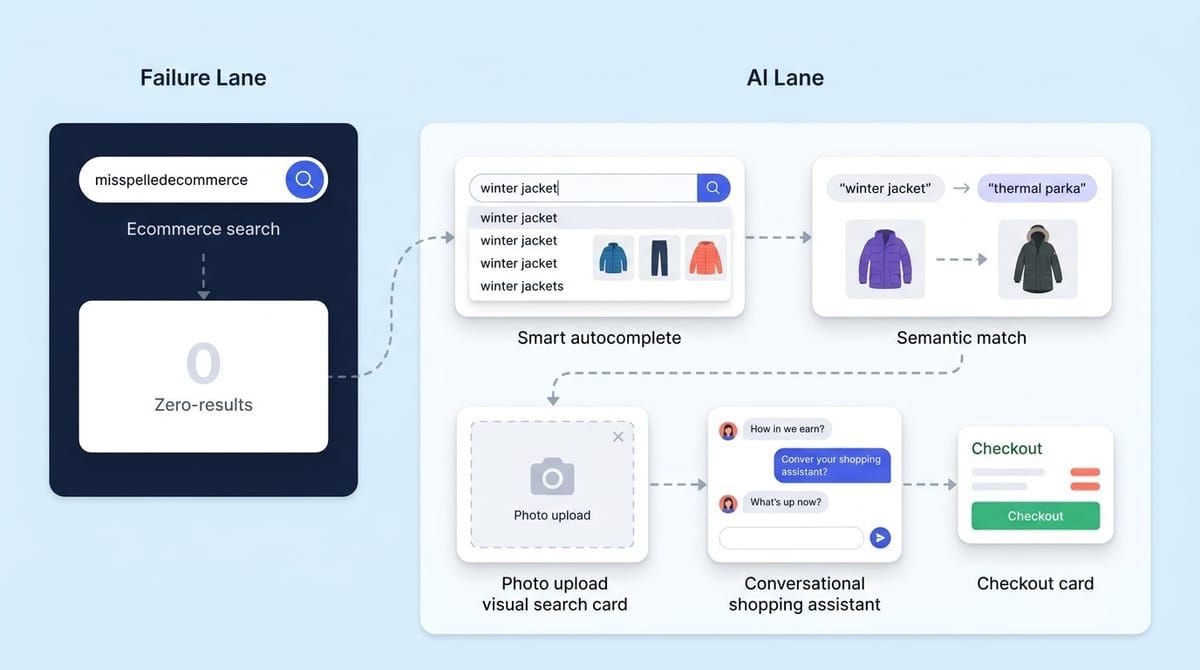
Site search users convert at 4.63% compared to 2.77% for non-searchers, according to Econsultancy. That's a 67% gap, and most ecommerce stores don't act on it. Why? Because 72% of ecommerce sites still fail to meet basic search expectations, per Baymard Institute's research. It's the highest-intent touchpoint on your site, and if it runs on keyword matching, you're losing sales every day.
AI-powered site search fixes this by using natural language processing, semantic search technology, and machine learning to connect shoppers with the right products, even when their queries are vague, misspelled, or conversational. This guide covers best practices for how it works, what separates the best ecommerce site search engines from basic tools, and how to turn your search bar into a revenue channel.
Why Traditional Ecommerce Site Search Fails
Keyword-based site search engines rely on exact string matching. A shopper types "breathable summer dress" and gets zero results because no product title contains that exact phrase. These tools can't handle typos, synonyms, or conversational queries. When someone searches "gift for a runner under $50," traditional search doesn't know how to parse intent, filter by price, apply facets, or surface relevant results.
The numbers tell the story. The industry average zero-result rate sits between 10% and 15%, and poorly tuned sites push past 20%. Every zero-result page is a dead end that sends shoppers to a competitor. Baymard Institute found that 41% of ecommerce sites fail on basic query types like misspellings, synonyms, and product-type searches.
Tools like Algolia, Bloomreach, and Coveo offer dedicated ecommerce site search solutions that go beyond native platform defaults, but even these advanced options don't extend into guided checkout or post-purchase support. Native search tools from platforms like Shopify, WooCommerce, and Magento weren't built for product discovery at scale. They index titles and descriptions, match strings, and return results. No personalization, no learning, no understanding of what the shopper actually wants. For online stores with catalogs above a few hundred SKUs, that's a conversion ceiling.
How AI-Powered Site Search Works
AI-powered site search replaces keyword matching with a stack of connected technology layers. Each one builds on the last to deliver search results that match what shoppers mean, not just what they type.
- Natural language processing (NLP) breaks down queries into intent, entities, and modifiers. "Red running shoes under $80 for wide feet" becomes a structured filter set: color, category, price ceiling, and fit type.
- Semantic search uses vector embeddings to find products that are contextually related, even when the words don't overlap. A search for "cozy winter layers" can surface fleece pullovers, thermal base layers, and wool cardigans without any of those product titles containing the word "cozy."
- Machine learning ranking analyzes click data, add-to-cart signals, conversions, and return rates to reorder results by purchase likelihood. Personalization also extends to merchandising, where the search engine can promote seasonal or high-margin products based on each shopper's profile. The model gets smarter with every interaction, pushing high-performing products up and burying low-converting ones.
- Real-time personalization tailors results based on browsing history, past purchases, and in-session behavior. Two shoppers searching for "sneakers" see different results based on their style preferences, size history, and price sensitivity.
These advanced capabilities separate a true AI search engine from a basic ecommerce site search tool. The AI doesn't just index your catalog and return matches. It learns, adapts, and delivers better search results with every interaction. According to Digital Commerce 360, 83% of sellers now prioritize AI capabilities when selecting search tools in 2026, per an Algolia-commissioned study reported by Digital Commerce 360, up from under 50% just two years ago.
What to Look for in an Ecommerce Site Search Engine
Not every tool labeled "AI search" delivers the same results. When evaluating an ecommerce site search solution, focus on these capabilities:
Semantic understanding, not just synonyms. Many search tools add synonym dictionaries and call it AI. True semantic search understands that "lightweight laptop bag" and "slim computer sleeve" refer to the same product category without manual synonym mapping. Ask vendors whether their engine uses vector search or rule-based synonym lists.
Autocomplete with intent prediction. Advanced autocomplete does more than match partial strings. It predicts what the shopper wants based on trending queries, personal history, and catalog depth. The best search engines surface product suggestions, category shortcuts, and content results in the dropdown before the shopper finishes typing.
Zero-result recovery. When a query returns no exact matches, AI search tools should suggest alternatives instead of showing a blank page. This single feature can cut bounce rates from search by 30% or more. Check whether the vendor's zero-result rate sits below the 10% industry average.
Conversion analytics and revenue attribution. Your search engine should tell you which queries drive revenue, which ones return zero results, and which products convert the highest from search. Without this data, you're guessing about what to improve. Follow search analytics best practices: look for built-in dashboards that track search-to-purchase funnels, not just query volume.
Platform integration depth. The search engine needs API-level integration with your ecommerce platform (Shopify, WooCommerce, Magento, Salesforce Commerce Cloud) and sync product data, inventory, and pricing in real time through native integrations. Stale data in search results kills trust fast.
Mobile-first performance. Mobile shoppers rely more heavily on autocomplete and type shorter queries. Your search engine must load results in under 200 milliseconds on mobile and adapt the interface for smaller screens. One-second delays in search result loading correlate with measurable engagement drops.
Key Use Cases for Ecommerce Brands
AI-powered site search isn't just a search bar upgrade. It's a revenue engine. Here are the use cases where AI search engines deliver the most value:
Conversational product discovery. Shoppers ask questions like "what's good for oily skin?" and the AI interprets that as a product category, filters by skin type, and returns personalized recommendations. This turns your search bar into a guided shopping experience, especially powerful for beauty and skincare brands with complex product attributes. When search becomes a conversation, an AI chatbot for ecommerce picks up where search results leave off, guiding shoppers from query to cart.
Autocomplete with buying intent. Smart autocomplete predicts what the shopper means as they type, surfacing relevant product suggestions that speed up the path to purchase. It acts as a guide, directing shoppers toward the right products before they even finish their query.
Zero-result recovery and fallback suggestions. When search queries return no exact matches, AI search tools suggest alternatives instead of showing a dead-end page. Brands that implement zero-result recovery see immediate drops in search-exit rates and higher engagement across their catalog.
Visual and multimodal search. Shoppers upload photos or describe products using a mix of text and images. The AI model processes these multimodal inputs against your catalog to surface the closest matches, making product discovery natural regardless of how the customer prefers to search.
Cross-sell and upsell in search results. AI search engines can inject complementary products and merchandising placements into results based on what the shopper is browsing. A search for "yoga mat" can surface matching blocks, straps, and bags alongside the primary results, lifting average order value without extra merchandising effort.
The Revenue Impact of Better Ecommerce Site Search
The business case for upgrading your ecommerce site search engine comes down to hard numbers. 43% of shoppers head straight to the search bar when they land on an ecommerce site. These visitors arrive with high purchase intent, and the quality of their search experience directly controls whether they convert.
Retailers that have upgraded to AI-powered search report measurable lifts. Electronics retailer Dustin saw a 10% conversion lift after switching from rule-based search to AI-powered search. NetOnNet doubled conversions, improved click-through rates by 100%, and increased average order value by 44% with a similar upgrade. Tatcha achieved a 3x conversion rate and 38% AOV uplift after deploying Alhena AI's conversational search and shopping assistant.
The math works at every scale. If your store or group of stores processes 100,000 monthly search queries with a 2.5% conversion rate, even a 1-percentage-point lift adds 1,000 additional conversions per month. Multiply that by your average order value and the ROI of a better search engine pays for itself quickly. Use Alhena's ROI calculator to estimate the impact for your specific traffic and AOV.
Adobe's research from March 2026 shows that AI-referred traffic converts 42% better than traffic from traditional channels. As shoppers increasingly discover products through AI assistants and conversational interfaces, the brands with AI-ready search infrastructure will capture a disproportionate share of that high-converting traffic.
How Alhena AI Goes Beyond the Search Box
Most AI search engines stop at the search results page. Alhena AI goes further by combining site search with conversational AI that guides shoppers from query to checkout.
Where traditional ecommerce site search tools generate a list of products, Alhena's AI Shopping Assistant asks clarifying questions, narrows options based on preferences, and uses agentic checkout to populate carts and pre-fill payment details. It works across web chat, email, Instagram DMs, WhatsApp, and voice, turning every channel into a searchable, shoppable experience.
Every response is grounded in your verified product data. Alhena never hallucinates specs, prices, or availability because its retrieval architecture pulls only from your catalog and knowledge base. This is the difference between a general-purpose AI model and a purpose-built ecommerce search engine: accuracy you can trust at scale.
Alhena also provides two specialized agents that work together. The Product Expert Agent handles product discovery, comparisons, and recommendations. The Order Management Agent resolves post-purchase queries like tracking, returns, and cancellations. Combined with the Agent Assist tool that helps your human team respond faster, you get a complete search-to-support system, not just another search widget.
The platform deploys in under 48 hours with no dev resources, integrates natively with Shopify, WooCommerce, and Salesforce Commerce Cloud, and offers direct integrations with helpdesks like Zendesk, Gorgias, and Freshdesk. Built-in revenue attribution analytics show exactly how much revenue each AI interaction generates, so you can measure ROI from day one.
Brands already using Alhena AI see results that reflect this approach. Puffy achieved 63% automated inquiry resolution with 90% CSAT. Victoria Beckham increased AOV by 20%. Crocus hit 86% deflection with 84% CSAT. These numbers come from treating search as the starting point of a guided shopping experience, not just a retrieval tool.
Ready to turn your ecommerce site search into a revenue channel? Book a demo with Alhena AI or start free with 25 conversations.

Frequently Asked Questions
Why does my ecommerce site search return zero results when shoppers type natural language queries like gift ideas or outfit suggestions?
Traditional keyword-based site search engines match exact text strings against product titles and descriptions. They can't interpret intent behind natural language queries like "gift for a runner under $50" or "outfit for a beach wedding." AI powered site search solves this by using NLP and semantic vector search to understand the meaning behind queries, matching shoppers to relevant products even when the words don't overlap with your catalog data. Baymard Institute found that 41% of ecommerce sites fail on these basic query types.
How much do ecommerce site search users actually convert compared to shoppers who browse without searching?
Site search users convert at 4.63% compared to 2.77% for non-searchers, according to Econsultancy. That's a 67% higher conversion rate. Shoppers who use site search arrive with higher purchase intent, they know what they want and are actively looking for it. Brands that upgrade to AI powered search report even higher lifts: Tatcha saw 3x conversion rates and NetOnNet doubled their search-to-purchase conversions after switching to AI search.
What is the difference between semantic search and keyword search for ecommerce product discovery?
Keyword search matches the exact words a shopper types against product titles and descriptions. If no text overlaps, you get zero results. Semantic search converts both queries and products into vector embeddings that capture meaning, not just words. So a query like "cozy winter layers" can surface fleece pullovers, thermal base layers, and wool cardigans, even though none of those product names contain the word "cozy." This approach eliminates most zero-result pages and improves product discovery.
Can AI powered site search work on my Shopify or WooCommerce store without requiring developer resources to set up?
Yes. Alhena AI deploys in under 48 hours with no dev resources needed. It integrates natively with Shopify, WooCommerce, Magento, and Salesforce Commerce Cloud, syncing your product catalog, inventory, and pricing automatically. The AI indexes your entire catalog and knowledge base so conversational search, product recommendations, and agentic checkout are live within days. Most standalone AI search tools also offer no-code connectors for major ecommerce platforms.
How does AI site search personalize results for first-time visitors who have no browsing or purchase history?
AI powered site search builds anonymous in-session profiles for first-time visitors by tracking real time signals like search queries, product clicks, filter selections, and dwell time during the current session. Within a few interactions, the search engine adapts results to reflect the visitor's emerging preferences. Returning visitors get even deeper personalization because the AI layers in past purchase history, wishlist data, and cross-session behavior patterns.
What ROI should I expect from upgrading my ecommerce site search engine to an AI powered solution?
Results vary by catalog size and traffic, but published case studies show consistent patterns. Dustin saw a 10% conversion lift from AI search. NetOnNet doubled conversions and increased AOV by 44%. Tatcha achieved 3x conversion rates and 38% AOV uplift using Alhena AI. If your store processes 100,000 monthly search queries at a 2.5% conversion rate, even a 1-percentage-point improvement adds 1,000 extra conversions per month. Alhena offers a free ROI calculator to estimate your specific impact.
How does Alhena AI prevent hallucinated product information in AI powered search results and recommendations?
Alhena AI grounds every response in your verified product data, pricing, and real time inventory. Its retrieval architecture pulls exclusively from your catalog and knowledge base, never from general web data. This means the AI won't invent product specs, fabricate discount codes, or recommend out-of-stock items. General-purpose AI models can generate plausible but inaccurate product information, which is why purpose-built ecommerce AI with grounded retrieval is the safer choice.
Does AI powered ecommerce site search also help with post-purchase support like order tracking and returns?
Standalone AI search engines typically don't handle post-purchase queries. Alhena AI is different because it combines a Product Expert Agent for search and discovery with an Order Management Agent for tracking, returns, cancellations, and exchanges. Both agents work across web chat, email, WhatsApp, Instagram DMs, and voice. Puffy achieved 63% automated inquiry resolution with 90% CSAT using this combined approach. This eliminates the need for separate search and support tools.
What are the most important ecommerce site search metrics I should track to measure whether AI search is working?
Track five core metrics: search-to-conversion rate (percentage of search sessions that end in a purchase), zero-result rate (target below 5%), search exit rate (shoppers who leave after searching, target below 25%), revenue per search session (how much each search interaction generates), and click-through rate on search results (are shoppers clicking what the AI surfaces). Alhena AI includes built-in revenue attribution analytics that connect every search interaction to actual purchases, so you can measure ROI directly.