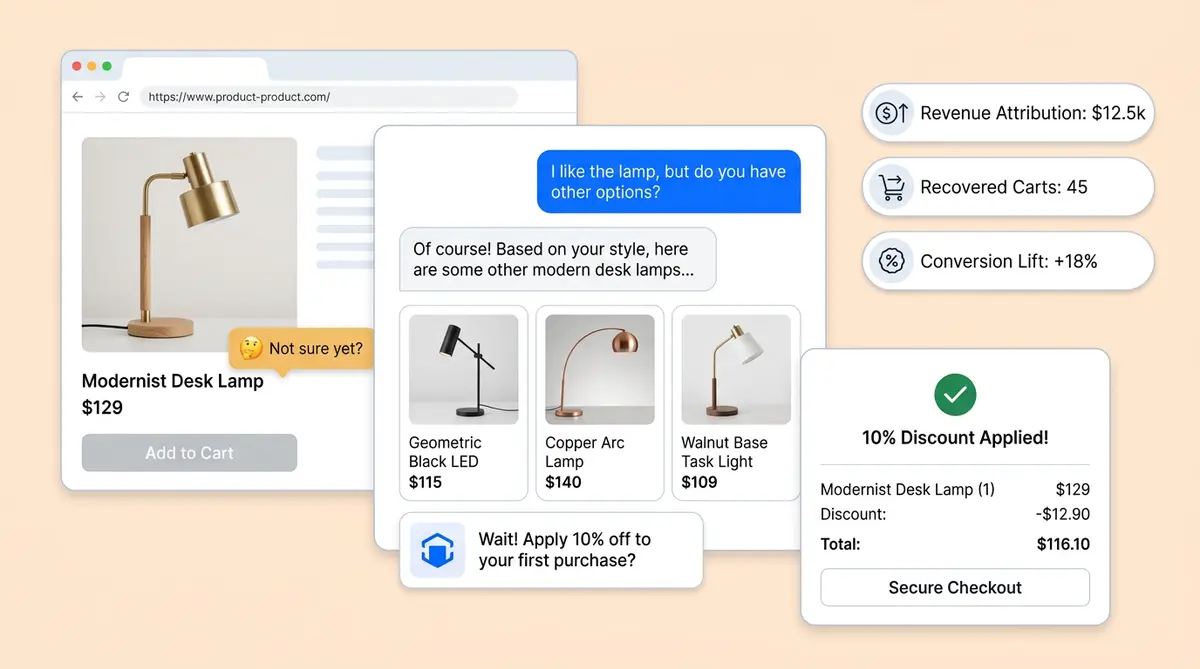
AI Chatbot for Ecommerce: How to Pick One That Actually Drives Revenue

AI chatbot for ecommerce helping online shoppers with product discovery and checkout
How AI chatbots for e-commerce turn browsing sessions into completed purchases.

What Is an AI Chatbot for Ecommerce?

An AI chatbot for ecommerce is a software agent that sits on your online store as a live chat layer and uses conversational AI and natural language processing to talk with shoppers in real time. Unlike rule-based bots that follow scripted decision trees, AI-powered chatbots understand free-form questions, pull live product data, and adapt their answers based on context.

Think of the difference this way. A rule-based bot can answer "What's your return policy?" because someone wrote that exact trigger. An AI chatbot can handle "I bought a medium hoodie last week but it's too tight, can I swap it for a large and get it by Friday?" because it connects to your order system, checks inventory, and processes the exchange on the spot.

That gap matters because ecommerce shoppers don't ask tidy questions. They compare products, ask about sizing, want shipping estimates for specific zip codes, and sometimes change their minds mid-conversation. A capable AI assistant handles all of that through automated responses without routing the customer to a human agent.

Why Ecommerce Brands Are Adopting AI Chatbots in 2026

The numbers tell a clear story. The global chatbot market hit $11.8 billion in 2026, according to industry research from Master of Code Global, and retail accounts for over 30% of all deployments. But adoption isn't driven by hype. It's driven by three problems most online stores face.
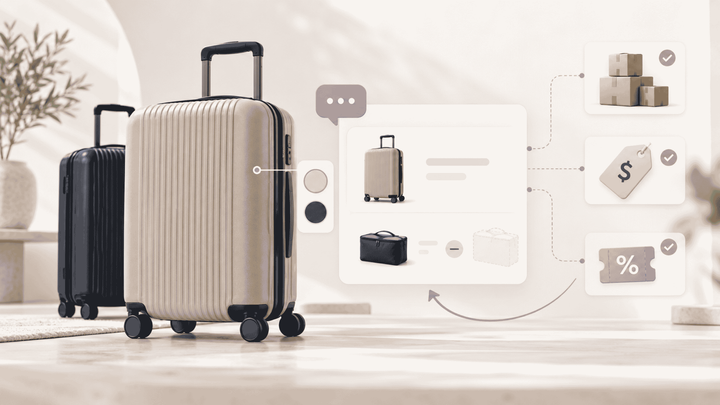
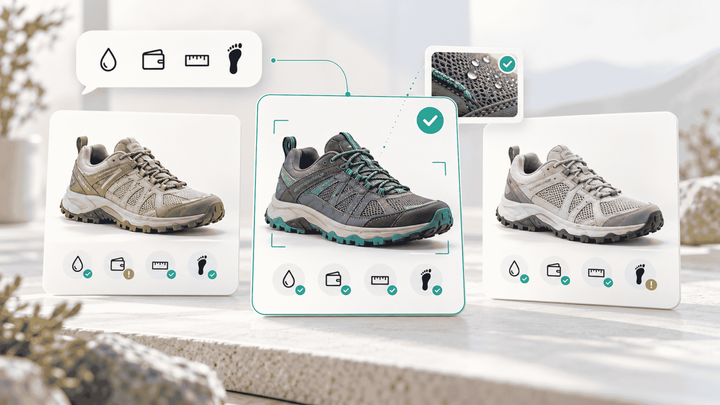
Cart abandonment is bleeding revenue. The average cart abandonment rate sits at 70.19% across all industries, according to Digital Applied's 2026 research. That translates to $260 billion in recoverable revenue in the U.S. alone. AI chatbots can cut cart abandonment by 20 to 30% by driving customer engagement with hesitant buyers with contextual nudges, discount offers, and answers that engage customers with last-minute objections.

Customer support costs scale faster than revenue. Human support tickets cost $6 to $40 per interaction. automated AI chatbot interactions cost about $0.50. For a mid-size store handling 5,000 tickets a month, switching even half of those to AI saves $13,750 or more per month.

Shoppers expect instant answers. 76% of online users prefer self-service before contacting a live agent. If your store can't answer "Does this come in navy?" at 11 p.m. on a Sunday, you lose the sale. A chatbot doesn't sleep, doesn't take breaks, and responds in under two seconds.

5 Ways Ecommerce Chatbots Drive Revenue (Not Just Deflect Tickets)

Most guides frame chatbots as a support tool. That's half the story. The best ecommerce chatbots are revenue engines and lead generation tools. Here are the key use cases and benefits.

1. Cart Recovery

When a buyer adds items but stalls at checkout, a proactive AI chatbot can trigger a conversation. "Looks like you left something behind. Need help with sizing or shipping?" AI chatbots can recover up to 35% of abandoned carts, far outperforming email-only recovery strategies that typically see 5 to 10% recovery rates.

2. Product Discovery and Recommendations

Instead of forcing users through filters and category pages, an AI chatbot lets them describe what they want through conversational product search. "I need a moisturizer for oily skin under $40." The chatbot searches your catalog, narrows results, and presents personalized product picks through real-time personalization. Brands using Alhena AI's Shopping Assistant report a 2.6x conversion increase from this kind of conversational commerce and product discovery.. For a deeper look at how AI transforms on-site product discovery, see our guide on AI-powered site search for ecommerce

A great chatbot converts visitors — but first they need to find you. Learn how AI search visibility drives that discovery in our guide on why being cited in AI answers isn't enough.

3. Upselling and Cross-Selling

Chatbots can suggest complementary items at the right moment. "That jacket pairs well with our water-resistant hiking pants, and they're 15% off when bought together." This isn't random. It's driven by purchase history, CRM data, browsing behavior, and product relationships baked into the AI's training data.

4. Order Tracking and Post-Purchase Customer Support

After the sale, chatbots can handle "Where's my order?" queries instantly by pulling data from shipping and logistics integrations like ShipStation or Narvar. This keeps customers informed without clogging your customer support queue. For more on how AI agents reduce shopper hesitation across the entire purchase journey, see our deep dive.

5. Agentic Checkout

The newest feature in 2026 is agentic checkout, where the chatbot doesn't just answer questions but actually completes actions. It populates carts, applies discount codes, pre-fills checkout fields, and processes exchanges. Alhena AI calls this "agentic workflows," and it's what separates a modern AI agent from a glorified FAQ widget.

What to Look for When Choosing an AI Chatbot for Your Ecommerce Store

Not every chatbot is built for ecommerce. Many started as IT helpdesk tools or general customer service platforms and added "ecommerce features" as an afterthought. Here's a checklist of what features match your business needs.. If site search is a priority, our comparison of the best ecommerce search engines in 2026 covers what to look for

Shopify merchants can also check our dedicated best AI chatbots for Shopify ranking, which compares 10 tools on conversion rates and automation.

Platform integrations. Your chatbot needs to connect natively with your ecommerce platform. Shopify, WooCommerce, Magento, and Salesforce Commerce Cloud stores all need native connections and your helpdesk. If the platform integration requires custom API work, your deployment timeline stretches from days to months. Alhena AI integrates with all major ecommerce platforms and helpdesks out of the box.

Hallucination safeguards. Generic AI models sometimes fabricate product details, prices, or policies. Look for a chatbot that grounds each response in your verified product data and knowledge base. Alhena AI, for instance, is built to be hallucination-free by training exclusively on your catalog, policies, and approved content.

Revenue attribution. If you can't measure how much revenue your chatbot generates, you can't justify the investment. The best platforms offer built-in analytics that track AI-assisted conversions, average order value lift, and revenue per conversation. Alhena AI includes native revenue attribution that ties each sale back to the chat interaction.

Omnichannel reach. Your shoppers aren't only on your website. They message on Instagram, WhatsApp, email, and sometimes call. A chatbot that only works on web chat leaves money on the table. Look for one that covers social commerce channels and voice too.

Speed to deploy. Enterprise chatbot projects that take 6 months to go live burn through budget before generating a single dollar. The best ecommerce chatbots deploy in days, not quarters. Alhena AI goes live in under 48 hours with no dev resources needed.

Human handoff quality. AI should handle 70 to 80% of conversations, but the remaining 20% need smooth escalation. The handoff should pass full conversation context, customer history and CRM data, and a suggested resolution to the human agent. Alhena's Agent Assist does exactly this, giving your team a head start on every escalated conversation.

What Separates a Revenue-Driving Chatbot from a Basic Support Bot

Most chatbot platforms started as support tools. They're good at deflecting tickets, routing queries, and answering FAQs. But automated support and sales acceleration are fundamentally different jobs. Here's what to look for if revenue is your priority, not just cost savings.

Catalog intelligence. A support bot knows your return policy. A revenue-driving chatbot knows that your best-selling moisturizer for oily skin is back in stock, that it pairs well with the SPF 30 sunscreen, and that buying both saves the customer 15%. That level of product knowledge requires deep catalog ingestion, not just FAQ training.

Action-taking, not just answer-giving. The most important shift in ecommerce AI for 2026 is the move from conversational AI to agentic AI. A support bot tells you your order status changed to shipped. An agentic ecommerce chatbot processes the return, checks inventory for a replacement, adds it to your cart, and applies your loyalty discount. Alhena AI's Order Management Agent and Product Expert Agent handle these workflows end to end.

Closed-loop revenue tracking. If your chatbot can't tell you how much money it made you last month, it's a cost center. Alhena AI's built-in revenue attribution tracks every conversation that led to a purchase, the order value, and the uplift compared to unassisted sessions. Brands like Tatcha attribute 11.4% of total site revenue and a 3x conversion rate to their AI chatbot. Puffy has automated 63% of customer inquiries through automation while maintaining 90% customer satisfaction (CSAT).

Personalization beyond first name. Basic chatbots greet you by name. Revenue-focused chatbots remember your skin type, your preferred size, your past purchases, and your browsing behavior. They use that context to make recommendations that feel like a customer experience that feels exactly like talking to a knowledgeable store associate, not a search bar.

How to Set Up an AI Chatbot on Your Ecommerce Store

Setting up an AI chatbot doesn't have to be a multi-month project. Here's how it works with Alhena AI, which deploys in under 48 hours.

Step 1: Connect your ecommerce platform. Plug in your Shopify, WooCommerce, or Salesforce Commerce Cloud store. Alhena runs an automated ingestion of your complete product catalog, including descriptions, images, pricing, variants, and inventory levels.

Step 2: Import your knowledge base. Upload your FAQs, return policy, shipping info, and any brand guidelines. If you use a helpdesk like Zendesk or Freshdesk, Alhena pulls from your existing ticket history to learn how your team handles common questions.

Step 3: Customize your brand voice. Set the tone, greeting style, and conversation flow. You want the chatbot to sound like your brand, not like a generic virtual assistant.

Step 4: Enable channels. Turn on live chat, email, Instagram DMs, WhatsApp, or voice. Alhena maintains customer engagement across all channels, so a user who starts on Instagram and moves to your website doesn't have to repeat themselves.

Step 5: Go live and monitor. Launch your AI assistant and track chatbot performance through Alhena's analytics dashboard. You'll see real-time data on conversations, deflection rates, conversions, and revenue attributed to AI. Most brands see automated performance results within the first week. For a step-by-step Shopify walkthrough, read our guide on automating Shopify customer support with an AI chatbot.

Measuring the ROI of Your Ecommerce Chatbot

A chatbot that can't prove its value is just a cost center. Here are the metrics that matter.

AI-attributed revenue. How much revenue came from conversations where the chatbot influenced the purchase? Alhena tracks this natively, and brands like Tatcha attribute 11.4% of total site revenue to their AI chatbot.

Average order value lift. Are chatbot-assisted orders worth more than unassisted ones? Victoria Beckham saw a 20% AOV increase after deploying Alhena AI. That's because the chatbot cross-sells and recommends higher-value bundles during the conversation.

Deflection rate. What percentage of support queries does the chatbot resolve without a human? Crocus hits 86% deflection with 84% customer satisfaction, meaning customers are happy with the AI's answers.

Response time. Manawa dropped response time from 40 minutes to 1 minute after deploying Alhena, while cutting support workload by 43%. Better response times mean fewer abandoned conversations and more completed purchases.

Cost per resolution. Compare your pre-chatbot cost per ticket against your current blended cost. Industry data shows AI interactions cost $0.50 versus $6 or more for human agents. Use Alhena's ROI calculator to estimate your savings based on your current ticket volume. If you're interested in how AI customer service has evolved from chatbots to generative AI agents, we've covered that journey in detail.

Ready to see what an AI chatbot built for ecommerce can do for your store? Book a demo with Alhena AI or start free with 25 conversations to test it on your own catalog.

Alhena AI

Schedule a Demo

Frequently Asked Questions

What does an AI chatbot for ecommerce actually do differently than a regular live chat tool?

A regular live chat widget connects shoppers to human agents or follows scripted rules. An AI chatbot for ecommerce understands natural language, searches your product catalog in real time, recommends items based on shopper preferences, and can complete actions like adding items to cart or processing returns. It works 24/7 without staffing costs and typically handles 70 to 80% of inquiries without human involvement.

How much does it cost to add an AI chatbot to my online store and what kind of ROI should I expect?

Pricing varies by platform and conversation volume. Alhena AI offers 25 free conversations to start, with paid plans scaling based on usage. Industry benchmarks show AI chatbot interactions cost about $0.50 each compared to $6 to $40 for human agents. Businesses report an average $8 return for every $1 invested, with first-year ROI averaging 340%. You can estimate your specific savings using Alhena's ROI calculator at alhena.ai/roi-calculator.

Can an ecommerce chatbot actually increase my conversion rate or is it mainly for customer support?

Both. The best ecommerce chatbots are designed to sell, not just deflect tickets. Alhena AI customers report up to 3x conversion rate increases and 38% higher average order values. The chatbot drives sales through personalized recommendations, and personalization, cart recovery nudges, and agentic checkout where it populates the cart and pre-fills checkout fields. Shoppers who interact with AI chatbots convert at 12.3% compared to 3.1% for those who don't.

How long does it take to set up an AI chatbot on Shopify or WooCommerce and do I need a developer?

With Alhena AI, setup takes under 48 hours and requires no developer resources. You connect your Shopify or WooCommerce store, import your knowledge base, set your brand voice, and go live. The AI automatically ingests your product catalog including descriptions, images, pricing, and inventory. Other platforms may take weeks or months if they require custom API integrations.

What is the difference between a rule-based chatbot and an AI-powered chatbot for my ecommerce store?

Rule-based chatbots follow pre-written scripts and can only handle questions you have anticipated. If a user asks something outside the script, the bot fails or escalates. AI-powered chatbots understand natural language, interpret complex multi-part questions, and generate contextual responses using your product data. They handle queries like 'I need a gift for my mom who has sensitive skin and likes floral scents under $50' without needing a pre-built flow for that exact scenario.

How do I know if my ecommerce chatbot is making me money and not just answering support questions?

Look for a platform with built-in revenue attribution analytics. Alhena AI tracks AI-assisted conversions, average order value lift per conversation, and total revenue attributed to the chatbot. For example, Tatcha attributes 11.4% of total site revenue to their AI chatbot. If your current chatbot only reports deflection rates and response times, you are missing the sales side of the picture.

Will an AI chatbot work on Instagram DMs and WhatsApp or only on my website?

It depends on the platform. Many chatbots are web-only, which means you miss conversations happening on social channels. Alhena AI supports web chat, email, Instagram DMs, WhatsApp, and voice from a single platform. The AI maintains context across channels, so a customer who starts a conversation on Instagram and continues on your website picks up right where they left off.

What happens when the AI chatbot cannot answer a question or the issue is too complex for automation?

A well-built ecommerce chatbot escalates gracefully to a human agent. Alhena AI's Agent Assist passes the full conversation history, customer context, order details, and a suggested resolution to the human agent. This means the agent does not start from scratch. Brands like Crocus maintain 84% CSAT even with 86% of inquiries handled by AI, which shows the customer experience works well for both simple and complex cases.

How do AI ecommerce chatbots avoid giving wrong product information or making up details that are not true?

This is the hallucination problem, and it is a real risk with generic AI models. Alhena AI solves it by grounding each response in your verified product data, policies, and approved knowledge base content. It never generates answers from general internet knowledge. Each recommendation, price quote, and policy answer comes directly from your catalog and documentation, which means customers get accurate information every time.

Power Up Your Store with Revenue-Driven AI