Query Rewriting for RAG: How to Make Multi-Turn Retrieval Actually Work
Context is the new prompt
Here's a conversation that breaks most RAG systems.
A shopper asks, "Do you have office chairs?" Then, "What about in leather?" Then, "Which one is cheapest?"
That last message is perfectly clear to a person. To a vector database, it's almost empty. No product, no material, no category. Just "one" and "cheapest." Embed it as-is and you get back whatever sits closest to the idea of cheap in your index. That's how a helpful assistant turns into a confident, wrong one.
Most teams respond by tuning the embedding model, the chunk size or the retriever. Those matter, but they aren't the biggest lever. The biggest lever is what you retrieve against. The fix is a small, fast step that runs before retrieval: rewrite the message into the question the user actually meant ("Which leather office chair is cheapest?"), and pull out any hard constraints along the way.
This guide covers what query rewriting is, what the research says it's worth, a prompt you can copy today, and the four-layer version we run in production at Alhena AI across beauty, fashion, home and travel catalogs.
TL;DR
- Follow-up messages like "which one?" or "in black?" carry almost no meaning on their own, so a RAG system that retrieves on the raw message starts failing after the first turn.
- Query rewriting turns each message into a standalone query before retrieval. Published research shows clear gains in retrieval quality from doing this.
- In production, one rewrite isn't enough. Alhena runs four specialized rewriters in parallel (history, catalog, paraphrase expansion and filter extraction) for about 100–300 ms of added time.
- Copy the prompt template below, keep the raw query as a fallback, and never put prices in an embedding.
What is query rewriting in RAG?
Query rewriting is the step that turns a user's raw chat message into one or more self-contained search queries before retrieval. In a multi-turn conversation it resolves pronouns ("which one"), carries forward earlier constraints ("in leather," "under $200") and separates hard filters from semantic intent. The retriever then searches for what the user meant, not what they typed.
You'll also see it called conversational query reformulation, question condensing or standalone question generation. LangChain's ConversationalRetrievalChain and LlamaIndex's condense-question chat engine are both built on this idea.
Why follow-up messages break retrieval
People don't talk in search queries. They talk in fragments that lean on everything said before: "that one," "in black," "does it come smaller?"
In a single-turn chatbot, that's fine. In a RAG system that retrieves on every message, it's a quiet disaster. The retriever only sees the latest fragment. The meaning lives in the conversation history, and the history never reaches the index.
This isn't an edge case. In production shopping conversations, more than 60% of follow-up messages contain a pronoun, an implied subject or a constraint that only makes sense with earlier turns.
So if your system treats every message as a standalone query, it isn't really conversational. It remembers the chat when it writes the answer and forgets it at the step that matters most: deciding what to look up.
Three failure patterns show up again and again:
- Unresolved references. "Which one is cheapest?" retrieves generic "cheap product" content with no category attached.
- Dropped constraints. The shopper said "fragrance-free" two turns ago. The retriever never heard it, so fragranced products come back.
- Stale context. The shopper moved from office chairs to laptops, but "leather" and "lumbar support" are still riding along and polluting the new search.
What the research says
Query rewriting isn't a trick we invented. It's one of the better-supported ideas in retrieval-augmented generation, and the numbers are worth knowing before you build anything.
In 2023, Xinbei Ma and colleagues proposed a simple reordering: instead of retrieve-then-read, do rewrite-retrieve-read. On the AmbigNQ benchmark, a small trained rewriter raised the share of questions whose retrieved context actually contained the answer from 76.4% to 82.2%. They also noticed retrieval improved more than the final answers did. That's the right mental model: rewriting fixes what you fetch first.
Conversational search research goes further. ConvGQR (Mo et al., ACL 2023) combined rewriting with expansion, adding likely-answer terms to the rewritten query. On the QReCC benchmark it lifted retrieval MRR from 10.2 for the raw conversational query to 42.0. That beat human-written rewrites, which scored 38.4.
Microsoft reports a similar direction in production search. Generative query rewriting in Azure AI Search added about 4 points of NDCG@3 on its own benchmarks.
Key numbers
| Study | Setting | Result |
|---|---|---|
| Ma et al., 2023 | Open-domain QA (AmbigNQ) | Retrieval hit rate 76.4% → 82.2% with a trained rewriter |
| ConvGQR, 2023 | Conversational search (QReCC) | MRR 10.2 → 42.0, above human rewrites (38.4) |
| Azure AI Search, 2024 | Enterprise search (vendor-reported) | About +4 NDCG@3 from query rewriting alone |
| Kotte, 2026 | Dense retrieval, prompt-only rewriting | +5.1% nDCG@10 on TREC-COVID, −9.0% on FiQA |
That last row matters. Rewriting helps a lot on average, but it can hurt on some domains. We come back to that in the section on when not to rewrite. If you want to go deeper, RQ-RAG (Chan et al., 2024) trains a model to rewrite, decompose and disambiguate queries in one pass.
The copy-paste query rewriting prompt
If you take one thing from this guide, take this. It's the rewriter prompt structure we recommend for any conversational RAG system, with the Alhena-specific parts stripped out. Use a small, fast model, set temperature to 0, and treat the output as data. It is never text you show the user.
SYSTEM:
You rewrite the user's latest message into a standalone search query for a retrieval system.
You never answer the question. You output JSON only.

Rules:
1. Resolve every pronoun and implied reference ("it", "that one", "the cheaper one") using the chat history.
2. Carry forward constraints that still apply: category, brand, size, color, budget, dates, location.
3. If the user clearly switched topics, drop constraints from the old topic and set "topic_changed": true.
4. Keep the user's language. Keep product names, SKUs, numbers and units exactly as written.
5. Remove greetings, filler and chit-chat. One sentence, ideally under 20 words.
6. Move hard constraints (price ranges, sizes, stock, shipping region, yes/no attributes) into "filters". Keep them out of the query text.
7. If the latest message already stands alone, return it unchanged.
8. If the message needs no retrieval (for example "thanks!"), set "needs_retrieval": false.

Output format:
{"standalone_query": "...", "filters": {...}, "topic_changed": false, "needs_retrieval": true}

CHAT HISTORY (most recent last, max 6 turns):
{chat_history}

LATEST USER MESSAGE:
{latest_message}
Example. The history is "I have sensitive skin, looking for a moisturizer" then "Something without fragrance." The latest message is "Do you have one with SPF?"
{"standalone_query": "fragrance-free moisturizer with SPF for sensitive skin",
 "filters": {"spf": true, "fragrance_free": true},
 "topic_changed": false,
 "needs_retrieval": true}
Wrap the call so a bad rewrite can never break retrieval:
import json

FALLBACK = {"filters": {}, "topic_changed": False, "needs_retrieval": True}

def rewrite_query(llm, history, latest):
    prompt = REWRITE_PROMPT.format(
        chat_history=format_history(history[-6:]),
        latest_message=latest,
    )
    try:
        out = json.loads(llm(prompt, temperature=0, timeout=0.3))
        query = out.get("standalone_query", "").strip()
        # Reject rewrites that echo the instructions or run long
        if not query or len(query.split()) > 30 or "standalone" in query.lower():
            raise ValueError("bad rewrite")
        return out
    except Exception:
        return {"standalone_query": latest, **FALLBACK}
Three mistakes we see constantly:
- Letting the model answer instead of rewrite. "Do you have one with SPF?" comes back as "Yes, we have several SPF moisturizers." Rule 1 of the system prompt and JSON-only output stop this.
- Sending the model's reasoning or the instruction itself to search. When the output fails to parse, some pipelines pass along whatever the model said, so the search engine receives an instruction or a reasoning trace instead of a query. Validate the output and fall back to the raw message.
- Embedding prices. "Under $50" belongs in a filter, not a vector. More on that in Layer 4 below.
Beyond one rewrite: Alhena's four-layer Contextualizer pipeline
The prompt above handles the most common failure. Real shopping conversations need more. At Alhena, every message passes through a pre-retrieval stage we call the Contextualizer. It runs up to four specialized rewriters in parallel, and retrieval runs against all of their outputs together, never the raw message alone.
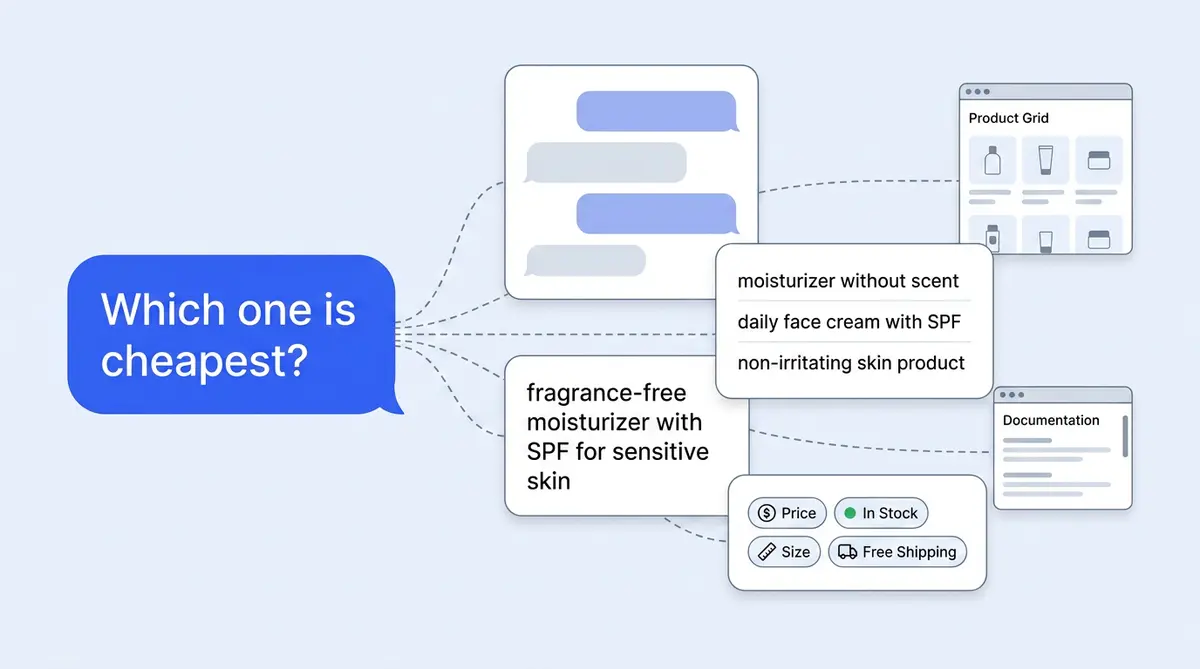
One shopper message becomes several retrieval queries
The orchestrator picks which layers run based on the bot's configuration and the conversation. Is there chat history? Add the history layer. Is conversational product search turned on? Add the catalog layer. Did the shopper attach a photo? Add an image contextualizer too.
Layer 1: Chat history (coreference resolution)
This is the foundation. It takes the latest message plus the chat history and collapses them into one self-contained question.
- Raw: "Which one is cheapest?"
- Rewritten: "Which leather office chair is cheapest?"
We run it on a nano-tier model (GPT-4.1-nano by default) because it sits on the critical path of every response. Resolving "which one" doesn't need a frontier model. It needs speed. This layer stays under 100 ms at p95, and we time it on every request.
Layer 2: Product search (catalog-aware rewriting)
A standalone question is enough for FAQs. Product catalogs need structure, because retrieval improves when the query mirrors the shape of the catalog.
This layer takes five inputs: the message, the chat history, preferences learned earlier ("under $200," "must have lumbar support"), the store's category tree, and the products the shopper has already seen. It returns a structured query:
Category: Office Equipment | Subcategory: Office Chairs | Product Description: comfortable leather office chair | Product Attributes: material - leatherTwo behaviors make it work:
- Topic-change detection. When the shopper jumps from office chairs to laptops, the layer resets. "Leather" and "lumbar support" don't leak into the laptop search.
- Context continuity. When the shopper stays on topic ("something cheaper," "in black"), earlier attributes stay and the new constraint layers on top. For "show me something like this one," the products already on screen become the seed.
This layer runs on Gemini 2.5 Flash, because following a strict output structure matters more here than raw speed. Its output lines up with our agentic chunking index, where product documents are stored in the same shape.
Layer 3: Query expansion (paraphrase diversity)
Dense embeddings are still sensitive to wording. "Laptop" and "notebook computer" can land in different parts of the vector space. So this layer writes up to three paraphrases of the already-rewritten query:
- Original: "What's the best laptop for programming?"
- "Which laptop is recommended for software development?"
- "What is a good developer laptop?"
- "Top coding laptops?"
Each paraphrase becomes its own retrieval query. Results are merged, deduplicated and re-ranked. Think of it as a cheaper, more controllable cousin of HyDE. Instead of inventing a whole hypothetical answer, we cover the wordings the shopper could have used. Three extra embedding calls cost very little next to the recall they buy.
Layer 4: Filter extraction (hard constraints)
This layer does something different from the other three. It pulls hard constraints out of the conversation, like "under $50," "in stock," "size medium" or "ships to Canada," and turns them into a structured filter. The vector database applies that filter alongside hybrid search.
Price is a filter, not a feeling. If "comfortable leather chair under $50" becomes one vector, the "$50" bends the embedding. You can miss the perfect $45 chair because nothing in its description looks like "$50." So meaning goes through the embedding, and hard constraints go through the filter.
That split is how the AI Shopping Assistant handles a request like "vegan leather bag under $200 that fits a 15-inch laptop" without recommending bags that break the rules.
Orchestration: parallelism, latency and graceful failure
Four LLM calls before every retrieval sounds slow. It isn't, because of three design choices.
Configuration, not code. Each bot turns layers on or off. A simple FAQ bot might only need the history layer. A full shopping experience gets all four plus image handling. Adding a new vertical means a new taxonomy prompt, not a new embedding model or a rebuilt index. That's how the same pipeline serves beauty, fashion, home furnishing and travel brands.
Parallel, not sequential. Every active layer fires at the same time, each on the model that suits its job. Total added time is set by the slowest layer, not the sum of all four. In practice that's 100–300 ms before retrieval starts.
Fail soft. If one layer errors or times out, that branch falls back to the original message. You lose a little recall on that one dimension, and the shopper still gets an answer. An LLM timeout should never become a user-facing error.
Once the layers return, the merged queries go to retrieval. Each one gets dense and sparse embeddings for hybrid search, and the retrievers run in parallel against the right indexes: knowledge base, products and FAQs. One shopper message becomes several focused retrieval passes, each aimed at a different part of what they meant.
Results: what better retrieval changed for brands
Retrieval quality shows up in business numbers. A shopper who gets the right product the first time is more likely to buy it, and less likely to send it back. Two Alhena customers show what that looks like.
Dryrobe®: fewer "too big" returns
Dryrobe® changing robes are deliberately cut oversized, because customers get changed inside them. Shoppers kept sizing them like a normal coat, and "too big" became the single largest return reason. With Alhena guiding shoppers through sizing and product questions at the moment of decision, Dryrobe® saw:
Tatcha: higher conversion from guided discovery
Tatcha, a luxury skincare brand, uses Alhena as a digital beauty advisor that runs adaptive skin consultations and recommends full routines. Shoppers who engaged with it converted at 3x the site average.
These results come from the full Alhena assistant, not query rewriting alone. But every one of them depends on the assistant retrieving the right product for what the shopper actually meant, and that work starts before retrieval.
Query rewriting vs HyDE vs multi-query vs decomposition
These techniques get lumped together as "query transformation," but they fix different problems. Most production systems combine two or three.
| Technique | What it fixes | How it works | Extra cost | Use it when |
|---|---|---|---|---|
| Standalone rewriting | Follow-ups that depend on earlier turns | An LLM rewrites the latest message using chat history | 1 small-model call | Any multi-turn chatbot. Start here. |
| Multi-query / paraphrase expansion | Missed results due to wording | Generate 2–5 rewordings and retrieve on each | 1 call + a few extra embeddings | Recall matters more than cost, e.g. catalogs with varied product language |
| HyDE | Short queries that don't look like your documents | Generate a hypothetical answer and embed that instead | 1 larger call; can inject made-up details | Knowledge bases where answers are long and questions are short |
| Step-back prompting | Questions too specific to match general docs | Ask a broader version of the question first | 1 call + a second retrieval | Technical or policy questions that need background first |
| Decomposition (sub-questions) | Compound questions ("compare X and Y for Z") | Split into sub-questions and retrieve for each | 1 call + one retrieval per sub-question | Comparisons and multi-step questions |
| Filter extraction | Hard constraints lost or distorted in embeddings | Pull price, size, stock and yes/no attributes into metadata filters | 1 small-model call | Ecommerce, travel, any catalog with structured attributes |
Our rule of thumb: standalone rewriting first, filter extraction second if you have structured data, then add expansion if recall is still short. We use paraphrases instead of HyDE in shopping, because a hypothetical product description can pull in attributes the shopper never asked for.
When not to rewrite
Rewriting every message sounds safe. It isn't.
When a shopper types a clean, specific query like "Tatcha Dewy Skin Cream 50ml," a rewriter can only make it worse. It might normalize the product name, add context nobody asked for, or quietly drop the size. Research backs this up: the 2026 study in the table above found prompt-only rewriting lowered nDCG@10 by 9.0% on a finance benchmark while raising it 5.1% on a medical one. Rewriting is a tool with a domain, not a free upgrade.
Here's how we handle it:
- Rewrite when the message leans on history. No history, or a message that already names the product? Pass it through untouched. Rule 7 of the template does this.
- Always keep the raw query as a retrieval branch. It costs one extra embedding and has saved us from more bad rewrites than any prompt tweak.
- Decide per bot, and per message. A support bot answering policy questions needs a different mix of layers than a shopping assistant. That's why every layer in our pipeline can be switched off.
- Watch for over-carrying. If the shopper says "actually, show me sneakers," old constraints must go. Topic-change detection isn't optional.
One more honest point. Query rewriting sharply reduces bad retrieval, but it doesn't make an assistant infallible. The answer still depends on your catalog data, your ranking and your generation step. Rewriting makes sure all of them start from the right question.
Three ecommerce walk-throughs
Here's what the retriever actually receives in three real conversation shapes.
Skincare: stacking constraints
A shopper on a skincare brand's site, three turns in:
- "I have sensitive skin and I'm looking for a moisturizer"
- "Something without fragrance"
- "Do you have one with SPF?"
Without rewriting, "Do you have one with SPF?" goes straight to the retriever. It returns sunscreens, SPF lip balms and random matches for "one." Nothing about moisturizer, sensitive skin or fragrance.
With the Contextualizer, each layer contributes something different:
| Layer | Output |
|---|---|
| Chat history | "Do you have a fragrance-free moisturizer with SPF for sensitive skin?" |
| Product search | Category: Skincare, Subcategory: Moisturizers, Attributes: SPF yes, fragrance none, skin type sensitive |
| Query expansion | "SPF moisturizer for sensitive skin without fragrance" · "gentle daily moisturizer with sun protection" · "unscented SPF face cream for reactive skin" |
| Filter extraction | spf = true, fragrance_free = true |
All of these queries fire in parallel, with the filter applied to every one. Every product that comes back is a moisturizer, has SPF and is fragrance-free.
Apparel: relative sizes
A shopper asks about "the linen shirt in the photo," then "does it run small?", then "OK show me the next size up in navy."
The last message has no product, no current size, and "next size up" is relative. The history layer resolves the product from what's on screen. The catalog layer turns "next size up" into an actual size from the one the shopper was viewing. The result is "navy linen button-down shirt, men's size L" with filters for color, size and stock. Without the rewrite, the assistant searches for "navy" and "size up" and shows socks.
Furniture: the topic pivot
A shopper spends four turns narrowing down a leather office chair with lumbar support under $400. Then they write: "Also need a desk lamp."
A naive rewriter carries everything forward and searches for a "leather desk lamp with lumbar support under $400." Topic-change detection sees the new category, drops the chair constraints and keeps only what still applies, like the shopper's preferred finish if they mentioned one. The lamp search starts clean.
How to evaluate your own rewriter
You can't improve what you only eyeball. Here's the evaluation loop we'd set up from day one.
- Build a small, honest eval set. Pull 200–500 real follow-up messages with their chat history. Include the awkward ones: topic pivots, messages that already stand alone, "thanks!" and mixed-language turns. Label the documents or products that should come back.
- Score retrieval, not just answers. Compare recall@10 and nDCG@10 for the raw message against the rewritten query. Answer quality hides retrieval problems, because a good generator can paper over a weak context.
- Check faithfulness. For each rewrite, ask two questions. Did it keep every constraint the shopper gave? Did it add anything they didn't say? An LLM judge plus a weekly human spot check works well.
- Track the constraint-break rate. For catalogs, count recommended products that violate a stated constraint (wrong size, over budget, contains fragrance). This is the metric shoppers actually feel.
- Watch pass-through and fallback rates. Standalone messages should come through almost unchanged. Rising parse failures or fallbacks mean your prompt or model has drifted.
- Time every layer. Log p95 latency per rewriter so one slow model doesn't quietly eat your response budget.
A minimal comparison looks like this:
def recall_at_k(retrieved_ids, relevant_ids, k=10):
    hits = len(set(retrieved_ids[:k]) & set(relevant_ids))
    return hits / max(len(relevant_ids), 1)

raw_scores, rewritten_scores = [], []
for ex in eval_set:
    rewritten = rewrite_query(llm, ex.history, ex.latest_message)
    raw_scores.append(recall_at_k(retrieve(ex.latest_message), ex.relevant_ids))
    rewritten_scores.append(recall_at_k(
        retrieve(rewritten["standalone_query"], filters=rewritten["filters"]),
        ex.relevant_ids,
    ))

print(f"raw: {mean(raw_scores):.3f}  rewritten: {mean(rewritten_scores):.3f}")
Run it on every prompt or model change. It takes minutes and catches regressions before your shoppers do.
Frequently asked questions
What is query rewriting in RAG, and why do I need it?
Query rewriting turns a user's raw message into a standalone search query before retrieval. You need it as soon as your chatbot handles more than one turn. Follow-ups like "which one is cheaper?" have no meaning without the earlier conversation, so retrieving on them directly returns irrelevant results.
How do I make my RAG chatbot understand follow-up questions like "which one is cheaper?"
Add a rewriting step before retrieval. Pass the last few turns of chat history and the latest message to a small LLM, and ask it to return one self-contained query. "Which one is cheaper?" becomes "Which leather office chair is cheapest?" Then retrieve on the rewritten query, and keep the raw message as a fallback.
What's a good prompt to rewrite a user's last message into a standalone search query?
A good rewriting prompt tells the model to resolve pronouns, carry forward constraints that still apply, drop them on a topic change, keep product names and numbers exact, remove chit-chat, and never answer the question. Ask for JSON output so you can validate it. Our full template is in the copy-paste prompt section above.
Is query rewriting the same as HyDE or multi-query retrieval?
No. Query rewriting makes one message understandable on its own. Multi-query retrieval generates several rewordings to improve recall. HyDE embeds a hypothetical answer instead of the question. They solve different problems and often work together. We combine rewriting with paraphrase expansion, and skip HyDE for shopping because invented product details can skew results.
How much latency does query rewriting add?
A single rewrite on a small model typically adds tens of milliseconds. Alhena's history layer stays under 100 ms at p95. Running four rewriters in parallel adds 100–300 ms in total, because the time is set by the slowest layer rather than the sum of all four.
Which model should I use for query rewriting?
Use the smallest model that passes your evaluation set. Resolving references doesn't need a frontier model. We use GPT-4.1-nano for chat-history rewriting because it's fast, and Gemini 2.5 Flash for catalog rewriting because strict structured output matters more there. Keep temperature at 0.
When should I skip query rewriting?
Skip it when the message already stands alone, such as a full product name or a first message with no history. Rewriting clean queries can make them worse. One 2026 study found prompt-only rewriting lowered retrieval quality by 9.0% on a finance benchmark. Always keep the raw query as a retrieval branch.
How do I stop my rewriter from sending its instructions or reasoning to the search engine?
Require JSON output, parse it, and validate the query before using it. Reject empty results, very long strings, and anything that repeats words from your instructions. If validation fails, fall back to the user's original message. Never pass raw model output straight to a search API.
How do AI shopping assistants remember my size, budget and preferences?
They carry your stated preferences forward and rewrite each new message with them. When you say "in navy" after asking about a linen shirt, the assistant searches for a navy linen shirt in your size, not just "navy." Good assistants also reset those preferences when you switch to a different kind of product.
Which paper combined query rewriting and expansion for conversational search?
ConvGQR (Mo et al., ACL 2023) is one of the best-known papers to combine the two. It rewrites the conversational query and adds likely-answer terms. On the QReCC benchmark it lifted retrieval MRR from 10.2 to 42.0, beating human-written rewrites.
Does query rewriting work with any vector database?
Yes. The rewritten queries are plain text, so you can embed them with any model and search any vector store. Extracted filters need to match your database's filter format. Alhena emits Qdrant filters, and the same structure maps to Pinecone, Weaviate or Milvus.
Does query rewriting reduce hallucinations?
It reduces a major cause of them. Models make things up when the retrieved context doesn't contain the answer. Better queries retrieve better context, and hard filters keep products that break the shopper's constraints out of the context entirely. Rewriting doesn't eliminate hallucination, but it removes a common source of it.
The takeaway: the retriever never sees what the user typed
If you're building conversational RAG, three principles carry over from everything above:
- Make rewriting its own stage. Keep it before retrieval, time it, and make it configurable. Mixing it into the retriever makes both harder to debug.
- Put domain knowledge in prompts. A new vertical should mean a new taxonomy prompt, not a retrained embedding model or a rebuilt index.
- Separate meaning from constraints. Prices, sizes, stock and yes/no attributes belong in filters. Everything else belongs in the embedding.
The prompt the retriever sees is not the prompt the user typed. The conversation gets folded into the query before a single vector is compared. That's what makes multi-turn RAG actually work.
To see how this fits the rest of our stack, read about our multi-agent planning system, which generates the sub-queries the Contextualizer rewrites, and unified memory, which supplies the shopper preferences the catalog layer uses.
Want to see query rewriting on your own catalog?
Book a technical demo with Alhena AI or start for free and test it on your data.