A 5% increase in customer retention can boost profits by 25% to 95%, according to research from Bain & Company. For any ecommerce business, that math starts with one thing: how well your customer services perform.
Ecommerce customer service has changed fast. Shoppers expect instant answers, personalized recommendations, and support on whatever channel they prefer, whether that's live chat, email, SMS, Instagram DMs, or WhatsApp. Brands that still rely on slow email queues and scripted chatbots are bleeding revenue to competitors who don't.
This guide covers 10 ecommerce customer service best practices that drive real results in 2026, from self-service and omnichannel support to AI-powered personalization and proactive outreach. You'll also see how brands like Tatcha and Puffy use these strategies to turn support into a revenue channel.
What Is Ecommerce Customer Service?
Ecommerce customer service is the support you provide to online shoppers before, during, and after a purchase. It covers everything from answering product queries and questions and helping with sizing to processing returns and tracking orders.
What separates great ecommerce customer service from average support is scope. It's not just about resolving tickets and helping resolve issues. It includes guiding a first-time visitor toward the right product, helping a returning customer reorder, and making post-purchase experiences smooth. Great experiences compound enough that they come back.
According to Salesforce research, 80% of customers say the experiences a company provides matters as much as its products. In ecommerce, your customer service is a big part of those experiences.
Why Ecommerce Customer Service Matters More Than Ever
Customer acquisition costs keep climbing. McKinsey reports that 71% of consumers expect personalized interactions, and 76% get frustrated when they don't get them. Meanwhile, Gartner predicts that chatbots will become the primary customer service channel for 25% of organizations by 2027.
Every ecommerce business winning in 2026 treat customer service as a growth lever, not a cost center. The price of ignoring this shift is lost revenue. When your service team (or your AI) can recommend the right product during a conversation, you'll find you're not just solving a problem. You're driving revenue.
That shift from "support" to "sales-through-service" is what separates top-performing ecommerce brands from the rest. And it's exactly what modern AI customer service tools are built to do.
10 Ecommerce Customer Service Best Practices for 2026
1. Map Your Entire Customer Journey
Before you fix your customer service, understand where it breaks. Walk through your own buying experience from homepage to post-delivery. Can a first-time shopper find the right product quickly? Is checkout smooth on mobile? How easy is it to track a shipment or start a return?
Most support tickets trace back to friction somewhere in the journey. A confusing size chart creates "does this run large?" chats. A vague shipping policy generates "where's my order?" emails. Fix the root cause and you reduce ticket volume while improving the customer experiences.
2. Offer Self-Service That Actually Works
Shoppers want quick answers and to solve simple problems on their own. According to Emplifi, 35% of consumers say self-service options are "very important" for ecommerce brands. But a static FAQ page from 2022 doesn't count.
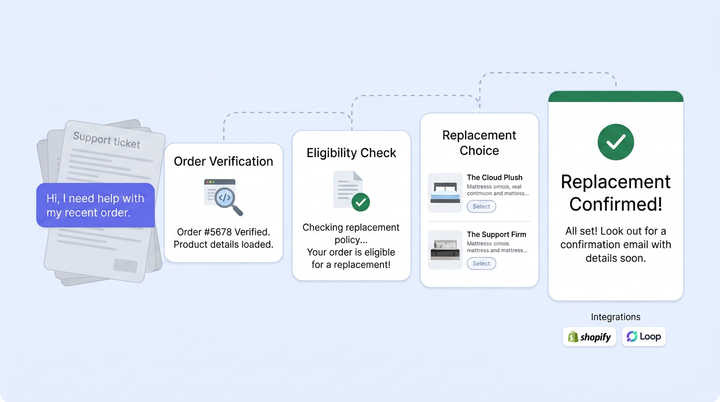
Effective self-service in 2026 means AI-powered automation and knowledge bases that understand natural language questions, interactive size guides, real-time order tracking, and chatbots that can handle common requests without routing via escalation to a human. Alhena AI's AI Shopping Assistant handles product questions, order lookups, and returns automatically, covering the self-service journeys that make up the bulk of support volume.
3. Go Omnichannel (for Real)
Your customers don't think in channels. They message you on Instagram, follow up via email, and make calls when it's urgent. If your support team can't see that full conversation history, you're making the customer's experience worse by forcing them to repeat themselves every time.
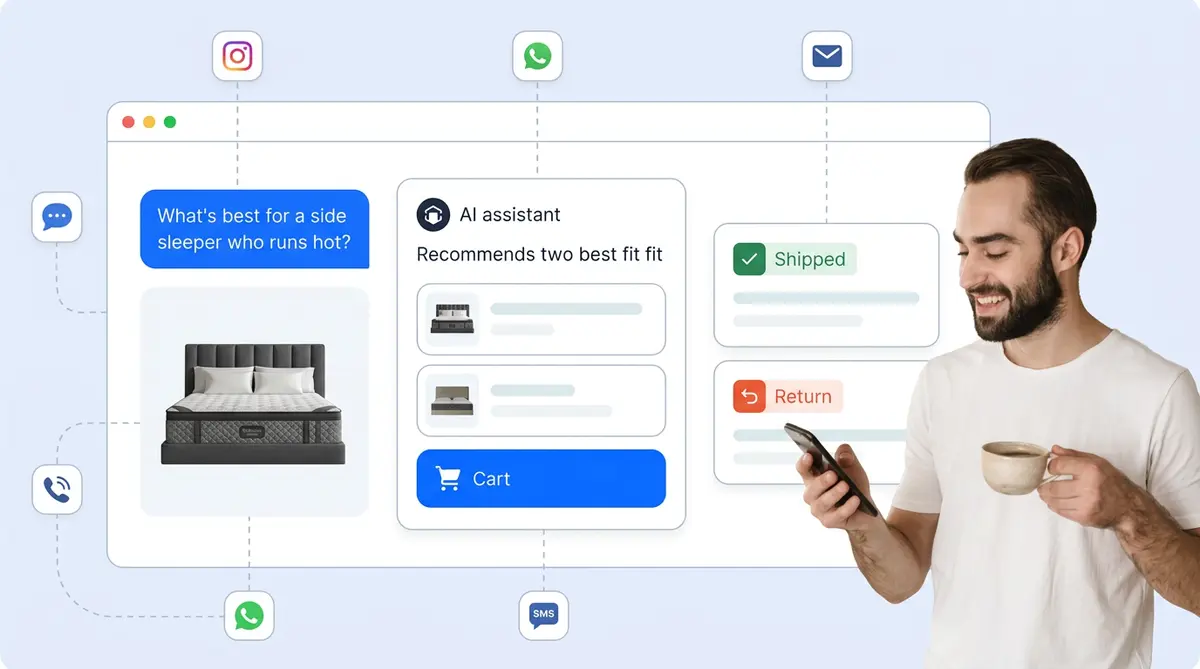
True omnichannel customer service means connecting web chat, email, SMS, social DMs, WhatsApp, phone calls, and voice into a single view. It also means your AI assistant recognizes the same customer whether they reach out via Instagram or your website. Alhena provides integrations across all these channels, including Instagram DMs and WhatsApp, with unified conversation history.
4. Personalize Every Interaction
Generic responses kill trust. When a customer asks "will this moisturizer work for my skin?" and gets a copy-paste product description, they leave. Personalization means using purchase history, browsing behavior, and conversation context to tailor every answer.
McKinsey found that companies excelling at personalization generate 40% more revenue from those activities than average performers. In practice, this looks like an AI assistant that remembers a customer prefers fragrance-free products, or a support agent who can see that the shopper already bought the matching serum last month.
5. Cut Response Times Dramatically
Speed matters. Statista data shows 12% of Americans cite slow response time as their biggest customer service frustration. In ecommerce, a delayed answer on a pre-purchase query often means a lost sale.
AI brings response times from hours down to seconds. Manawa, a travel and experiences brand, cut their average response time from 40 minutes to under 1 minute after deploying Alhena AI, while using automation to handle 80% of inquiries. That kind of speed doesn't just improve satisfaction. It catches shoppers while they're still ready to buy.
6. Use AI to Sell, Not Just Support
Most ecommerce brands treat AI as a deflection tool: answer the question, close the ticket, move on. That misses the bigger opportunity. The best AI shopping assistants guide customers toward the right product, suggest complementary items, and even complete checkout within the chat.
Tatcha saw a 3x conversion rate and 38% average order value (AOV) uplift after adding Alhena's AI Shopping Assistant. The AI doesn't just answer "what's good for dry skin?" It recommends specific products, explains why they work, and populates the cart, turning a support interaction into a sale.
7. Empower Your Human Agents
AI and automation handle volume. Humans handle nuance. Your agents need tools that make them faster and better at the complex conversations AI escalates to them.
That means giving agents real-time access to order data, product knowledge, and conversation history without switching between tabs. Alhena's Agent Assist surfaces relevant knowledge in real-time and drafts responses for agents in real time, so they spend less time searching and more time solving. It's the difference between a 10-minute resolution and a 2-minute one.
8. Be Proactive, Not Reactive
Don't wait for customers to complain. Proactive customer service means reaching out before a problem escalates: shipping delay notifications, back-in-stock alerts, personalized product recommendations after a purchase.
Proactive outreach reduces inbound ticket volume and builds trust and confidence. When a customer gets a "your order is delayed by 2 days, here's a 10% credit" message before they even think to ask, that's the kind of trust-building experience that drives loyalty and repeat purchases.
9. Track the Right KPIs
You can't improve what you don't measure. But tracking the wrong metrics is almost as bad as tracking none. Focus on these ecommerce customer service KPIs:
- Customer Satisfaction Score (CSAT): Direct feedback after interactions. Puffy maintains 90% CSAT through automation of 63% of inquiries with Alhena AI.
- First Response Time (FRT): How fast you reply to chats and calls. Under 1 minute is the new benchmark for chat.
- Resolution Rate: How often your team can resolve issues without escalation.
- Revenue Attribution: How much revenue your support channel generates through upsells, cross-sells, and guided purchases.
- Deflection Rate: How many inquiries AI handles without a human. Crocus hits 86% deflection while maintaining 84% CSAT.
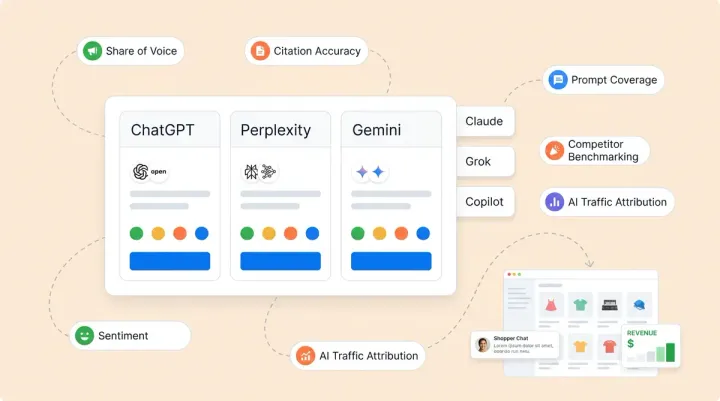
Revenue attribution is the metrics gap most brands overlook. Without revenue metrics. If you're only measuring cost savings from deflection, you'll be ignoring the sales your AI could be driving. Alhena's built-in revenue attribution analytics track exactly how much revenue each AI conversation generates.
10. Gather and Act on Customer Feedback
Every support interaction is a feedback signal. AI technology makes it possible to collect and analyze this data at scale with full data security and without burdening customers with post-chat surveys.
Modern AI analytics tools analyze conversation sentiment, identify recurring queries and pain points, and surface product issues before they become widespread. If 50 customers ask the same sizing question about a specific product in one week, that's a signal to update the product page, not just answer the same question 50 more times.
How AI Is Reshaping Ecommerce Customer Service in 2026
The biggest shift in ecommerce customer service isn't more agents or better scripts. It's AI that goes beyond answering questions to taking action. Generative AI in customer service can raise productivity by 30% to 45%, according to McKinsey.
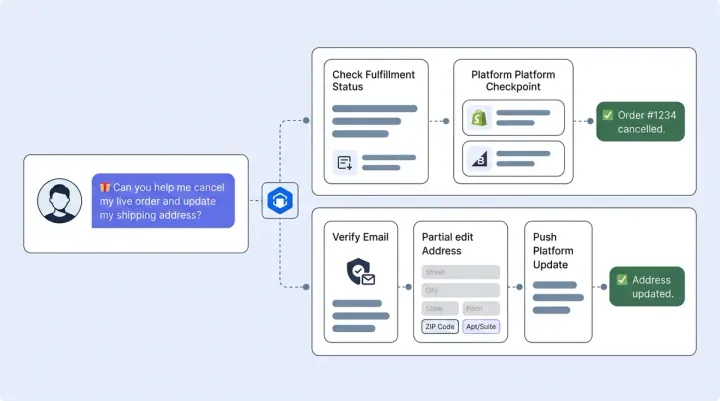
But not all AI is equal. Basic chatbots read from a script and deflect to humans when things get complex. Conversational AI agents understand context, remember past interactions, and execute workflows like processing returns, checking inventory, or using checkout technology to populate a cart.
The next generation, agentic AI, takes this further. An agentic AI agent doesn't just respond to requests. It anticipates needs, coordinates across systems (your ecommerce system, helpdesk system, and shipping provider), and completes multi-step tasks in a single conversation. That's the direction ecommerce customer service is heading, and brands that adopt early are already seeing outsized results.
How Alhena AI Improves Ecommerce Customer Service
Alhena AI is purpose-built for ecommerce, not retrofitted from a generic support tool. It combines two specialized agents: a Product Expert Agent that handles product discovery and sales, and an Order Management Agent that covers post-purchase support.
Here's what that looks like in practice:
- Hallucination-free answers: Every response is grounded in your verified product data, giving you security that customers never get incorrect recommendations.
- Agentic checkout: The AI populates carts and pre-fills checkout fields, reducing friction between "I want this" and "I bought this."
- Omnichannel from day one: Web chat, email, SMS, Instagram DMs, WhatsApp, and voice, all connected via platform integration with shared memory.
- 48-hour deployment: No technology team or dev resources needed. Alhena’s system ingests your product catalog, knowledge base, and help center content, then goes live.
- Revenue attribution: Built-in analytics show exactly which conversations led to purchases, so you'll be able to track metrics and measure ROI from day one.
The results speak for themselves. Tatcha generates 11.4% of total site revenue through Alhena's AI. Victoria Beckham saw a 20% AOV increase. Manawa cut support workload by 43% while dropping response times from 40 minutes to 1 minute.
Alhena offers deep integrations with the platforms ecommerce brands already use: Shopify, WooCommerce, Salesforce Commerce Cloud, Zendesk, Gorgias, Freshdesk, HubSpot, and more.
Key Takeaways
- Ecommerce customer service is a revenue channel, not just a cost center. The price of ignoring this shift is lost revenue. Brands that treat it as such see higher conversions, larger orders, and better retention.
- Self-service and omnichannel support are table stakes. Customers expect instant answers on whatever channel they prefer.
- AI should sell, not just deflect. The best AI shopping assistants guide purchases, recommend products, and complete checkout within the conversation.
- Speed wins. Response times under 1 minute are the new standard. AI makes that possible at scale.
- Measure revenue, not just deflection. Track how much your support channel generates, not just how many tickets it avoids.
- Human agents still matter. AI and automation handle volume so your team can focus on complex, high-value interactions.
Ready to turn your ecommerce customer service into a revenue engine? Book a demo with Alhena AI or start free with 25 conversations to see the difference.
Frequently Asked Questions
What is ecommerce customer service?
Ecommerce customer service is the support you provide to online shoppers before, during, and after a purchase. It includes answering product queries and questions, helping with sizing and recommendations, processing returns, tracking orders, and resolving payment issues across channels via live chat, email, social media, and phone.
How can AI improve ecommerce customer service?
AI improves ecommerce customer service by providing quick, instant 24/7 responses around the clock, every hour of every day, personalizing product recommendations based on browsing and purchase history, automating and handling routine tasks via automation like order tracking and returns, and freeing human agents to handle complex issues. Brands using Alhena AI see results like 3x conversion rates and response times under 1 minute.
What are the most important ecommerce customer service KPIs?
The five essential KPIs are Customer Satisfaction Score (CSAT), First Response Time (FRT), Resolution Rate, Deflection Rate, and Revenue Attribution. Revenue attribution is the one most brands miss. It tracks how much revenue your support channel generates through AI-guided purchases, upsells, and cross-sells.
How fast should ecommerce customer service respond?
For live chat and messaging, the benchmark in 2026 is under 1 minute. For email, the target is 4 hours or less. During business hours, aim for under 2 hours. AI chatbots respond in seconds, which is critical because delayed pre-purchase answers often mean lost sales. Manawa cut their response time from 40 minutes to under 1 minute with Alhena AI.
What is the difference between customer service and customer experience in ecommerce?
Customer service is one component of customer experience. Customer experience covers the entire journey: website design, product discovery, checkout flow, delivery, and post-purchase follow-up. Customer service specifically handles the support interactions when shoppers need help. Improving customer service directly improves the overall customer experience.
How does Alhena AI compare to Zendesk AI for ecommerce?
Zendesk AI is built for ticket deflection across industries. Alhena AI is purpose-built for ecommerce sales and support. Alhena offers agentic checkout (cart population and checkout pre-fill), product recommendations, revenue attribution analytics, and hallucination-free answers grounded in your product catalog. Zendesk handles support well but wasn't designed to drive revenue from conversations.
What self-service options should ecommerce brands offer?
Effective self-service includes AI chatbots that handle product questions and order lookups, real-time order tracking, interactive size guides, a searchable knowledge base, and automated returns initiation. According to Emplifi, 35% of consumers consider self-service options very important for ecommerce brands.
How much does it cost to set up AI customer service for ecommerce?
Alhena AI offers a free tier with 25 conversations to start. Paid plans scale based on conversation volume, with transparent price tiers. Most brands see positive ROI within the first month through a combination of support cost reduction (fewer tickets for agents) and revenue generation (AI-guided purchases). Use the Alhena ROI Calculator at alhena.ai/roi-calculator to estimate your return.