Customer service automation is how the best ecommerce brands stop bleeding money on repetitive support tickets. If your team still answers "where's my order?" fifty times a day, you're not just wasting payroll. You're slowing down the agents who should be handling returns disputes, VIP complaints, and the conversations that actually keep customers coming back.
The good news: you don't need to automate everything at once. Most ecommerce support teams can cut ticket volume by 40 to 60 percent by automating just a handful of predictable, high-volume workflows. The trick is knowing which ones to start with.
This guide walks through ten self service journeys that are worth automating first, why they matter, and how brands like Tatcha, Puffy, and Crocus have already done it with real, measurable results.
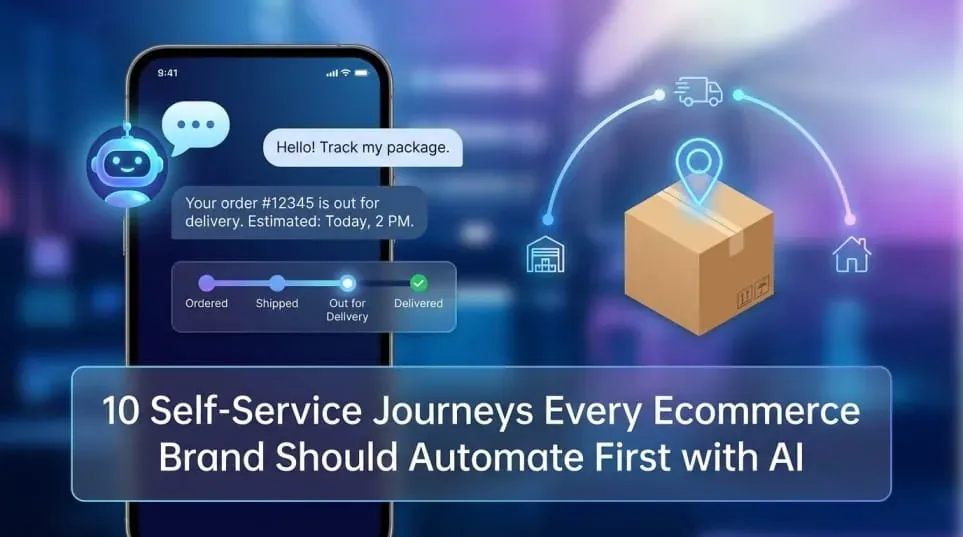
1. Order Status and Shipment Tracking
Order tracking is the most common repetitive inquiry in ecommerce customer support. Customers want to know where their package is, when it will arrive, and whether any delays have occurred. WISMO ("where is my order?") tickets alone can account for 30 to 50 percent of total support volume in peak seasons.
An AI powered chatbot integrated with your CRM and logistics systems can:
- Pull real-time shipment data
- Provide delivery estimates
- Share tracking links
- Proactively notify customers about delays
This reduces contact center load and improves customer satisfaction by providing immediate answers. It also frees live agents from basic status requests and allows human agents to focus on higher-value conversations.
Alhena AI's Support Concierge connects directly to Shopify, WooCommerce, and other platforms to pull live order and tracking data. Crocus, a major UK garden retailer, saw an 86% deflection rate after automating order tracking and similar routine queries with Alhena.
2. Returns and Exchanges
Returns generate a significant percentage of inbound inquiries, particularly in apparel, beauty, and footwear.
Automated customer service workflows can guide users through:
- Eligibility checks
- Policy explanation
- Label generation
- Exchange selection
- Refund status updates
An AI agent can reference your knowledge base and FAQs while dynamically verifying order data. When edge cases arise, the system can escalate to human agents with the full context attached. This improves CSAT because customers don't need to repeat information.
For a deeper look at automating this workflow, see our guide on how AI automates returns and refunds in ecommerce.
3. Order Modifications and Cancellations
Customers often want to change an address, swap a size, or cancel an order shortly after purchase. These requests are time-sensitive, and delays frustrate buyers.
Instead of routing every request to human agents, automation tools can:
- Validate whether the order is still editable
- Apply permitted changes
- Confirm updates in real time
Clear workflow automation ensures that automated systems only allow changes within defined service processes. If an order has already shipped, the AI chatbot can explain next steps and suggest alternatives.
Alhena AI's Order Management Agent handles cancellations and address changes as fully automated self-service actions, connected directly to your ecommerce platform. No manual ticket required.
4. Account Management and Password Resets
Account access issues are predictable and high frequency. They're ideal candidates for self service.
Automated systems can manage:
- Password resets
- Email updates
- Subscription preferences
- Address book changes
By integrating with CRM and authentication layers, these workflows reduce manual effort inside the contact center. They also improve customer experience by delivering immediate resolution.
5. Product Discovery and Pre-Purchase Questions
When starting customer service automation, many brands focus only on post-purchase use cases. Pre-purchase inquiries are equally important, and arguably more valuable since they directly affect conversion rates.
An AI powered chatbot using natural language processing can help customers:
- Compare products
- Clarify sizing or compatibility
- Understand ingredients or materials
- Review availability
This is where AI chatbots begin to influence buying decisions more directly. When trained on a structured knowledge base, they can deliver personalized responses based on browsing behavior and expressed preferences.
Complex product consultations can escalate to live agents, but the majority of informational inquiries can be handled through automated customer service.
Pre-purchase customer experience automation is best handled by purpose-built AI Shopping Assistants. Tatcha, the luxury skincare brand, saw a 3x conversion rate and 38% AOV uplift after deploying Alhena AI's Product Expert Agent to handle pre-purchase questions.
6. FAQs and Policy Clarification
Many support tickets originate from information that already exists in FAQs. Customers often don't navigate static help centers efficiently, so they open a ticket instead.
Instead of relying solely on searchable documentation, a chatbot interface layered on top of your knowledge base can interpret questions conversationally. The AI improves intent recognition over time, reducing friction in service processes.
This approach maintains consistency across channels and ensures that automated responses reflect the latest policy updates. Alhena AI grounds every answer in your verified product and policy data, so customers get accurate responses without the risk of hallucinated information.
7. Subscription Management
For brands offering replenishment or subscription services, common inquiries include:
- Skipping deliveries
- Changing shipment frequency
- Updating payment methods
- Canceling subscriptions
Workflow automation connected to billing and fulfillment systems allows customers to manage these actions independently. This reduces dependency on live agents while preserving control and compliance.
When customers request exceptions outside policy, the AI agent can escalate with full transaction history attached to the support team automatically.
8. Basic Warranty and Claim Intake
For certain categories such as electronics, furniture, or premium accessories, warranty inquiries can overwhelm customer support.
Automated customer service can guide customers through structured intake:
- Purchase validation
- Photo uploads
- Issue classification
- Documentation submission
Using natural language processing, the system can triage cases and route them appropriately. Clear workflows ensure that human agents only handle cases that require manual review.
9. Appointment Booking or Service Scheduling
Brands that offer consultations, styling sessions, or repair services often rely on manual coordination.
Automation tools integrated with scheduling platforms allow customers to:
- View available slots
- Book or reschedule appointments
- Receive reminders
This reduces repetitive back-and-forth communication in the contact center and ensures accurate data entry within the CRM.
10. Intelligent Call Routing and Interactive Voice Response
Self service isn't limited to web chat. For brands with a phone channel, interactive voice response systems can reduce call handling time.
Modern AI powered interactive voice response goes beyond rigid menus. With conversational AI, callers can describe their issue in natural language. The system can:
- Provide automated answers
- Route to the appropriate support team (if needed)
- Attach context before escalation
This improves efficiency while protecting CSAT. When escalation is required, human agents receive structured summaries instead of starting from scratch. Alhena AI's Voice AI brings the same conversational intelligence to phone channels, handling routine calls so your team can focus on complex cases.
How Alhena AI Automates These Journeys in Under 48 Hours
Most of the ten workflows above sound straightforward on paper. In practice, the hard part is connecting your AI to real order data, product catalogs, and policies without a months-long integration project.
Alhena AI was built specifically for ecommerce customer service automation. It connects to Shopify, WooCommerce, Magento, and Salesforce Commerce Cloud out of the box, and works alongside helpdesks like Zendesk, Gorgias, Intercom, and Freshdesk.
Two specialized agents handle the work:
- Order Management Agent: covers order tracking, modifications, cancellations, returns, and refund status. It pulls live data from your store, so customers get real answers, not canned responses.
- Product Expert Agent: handles pre-purchase questions, product comparisons, sizing, and availability. It's trained on your product catalog and actually helps shoppers buy, not just browse.
The results from brands already using Alhena speak for themselves. Puffy hit 63% automated inquiry resolution with a 90% CSAT. Manawa cut agent workload by 43% and dropped response time from 40 minutes to under 1 minute. Victoria Beckham saw a 20% increase in average order value from AI-assisted shopping conversations.
Setup takes less than 48 hours, and you don't need developer resources to get started.
A Practical Framework for Starting Customer Service Automation
Customer service automation should be phased. Brands often succeed by following three principles:
1. Start With High-Volume, Low-Complexity Journeys
Focus on repetitive inquiries where rules are clear and risk is low. Order tracking and password resets are the obvious first picks. They account for a large share of ticket volume, follow predictable patterns, and rarely need human judgment.
2. Integrate With Core Systems
Automation works best when connected to CRM, order management, and logistics systems. Isolated AI chatbots create fragmented customer experience. Your AI needs access to real order data, not just FAQ answers.
3. Design Clear Escalation Paths
Automated doesn't mean closed. Every AI agent should have defined triggers to escalate to live agents. Smooth handoffs protect customer satisfaction. Alhena AI's Agent Assist gives your human agents full conversation context and suggested responses when a handoff occurs, so nothing falls through the cracks.
Measuring Impact Without Overstating Results
When implemented thoughtfully, automated customer service can improve:
- First response times
- Contact center efficiency
- CSAT for routine interactions
- Internal workflow clarity
But success depends on alignment between automation, support team processes, and customer needs. Over-automation without governance can create friction.
Brands that approach automation as a disciplined redesign of service processes rather than a technology overlay are more likely to see sustainable improvements in CX. Alhena AI includes built-in revenue attribution analytics, so you can track exactly how much revenue and cost savings your automated workflows generate.
Final Thoughts
Starting customer service automation is less about deploying tools everywhere and more about picking the right workflows to automate first. Order tracking, returns, account management, and FAQs are practical starting points because they're structured, repetitive, and high-volume.
As your automated systems mature, you can extend into more personalized use cases: product recommendations, proactive outreach, and social commerce through channels like Instagram DMs and WhatsApp. The role of human agents evolves toward exception handling, empathy, and the complex conversations that build real loyalty.
Customer service automation, when implemented incrementally and measured carefully, creates a more efficient support team and a better customer experience. The brands seeing the biggest results aren't the ones who automated the most. They're the ones who automated the right things first.
Ready to automate your highest-volume support workflows? Book a demo with Alhena AI to see how it works with your store, or start for free with 25 conversations.
Frequently Asked Questions
What is customer service automation in ecommerce?
Customer service automation in ecommerce means using AI agents and workflow tools to handle repetitive support tasks like order tracking, returns, and FAQs without human involvement. Alhena AI automates these workflows by connecting directly to your store's order and product data, resolving up to 80% of routine inquiries automatically.
Which customer service workflows should I automate first?
Start with high-volume, low-complexity workflows: order status and tracking (WISMO), returns and exchanges, password resets, and FAQ responses. These account for the largest share of ticket volume and follow predictable patterns. Alhena AI's Order Management Agent handles all four out of the box.
How long does it take to set up customer service automation for my store?
With Alhena AI, setup takes less than 48 hours. It connects to Shopify, WooCommerce, Magento, and Salesforce Commerce Cloud without developer resources. Your AI agents start handling tickets as soon as product and order data syncs.
Can automated customer service handle returns and refunds?
Yes. AI agents can verify return eligibility, explain policies, generate shipping labels, and provide refund status updates. Alhena AI processes these as fully automated self-service actions. Edge cases with exceptions get escalated to human agents with full conversation context attached.
Does customer service automation hurt customer satisfaction?
Not when done right. The key is automating predictable tasks and keeping clear escalation paths to human agents for complex issues. Puffy achieved 90% CSAT after automating 63% of inquiries with Alhena AI. Crocus hit 84% CSAT alongside an 86% deflection rate.
How do I measure the ROI of customer service automation?
Track deflection rate, first response time, CSAT for automated interactions, and cost per ticket before and after automation. Alhena AI includes built-in revenue attribution analytics, so you can see exactly how much revenue and cost savings your automated workflows generate. Try the ROI calculator at alhena.ai/roi-calculator.
What is the difference between a chatbot and customer service automation?
A chatbot is one component of customer service automation. Full automation includes workflow logic, system integrations (CRM, order management, logistics), escalation rules, and analytics. Alhena AI goes beyond basic chatbots by connecting to your store data and executing real actions like canceling orders or processing returns.
Can I automate customer service on Instagram and WhatsApp?
Yes. Alhena AI's Social Commerce agents handle customer inquiries on Instagram DMs and WhatsApp with the same product knowledge and order access as web chat. This lets you automate support across every channel your customers use, not just your website.