In early 2025, Walmart shared that shoppers who interact with Sparky, its in-house AI shopping assistant, place online orders in 2025 that are 35% larger than those who don't. The claim, reported by Investopedia in 2025 and sourced from Walmart's own disclosures, lacks methodology details: no attribution window, no analytics methodology, no control group structure, and no category breakdown. Still, it's one of the highest-signal data points. The conversational AI market is projected to reach $49.9 billion by 2030, with e-commerce driving the largest share of growth through 2030 as conversational AI moves basket size at scale.
For mid-market e-commerce brands and online buyers in 2025, the question isn't whether Walmart's number is precise. It's what mechanics drive, and which of those mechanics you can actually replicate without an in-house engineering org.
Why a Conversational Interface Grows Baskets
The 35% figure doesn't come from magic. It comes from five well-understood shopping behaviors that a conversational AI accelerates.
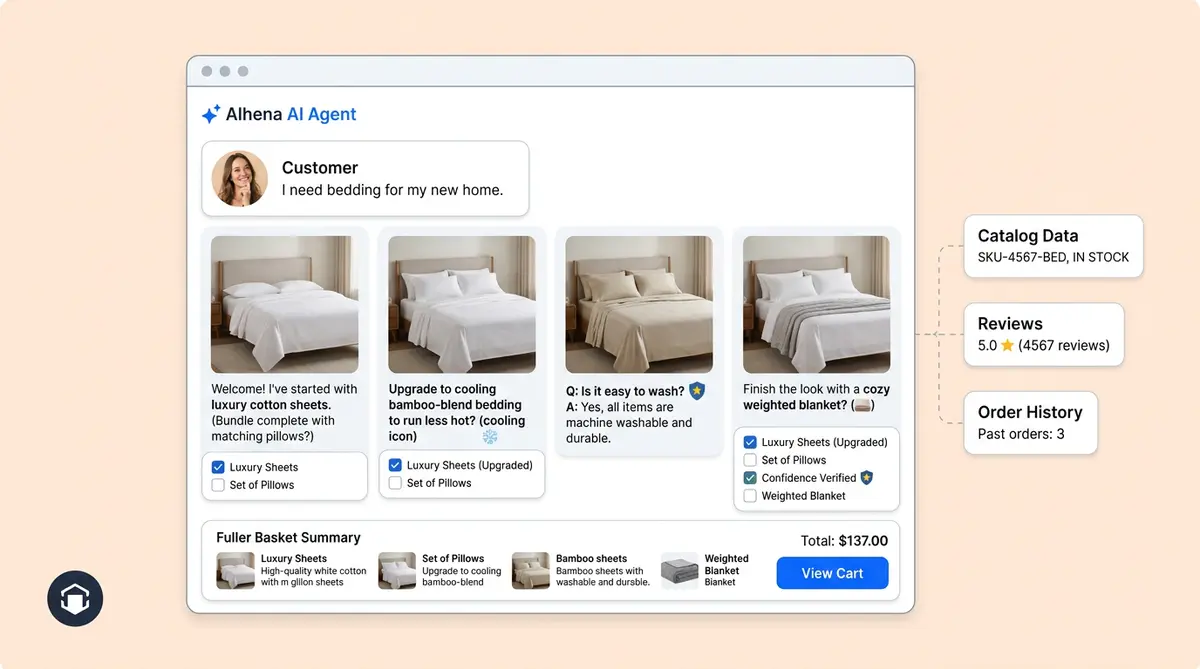
- Product discovery and bundle completion. A shopper buying a moisturizer gets asked about a cleanser and SPF. The AI reads buyer intent and knows the catalog well enough to suggest products that work together, not just products that look similar in a vector space. This cross-sell logic is catalog-aware, not keyword-based.
- Trade-up framing. "For $8 more, the 200ml bottle lasts twice as long." This actually works when the AI understands pricing tiers and product specs, not just keywords.
- Confidence-driven add-ons. Answering "does this work for sensitive skin?" reduces buyer hesitation and lifts conversion. Confident shoppers add more to the cart, with or without a human agent involved.
- Fewer exit points. When the AI captures purchase intent in real time, queries answered inside the chat thread mean fewer tabs opened, fewer Google searches started, and fewer chances to leave.
- Persistent context. This level of personalization means the AI remembers what the shopper said three messages ago. No re-explaining to a human rep, no starting over after clicking a new category page.
These aren't hypothetical. They're the same levers behind the 15 documented conversational AI personalization examples already producing results for e-commerce brands.
What Changes When You're Not Walmart
Walmart built Sparky internally. They have a dedicated ML organization, billions in transactions flowing through hundreds of millions of monthly active app users, exclusive in-app placement, and proprietary supply chain data and internal services feeding the model. Most e-commerce brands have none of that.
What mid-market brands actually have: full catalog metadata, customer data from support transcripts, product reviews, and order history. That's more than enough raw material for a conversational AI to work with, provided the AI is built to read customer intent and use it.
The gap isn't data. It's engineering capacity. Third-party conversational commerce agents fill the same functional role as Sparky for brands that won't (and shouldn't) build it themselves. The real question is whether the tool you pick is built to sell or just built to deflect support tickets.
That distinction matters more than most buyers realize. We broke it down in our Ecommerce AI ROI Playbook, which explains why deflection alone is the wrong north star for measuring AI value.
How Alhena Replicates the Sparky Mechanics
Alhena's AI Shopping Assistant is purpose-built for agentic e-commerce sales, not repurposed from helpdesk workflows or support-only workflows. It addresses each of the five basket-size levers directly.
For bundle completion and trade-up framing, Alhena's product expert agent indexes your full catalog, including pricing tiers, variants, compatibility data, and ingredient lists. When a shopper asks a question, the AI responds with grounded personalization-driven product discovery recommendations, not hallucinated guesses. Every answer traces back to verified catalog data.
For confidence-driven add-ons, the agent pulls from product reviews, FAQs, and brand guidelines to answer pre-purchase questions in the chat thread. Shoppers who get clear answers buy more and return less.
For reducing exit points and matching user intent, Alhena works across web chat, email, Instagram DMs, WhatsApp, and voice. Wherever the shopper starts the conversation, the AI can finish it without pushing them to a different channel or waiting for a human agent or a Google search.
For persistent context, Alhena's unified memory layer carries the full conversation history across sessions and channels. A shopper who asked about sizing on Instagram yesterday doesn't need to repeat themselves when they return to your website today.
None of this requires your human engineering team. Alhena deploys in under 48 hours, connects to Shopify, WooCommerce, Magento, and Salesforce Commerce Cloud, and starts working with the catalog data you already have.
How to Measure Your Own Basket-Size Lift
Walmart's 35% number is self-reported and unaudited. Your own measurement should be more rigorous. Two principles matter most.
Compare the right cohorts. AI-engaged shoppers are inherently more engaged, so comparing their AOV to the site-wide average inflates the number. Instead, match AI-engaged sessions against non-engaged sessions with similar entry points, traffic sources, and browsing depth. The CTR Trap post explains why order success rate is a better metric than click-through rate for this analysis.
Use a tight attribution window. A 24-hour, first-touch window gives you a cleaner signal than 7-day or 30-day windows that blend too many touchpoints. Alhena's built-in revenue attribution analytics and reporting use this approach, giving you analytics on every AI-engaged session, so the analytics dashboard lets you see the AOV and conversion rate lift of AI-engaged sessions without stitching together conversion data from three different tools.
For a full evaluation framework, our CRO Chat Platform Checklist covers the 10 features that separate revenue-driving chat from deflection-only chat.
The Bigger Signal
The most interesting thing about the Sparky announcement isn't the 35% number. It's that Walmart, a company with $648 billion in annual revenue that could build anything, chose to invest in conversational commerce for shopping, not just for customer service. That shift from customer service to conversion-driving sales is the real story.
That's a category-level validation. When a retailer with $648 billion in annual revenue says conversational AI drives larger orders, it confirms what smaller brands have been measuring quietly since early adoption in 2025: intent-driven AI that sells outperforms AI that only deflects.
Alhena customers have seen this play out in their own stores. Tatcha measured a 3x conversion rate lift and 38% AOV uplift from AI-engaged sessions. The methodology, attribution framework, and full results are in that case study.
You can estimate your own potential lift with the Alhena ROI Calculator, or book a demo to see how the Shopping Assistant works with your catalog. If you'd rather start testing on your own, sign up free with 25 conversations included.
Frequently Asked Questions
What is Walmart's Sparky AI and what does it do?
Sparky is Walmart's in-house AI shopping assistant built into the Walmart app. Walmart reports that shoppers who interact with Sparky place orders that are 35% larger than non-users. It helps with product discovery, intent recognition, purchase personalization, and buying decisions within the app experience.
How does conversational AI increase average order value in ecommerce?
Conversational AI personalization grows basket size through five main levers: bundle completion (suggesting complementary products), trade-up framing (showing value in larger sizes or premium options), confidence-driven add-ons (answering pre-purchase queries that reduce hesitation), fewer exit points (keeping shoppers in the conversation instead of searching elsewhere), and persistent context (remembering preferences across the session).
Can mid-market brands replicate what Walmart built with Sparky?
Yes, functionally. Brands can't replicate Walmart's scale or in-house ML team, but third-party AI shopping assistants like Alhena address the same basket-size mechanics using your existing catalog data, reviews, and product information. Alhena deploys in under 48 hours without engineering resources.
How should I measure AOV lift from an AI shopping assistant?
Use session analytics to compare AI-engaged sessions against matched non-engaged sessions with similar entry points and traffic sources, not against site-wide averages. Use a 24-hour first-touch attribution window for cleaner signals. Alhena's built-in revenue attribution analytics handle this automatically.
What results have e-commerce brands seen with Alhena's AI Shopping Assistant?
Tatcha measured a 3x conversion rate lift and a 38% AOV uplift from AI-engaged sessions. Victoria Beckham saw a 20% AOV increase. Puffy achieved 63% automated inquiry resolution with 90% CSAT. Each brand's results are documented with specific attribution methodology in Alhena's case studies.
Does Alhena work on Shopify, WooCommerce, and other platforms?
Yes. Alhena integrates with Shopify, WooCommerce, Magento, and Salesforce Commerce Cloud for storefront data, and connects to all major helpdesk platforms. Setup takes under 48 hours with no developer resources needed.