Personalization isn't one product category anymore. By 2026, the retail market has split into two distinct technology systems and architectures: behavioral personalization (the customer browses, the system swaps page elements) and conversational personalization (the customer talks, the generative AI system reasons and acts with personalized, contextual responses). Most e-commerce companies and retail teams will eventually run both across the full customer journey. The question is which to deploy first for maximum customer engagement to improve the shopping journey and where to spend your next dollar to serve customers better and deliver better experiences.
This guide gives you a practical framework for conversational e-commerce and conversational commerce to make that call based on your catalog, your traffic, and the surfaces where customers actually get stuck.
Two Architectures, Two Different Surfaces
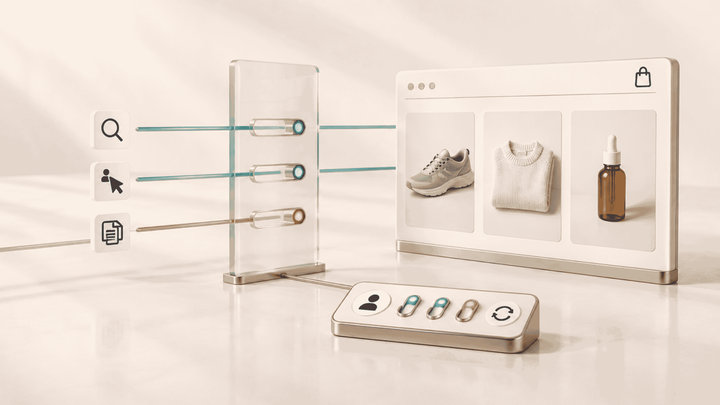
Page-level personalization tools change what visitors and customers see on a page. Think swapped hero banners delivering personalized experiences to returning customers, tailored product recommendation rails, and dynamic category sorting. The system watches clicks, dwell time, browsing history, and behavior in real time, then picks which content variant to render for each customer. Recommendations change based on context.
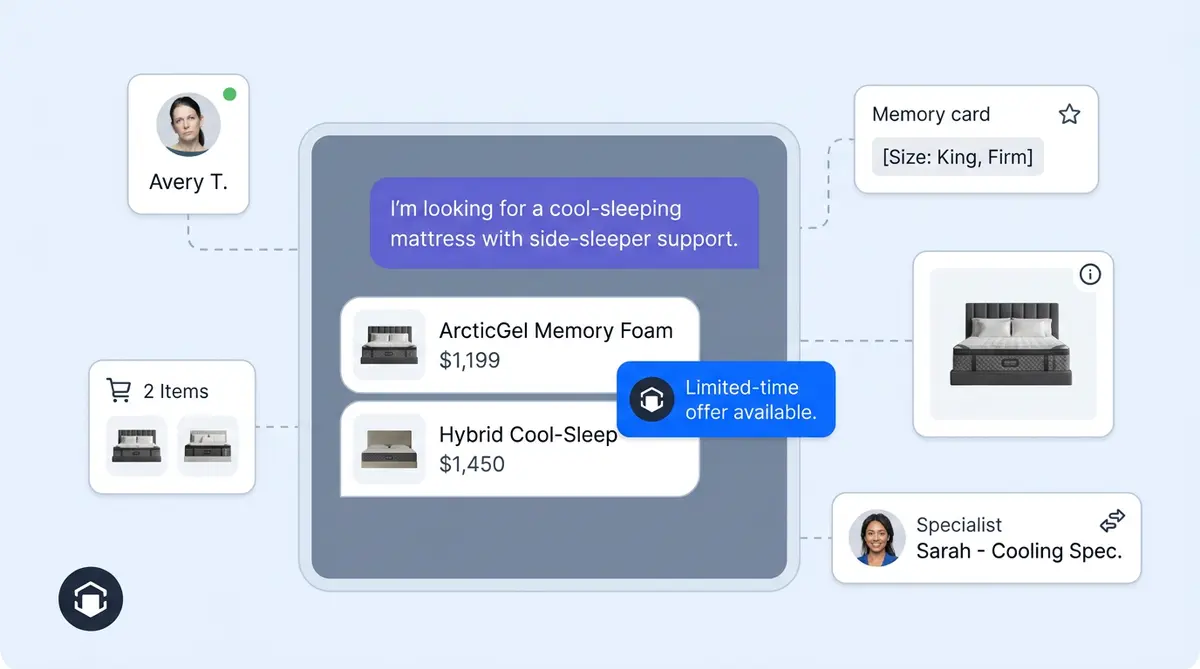
Conversational personalization works differently. It turns browsing into conversations. Shoppers express intent directly, in natural language, and the AI-powered system retrieves relevant products, answers questions, and takes action. Unlike basic chatbots, conversational AI agents reason about context. They hold real interactions and conversations across chat, voice, and social channels to drive customer engagement. The surfaces are different too: a chat widget, AI-powered chatbots, intent-driven proactive nudges on product pages, or messages on WhatsApp and Instagram. Instead of guessing from implicit intent signals and purchase intent, the AI asks and listens.
These two approaches aren't interchangeable. A page-level tool won't help a first-time shopper who types "I need a moisturizer for dry skin." Conversational AI won't swap your homepage hero based on referral source. You're choosing which surface to invest in first. For a deeper look, see our conversational AI vs. page-level personalization breakdown.
How to Decide Which to Deploy First
1. How complex is your catalog?
If you sell 50 SKUs in a single category, page-level personalization may handle discovery well. But if your catalog has hundreds of SKUs with meaningful differences, such as skincare ingredients, furniture dimensions, or technical specifications, shoppers can get stuck. They may not understand why Product A costs twice as much as Product B.
Conversational AI shines here because it can ask clarifying questions and narrow the catalog in ways that static filters can't. Tatcha saw a 3x conversion rate and 38% higher average order value after deploying Alhena's AI Shopping Assistant, which uses purchase history and browsing history to deliver contextual, personalized AI for e-commerce, guiding shoppers through a complex skincare catalog with AI-powered personalized product recommendations and tailored suggestions. (Full case study here.)
2. How much of your support volume is pre-purchase?
Check your helpdesk. If a large share of tickets are "Which size should I get?" or "Does this work with my existing setup?", those are sales and marketing interactions disguised as support tickets. Basic chatbots and behavioral personalization won't address them because they need a two-way conversation that moves shoppers forward in the customer journey.
Alhena's Support Concierge and Product Expert Agent handle these queries across chat, email, Instagram, and WhatsApp. Victoria Beckham Beauty reported a 20% increase in average order value associated with AI-assisted product guidance. (Case study.)
3. Can you measure the lift?
Page-level tools measure lift through A/B tests on page slots. Conversational AI measures lift through engaged-session attribution: did this shopper interact with the AI-powered assistant during their shopping journey, and did they convert?
Alhena's Revenue Impact analytics dashboard tracks total add-to-cart GMV, average cart value for AI-influenced sessions, customer journeys, loyalty metrics, and daily revenue trends. For a deeper look at measurement design, see our guide to holdout tests vs. before-after analysis.
What Conversational Personalization Looks Like in Practice
Multi-agent orchestration. Separate specialized AI systems can handle product discovery, order management, and contextual support. The system routes each query to the appropriate agent based on the shopper's request.
User Memory. Alhena persists facts about each shopper across sessions: name, skin type, purchase history, browsing history, and stated preferences. The next conversation picks up where the last one left off. (Here's how Unified Memory works.)
AI Nudge Technology. Proactive prompts can trigger based on page URL, scroll depth, or time on page. On product pages, Alhena can generate FAQ nudges from the product's data.
Agentic checkout technology. When a shopper confirms a recommended product, the assistant can add that item to a cart or start checkout. Exact capabilities depend on the commerce platform and configuration.
For Shopify merchants, Alhena connects through its Shopify integration. Merchants on other platforms can use platform-specific integration points and APIs for custom workflows.
The Honest ROI Framing
- High-traffic, low-consideration catalogs (fast fashion, consumables): Page-level personalization often delivers more total revenue because small lifts compound across millions of sessions.
- High-consideration, support-heavy catalogs (beauty, electronics, furniture): AI-powered conversational AI typically delivers higher per-customer value across the customer journey because it solves the "I don't know what to pick" problem.
- Mid-market Shopify merchants: Brands that use ai for conversational personalization see tailored customer experience improvements measurable within weeks, not months.
Puffy hit 63% automated inquiry resolution at 90% CSAT. (Case study.) Crocus reached 86% deflection with 84% CSAT. (Case study.) These company-reported results describe different support outcomes; they do not establish that one personalization architecture caused the change.
Use the Alhena ROI Calculator to model what conversational personalization could deliver for your store.
Start With the Conversational Ecommerce Surface That Matches Your Biggest Gap
If shoppers bounce because they can't find the right product in a complex catalog, start with conversational AI. If they land on the right pages but don't convert because the content isn't tailored, start with page-level personalization. Many ecommerce companies and brands will run both, blending page-level changes with real conversations within 18 months. The question is sequencing, not exclusivity.
Ready to see how conversational e-commerce personalization works on your catalog? Book a demo with Alhena AI or start free with 25 conversations.
Alhena AI
Frequently Asked Questions
What is conversational AI personalization in ecommerce?
Conversational AI personalization uses natural-language interactions to tailor the shopping experience. It can ask questions, use stated preferences or permitted customer history, and recommend products within a two-way conversation across supported channels.
How does conversational personalization differ from behavioral personalization?
Behavioral personalization changes page elements based on signals such as clicks or session history. Conversational personalization changes what an assistant says or does based on explicit intent, stated preferences, available context, and the current dialogue.
Which ecommerce stores benefit most from conversational AI personalization?
Stores with complex catalogs or high pre-purchase question volume may benefit when shoppers need help comparing products. The best fit depends on catalog complexity, traffic, integration coverage, and measured outcomes. Alhena's Tatcha case study reports a 3x conversion rate for AI-engaged visitors, but that result should not be treated as a universal benchmark.
How fast can you deploy conversational AI personalization?
Deployment time varies by platform, catalog size, data quality, and integration scope. Alhena offers a Shopify integration; other platforms may require additional integration work.
How do you measure ROI from conversational AI personalization?
Alhena's Revenue Impact dashboard reports Total Add-to-Cart GMV, average cart value for AI-influenced sessions, and daily revenue trends. Use a controlled holdout when available to estimate incremental impact; dashboard attribution alone does not prove lift.
Can you run both behavioral and conversational personalization together?
Yes. Behavioral and conversational personalization can run together because they operate on different surfaces. Sequence them based on the customer-experience gap and the measurement plan.
What is agentic checkout in conversational AI?
Agentic checkout describes a conversational flow in which an assistant can add a selected item to a cart or start checkout after the shopper confirms the choice. Exact capabilities depend on the platform and configuration.