Two Approaches to AI Personalization in Ecommerce
The ecommerce personalization market in 2026 has split into two distinct camps. One rearranges what customers see on a page. The other talks to them. Understanding the difference is the first step toward choosing the right ecommerce personalization approach and the right ecommerce personalization platform for your brand.
Page-Level Personalization: Dynamic Yield's Model
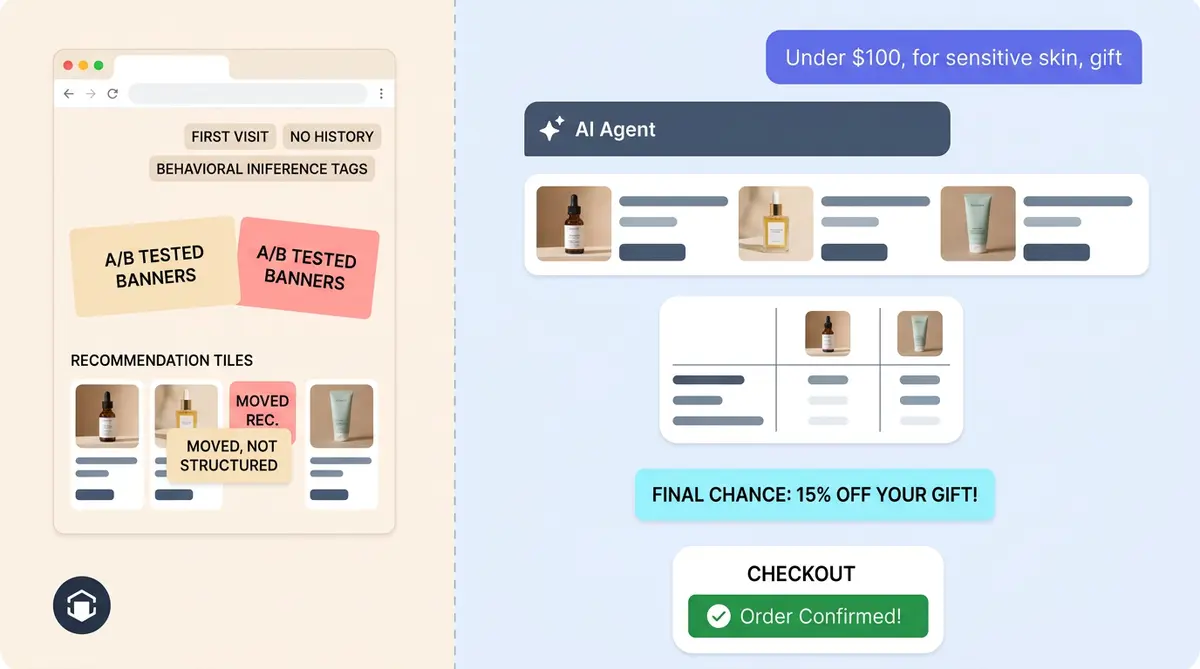
Dynamic Yield, now owned by Mastercard, is a personalization platform in 2026 built around a simple idea: show personalized content to different audience segments. It tracks customer behavior, shopping patterns, and customer data as visitors browse, assigns them through segmentation into customer segments, and swaps page elements with dynamic content accordingly. Hero banners, product recommendations, dynamic pricing widgets, pop-ups, and email templates all change based on behavioral targeting and segment rules and machine learning, predictive AI, and advanced models.
This is passive personalization. The system observes clicks, scrolls, and purchase history, then infers what a shopper might want. It works well when you have enough behavioral data to build accurate segments. But it relies entirely on what the shopper does, not what they say.
Conversational AI Personalization: The Active Approach
Conversational AI flips the model. Instead of guessing from behavioral signals, it asks customers directly: "What are your preferences today?" or "Is this a gift or for yourself?" Each answer narrows the recommendation in real time, giving customers exactly what they need through real-time customer interactions, creating a personalized, contextual interaction that adapts to stated preferences and intent, preferences, and customer needs rather than inferred segments.
This is the approach that Alhena AI's Shopping Assistant takes. It engages customers in natural-language dialogue, understands context in real-time (skin type, budget, preferences, and occasion), and guides customers across every touchpoint, from product discovery to checkout. According to McKinsey, fast-growing companies get 40% more revenue from personalization, but the type of personalization matters. The question for ecommerce businesses isn't whether to personalize. It's which approach delivers more revenue per visitor.
Alhena AI vs Dynamic Yield: At a Glance
Before going deeper, here's how the two platforms compare across the features that matter most for ecommerce brands evaluating an AI personalization ecommerce solution.
Alhena AI vs Dynamic Yield: At a Glance
| Alhena AI | Dynamic Yield | |
|---|---|---|
| Core Focus | Conversational AI for ecommerce sales + support | Page-level personalization + A/B testing |
| Personalization Method | 1-to-1 real-time dialogue with each shopper | Segment-based content swaps across pages |
| First-Visit Handling | Asks intent directly, personalizes from first message | Limited until customer data accumulates |
| Implementation Time | Under 48 hours, no dev resources needed | Weeks to months, requires IT involvement |
| Channels | Web chat, email, Instagram, WhatsApp, voice: every customer touchpoint and channel | Web, email, mobile app, kiosk |
| Checkout Assistance | Agentic: populates carts, pre-fills checkout | None (product recommendations widgets only) |
| Customer Support | Built-in: order tracking, returns, loyalty support | Not included |
| Pricing | Transparent tiers, 25 free conversations to start | Custom quotes, reported starting at ~$35K/year |
What Dynamic Yield Does Well (and Where It Falls Short)
Dynamic Yield's Strengths
Give credit where it's due. Dynamic Yield has spent over a decade refining ecommerce personalization at the page level, and it shows in a few areas.
Its A/B testing and optimization engine is one of the most mature in the market. If your team runs dozens of experiments per month across landing pages, product detail pages, and email templates, Dynamic Yield gives you the statistical rigor to make confident business decisions. Its AdaptML product recommendation engine uses deep learning, predictive analytics, and predictive models to surface products based on browsing patterns, preferences, purchase history, and past purchase behavior, and affinity modeling. For high-traffic sites with rich customer data, these recommendations can move the needle.
The Mastercard acquisition also brought a unique data asset. Through its Element feature, Dynamic Yield can tap into anonymized Mastercard spending signals, giving brands customer insights into offline purchase behavior that pure-play SaaS tools can't match.
Where Dynamic Yield Falls Short
The limitations matter more if you're a mid-market ecommerce brand looking for a dynamic yield alternative that drives direct revenue.
No real conversation. Dynamic Yield launched Shopping Muse in 2023, a generative AI add-on for product discovery. Bergzeit, a European sports retailer, reported a 3.4x conversion lift using it. But Shopping Muse runs on Dynamic Yield's page-level architecture and can't access your CRM, order management system, or real-time inventory data. It doesn't handle automated customer support, process returns, recover abandoned carts through ai-driven outreach, or assist with checkout. It finds products through customized search. That's where it stops.
The cold-start problem. Page-level personalization needs customer data to work. A first-time customer with no browsing history gets generic content. For many ecommerce brands, 50-70% of consumers are new visitors, meaning the majority of your audience gets the weakest version of your site.
Expensive and resource-heavy. Third-party estimates put Dynamic Yield's pricing at $35,000/year and up, with implementation timelines stretching weeks to months. G2 reviewers consistently flag the need for dedicated technical resources and difficult customer support.
No checkout or post-purchase coverage. Dynamic Yield personalizes what shoppers see. It doesn't help customers buy. There's no cart assistance, no checkout solutions, no order tracking, and no returns handling. For the full shopping journey and customer lifecycle, you need additional tools.
How Conversational AI Changes the Equation
The shift from page-level to conversational ecommerce personalization isn't just a feature upgrade. It's a different philosophy about how ecommerce brands should interact with shoppers. Gartner predicts that 60% of brands will use agentic AI for 1-to-1 interactions by 2028. As of 2026, the momentum is clear. Here's why that prediction makes sense.
Intent Understanding vs Behavioral Inference
Page-level tools infer intent from behavior. If someone viewed three moisturizers, the system guesses they want moisturizer and shows more of it. But what if they're shopping for a gift? What if they already bought one and came back for the serum they saw mentioned in a review? Behavioral signals can't capture that nuance.
AI-driven conversational ecommerce personalization captures it in seconds. "I'm looking for a birthday gift for my mom, she has sensitive skin, budget around $80" gives the AI everything it needs to make a personalized recommendation. No guessing. No segment rules. According to Epsilon, 80% of consumers are more likely to buy when brands offer a personalized shopping experience. Conversations build loyalty and deliver that personalization faster and more accurately than page swaps.
Solving the First-Visit Problem
First-time visitors are the blind spot for every ecommerce personalization platform that relies on historical data. Dynamic Yield assigns new visitors to broad segments based on referral source, device type, and geography. That's a blunt instrument.
Conversational ecommerce personalization doesn't need history. It creates context from the first interaction. When a new customer asks "Do you have running shoes for flat feet under $150?", the AI instantly knows their need, foot condition, and budget, driving higher conversions and loyalty from the first visit. That's three data points Dynamic Yield wouldn't have until the visitor browsed for several sessions. Research from Rep AI shows that 64% of AI-powered sales come from first-time buyers, proving that conversations are especially effective with visitors who have zero browsing history.
From Discovery to Checkout in One Conversation
Page-level personalization stops at the product detail page. It can show you the right product, but it can't walk you through sizing, answer customer "will this work with..." question, or pre-fill your checkout. Each of those handoff points hurts customer engagement and creates drop-off risk.
Alhena AI's Shopping Assistant keeps the conversation going from first question to completed purchase. It handles product recommendations, comparisons, answers objections, applies discount codes, and uses agentic checkout to populate the cart and guide shoppers to the payment page. That continuity matters: shoppers complete purchases 47% faster with AI assistance, according to Rep AI's 2025 ecommerce report.
The ROI Case: What the Numbers Say
Numbers tell the real story. Here's how ai-powered conversational personalization compares to page-level optimization on the conversion rate optimization metrics that drive actual revenue from ai personalization ecommerce examples.
Conversion rates. Consumers who engage conversational AI convert at 12.3%, compared to 3.1% for those who don't, a nearly 4x lift (Rep AI, 2025). In 2026, that gap is only widening as more ecommerce businesses adopt ai-driven recommendations. Tatcha, using Alhena AI, saw a 3x conversion rate versus site average and attributed 11.4% of total site revenue to its AI assistant. Dynamic Yield's Bergzeit case study reports a 3.4x conversion lift with Shopping Muse, but that's limited to the product discovery interaction, not the full customer journey.
Average order value. Victoria Beckham saw a 20% AOV increase after deploying Alhena's conversational AI, driven by personalized follow-up suggestions during dialogue. Tatcha's AOV jumped 38%. Barilliance data shows sessions with AI-powered recommendations see 369% higher AOV, but that stat applies broadly to engaged recommendation interactions, not specifically to page-level tools.
Cart recovery. AI-driven ai-driven proactive chats recover 35% of abandoned carts (Rep AI). Dynamic Yield has no native cart recovery through conversation. It can trigger exit-intent pop-ups and retargeting, but those are one-directional, not a dialogue. With average cart abandonment rates at 70% on desktop and 86% on mobile (Baymard Institute), conversational recovery is a significant revenue lever.
Support cost reduction. Alhena's Support Concierge also handles post-purchase inquiries. Puffy resolves 63% of customer inquiries through AI at 90% CSAT, boosting customer loyalty and driving repeat purchases. Crocus deflects 86% of support tickets. Dynamic Yield doesn't touch customer support at all, so these savings don't exist in its ROI calculation. For a full cost-benefit analysis, try the Alhena ROI Calculator.
When to Choose Dynamic Yield vs Alhena AI
This isn't an either/or decision for every brand. Every ecommerce business has different priorities, and the best ecommerce personalization platform for you depends on what problem you're solving first.
Dynamic Yield Fits When...
- You run heavy experimentation programs. If your team tests 20+ page variants per month and needs enterprise-grade statistical analysis, Dynamic Yield's experimentation engine is hard to beat.
- You need offline data signals. The Mastercard Element integration provides anonymized spending data that lets brands analyze customer insights into offline purchase behavior that no other personalization tool offers users.
- Your site has massive traffic and deep behavioral data. Page-level personalization shines when you have millions of sessions feeding segment models. Enterprise retailers with large data science teams get the most from this approach.
- Your budget supports enterprise tools. At $35K+/year plus implementation costs, Dynamic Yield is built for teams that can invest upfront and wait months for ROI.
Alhena AI Fits When...
- You want revenue attribution you can measure. Alhena tracks every conversation that leads to a purchase, giving you clear revenue attribution from AI interactions. No guessing which page swap drove the sale.
- You need fast time-to-value. Deploying in under 48 hours with zero developer involvement means your business sees results this week, not next quarter.
- Your products require explanation and you want to build loyalty. Beauty, skincare, wellness, home furnishing, and specialty retail brands see the biggest lift from conversational personalized product guidance. When shoppers have questions before buying, conversation converts better than page layout changes.
- You want sales and support in one platform. Alhena combines product discovery, checkout assistance, order tracking, and returns handling across the full customer lifecycle. One tool for the entire customer journey instead of three.
- You sell across multiple channels. Alhena's Social Commerce module handles Instagram DMs, WhatsApp, Facebook, and other social media touchpoints plus web chat from one unified platform. Dynamic Yield is limited to web, email campaigns, mobile app, and other touchpoints.
Some brands run both. Dynamic Yield handles page-level optimization for returning visitors with deep behavioral profiles, while Alhena engages new visitors, answers questions, and handles checkout and support. If you're choosing one to start with, the faster ROI typically comes from conversational AI, especially for brands focused on improving the customer experience.
How Alhena AI Approaches Ecommerce Personalization
Alhena isn't a generic chatbot bolted onto your site. It's an ai-powered ecommerce personalization platform. It's a purpose-built ecommerce AI with two specialized agents that work together.
The Product Expert Agent handles everything pre-purchase. It ingests your full product catalog, learns your brand voice, and engages shoppers in personalized guided conversations. When a customer asks "What's the best moisturizer for oily skin under $60?", the agent filters your catalog in real time, explains ingredient differences, suggests cross selling opportunities, and delivers highly personalized product recommendations for complementary products. Unlike Dynamic Yield's recommendation widgets, this isn't a static carousel. It's a dialogue that adapts to each follow-up question.
The Order Management Agent picks up after the sale. It tracks shipments, processes automated returns, handles cancellations, and answers "where's my order?" without touching your support queue. Manawa cut its support workload by 43% and dropped response times from 40 minutes to 1 minute, building lasting customer loyalty using this agent.
Both agents share a hallucination-free architecture. Every response is grounded in your verified product data, knowledge base, and order systems. No fabricated specs, no invented policies, no made-up availability. This is the core difference between Alhena and general-purpose AI tools: it only says what it can verify.
Deployment takes less than 48 hours. Alhena auto-trains on your product feed, help center articles, and past support tickets. It integrates natively with Shopify, WooCommerce, Magento, and Salesforce Commerce Cloud, plus CRM and helpdesks like Zendesk, Gorgias, and Intercom. If you're exploring how other comparison posts stack up, see our Alhena AI vs Rep AI breakdown or the Alhena AI vs Zowie comparison.
The Bottom Line
Dynamic Yield is a strong ecommerce personalization platform for enterprises that need page-level experimentation and have the budget, data infrastructure, and technical team to support it. It's been a market leader in segment-based ecommerce personalization for years, and Mastercard's data assets make it even stronger for brands that can use offline spending signals.
But if you're looking for a dynamic yield alternative that drives measurable, attributable revenue and customer loyalty and brand affinity from day one, Alhena AI operates on a different level for conversions and loyalty. Conversational AI doesn't just show shoppers a different page. It talks to them, understands what they need, and walks them through the purchase. That's why brands like Tatcha see 3x conversion rates and 38% AOV lifts within weeks of deployment.
The conversational commerce market is on a growth trajectory to reach $39.5 billion by 2034 (Fortune Business Insights). The brands that move early in 2026 will capture disproportionate growth. The ones that wait will spend more to catch up. The ones that wait will spend more to catch up.
Ready to see how conversational AI personalization compares to your current setup? Book a demo with Alhena AI or start free with 25 conversations and see the difference in conversions, loyalty, and revenue in your first week.

Frequently Asked Questions
What is the difference between conversational AI and page-level personalization?
Page-level personalization (like Dynamic Yield) changes what appears on your website based on audience segmentation and customer data. Conversational AI (like Alhena) engages each shopper in real-time dialogue to understand their preferences and specific personalized needs. The key difference: page-level tools with product recommendations infer intent from clicks, while conversational AI asks shoppers directly, delivering hyper-personalized 1-to-1 shopping experiences from the first interaction.
Is Dynamic Yield worth the cost for mid-market ecommerce brands?
Dynamic Yield’s reported starting price of $35,000/year, plus the technical resources needed for implementation, makes it a better fit for enterprise businesses with large data science teams. Mid-market businesses often see faster ROI from conversational ecommerce personalization platforms like Alhena AI, which deploy in under 48 hours and start generating measurable revenue within the first week.
Can conversational AI replace Dynamic Yield entirely?
It depends on your needs. If you rely heavily on multivariate page testing and segment-based content swaps, Dynamic Yield fills a role that conversational AI doesn't. But if your priority is driving product discovery, increasing conversion rates, and handling customers through support, conversational ecommerce personalization covers those areas more effectively. Some brands use both, with Dynamic Yield for page-level optimization and Alhena for direct shopper engagement.
How long does it take to see ROI from Alhena AI vs Dynamic Yield?
Alhena AI deploys in under 48 hours with no developer involvement, and brands like Tatcha saw 3x conversion rates shortly after launch. Dynamic Yield typically requires weeks to months of implementation before delivering results, with ongoing IT support needed for optimization. The time-to-value gap is significant for teams that need quick wins.
What ecommerce platforms integrate with Alhena AI?
Alhena AI integrates natively with Shopify, WooCommerce, Magento, and Salesforce Commerce Cloud as ecommerce platforms, plus Zendesk, Gorgias, Intercom, Freshdesk, and other helpdesks for support. It also connects with social platforms (Instagram, WhatsApp, Facebook) for omnichannel coverage. Over 200 global integrations for global markets are available out of the box.
Does Dynamic Yield have a conversational AI feature?
Dynamic Yield launched Shopping Muse in 2023, a generative AI product discovery tool. Michael Kors was the first brand to deploy it in 2024. While Shopping Muse handles natural-language product search, it doesn't cover customer support, checkout assistance, cart recovery, or omnichannel conversations. It's an add-on to Dynamic Yield's page-level platform, not a full conversational AI system.
How does Alhena AI handle first-time visitors with no browsing history?
Alhena's conversational approach eliminates the cold-start problem. Instead of waiting for behavioral data to accumulate, it asks shoppers what they need from the first message. Research shows 64% of AI-powered sales come from first-time buyers, making conversational ecommerce personalization especially effective for brands with high new-visitor traffic.
What is agentic checkout and how does it increase conversions?
Agentic checkout means the AI doesn't just recommend products, it takes action. Alhena AI can populate shopping carts, apply discount codes, and pre-fill checkout fields within the conversation. This removes friction between product discovery and purchase. Shoppers complete purchases 47% faster with AI assistance, reducing the drop-off that happens when customers have to navigate from a recommendation to checkout on their own.