Seven out of ten online shopping carts are abandoned before checkout. That's not a support problem. It's a sales problem. And for most ecommerce brands, the gap between browsing experiences and a completed purchase comes down to one thing: nobody's there to help the shopper buy.
In a physical store, a knowledgeable sales associate reads body language, answers questions, and guides customers to the right product. Online, customer experiences suffer as shoppers are left alone with a search bar and a FAQ page. That's where AI sales assistants are changing the game. They don't just answer tickets. They sell. And they can help at every stage of the buying journey.
This post breaks down seven proven ways AI increases ecommerce sales, backed by real data from brands already seeing results.
Why Most Ecommerce Brands Still Lose Sales Online
The average ecommerce conversion rate sits between 2% and 3%. That means 97 out of 100 visitors leave without buying. The reasons are well-documented: shoppers can't find the right product, they have unanswered questions about sizing or compatibility, or they hesitate at checkout with no one to reassure them.
Traditional chatbots were supposed to fix this. They didn't. Most ecommerce chatbot tools follow rigid scripts, and their capabilities stop at basic FAQ handling, handle basic FAQs, and route everything else to a human agent. They're support tools, not sales tools. They don't recommend products, don't understand purchase intent, and don't help shoppers complete a transaction.
The result? Brands invest in traffic acquisition (paid ads, SEO, influencer campaigns) but lose most of that retail traffic at the point of conversion. According to IBM, only 14% of consumers describe themselves as satisfied with online purchasing experiences. That dissatisfaction translates directly into lost revenue.
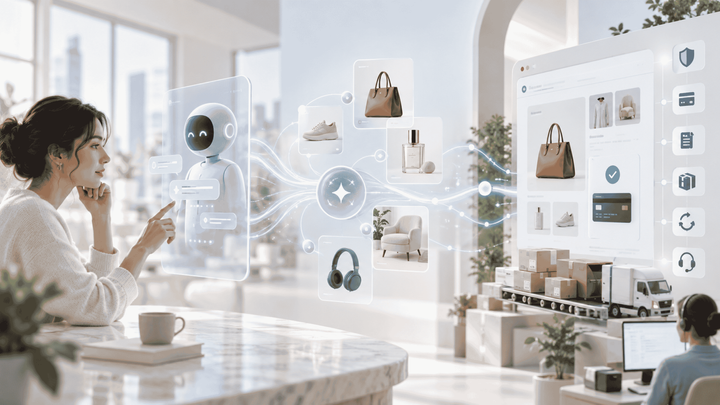
Generative AI for ecommerce changes this equation. Instead of treating AI as a deflection tool for support tickets, the smartest brands now use AI shopping assistants as an active sales channel that engages shoppers, answers product questions in real time, and guides them to checkout.
How AI Increases Ecommerce Sales at Every Funnel Stage
AI doesn't just help at one moment in the shopping journey. It works across the entire funnel, from first visit to post-purchase repeat buying.
Discovery: Helping Shoppers Find What They Want
Most ecommerce search is broken. A shopper types "lightweight running shoes for flat feet" and gets 200 results sorted by bestseller rank. An AI shopping assistant understands the query, filters by arch support, weight, and price range, and surfaces three to five relevant options with explanations for why each fits. Amazon attributes up to 35% of its revenue to its AI recommendation engine, according to Shopify's CRO research.
Consideration: Answering the Questions That Block Purchases
Consumers don't abandon carts because they lost interest. They abandon because they hit a question nobody answers. "Will this moisturizer work with retinol?" "Does this couch fit through a 32-inch doorway?" "Can I return this if the color doesn't match?"
An AI sales assistant trained on your product catalog, return policy, and customer reviews answers these questions instantly, 24 hours a day, across every channel. No wait time, no ticket queue, no "we'll get back to you in 24 hours."
Checkout: Reducing Friction at the Point of Sale
The best AI sales assistants don't just answer questions and hope the shopper figures out the rest. They populate carts, apply discount codes, and pre-fill checkout fields. This is what agentic checkout looks like: the AI handles the transaction mechanics so the shopper doesn't drop off between "I want this" and "order confirmed."
7 AI Sales Strategies Driving Real Ecommerce Revenue
Here are seven specific ways ecommerce brands use AI to sell more, with data to back each one.
1. Conversational Product Recommendations
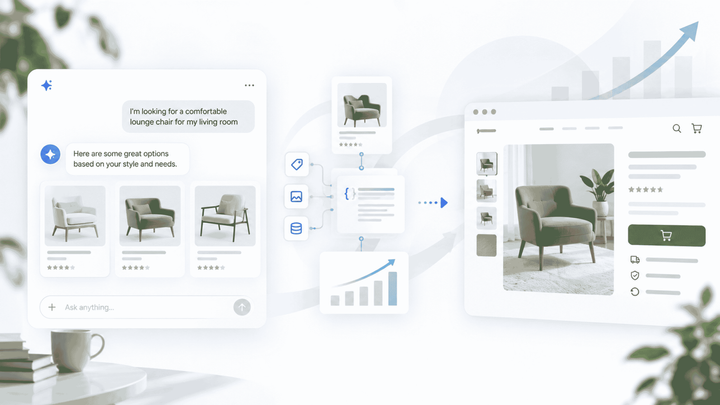
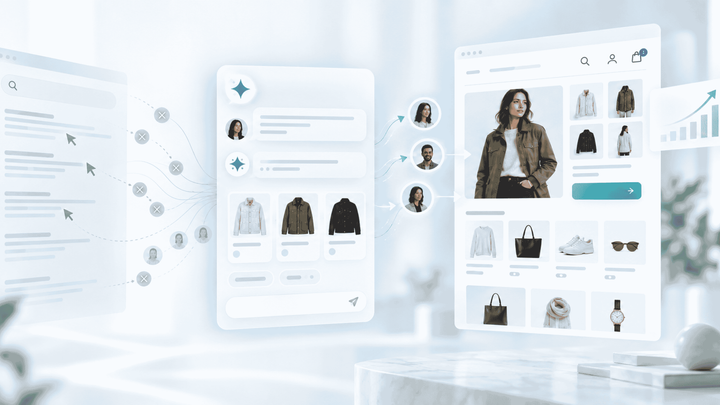
Instead of static "customers also bought" widgets, AI engages shoppers in a guided conversation. It uses customer data like browsing history and preferences, asks about budget and use case, then narrows options down. Brands using conversational product discovery see conversion rates 2.6x higher than site averages.
2. Proactive Engagement at High-Intent Moments
AI identifies when a shopper is stuck, comparing two products for more than 30 seconds or hovering over the size chart. It steps in with a helpful nudge: "Need help choosing between these two? The Classic fits true to size, while the Relaxed runs one size large." This mirrors what a great in-store associate does naturally.
3. Instant Answers Across Every Channel
Shoppers don't always start on your website or mobile app. They DM you on Instagram, email a question, or call your support line. An AI concierge that works across web chat, email, WhatsApp, Instagram DMs, and voice means no sales conversation falls through the cracks, regardless of where it starts.
4. Abandoned Cart Recovery
When a shopper leaves items in their cart, AI can help by following up with a personalized message addressing the specific hesitation. Not a generic "you left something behind" email, but a targeted response: "You asked about the return policy for the Merino sweater. Here's our 30-day free return guarantee. Ready to complete your order?" Brands using AI-driven cart recovery report recovery rates of 35% on previously abandoned sessions.
5. Upselling and Cross-Selling with Context
AI doesn't just suggest the most expensive option. It recommends complementary products based on what the shopper already selected and what similar customers purchased. "Customers who bought this foundation also added the setting spray, and 89% rated the combo five stars." Context-aware upsells feel highly relevant and helpful, not pushy.
6. Post-Purchase Support That Drives Repeat Sales
An AI support concierge handles order tracking, returns, and exchanges without human involvement. But it also uses that interaction as a sales moment: "Your running shoes shipped today. Based on your purchase, you might like these moisture-wicking socks, now 15% off for returning customers."
7. Revenue Attribution and Optimization
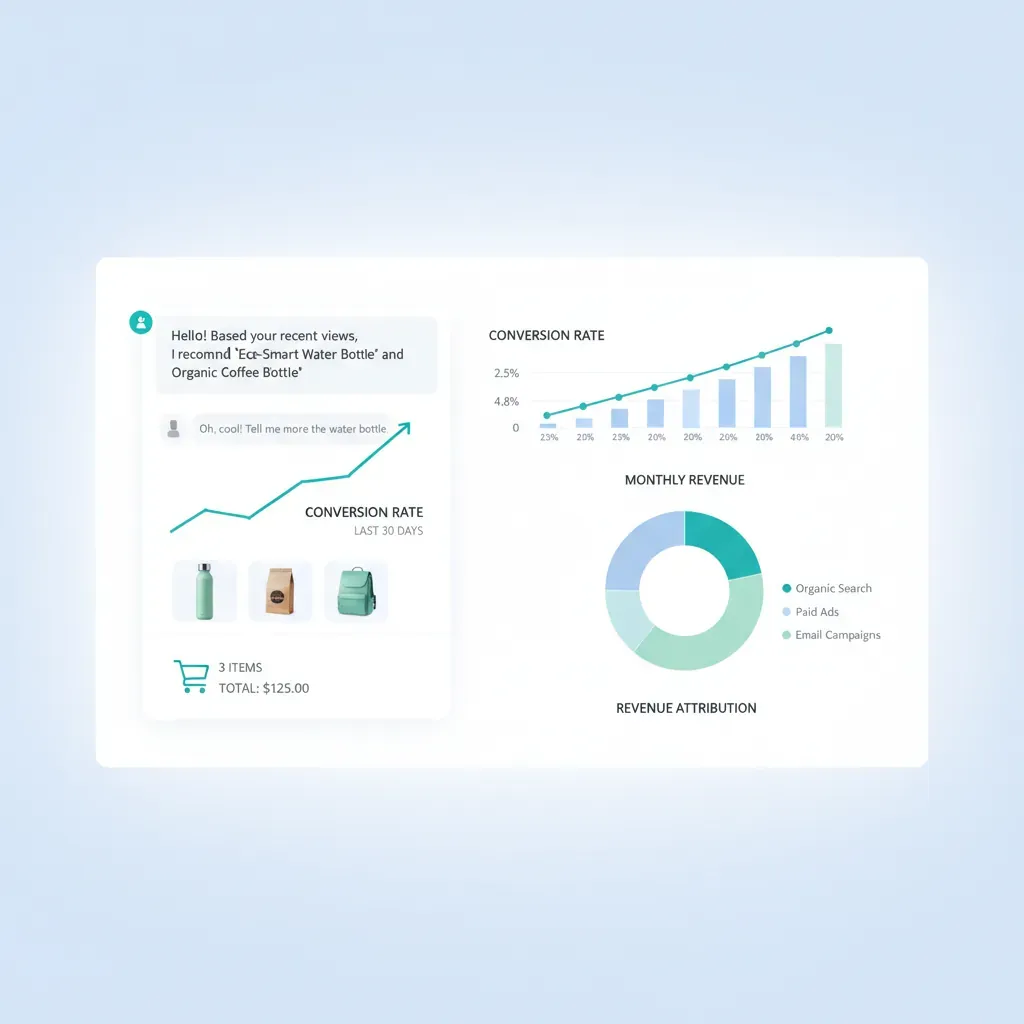
You can't improve what you can't measure. AI platforms with built-in revenue attribution show exactly which conversations led to purchases, the average order value of AI-assisted sales, and which product categories benefit most from AI engagement. This data lets you double down on what works.
What Separates an AI Sales Assistant from a Chatbot
Not all ecommerce AI is built to sell. Most chatbots, including the AI features built into platforms like Zendesk, Intercom, and Gorgias, focus on ticket deflection. They're designed to reduce support costs, not generate revenue.
An AI sales assistant is fundamentally different. It's trained on your product catalog, understands purchase intent, recommends products conversationally, and can complete transactions. The distinction matters because the ROI model is completely different. A support chatbot saves you money. An AI sales assistant makes you money.
There's also the accuracy question. Generic AI models can hallucinate, generating plausible-sounding but incorrect product information. That's a dealbreaker for ecommerce, where a wrong sizing recommendation, fabricated ingredient list, or inaccurate fraud policy information erodes trust instantly. The best AI sales assistants ground every response in verified product data, eliminating hallucinations entirely.
Real Results: Ecommerce Brands Using AI to Sell More
The numbers aren't theoretical. Brands across beauty, home furnishing, fashion, and travel are already using AI as a sales channel with measurable results.
Tatcha, the luxury skincare brand, saw a 3x conversion rate from AI-assisted shoppers compared to the site average, with a 38% increase in average order value. Their AI shopping assistant now drives 11.4% of total site revenue, making it one of the highest-performing sales channels in their stack.
Victoria Beckham achieved a 20% lift in average order value after deploying an AI sales assistant that helps shoppers find the right shade, understand ingredients, and build multi-product routines.
Puffy, a direct-to-consumer mattress brand, automated 63% of all customer inquiries while maintaining a 90% customer satisfaction score. For high-consideration purchases like mattresses, AI-powered product guidance makes a direct impact on buyer confidence.
Manawa, a travel and experiences marketplace, cut response times from 40 minutes to 1 minute and reduced team workload by 43%, while automating 80% of customer inquiries. Faster responses mean fewer lost bookings.
These results share a common thread: AI isn't just handling support. It's actively selling, recommending products, answering pre-purchase questions, and removing friction at checkout.
How to Get Started with AI for Ecommerce Sales
You don't need a data science team or a six-month implementation timeline. The fastest path to AI-driven ecommerce sales follows three steps.
Step 1: Connect your product catalog. The AI needs your product data, descriptions, images, pricing, inventory levels, and customer reviews. Most modern systems pull this directly from Shopify, WooCommerce, or Salesforce Commerce Cloud without any custom development.
Step 2: Train on your brand voice. Your AI sales assistant should sound like your brand, not like a generic bot. Upload your tone guidelines, FAQ content, and creative assets like top-performing sales scripts. The best platforms learn your voice from existing content automatically.
Step 3: Launch and measure. Start with web chat, track conversion rates and revenue attribution for 30 days. Analyze which conversations drive the most value, then expand to email, social DMs, and voice. The data from your first month tells you exactly where AI drives the most sales value.
How Alhena AI Turns Browsing Into Revenue
Alhena AI is purpose-built for ecommerce sales, not adapted from a support platform. It combines two specialized agents: a Product Expert Agent that handles product discovery and search, recommendations, and guided selling, and an Order Management Agent that manages order tracking, returns, and exchanges.
What makes Alhena different from Zendesk AI, Intercom Fin, Tidio, or Freshdesk bots is the sales DNA. Alhena's AI populates carts, pre-fills checkout, and attributes revenue back to every conversation and measures which conversations convert. It deploys in under 48 hours, works across web chat, email, Instagram, WhatsApp, and voice, and grounds every response in your verified product data with zero hallucinations.
Brands using Alhena see an average 340% ROI in year one, with 64% of AI-driven sales coming from first-time shoppers. That's net-new revenue, not cannibalized from existing channels.
Ready to see how AI can increase your ecommerce sales? Book a demo with Alhena AI to see it in action, or start free with 25 conversations and measure the results yourself.
Frequently Asked Questions
How does AI increase ecommerce sales?
AI increases ecommerce sales by recommending products through guided conversation, answering pre-purchase questions instantly, recovering abandoned carts with personalized follow-ups, and reducing checkout friction and improving shopping experiences with agentic checkout features like cart population and discount code application. Brands using AI sales assistants see conversion rate lifts of 2x to 3x compared to site averages.
What is an AI sales assistant for ecommerce?
An AI sales assistant is an intelligent system powered by machine learning and trained on your product catalog that engages shoppers in real-time conversation, recommends products based on their needs, answers product questions, and helps complete purchases. Unlike support chatbots that focus on ticket deflection, AI sales assistants are designed to generate revenue by guiding shoppers from discovery to checkout.
How is an AI sales assistant different from a chatbot?
Traditional chatbots follow scripted flows and handle basic FAQs. An AI sales assistant understands purchase intent, makes personalized product recommendations, handles complex product questions, and can populate carts or pre-fill checkout. The key difference is the goal: chatbots reduce support costs, while AI sales assistants drive revenue.
What results do ecommerce brands see with AI sales assistants?
Results vary by brand and vertical, but published case studies show strong outcomes. Tatcha achieved a 3x conversion rate and 38% AOV uplift. Victoria Beckham saw a 20% increase in average order value. Puffy automated 63% of inquiries at 90% customer satisfaction. Most brands report ROI within the first 90 days of deployment.
Can AI sales assistants work on Shopify, WooCommerce, and other platforms?
Yes. Leading AI sales assistants integrate directly with Shopify, WooCommerce, Magento, and Salesforce Commerce Cloud. They pull product data, inventory levels, and pricing automatically from your store, with no custom development needed. Most platforms also connect with helpdesks like Zendesk, Gorgias, and Freshdesk.
How long does it take to set up an AI sales assistant?
Modern AI sales assistants deploy in 24 to 48 hours. Setup involves connecting your product catalog, uploading brand guidelines, and configuring channels. Platforms like Alhena AI pull data from your ecommerce platform automatically, so no engineering resources are required.
Does AI-driven selling work for high-consideration purchases?
Yes, and it often works even better. For products like mattresses, furniture, skincare routines, and electronics, shoppers have more questions and longer decision cycles. AI sales assistants provide instant, detailed answers that build confidence and reduce the hesitation that causes cart abandonment. Puffy, a mattress brand, automated 63% of inquiries while maintaining 90% customer satisfaction.
How do you measure the ROI of an AI sales assistant?
Look for platforms with built-in revenue attribution that tracks which AI conversations led to purchases, the average order value of AI-assisted sales, and the percentage of total revenue influenced by AI. Alhena AI, for example, provides real-time dashboards showing revenue attributed to AI interactions, conversion rates, and CSAT scores. Use the ROI calculator at alhena.ai/roi-calculator to estimate your potential returns.