The Promise of the Visual Chatbot Builder
Every major e-commerce chatbot builder now ships some version of an "Agent Studio", a no-code interface where you drag boxes, connect arrows, and map out conversational chatbot flows. The pitch: build an AI chatbot that can drive sales, handle customer support queries, and automate cart abandonment recovery, all live by Friday.
For a narrow set of use cases, it works. But for e-commerce businesses dealing with real catalog complexity, policy nuance, and shoppers across multiple channels, the studio approach creates more problems than it solves.
Four Cracks in the Studio Approach
1. The long tail eats the canvas
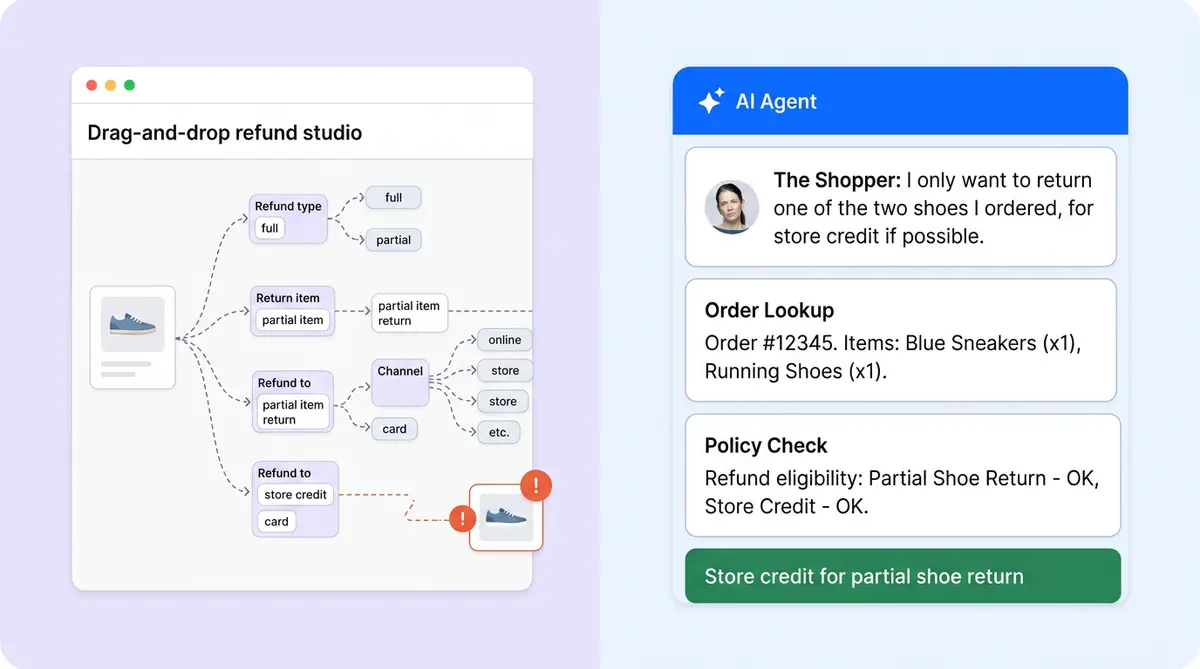
Pre-built flows cover maybe 20 happy paths. Real shoppers don't follow scripts. "Refund just the shoes; keep the dress" breaks a bot flow built for full-order returns. Every edge case means another branch, another maintenance ticket for your human agents to handle.
2. Flows assume you know the question in advance
When a shopper asks something the canvas didn't anticipate, the e-commerce chatbot falls back to "Let me connect you with an agent." That's not real value for the customer experience. That's a delayed transfer.
3. Maintenance is a hidden tax
Every promo, policy update, or SKU change means opening the studio to edit flows. Multiply that across live chat, email, voice, and WhatsApp. One missed update on one channel erodes customer satisfaction and trust.
4. Drag-and-drop hides decisions
The hard part of handling customer inquiries isn't laying out boxes. It's deciding when to refund, how to verify identity, and what to escalate. Studios push that judgment back onto whoever drags the boxes, not onto an AI agent that can reason through it.
What "Agentic" Means for Ecommerce
The alternative is an AI-powered agent that plans at runtime. Instead of following a fixed path, a planner agent reads the shopper's message, decides which tools to call, executes them, and replans if needed. Think of it as conversational AI that reasons through customer interactions rather than following a script.
This is how Alhena AI works. There's no visual canvas because the reasoning happens inside the model. In practice:
- Live data, not cached snapshots. Alhena calls your e-commerce platform's APIs in real time for order tracking, order status, and product catalog lookups across Shopify, WooCommerce, and your helpdesk. No stale inventory. We've covered why fresh data changes everything for AI assistant accuracy.
- Guardrails on every action. Before the AI agent processes a refund, cancels an order, or shares PII, it runs a confirm, log, and escalate framework. No human agents need to pre-map every branch.
- Continuous learning. Your team updates a guideline from the knowledge base, not a flow diagram. One change applies across every chat channel automatically. Alhena's continuous learning architecture keeps improving customer engagement over time.
- Cross-channel memory. A shopper who starts on Instagram and follows up via email doesn't repeat themselves. Unified Memory carries context across every touchpoint, improving the full customer journey.
The Refund Test
Studio path: An admin drags an "if intent = refund" node, connects it to "lookup order", and branches into "eligible" and "ineligible". Then a shopper says, "Refund only the shoes, but give me store credit." The automated flow doesn't have that branch. The bot escalates to human agents.
Agentic path: The AI assistant identifies the intent (partial refund), the item (shoes), and the preferred resolution (store credit). It verifies identity, calls the order API, checks the return policy, and confirms with the shopper. No box dragged. Conversations resolve in real time instead of stalling, which means fewer abandoned carts from confused shoppers.
The work moved from build-time to run-time. Your team focuses on customer support policies, not on maintaining a visual graph that grows more fragile with every edge case.
When a Studio Makes Sense
Studios aren't always wrong:
- Highly regulated, deterministic workflows where every branch must be pre-audited.
- Very low query volume where a few automated macros cover 90%+ of customer queries.
For most e-commerce businesses with growing product catalogs and business needs that span commerce, customer support, and personalized customer engagement, the studio creates ongoing drag. The ecommerce AI maturity model can help you figure out where your team falls.
Five Questions to Ask Any Vendor
- "What happens when a shopper asks something you didn't anticipate?" Studios escalate. AI agents with conversational AI reason through it.
- "How do policy changes propagate?" "Edit each flow" is studio. "Update one guideline" is agentic.
- "How fresh is the data?" Cached syncs miss real-time inventory and order status changes.
- "Which channels share memory?" Separate silos mean shoppers repeat themselves, hurting the customer experience.
- "Can the AI agent drive sales, or only deflect?" AI shopping assistants that recover abandoned carts and handle cart-to-checkout conversion are a different category from chatbot builders that only automate support.
The Canvas Is in the wrong place.
Studios were the right answer for the bot era. For the AI-powered agent era in 2026, the canvas belongs in the model's reasoning, not in an admin's mouse.
Don't start by comparing who has the prettier chatbot builder. Start by asking whether you need one at all. For most e-commerce teams, configuring agentic workflows without scripts gets you further, faster.
Ready to see the difference? Book a demo with Alhena AI or start free with 25 conversations.
Frequently Asked Questions
What is an AI agent studio?
An AI agent studio is a visual, no-code interface where teams build chatbot conversation flows by dragging and connecting nodes. It works for simple, predictable interactions but struggles with the long tail of real customer queries and conversations.
Why do drag-and-drop chatbot builders break at scale?
Pre-built flows only cover the paths someone mapped in advance. Ecommerce shoppers ask hundreds of variants (partial refunds, item swaps, credit vs. card). Each new edge case requires a manual update to the canvas, creating compounding maintenance.
How does agentic AI handle requests without pre-built workflows?
An agentic system uses a planner that reads the shopper's message, identifies the intent and entities, calls the relevant APIs, checks policies, and takes action at runtime. No one needs to pre-map every branch.
Does Alhena AI use a visual workflow builder?
No. Alhena uses a planner-led multi-agent architecture where reasoning happens inside the model, not on a drag-and-drop canvas. Teams configure behavior through guidelines, not flow diagrams.
Can agentic AI handle refunds and order changes automatically?
Yes. Alhena's agents verify shopper identity, call live order APIs, apply return policies, and confirm actions with the shopper before processing. Brands like Puffy resolve 63% of inquiries automatically with 90% CSAT.
How do I know if my ecommerce brand needs a studio or an agentic system?
If you have a growing catalog, frequent policy changes, and shoppers across multiple channels, an agentic system will scale better. Studios work best for very low query volume or highly regulated, deterministic flows.