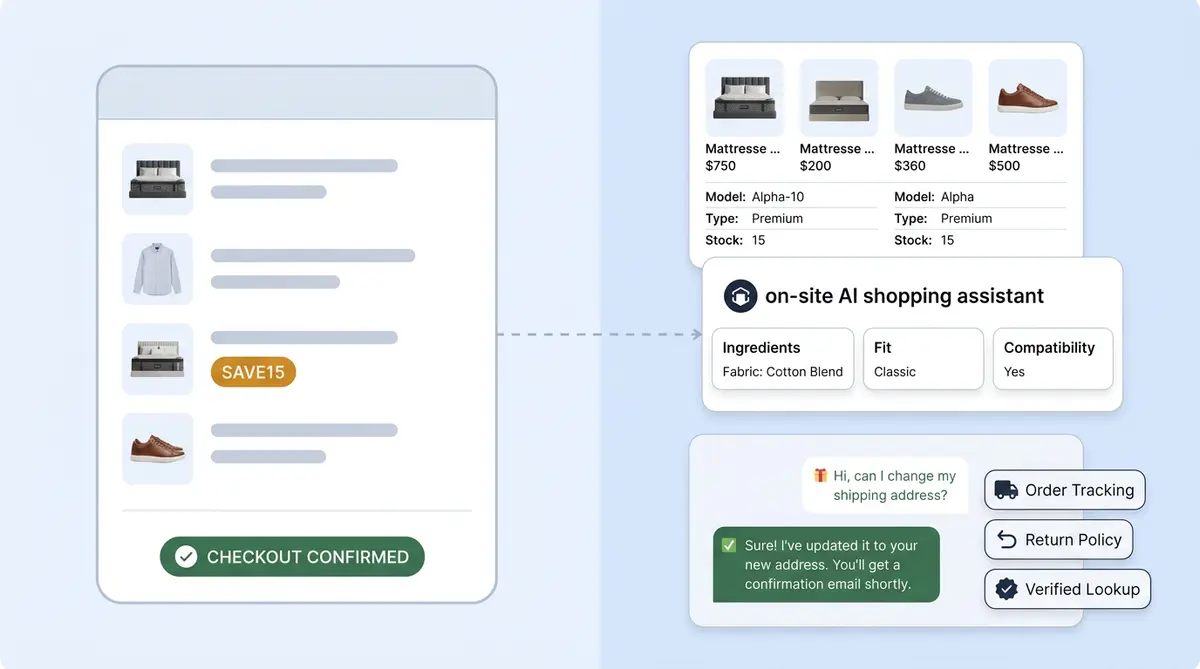
In January 2026, Google and Shopify launched the Universal Commerce Protocol (UCP), an open protocol, enabling conversational commerce and agentic checkout directly inside the Google Gemini app, Google AI Mode, and Google Search. Retailers like Gap, Walmart, Wayfair, and Etsy (major retailers) were the first wave. By April 2026, Gap completed a full in-conversation checkout inside Gemini without the shopper ever visiting gap.com.
For millions of Shopify merchants whose catalogs now flow into Google's AI, this isn't something you opted into. It happened to your store. The question isn't whether agentic commerce is real. It's what you still control now that AI chatbots are becoming storefronts.
What Google Gemini Now Owns: Where Retailers Sell in the Shopping Journey
When a user asks Google Gemini a natural language query like "find me a lightweight moisturizer under $40," Google's model decides which products appear, in what order, and with what context. The shopper can add to cart, process payments via Google Pay and other payment methods, redeem loyalty points, and check out without ever leaving the conversation. Unlike Google Ads, there's no click to a landing page.
Your product detail pages, your on-site reviews, your product listings: none of that gets surfaced unless Google's AI decides it's relevant. Three things shifted out of your hands:
- Product discovery. Google Gemini controls which items appear based on its own ranking signals and user queries, rather than your merchandising rules.
- The pre-sale conversation. You don't control how Gemini describes your product or what it compares it against. Shoppers see Google's summary rather than your curated content.
- Attribution. A Gemini sale looks different in your Shopify analytics. Your team needs to connect attribution tools and set UTM parameters, but data gaps persist.
We covered the mechanics of instant checkout in AI search in detail, including what works and what's still hype.
What You Still Own (and Should Double Down On)
Gemini is now a sales channel that handles discovery for some shoppers, but it doesn't replace your storefront, your support experience, or your customer relationships.
Product Data Quality
Gemini pulls from your Shopify product feed (configured in Shopify admin) via Google Merchant Center. Clean titles, detailed product descriptions, real-time inventory, structured product attributes (size, color, material), schema markup, high-quality images, GTINs, and accurate product data directly affect whether your items surface as a Google product listing at all. If you've already optimized your Shopify store for selling using ChatGPT Shopping (when consumers ask ChatGPT for product recommendations), the same feed hygiene applies across every AI shopping surface, including Google Gemini, Google AI Mode, Microsoft Copilot, and OpenAI's ChatGPT.
Your On-Site Experience
Not every Gemini interaction ends in a purchase. Shoppers can browse in Google Gemini, then visit your site to compare options, read reviews, or ask detailed questions. When they arrive, your AI shopping assistant picks up with product discovery expertise Gemini can't match: ingredient breakdowns, fit guidance, intent-based recommendations, and compatibility checks grounded in your actual catalog data.
Shopify brands like Tatcha saw a 3x conversion rate and 38% higher AOV when shoppers engaged with an on-site AI assistant. That lift happens on your domain, under your brand voice in the retail landscape.
Your Post-Purchase Relationship
Gemini completes the checkout, then disappears. The shopper still needs order tracking, returns processing, and product support. Your support concierge handles that. We covered the five post-purchase gaps in AI-mediated commerce that most brands haven't solved. Gemini widens those gaps because the buyer enters your system with less context than a typical site visitor.
Getting identity verification right on Shopify order lookups matters more when the original purchase didn't happen on your site.
Your AI Visibility
You can't control Gemini's ranking algorithm, but you can monitor how your products appear across AI shopping surfaces and track what content those engines cite when recommending your brand. Third-party reviews, structured data, and comparison content all feed into whether Google Gemini includes your products.
Where Alhena Fits, and Where It Doesn't
Alhena AI does not place your products inside Google Gemini. That pipe runs through Google's UCP and your Shopify product feed. Alhena doesn't handle the agentic checkout inside Gemini, and it doesn't guarantee your products will rank.
What Alhena does:
- Monitors your AI visibility across ChatGPT and Gemini so you know how your products are represented.
- Runs the conversation on your storefront through an AI shopping assistant built for Shopify, so Gemini-referred shoppers get hallucination-free, guided product discovery.
- Handles post-purchase support for every order, regardless of where it originated, with verified customer identity.
- Keeps memory unified across every channel: web chat, email, Instagram, WhatsApp, and voice.
Google Gemini owns the first click for a growing share of shoppers. Your job is to own everything that happens next. For a deeper look at how each AI shopping platform differs, see our comparison of ChatGPT, Gemini, Perplexity, and Google AI Mode.
Ready to cover both sides of the AI shopping journey? Book a demo with Alhena AI or start free with 25 conversations.
Frequently Asked Questions
Do Shopify merchants need to opt in to Gemini shopping?
No. Shopify Agentic Storefronts are rolling out to all eligible stores by default. If your product feed is active in Google Merchant Center, your catalog appears in Google Gemini and Google AI Mode automatically.
Does Alhena AI place products inside Gemini's chat?
No. Product placement in Gemini runs through Google's Universal Commerce Protocol and your Shopify product feed. Alhena adds a visibility and analytics layer and monitors (within days of implementation) how your products appear across AI shopping surfaces and runs the AI experience on your own storefront.
Will Gemini checkout cannibalize my direct site traffic?
Some purchases will shift to in-chat checkout, but many shoppers still visit the brand site for research and post-purchase support. Brands with on-site AI assistants report 3x conversion rates.
How can I track sales that come from Gemini?
Attribution is still evolving. Distinguishing Gemini sales from direct purchases requires UTM parameters and referral monitoring. Alhena's revenue attribution tracks AI-assisted conversions on your site.
What's the difference between Gemini shopping and ChatGPT shopping for Shopify?
Both let consumers buy products inside AI interfaces. Gemini runs on Google's Universal Commerce Protocol with native checkout. ChatGPT uses Shopify Agentic Storefronts with a different feed pipeline. Product data hygiene requirements are similar for both.
How does Alhena help with Gemini-referred shoppers?
Alhena's AI Shopping Assistant picks up where Gemini leaves off. When a shopper visits your site after browsing in Gemini, Alhena provides hallucination-free product guidance, builds carts, and handles post-purchase support with verified customer identity.