ChatGPT Instant Checkout: What Happened and What Merchants Do Now
Instant Checkout didn't die because shoppers refuse to buy from an AI. It died because the hard part of agentic commerce was never the conversation. It was the completion.
For a while there, the smartest people in retail were all preparing for the same future. A shopper would describe what she wanted, ChatGPT would find it, and she would buy it without ever seeing a product page. No site. No cart. No merchant brand. Just an answer and a confirmation.
On September 29, 2025, that future got a name. OpenAI shipped Instant Checkout with Etsy and Shopify, built on an open payments spec it had written with Stripe. Etsy's stock jumped roughly 16% on the news. Conference keynotes got rewritten. A lot of merchants spent Q4 quietly wondering whether their storefront had a year left.1
Then, on March 24, 2026, OpenAI published a post called Powering Product Discovery in ChatGPT. There was no press tour. The sentence that mattered sat in the second paragraph: the first version of Instant Checkout "did not offer the level of flexibility that we aspire to provide", so merchants would go back to using their own checkout.2
The button was gone. Most of the coverage read it as a verdict on AI shopping. We'd argue it was something much more specific, and much more useful to anyone building for this channel.
The Short Version
- Instant Checkout is retired. It launched September 29, 2025 and was wound down in March 2026. ChatGPT still recommends products; the purchase now happens on your site, in an in-app browser or a new tab.
- It failed on conversion math, not on principle. Walmart measured in-chat purchases converting at about one-third the rate of click-throughs to Walmart.com. Fewer than about 30 Shopify merchants ever turned it on.3
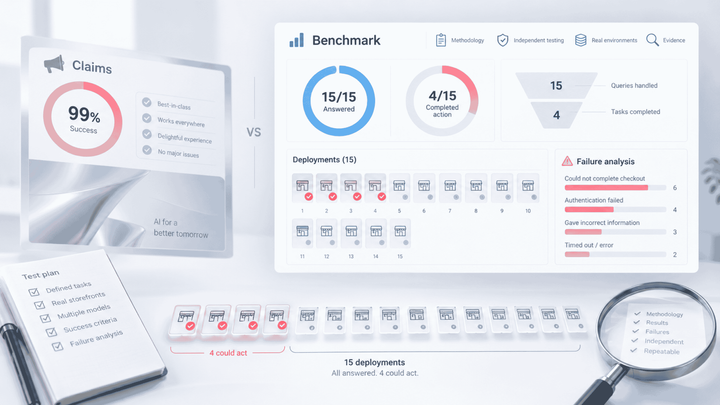
- Our read: this was an agentic gap, not a demand problem. The wall OpenAI hit at the payment step is the same one most on-site AI assistants hit at the order lookup. In our own testing, 15 of 15 live deployments could answer a question and only 4 could complete an action.
- AI shopping traffic did not fail. Adobe recorded a 693% year-over-year jump in AI-referred retail traffic over the 2025 holidays, and by March 2026 that traffic converted 42% better than non-AI traffic.
- The work moved to your side of the handoff: feeds, structured data, crawler access, third-party mentions, and a landing experience that can finish what the chat started.
What Happened to ChatGPT Instant Checkout?
OpenAI discontinued it and replaced it with a discovery-first model. Shoppers still find products inside ChatGPT, but they complete the purchase on the merchant's own store or inside a retailer's native ChatGPT app.
The chronology is tight. Instant Checkout launched with Etsy sellers on September 29, 2025, alongside the open-sourced Agentic Commerce Protocol, and Walmart and Sam's Club joined two weeks later. Shopify catalogs went live in January 2026, and the broad U.S. rollout that February is the moment most people remember as launch. Six weeks after that it was effectively over. Walmart's Daniel Danker called the in-chat setup "a very temporary period" on March 4, its conversion numbers went public via WIRED on March 18, and OpenAI confirmed the pivot to discovery on March 24. By September 16, 2026, OpenAI had announced advertising inside ChatGPT, including a Shopify app, which settled the question of how this channel gets monetized: through ads, not a cut of checkout.
Note that the protocol survived even though the product didn't. ACP is still live, still open source, and still how ChatGPT reads your catalog. What changed is where the money moves.
Why Did Instant Checkout Fail?
Because the people who ran the numbers found that shoppers who bought inside the chat bought less often than shoppers who clicked out.
Walmart was the only partner big enough to produce a clean read, and its EVP of AI acceleration, Daniel Danker, gave that read to WIRED in March 2026: in-chat purchases converted at one-third the rate of shoppers sent to Walmart.com. Internally the figures looked like a 1.18% conversion rate and roughly 77% cart abandonment, against a 2.5–3% ecommerce norm.3
Three things broke it, and all three are instructive:
The Cart Was Too Dumb
Launch supported a single item. No bundles, no accessories, no "you'll need the wall mount too." Walmart deliberately withheld categories like TVs for exactly this reason. Anyone who has ever built an AOV target knows what happens when you strip out attachment.
Merchants Had Nothing to Sell With
No upsells, no loyalty, no discount codes, no post-purchase flow, no marketing opt-in. The chat window was a vending machine with your logo taped to the front.
Almost Nobody Showed Up
Forrester's Emily Pfeiffer put live Shopify merchants at around 30. Out of millions. That is not a rollout, that is a pilot that never graduated.
Every one of those is a completion problem. None of them is a demand problem. Hold onto that distinction, because it is the whole story.
Our Read: An Agentic Gap, Not a Demand Problem
Instant Checkout could hold a shopping conversation. It could not reliably finish a purchase. That distance between discussing a task and completing it is the defining constraint in agentic commerce right now, and OpenAI is not remotely alone in hitting it.
We went looking for this pattern on purpose. In our 2026 Agentic CX Stress Test, we ran first-hand conversations against 15 live AI deployments on real brand storefronts across 11 verticals, behaving as ordinary shoppers rather than evaluators with a checklist. Every single one could answer a question. Four demonstrated a completed action.
The dimension scores tell the same story more precisely:
| Dimension | Average score | What it measures |
|---|---|---|
| Context | 3.00 | Understanding what the shopper is asking for |
| Accuracy | 2.47 | Getting the substance of the answer right |
| Agentic Capabilities | 1.60 | Actually doing the thing the shopper asked for |
Those are results for our tested sample, not an independently established industry average, and we'd ask you to treat our research with the same skepticism you'd apply to any vendor's. But the shape is hard to miss. Comprehension is close to solved. Execution is somewhere around half-built.
Which brings us to the part of the Instant Checkout story we think got underplayed. OpenAI has more engineering talent, more capital and more model access than any merchant reading this, and it still could not make the completion layer good enough to keep. That should recalibrate two things at once. It should lower your confidence in any vendor demo where an agent breezily "handles" a transaction. And it should raise your estimate of how much value sits in the completion layer, precisely because it stays hard.
The channel moved. The bottleneck didn't.
So Is AI Shopping Traffic a Bust?
No. It is the fastest-improving traffic source most merchants have.
Adobe Analytics, which tracks more than a trillion visits to U.S. retail sites, found AI-referred retail traffic up 693.4% year over year across November and December 2025. Growth cooled in 2026 (+393% in Q1, +269% in March) but stayed in triple digits.
The more interesting number is quality. In March 2025, AI-referred traffic converted 38% worse than other sources. In March 2026, it converted 42% better. By May 2026 Adobe put the gap at 54%, with 53% more time on site and 23% more pages per visit. That is an 80-point swing in twelve months, and it is the clearest signal available that people arriving from an AI answer have already made most of the decision.
Salesforce measured the same thing from the revenue side, attributing $262 billion in 2025 holiday sales to AI and agent influence. Director of consumer insights Caila Schwartz called agents "the operational heroes of the season."
Two honest caveats, because these numbers get abused. Adobe reports growth rates, not base volume, and the base is small; 693% of very little is still not very much. And last-click attribution systematically undercounts AI, since plenty of shoppers discover a product in ChatGPT and then return through a branded Google search to buy. The direction is real. The magnitude in your own GA4 will look smaller than the headlines.
Walmart found the same split, by the way. In-chat checkout converted badly, but ChatGPT drove roughly twice the new-customer rate of search. Discovery worked. Checkout didn't.4
What ChatGPT Shopping Looks Like in September 2026
Products surface organically in chat, ranked on relevance, price, availability and quality signals. There is no paid placement in organic product results. The shopper taps through and lands on your store, in an in-app browser on mobile or a new tab on desktop. Shopify's Mani Fazeli framed it plainly when the change landed: "Millions of Shopify merchants are open for business in ChatGPT."2
For Shopify stores, the plumbing is already done. Shopify Catalog syndicates to ChatGPT, Google AI Mode, Gemini and Copilot from a single setting, and it is on by default for eligible U.S. stores. On other platforms, ACP is three checkout endpoints plus order webhooks, or nothing at all if you only want discovery.
On the Fee Everyone Still Quotes
The 4% was specific to Shopify's Instant Checkout integration, and it effectively ended when the feature did. Discovery and redirect traffic from ChatGPT carries no OpenAI platform fee today, and no replacement has been announced. You pay your normal processing. If a vendor is pitching you on "avoiding the ChatGPT 4%," they are selling against a fee that no longer applies.
The Handoff Is Now Your Problem
The part that never changed, and the part most merchants got wrong in 2025: OpenAI was never the merchant of record. Settlement, refunds, chargebacks, fulfillment, support and compliance always stayed with you. You kept the customer. You just couldn't see them.
That used to read like an accounting detail. Now it's the whole job. Every shopper ChatGPT sends you lands on your site mid-decision, several exchanges into a conversation you never saw, carrying questions the chat already half-answered. Whatever happens in the next thirty seconds is entirely yours to build, and most storefronts are still built for a cold search visitor who knows nothing.
This is the layer we build, so read what follows as an interested party's view and hold it to the standard we'd apply to anyone else. Alhena's AI Shopping Assistant and Support Concierge exist to pick the conversation up at exactly this point, grounded in live product and order data rather than a scripted flow. Tatcha reported 3× conversion and 82% chat deflection after taking that layer seriously; Manawa cut response times from 40 minutes to 1 minute with 80% inquiry automation.
What Merchants Do Now
Stop optimizing for a checkout you don't control and start optimizing for the moment a model decides whether to name you, and the moment the shopper it sends you arrives. For the full cross-platform strategy, including where Gemini, Perplexity and Copilot diverge from OpenAI, our agentic commerce playbook covers the ground above this one. What follows is the tactical layer, in the order we'd actually do it.
- 1. Check whether you're blocking the bots that matter. The crawler debate consumed a lot of oxygen in 2025 and we think most of it was misdirected. It usually isn't
robots.txtcosting you visibility; it's a WAF or CDN rule someone added during a scraping scare. AllowOAI-SearchBot, which governs ChatGPT search visibility, andChatGPT-User, which fetches live. You can blockGPTBot(training only) and keep your shopping visibility intact. Do the same forPerplexityBotand Claude's search crawlers. - 2. Stop treating your product feed as a marketing asset. It's an API now, and it's read by machines that have no patience for missing fields. Complete GTIN, MPN and brand. Price and availability accurate in real time, because a model that recommends an out-of-stock item learns not to recommend you. Valid JSON-LD
Product,OfferandReviewmarkup. Our ChatGPT product feed guide has the field-level specifics. One clean data layer serves ChatGPT, Google AI Mode, Gemini and Copilot at once, which is the whole argument for doing it properly a single time. Platform-by-platform steps live in how to get your products listed on ChatGPT, Perplexity, Gemini and Google AI Mode. - 3. Answer first, then explain. Rewrite PDP and FAQ copy so the first sentence answers the question a shopper would actually ask, in their words. The Princeton GEO study (Aggarwal et al., KDD 2024) found that citing sources, adding statistics and including expert quotes lifted AI citation rates by roughly 25–40%, while keyword stuffing pushed them down. Semrush separately found promotional tone correlates negatively with citation. Models don't quote brochures, and the pages that survive the AI shift are the ones built to be read by machines first.
- 4. Get mentioned where you have no control. Ahrefs found brand mentions correlate with AI citation at around 0.66, against roughly 0.22 for backlinks. Reddit threads, YouTube comparisons, review roundups, "best X for Y" articles. Perplexity in particular rarely cites a product page on its own; it triangulates. This is the slowest lever here and the one competitors can't copy in a quarter. It's also the hardest to see without tooling, which is why we built AI Visibility to track where and how brands get recommended.
- 5. Accept that your measurement will be wrong, then measure anyway. Track
chatgpt.com,perplexity.aiandgemini.google.comas referral sources in GA4 and tag links where you can. But we'd argue last-click is now actively misleading rather than merely incomplete, so watch branded search volume, direct traffic and new-customer rate as the second signal. If your AI referral line looks flat while branded search climbs, that's the channel working, not failing. - 6. Make the landing experience finish the job. If you only do one thing on this list, do this one. An AI-referred shopper arrives warmer than any search visitor you've ever had, and a cookie banner over a product grid restarts a conversation that was already half-won. Macy's reported shoppers using its AI assistant generating 4.75× the revenue per visit of non-users in beta. Answer-first PDP copy, policy detail visible without a click, and an on-site assistant that can check a real order rather than recite the returns policy. This is the only part of the journey you fully control, and our stress test says it's where most merchants are weakest.
- 7. Decide on agentic checkout deliberately, and mostly decline. If it's a toggle, flip it and watch the data. If it's an engineering project, our honest advice is don't, not yet. Nothing in the 2026 numbers justifies re-architecting your commerce stack around a surface you don't own, on a spec that has already changed shape once inside twelve months.
Where We Think This Goes Next
In-chat checkout will come back. We'd be surprised if it didn't, and Google's Universal Commerce Protocol work suggests the industry agrees. But it comes back when the completion layer is genuinely good, not when the demo is, and the gap between those two moments is where merchants either build an advantage or lose one.
Three signals we're watching, and we'd suggest you watch the same ones:
- Multi-item carts, loyalty and real-time inventory ship inside a chat surface. Those were the exact gaps retailers named. Closing them changes the math, and it's the clearest tell that the agentic layer has matured.
- AI referrals reach double digits as a share of your sessions, not just triple digits as a growth rate. Growth rates off a small base flatter everyone. Share is the number that should move budget.
- In-chat conversion for a comparable merchant matches on-site conversion. Walmart's 3× gap is the benchmark to beat, and until someone publishes better, it's the honest baseline.
Until then, we'd read Instant Checkout as encouraging rather than cautionary. A very large company built the thing everyone said was inevitable, measured it honestly, published the result, and turned it off inside six months. The traffic it created kept growing anyway, and it's now landing somewhere you can actually do something about.
Frequently Asked Questions
Is ChatGPT Instant Checkout still available?
No. OpenAI retired it in March 2026. ChatGPT still recommends products, but purchases complete on the merchant's own site or inside a retailer's native ChatGPT app. 2
Why did OpenAI discontinue Instant Checkout?
Low adoption and weak conversion. Walmart reported in-chat purchases converting at roughly one-third the rate of click-throughs to its own site, and fewer than about 30 Shopify merchants ever enabled it. 3
Does Instant Checkout's failure mean AI shopping is overhyped?
We'd argue no, and that the two things get conflated too easily. Demand for AI-assisted discovery grew throughout the period Instant Checkout was struggling, and the traffic it generated converted better over time. What failed was the completion layer, not the channel.
Does OpenAI charge merchants a fee for ChatGPT traffic now?
No. The reported 4% applied only to Shopify's Instant Checkout integration and ended with the feature. Discovery and redirect traffic carries no OpenAI platform fee as of September 2026.
Is the Agentic Commerce Protocol dead too?
No. ACP is still open source and still how ChatGPT reads merchant catalogs. OpenAI extended it to support discovery in March 2026. 2
Should merchants enable agentic checkout in 2026?
If it's a platform toggle, flip it and measure. If it requires engineering investment, our view is that the evidence doesn't yet support it. The spec has already changed shape once, and the same effort spent on feed quality and on-site completion pays off across every AI surface rather than one.
Do I need to do anything to appear in ChatGPT shopping results?
If you're on Shopify, syndication is on by default for eligible U.S. stores. Everyone else needs an accurate product feed, valid Product and Offer schema, and crawler access for OAI-SearchBot and ChatGPT-User.
Should I block AI crawlers to protect my content?
Blocking GPTBot stops training use without removing you from ChatGPT shopping. Blocking OAI-SearchBot removes you from ChatGPT search visibility entirely. Most merchants want the first and not the second.