Your Website Is About to Lose to AI — Macy’s Just Proved It
In December 2025, Macy’s turned something on and didn’t tell anyone.
No press release. No NRF keynote. No LinkedIn post from a VP about “excited to share.” They dark-launched an AI shopping assistant to a slice of their own traffic, watched the numbers for a few weeks, and only went public in March — once the data was too good to sit on.
Here’s the number they eventually published: shoppers who used the assistant generated roughly 4.75x more revenue per visit than shoppers who didn’t.
Not 15% more. Not “a meaningful lift.” Nearly five times.
Your website doesn’t have a traffic problem. It has a conversation problem. The traffic decline everyone’s panicking about is real, and it’s not going to reverse. But the thing Macy’s actually proved isn’t that AI is eating your search rankings. It’s that the visitors who still show up are worth far more than they used to be — and almost nobody’s site is built to meet them.
Let me walk through what happened, what the data actually says, and what it means if you don’t have Macy’s budget.
What actually happened at Macy’s?
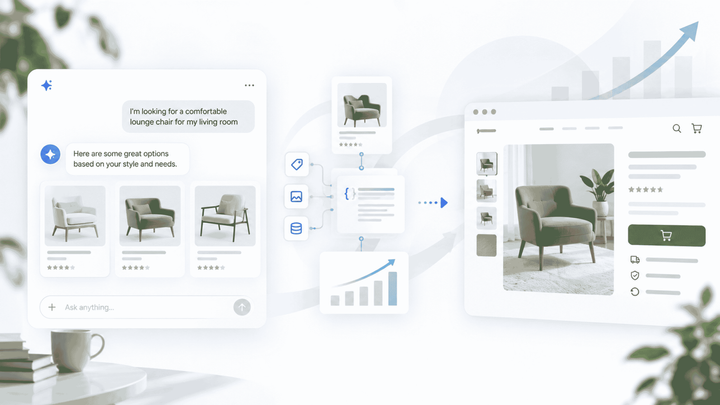
The product is called Ask Macy’s. It’s a conversational shopping assistant built on Google Gemini through Google Cloud, sitting on top of a catalog of more than 2.5 million SKUs. 1
The timeline matters more than the tech:
- December 2025 — quiet internal launch to a small test group
- March 23, 2026 — formal release across macys.com and the app
- April 22, 2026 — Macy’s and Google Cloud publish results together
By the time of the public announcement, it was running on roughly half of site traffic. The 4.75x figure comes from that beta window, measured as revenue per visit among users who engaged the assistant versus those who didn’t.
Two caveats, because you should be able to defend this number in a room: it’s company-reported, and it’s a beta metric measured over weeks, not a fiscal year. Also, a lot of coverage garbled it into “shoppers spent 400% more.” That’s not what was measured. Revenue per visit is a per-session number — it folds together conversion rate, basket size, and the fact that people who open a shopping assistant tend to be further down the funnel already.
But that last part is the interesting part, not a disclaimer.
Max Magni, Macy’s Chief Customer and Digital Officer, framed it at Shoptalk this way: it’s “not about search. It’s about curated discovery.” The features doing the heavy lifting are the ones a search box can’t do — complete-the-look bundling and virtual try-on. People arrive with a specific job (“something for a wedding in October”) and the assistant does what a good floor associate does. It asks a second question.
Magni’s other line is the honest one, and worth taping to a wall: nobody has cracked this yet, and every retailer is figuring it out a step at a time.
The number nobody saw coming: AI traffic flipped
Here’s the part that reframes everything.
A year ago, AI-referred traffic was the worst-converting channel most retailers had. Adobe Analytics measured it at 38% worse conversion than non-AI traffic in March 2025. The prevailing read was: ChatGPT sends tire-kickers.
By March 2026, that same traffic converted 42% better than non-AI traffic.
That’s an eighty-point swing in twelve months. In the same window, AI referrals to US retail sites grew 393% year over year, and by May 2026 Adobe had them up 1,324% since October 2024, converting 54% better than everything else.
The behavioral data underneath explains why. AI-referred visitors are 15% more engaged, spend 53% more time on site, view 23% more pages, add to cart 28% more often, and bounce 33% less. Through July 2026, Adobe recorded eleven consecutive months of AI traffic out-converting everything else.
Similarweb puts ChatGPT referral conversion at roughly 7.1% — second only to paid search at 7.8%, and ahead of organic.
So where did all the clicks go?
They didn’t go to a competitor. They stopped existing. Roughly 68% of US Google searches now end without a click to the open web, and organic click-through rates fall by 58 to 61% when an AI Overview is present.
SparkToro and Similarweb’s analysis of US Google searches from January through April 2026 found that 68.01% ended without a click — up from 60.45% in 2024. Their framing is brutal and precise: only 276 out of every 1,000 searches now reach the open web.
Pew Research studied nearly 69,000 real searches and found that when an AI Overview appears, users click an organic result 8% of the time, versus 15% without one. And the links inside the AI answer? Clicked 1% of the time.
Seer Interactive measured organic CTR on AI Overview queries falling 61%, from 1.76% to 0.61%. Paid fell 68%. Ahrefs found position-one CTR drops 58% when an Overview is present — noticeably worse than the 34.5% they measured in early 2025. The erosion is accelerating.
Gartner called a 25% decline in traditional search volume by 2026 back in early 2024, and got mocked for it.
So: your rankings may be fine. Your impressions may be fine. Your sessions are quietly draining out of the bottom of the funnel you built your entire acquisition strategy around.
Before you panic: AI referrals are still tiny
This is where most posts on this topic lose credibility, so let’s do the other side properly.
Conductor analyzed 3.3 billion sessions across nearly 14,000 domains and found AI referrals accounted for 1.08% of all sessions. Contentsquare, looking at 99 billion sessions, put it at 0.2% of visits — even while growing 632% year over year.
Shopify’s Q2 2026 numbers say the same thing from the merchant side: AI-referred sessions were up 197%, but organic search still delivered more total traffic than every AI platform combined, and organic itself grew 12%.
There’s platform risk too. ChatGPT accounts for the overwhelming majority of standalone AI referral traffic — one analysis of 6.77 million sessions put it around 92% — but its share of AI referrals fell from 89% to 63% in eight months as Gemini and Claude picked up ground. Building a strategy around one assistant’s referral behavior is building on sand.
Hold both facts at once. AI is a rounding error in volume and a step-change in intent. That’s not a contradiction. It’s the whole thesis.
The second conversation
Here’s the reframe I’d give any brand looking at this data.
For twenty years, your website was where the conversation started. Someone typed a vague query into Google, landed on a category page, and you spent the next eleven minutes and four page views trying to figure out what they wanted through the crude instrument of navigation.
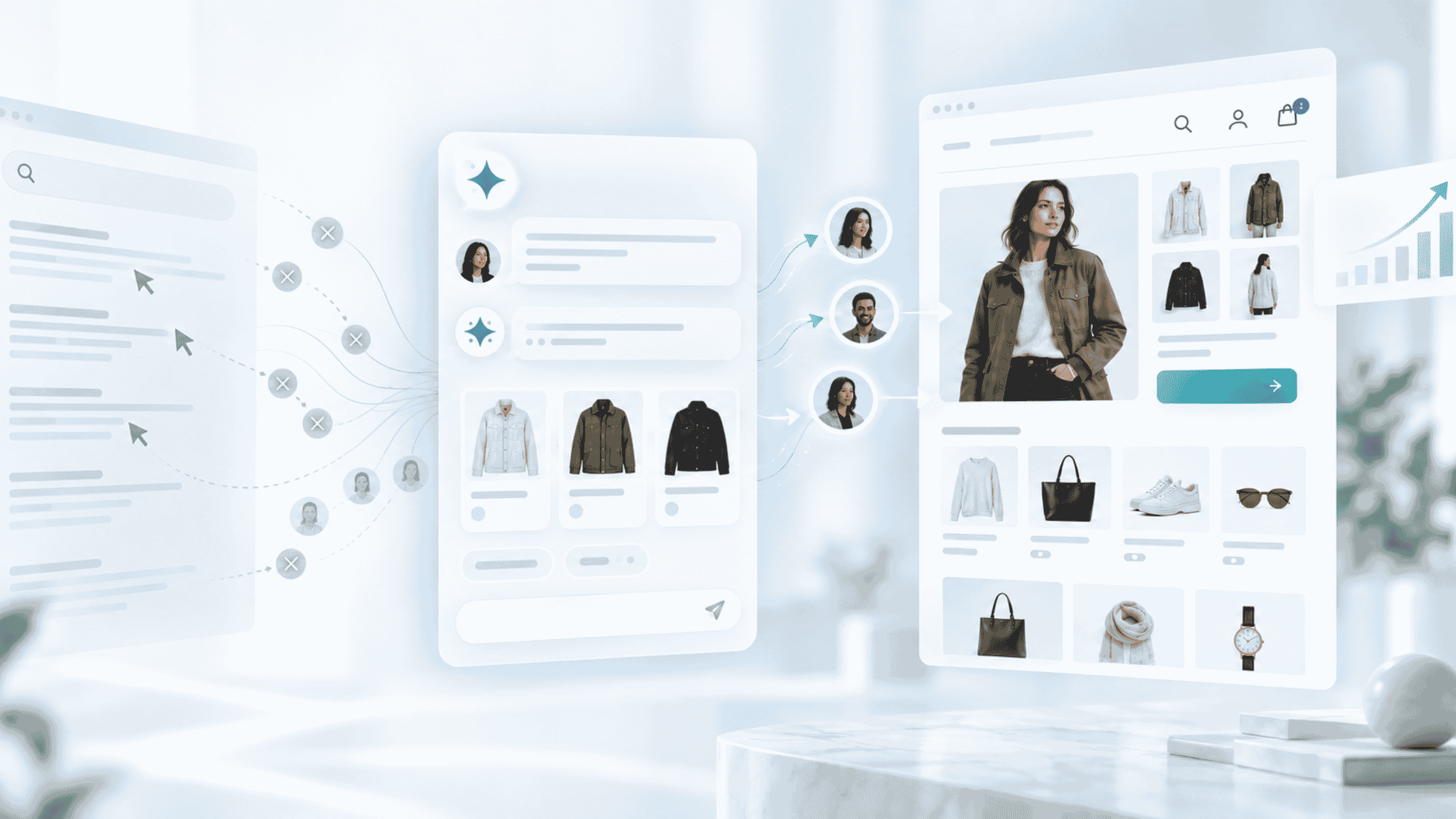
That’s over. The first conversation now happens somewhere you don’t own — inside ChatGPT, Gemini, Perplexity, Copilot, Rufus. A shopper spends four turns narrowing down what they need, and then arrives at your site.
And most sites are catastrophically bad at being the second conversation. Someone shows up having already described their skin type, their budget, and the event they’re shopping for — and lands on a filtered PLP with 340 results and a cookie banner. All that context, gathered by a machine on the other side of the internet, evaporates on arrival.
That’s the gap Ask Macy’s closed. It didn’t create demand. It picked up a conversation that was already in progress.
What Macy’s understood that most brands haven’t
The smartest thing Macy’s did isn’t the assistant. It’s that they’re running a two-front strategy and don’t seem embarrassed about the tension.
Front one
Keep the conversation on their own property with Ask Macy’s.
Front two
On January 11, 2026, at NRF, Macy’s signed on as an endorsing partner of Google’s Universal Commerce Protocol — the standard that lets agents complete purchases without the shopper ever visiting macys.com.
Most brands treat these as opposing bets. They’re not. One captures the intent that arrives. The other makes sure you’re purchasable when it doesn’t. You need both, and the plumbing for the second one is being poured right now:
| Standard / Product | Who | What it actually does |
|---|---|---|
| ACP (Agentic Commerce Protocol) | OpenAI + Stripe, Sept 2025 | Open-sourced checkout spec; launched with Etsy, Shopify merchants |
| UCP (Universal Commerce Protocol) | Google + Shopify, Etsy, Target, Walmart, Wayfair; NRF Jan 2026 | Agent checkout in AI Mode and Gemini; merchants publish a manifest at /.well-known/ucp |
| AP2 (Agent Payments Protocol) | Google, Sept 2025 → FIDO Alliance, ~April 2026 | Cryptographic mandates proving the human consented to the purchase |
| Rufus | Amazon | ~$12B incremental annualized sales in 2025; 300M+ users; Rufus users ~60% likelier to purchase |
| Copilot Checkout | Microsoft + PayPal, via ACP | Merchant program; reported 194% higher purchase rates on shopping-intent sessions |
| Instant Buy | Perplexity + PayPal, Nov 2025 | In-answer purchase for Pro users |
One note on how fast this moves: OpenAI’s standalone Instant Checkout has reportedly been deprioritized in favor of ChatGPT Apps and agentic storefronts, according to The Information. Anything you read about this space — including this post — has a shelf life measured in months. Timestamp your claims.
Also worth noticing: Amazon has joined neither ACP nor UCP. Rufus is a closed garden with $12 billion of evidence behind it. That tells you something about who thinks interoperability is a gift and who thinks it’s a tax.
What to do if you’re not Macy’s
You probably don’t have Google Cloud’s solutions team on speed dial. Fine. The moves that matter are less exotic than the coverage suggests.
1. Make your catalog legible to machines
Complete product schema in JSON-LD, FAQPage markup, clean feeds. This isn’t a growth hack; it’s removing ambiguity so an agent can represent you accurately. Products with complete structured data are meaningfully likelier to surface in AI answers, and Shopify reports syndicated product data roughly doubles conversion inside AI chats.
2. Write things worth quoting
The Princeton-led GEO study (Aggarwal et al., KDD 2024, ~10,000 queries) measured what actually lifts visibility in generative answers: quotations +41%, statistics +32%, citing sources +30%, fluency +28%. Yext’s analysis of 6.8 million AI citations found 86% come from brand-managed sources — your own site and your listings. Most of what AI says about you is drawn from things you control.
3. Don’t over-invest in llms.txt
More than 7.3 million sites now serve one, largely because Shopify ships it by default. Google stated in May 2026 that Search ignores it — it will neither help nor hurt. No major provider has confirmed reading it. It costs an hour. Treat it as cheap insurance, not strategy.
4. Build the second conversation
This is the one that compounds. Across 329 brands, Alhena found LLM-referred traffic converts at a 2.47% baseline — already fourth among acquisition channels, ahead of Google Ads and Meta Ads. But visitors who engage with an on-site AI assistant convert at 9.84%, roughly 4x. Cart-to-checkout completion runs 49.3% for AI-engaged sessions versus 26.3% for everyone else. 2
The number that should reorganize your roadmap: about 1% of visitors who engage the assistant drive roughly 10% of revenue.
Same pattern as Macy’s, at a fraction of the scale and a fraction of the budget. (Those are Alhena’s own figures — vendor-reported, like Macy’s are company-reported. Weigh them accordingly. But the shape of the curve keeps showing up across independent datasets, which is usually how you know something’s real.)
FAQ: AI search and agentic commerce
Does AI traffic actually convert better than Google traffic?
Yes, as of 2026. Adobe Analytics recorded AI-referred retail traffic converting 42% better than non-AI traffic in March 2026 and 54% better by May — reversed from 38% worse in March 2025. Similarweb puts ChatGPT referral conversion at ~7.1%, second only to paid search.
What were Macy’s AI shopping assistant results?
Macy’s and Google Cloud reported in April 2026 that shoppers using Ask Macy’s generated roughly 4.75x more revenue per visit than those who didn’t, measured during a beta across about half of site traffic. 1
Is AI search killing website traffic?
It’s reducing clicks, not visits-to-zero. About 68% of US Google searches ended without a click in early 2026, and organic CTR falls 58–61% when an AI Overview appears. But AI referrals are still only ~1% of total sessions, and organic search remains the largest single traffic source for most merchants.
What is agentic commerce?
Commerce where an AI agent completes purchase steps on a shopper’s behalf — discovery, comparison, and increasingly checkout — using standards like OpenAI’s ACP, Google’s UCP, and AP2. Forecasts for its 2030 size range from $144B (eMarketer) to $3–5T (McKinsey), a spread that mostly reflects disagreement over the definition.
How do I get my products cited by ChatGPT and Perplexity?
Structured product data, original statistics, quotable definitional sentences, clear sourcing, and freshness. Roughly 87% of ChatGPT citations overlap Bing’s top 10, and 93.67% of Google AI Overview citations link to a top-10 organic result — so classic SEO remains the foundation, not a replacement.
The part that should actually worry you
It isn’t the traffic chart.
It’s that a department store founded in 1858 dark-launched a Gemini-powered assistant, watched revenue per visit go up nearly fivefold, and shipped it to half their traffic inside four months — while most brands are still arguing in a Slack thread about whether AI search is real.
The clicks aren’t coming back. But the people who do arrive are the most qualified visitors you have ever received, carrying context gathered somewhere you’ll never see.
See what your AI-referred visitors are actually asking for
Alhena’s on-site assistant picks up the conversation that started in ChatGPT, Gemini or Perplexity — and shows you exactly where it goes next.