The mid-2026 consensus sounds reasonable: brands need unified commerce before they can deploy agentic commerce. Analysts and platform vendors keep repeating it. And on the surface, the logic holds. If an AI is going to cancel purchases, initiate returns, or handle payments, payment disputes, and refunds. Payments processing stays in your commerce platform, or to recommend products, it needs accurate data. Fragmented data means fragmented decisions.
But here's the problem with that argument: it tells most e-commerce operators to wait. And waiting isn't a strategy when your customers are waiting longer, your customer experience is flat and customers are leaving, and your competitors are already using AI to sell to customers.
The real question isn't whether unified commerce matters. It does. The question is whether you need to finish a complex, multi-year data unification project before you let an AI talk to your customers. The answer is no, and we’re seeing why every quarter. You need grounded AI.
The "Unify First" Argument and Where It Breaks Down
Most mid-market retailers and enterprise businesses run somewhere between 6 and 20 complex systems: a storefront, an OMS, a WMS, helpdesk software, a CRM, an ESP, reviews, returns, loyalty, and BNPL. Full unification across all of those is a serious enterprise infrastructure project. Retailers spend years on it and still aren't done.
Meanwhile, agentic commerce is already here. AI agents can answer product questions, processing returns, populating carts, and guiding checkout flows. The businesses deploying them aren't waiting for a single source of truth. They're using AI that grounds every response in live data from their existing systems.
That's the distinction the "unify first" crowd misses. You don't need one perfect database. You need an AI that calls the right system at the right moment and never makes up what it doesn't know.
What Grounded AI Actually Needs
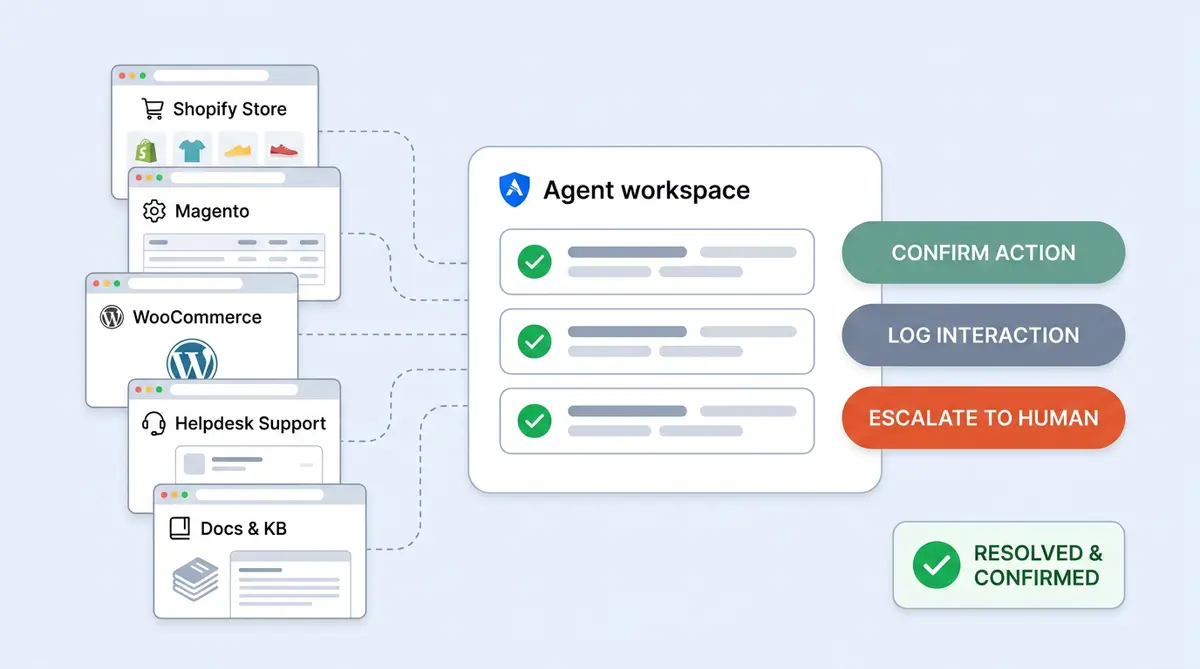
Grounding is the opposite of hallucination. Instead of generating plausible-sounding answers from training data, a grounded AI pulls every fact from a verified source at the time of the conversation. Alhena AI's agentic RAG architecture does exactly this: each response is built from live API calls to your storefront (Shopify, Magento, WooCommerce), your helpdesk tools, your knowledge base tools, and any custom data tools through direct integration solutions.
No staleness window. No batch sync that fell behind overnight. Alhena asks your systems of record what's true right now and only says what it can verify. When it can't verify something, it doesn't guess.
That's a fundamentally different approach than requiring all your data to live in one warehouse before AI can touch it.
Governance Isn't a Framework, It's an Operating Loop
The other piece of the unified commerce argument is safety: if an AI can take actions (cancel an order, issue a refund, change a shipping address), you need governance. That part is true. But governance doesn't require unified commerce. It requires guardrails at the AI level.
Alhena ships three built-in guardrails for every action-taking step: confirm, log, and escalate. Before any write action, Alhena confirms intent with the customer. Every action is logged to a full audit trail. And when the agent's confidence or scope is exceeded, it hands off to a human with complete conversation context and full feature coverage for the next rep.
On top of that, identity verification runs before any account data is shared. The agent doesn't show order details until it knows who it's talking to. That's not a unified commerce requirement. That's AI-level design.
The operating loop looks like this: flag risky interactions through smart QA review, tune your guidelines and FAQs based on what you find, and redeploy. Repeat weekly. This automation loop. Governance is a habit, not a one-time architecture decision.
The Minimum Viable Stack for Agentic AI
You don't need everything unified. But you do need a few things in place:
- Order identity resolution: Your AI must be able to match a customer to their purchase history at action time. If your stack can't do that, Alhena should refuse the action and escalate. Alhena does this automatically.
- Authoritative inventory source: If your storefront and OMS disagree on stock, the AI will recommend products that aren't buyable. Make your storefront API the single source of truth for inventory availability. Without this inventory truth, consumers see items that are out of stock. Accurate inventory data.
- Policy access: Return eligibility, shipping rules, warranty terms. These need to be accessible. Alhena’s AI solutions pull from these sources through your knowledge base or helpdesk. Direct integration with your policy tools, not locked in a PDF on someone's desktop.
That's your minimum viable checklist. If those three things are solid, you can deploy an AI that handles product discovery, tracking, returns, and guided shopping, checkout assistance, and checkout conversion today.
A Practical Rollout: Read-Only to Agentic
The brands seeing real results don't flip a switch. They phase in capabilities:
Phase 1: Discovery and support answers. Alhena reads from your product catalog and knowledge base. No write features. From the customer journey in product discovery to checkout, this is where Tatcha saw 3x conversion rates and Manawa cut response times from 40 minutes to 1 minute. Read-only, high impact.
Phase 2: Agent assist. The AI drafts responses and surfaces suggestions for your human reps through Alhena's Agent Assist. Humans stay in the action. Risk stays low. More features unlock over time.
Phase 3: Bounded autonomous actions. Turn on specific write actions one at a time: status lookups, address changes, return initiation, checkout recovery, and checkout completion. Each action uses confirm/log/escalate guardrails. QA tools catch edge cases before they become patterns.
Phase 4: Omnichannel expansion. Once web chat is stable, expand to new channels: Voice AI, Instagram DMs and WhatsApp, and email. Unified memory keeps personalized context intact across every channel.
Each phase builds on the last. You're not waiting for a unified commerce platform to show up. You're building governance into every step.
The Best Path Forward: Stop Waiting, Start Grounding.
Unified commerce is a good long-term goal. But it's not a prerequisite for agentic commerce. The e-commerce brands and businesses winning today run messy, partially-unified stacks, and they deploy AI for their consumers' agents that are grounded in live data, governed by clear guardrails, and scoped to the actions their systems can safely support.
Retailers ready to deploy grounded agentic commerce on your existing stack? Book a demo with Alhena AI or start for free with 25 conversations.
Frequently Asked Questions
Do I need unified commerce before deploying agentic AI?
No. A grounded AI pulls data from your existing ecommerce systems (storefront, helpdesk, CRM) in real time. You don't need a single unified database. You need AI that verifies every response against live sources and escalates when it can't.
What does grounded mean in the context of AI agents?
Grounded AI generates answers only from verified, real-time data sources, not from training data or cached information. Alhena AI uses agentic RAG to call your Shopify, Magento, or WooCommerce APIs at the moment of each conversation, so every response gives consumers and shoppers current product availability, order status, and policies.
How does Alhena AI prevent hallucinations without unified commerce?
Alhena connects directly to your systems of record through live API calls. If the agent can't verify a fact from a connected source, it won't make one up. It either pulls the accurate answer or escalates to a human rep with full context.
What guardrails does Alhena use for agentic actions like returns or cancellations?
Every write action follows a confirm, log, and escalate protocol. The AI confirms intent with the customer before acting, logs a full audit trail, and hands off to a human when confidence or scope is exceeded. Identity verification also runs before any order data is shared.
What is the minimum stack I need to deploy Alhena AI?
You need three things: the ability to resolve a customer to their purchase history (identity), an authoritative source for product availability (your storefront API), and accessible return and shipping policies. Alhena offers direct integration with Shopify, WooCommerce, Magento, and major helpdesks out of the box, and deploys in under 48 hours.
Can I start with read-only AI and add autonomous actions later?
Yes. Most brands start with Phase 1 (personalized product discovery and support answers) and add write actions over time. Tatcha saw 3x conversion rates with read-only AI. Autonomous actions like returns and address changes are added one at a time with guardrails at each step.