The Agent Already Did the Research. Why Is Your Site Starting Over?
A shopper spends twenty minutes with ChatGPT narrowing down a fragrance-free moisturizer for sensitive, acne-prone skin, under $40, no fungal-acne triggers. The AI gives her three options. She clicks the one that sounds right and lands on your product page. Your chat widget pops open: "Hi! What are you shopping for today?"
She has already answered that question. She answered it somewhere else, in detail, about ten minutes ago.
This is the most expensive moment in AI commerce, and almost nobody measures it.
Key takeaways
- The handoff is the new critical funnel stage. AI agents do the research. Humans still click through and buy on your site.
- The handoff tax is the conversion, time and trust a storefront loses when it makes an AI-referred shopper repeat research the AI engine already did.
- Re-litigation rate is the share of AI-referred on-site conversations in which the shopper re-asks a question the AI engine already answered. It is the most direct way to see the handoff tax in your own data.
- Verification is not re-litigation. Shoppers confirming an AI's claim is healthy. Shoppers forced to restart discovery is the leak.
- The fix is not more content. It is an on-site experience that picks up the conversation where the AI left off.
What changed: agents research, humans buy
The pattern is now visible in traffic data, not just surveys.
HUMAN Security's 2026 State of AI Traffic & Cyberthreat Benchmark, published in March 2026 and drawing on more than one quadrillion interactions observed in 2025, found that 77% of agentic AI activity happened on product and search pages, while just 2.3% happened on checkout pages. Account pages took 8.8% and authentication flows about 5%. HUMAN's June 2026 agentic traffic update showed the split holding, with product and search routes at 79% and checkout and payment at 2.34%.
In plain terms: agents browse, compare and shortlist. They rarely pay.
The platforms reached the same conclusion the hard way. OpenAI launched Instant Checkout inside ChatGPT in September 2025. [1] By February 2026, roughly 30 Shopify merchants were available via Instant Checkout, Forrester principal analyst Emily Pfeiffer told CNBC. Daniel Danker, Walmart's executive vice president of AI acceleration, product and design, told WIRED that purchases made inside ChatGPT converted at a third of the rate of shoppers who clicked through to Walmart.com. On March 24, 2026, OpenAI said the initial version of Instant Checkout "did not offer the level of flexibility that we aspire to provide." It is now letting merchants use their own checkout while it focuses on product discovery.
Google is still building agentic checkout into AI Mode and Gemini through its Universal Commerce Protocol, so in-AI purchasing is not going away. But for most brands in 2026, the dominant path is clear: discover in AI, buy on your site.
That makes the moment between those two steps the one that matters most.
AI-referred shoppers arrive warm. Most sites cool them down.
The visitors coming through that handoff are some of the best you get. Adobe's July 2026 data, covering U.S. retail sites, shows AI-referred visitors:
- spend 59% more time on site
- are 33% less likely to bounce
- add items to cart at a 28% higher rate
- convert 60% better than non-AI traffic, the 11th straight month AI referrals have outconverted the rest [2]
Alhena's own numbers point the same way. Across 329 brands, LLM-referred traffic converted at 2.47%, fourth among all acquisition channels. In our 310-brand LLM traffic study, U.S. LLM traffic converted at 2.68%, fourth of 13 tracked channels and ahead of Google Ads (1.87%) and Meta Ads (0.51%).
So where's the problem?
Look closely at that Adobe profile. More time on site and more add-to-carts alongside strong conversion describes a shopper who is ready but still working. L.E.K. Consulting's July 2026 survey of 2,650 U.S. consumers explains why. 31% of AI users said their purchase decision was largely made before they reached a brand or retailer site, up from 26% two years earlier. Yet 94% still validate AI output before completing a purchase, and 41% of them do it on retailer websites. Only 8% had ever bought entirely through an AI agent.
The shopper arrives with a shortlist and settled constraints, then spends her extra time on your site doing one of two things:
- 1. Verifying what the AI told her, which is quick and healthy and ends in a purchase.
- 2. Re-litigating it because your site gave her no way to pick up where she left off, which is slow and frustrating and often ends in a back-button.
Both look like "engagement" in analytics. Only one is good.
What is the handoff tax?
The handoff tax is the conversion, time and trust a storefront loses when it makes an AI-referred shopper repeat research the AI engine already completed.
You pay it in small ways that add up:
- A chat widget that opens with "How can I help?" instead of acknowledging what the shopper is clearly looking at.
- A quiz that asks skin type, budget and concerns the shopper already gave ChatGPT.
- A product page that hides the one spec the AI used to recommend it (fragrance-free, wide-fit, compatible with the 2023 model) three tabs deep.
- A returns policy the AI summarized one way and your site words differently.
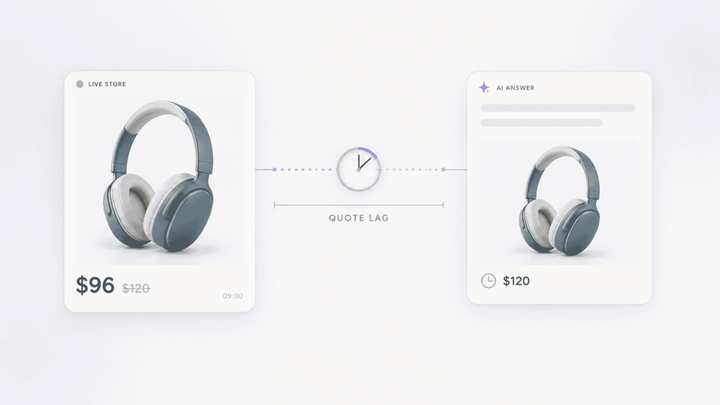
- A price that doesn't match what the AI showed, with no explanation.
Each one forces the shopper to argue her case again. Some will. Many won't.
What is re-litigation rate?
Re-litigation rate is the percentage of AI-referred on-site conversations in which the shopper re-asks a question the AI engine had already answered before the click.
It is the handoff tax made measurable. A high re-litigation rate means your storefront is restarting discovery for people who had already finished it.
Here's the distinction that makes the metric useful:
| Verification | Re-litigation | |
|---|---|---|
| What the shopper does | Confirms a specific claim ("Is this actually fragrance-free?") | Restarts the search ("What do you recommend for sensitive skin?") |
| What it signals | Healthy trust-checking before purchase | The site failed to carry context forward |
| Typical length | One or two turns | Many turns, often repeating constraints |
| Best response | Answer instantly from verified product data | Recognize the constraints and resume from the shortlist |
Verification is a feature of how people shop with AI. L.E.K.'s 94% figure says most shoppers will check. Re-litigation is a bug in how sites receive them.
Why sessions leak at the handoff
The existing Alhena analysis of LLM visitors showed that LLM-referred shoppers who engage on-site AI convert at 9.84%, roughly four times the 2.47% baseline. That post answers whether on-site AI helps AI-referred visitors. This one asks a different question: why do so many AI-referred sessions still leak, even on sites with good traffic and good products?
Our hypothesis, based on how these shoppers talk in chat, is that the leak sits in four places:
- 1. Constraint amnesia. The shopper's settled requirements (budget, skin concern, size, compatibility) never make it onto the site, so she has to restate them.
- 2. Shortlist blindness. The AI compared three products. The site treats the visit as a single-product view and offers unrelated recommendations, so she rebuilds the comparison herself.
- 3. Claim mismatch. The AI described a product one way and the site says something slightly different about price, ingredients or return window. Now she has a dispute to resolve, not a purchase to make.
- 4. Support-first greetings. The widget is set up for order tracking and returns, but AI-referred shoppers are almost all pre-purchase.
That last point shows up clearly in Alhena's published chat data. In the 310-brand study, 32.5% of LLM-referred shoppers who engaged the assistant asked a comparison question, versus 28.6% of other shoppers. 20.4% asked about a specific skin or body concern, versus 11.5%. They were less likely to ask "where is my order" (1.1% vs. 1.7%) or about returns (0.5% vs. 1.2%). These are prospects in comparison mode, not customers with a service problem. Greeting them like support tickets is a guaranteed handoff tax.
How to measure re-litigation rate
You need two things most analytics stacks keep apart: the arrival context (which AI engine referred the session) and the conversation (what the shopper actually asked). Here is the method.
Step 1: Identify AI-referred sessions correctly
Classify a session as AI-referred when the referrer or the UTM source matches an AI engine: chatgpt.com, perplexity.ai, gemini.google.com, copilot.microsoft.com, claude.ai and others. Check both signals. In one 40-day platform-wide window in Alhena's 310-brand study, UTM-tagged ChatGPT visits outnumbered referrer-identified ones by roughly ten to one, so referrer-only setups miss most of the channel. Our guide to AI search revenue attribution covers the setup. Also filter out non-human agent traffic so it doesn't distort your denominators; we call this denominator drift.
Step 2: Classify every question in the transcript
For each shopper message in an AI-referred chat, tag the intent. The categories that most often signal re-litigation are:
- Needs restatement: budget, skin or hair type, size, use case, recipient
- Spec or attribute re-check: ingredients, materials, dimensions, compatibility
- Comparison restart: "What's the difference between X and Y?" when X and Y were the AI's shortlist
- Price reconciliation: "ChatGPT said it was $34"
- Policy re-check: returns, shipping times, warranty
Step 3: Separate verification from re-litigation
Use a simple rule. A single, specific confirmation of a known claim counts as verification. A repeated constraint, a restarted comparison or a broad "what do you recommend" from someone who arrived on a specific product counts as re-litigation. An LLM classifier with human-reviewed samples works well here. Review at least a few hundred transcripts by hand before trusting automated labels.
Step 4: Calculate
Re-litigation rate = AI-referred conversations with at least one re-litigation question ÷ all AI-referred conversations × 100
Then segment by engine, by vertical and by landing page type.
Step 5: Tie it to conversion
Compare conversion, add-to-cart rate and time to purchase for AI-referred sessions with and without re-litigation. Treat the result as correlation, not causation. Shoppers who re-litigate may differ in other ways, so use holdout tests when you change the experience.
Why Alhena can see this when most tools can't
Most AI visibility tools see the engine side: whether ChatGPT mentions your product. Most web analytics see the session side: pages, clicks, checkout. Most helpdesks see the conversation side, but not where the shopper came from.
Re-litigation rate needs all three in one dataset. Alhena's AI Visibility tracks how specific SKUs appear in ChatGPT, Gemini and Perplexity answers. The Alhena AI Shopping Assistant and AI Support Concierge capture the on-site conversation and tie it to the arrival channel and the checkout. Because those pieces share one system, Alhena can see an AI-referred shopper land, read what she asks, and know whether she bought. That is the vantage point the metric needs.
The playbook: how to cut the handoff tax
1. Read the referral before you greet
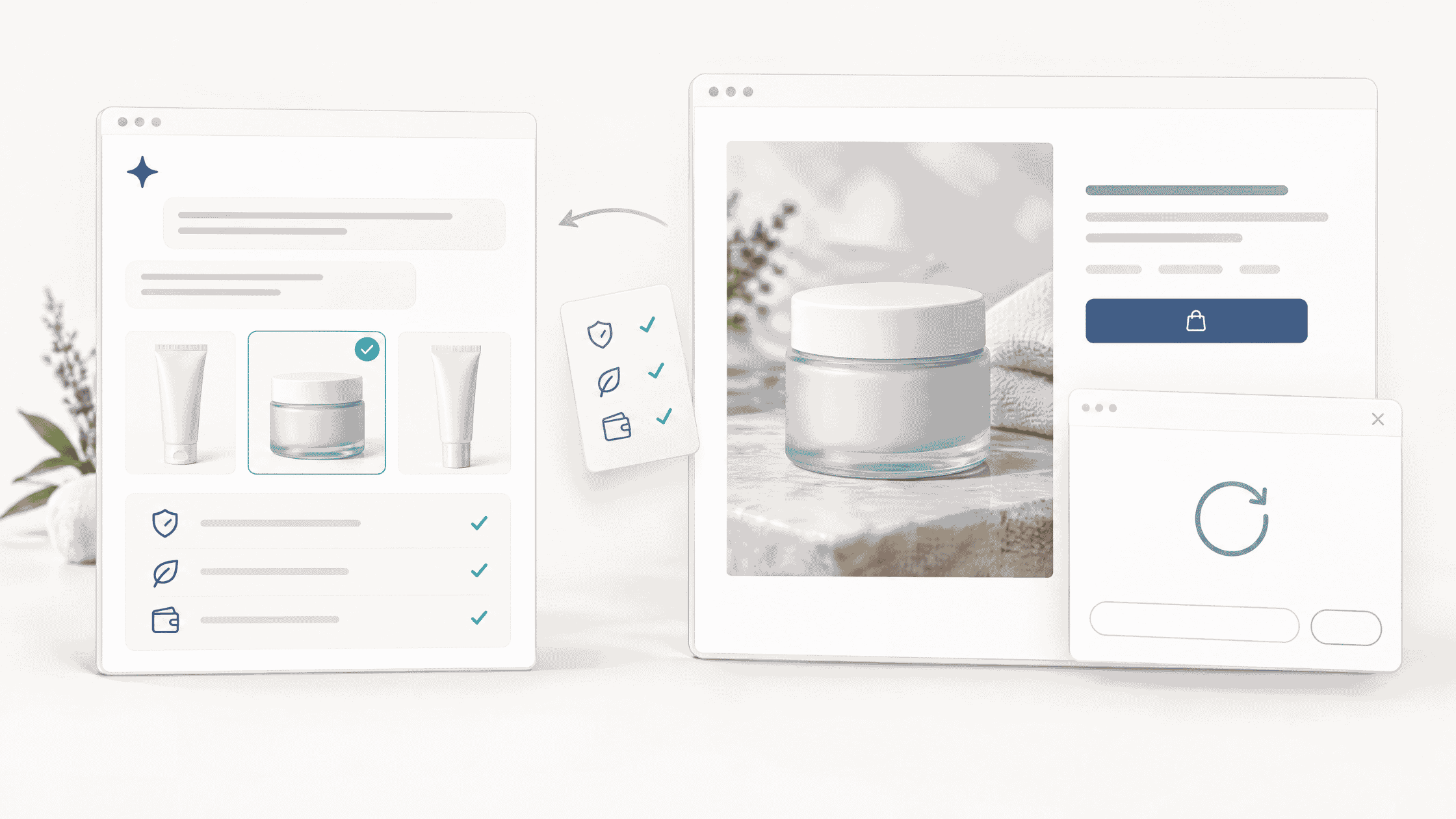
Treat the arrival context as a signal. A visitor from chatgpt.com landing on a specific PDP deserves a different opening line than a homepage browser from Meta Ads. Start with what she is looking at: "This one's fragrance-free and under $40. Want me to compare it with the other two you might be considering?"
2. Never restart discovery for a shopper who has finished it
If someone lands deep on a product page, skip the "what are you shopping for?" quiz. Offer comparison, confirmation and next steps instead. Alhena's conversational search and guided discovery should resume from the shortlist, not rebuild it.
3. Carry constraints forward
Once a shopper states a constraint on-site, every later recommendation should respect it without being asked again. Asking twice is a self-inflicted handoff tax.
4. Answer first, then sell
AI-referred shoppers are verifying. Give the direct answer in the first sentence (yes, it's compatible; returns are 30 days, free) from live, verified catalog and policy data, then suggest the next step. An assistant that dodges a yes-or-no question forces a restart. So does one that dead-ends a conversation.
5. Close the claim gap at the source
Your re-litigated questions are a to-do list for AI visibility. If shoppers keep re-checking an ingredient, a size chart or a price, the AI engines are probably describing it inconsistently with your site. Feed those questions into SKU-level AI visibility work and your product data, so the next shopper arrives with an accurate answer.
6. Make the greeting pre-purchase by default for AI traffic
Given how few AI-referred shoppers ask about order status or returns, lead with comparison and recommendation. Keep support one tap away.
7. Report re-litigation rate next to conversion
Put it on the same dashboard as AI-referred conversion rate and AOV. If conversion moves without re-litigation moving, you've changed traffic mix. If re-litigation drops and conversion rises, you've fixed the handoff.
What good looks like
Brands that treat on-site AI as a continuation of the shopper's research, not a reset, already see the payoff. Tatcha's AI shopping experience on Alhena delivered 3x the site-average conversion rate, a 38% AOV uplift and 11.4% of total site revenue, according to the Tatcha case study. Re-litigation rate is how you find out whether your AI-referred shoppers are getting that experience, or being asked to start over.
The agent already did the research. Your site's job is to finish the sale.
FAQ
What is re-litigation rate in ecommerce?
Re-litigation rate is the percentage of AI-referred on-site conversations in which the shopper re-asks a question an AI engine like ChatGPT or Perplexity had already answered before the click. It measures how often a storefront makes shoppers restart research they had already finished.
What is the handoff tax?
The handoff tax is the conversion, time and trust a storefront loses when it makes an AI-referred shopper repeat research the AI engine already completed. Examples include generic chat greetings, repeated quizzes, hidden specs and policies that contradict what the AI said.
How is re-litigation different from verification?
Verification is a shopper confirming one specific AI claim, such as "is this fragrance-free?", and it usually precedes a purchase. Re-litigation is a shopper forced to restate constraints or rebuild a comparison because the site didn't carry context forward. The first is healthy. The second is a leak.
How do you measure re-litigation rate?
Identify AI-referred sessions using both referrer and UTM data. Classify each on-site chat question by intent and separate verification from re-litigation. Divide conversations containing re-litigation by all AI-referred conversations. Then compare conversion for sessions with and without it.
Do AI-referred shoppers really convert better?
Yes, on current data. Adobe reported that in July 2026, AI-referred traffic to U.S. retail sites converted 60% better than non-AI traffic, spent 59% more time on site and added to cart at a 28% higher rate. Alhena's 310-brand study found U.S. LLM traffic converting at 2.68%, fourth of 13 tracked channels and ahead of Google Ads (1.87%) and Meta Ads (0.51%).
Why did OpenAI scale back Instant Checkout?
On March 24, 2026, OpenAI said the initial version of Instant Checkout did not offer the flexibility it wanted. It is now letting merchants use their own checkout while it focuses on product discovery. Adoption was low, and Walmart reported in-chat checkout converting three times worse than click-outs to its site.
How does an AI shopping assistant reduce the handoff tax?
A well-built assistant reads the arrival context and resumes from the shopper's shortlist instead of restarting discovery. It answers verification questions instantly from live catalog and policy data and carries stated constraints through every recommendation. Alhena's AI Shopping Assistant does this, and because it ties each conversation to its referral source and checkout, re-litigation rate can be measured directly.
Keep reading
See What AI-Referred Shoppers Ask When They Land
Alhena sees the AI referral, the on-site conversation and the checkout together, so you can stop making shoppers start over.