Products with five or more reviews are 270% more likely to be purchased than products with none, according to the Spiegel Research Center. But here's the problem: most shoppers don't actually read those reviews. They skim. They scroll past walls of text. They give up after the second page. Only 5% of shoppers ever make it past page two of a review section, according to Yotpo's own data.
The reviews are there. The intelligence inside them is there. Shoppers just can't get to it fast enough. Product Review Search is Alhena's answer to that gap. It's an agent tool that lets the AI Shopping Assistant search a merchant's stored product reviews during a live conversation and pull back the exact feedback a shopper needs to buy with confidence.
Below, we break down how Product Review Search works, what it can filter, and why it turns passive review content into an active sales tool.
What Product Review Search Actually Is
Product Review Search is a tool inside Alhena's Product Expert Agent called search_product_reviews. You'll see it in the Alhena dashboard as "Search Product Reviews." The job is simple: give the AI access to actual review text for a specific product so it can ground its answers in real customer feedback, not just product descriptions.
Don't confuse this with Alhena's Review Management product, which helps brands respond to reviews on Trustpilot, Feefo, Yotpo, and Bazaarvoice. Review Management is brand-facing and handles the reply side. Product Review Search is shopper-facing. The focus is on selling, not responding.
Think of it this way: Review Management helps you talk back to customers who have already bought. Product Review Search helps you sell to customers who haven't bought yet by showing them what previous buyers actually said.
If a buyer asks your AI assistant, "What do customers say about sizing?" or "Does this work for oily skin?", Product Review Search retrieves matching reviews and lets the agent answer from verified customer feedback. No guessing. No hallucinating. Just real words from real buyers.
How Product Review Search Works Under the Hood
The architecture has four steps, and none of them involve a live API call to an external review platform during the conversation. That's a deliberate design choice.
Step 1: Connect a Review Platform
A merchant connects their review platform to Alhena. The current implementation supports Yotpo, with the architecture designed to be platform-agnostic. Once connected, Alhena enables a marker called PRODUCT_REVIEWS_ACTIVATED, which registers Product Review Search as an available tool on the Product Expert Agent.
For a step-by-step walkthrough of how Yotpo connects to Alhena, including what data gets pulled and how the agent uses it, see our Yotpo + Alhena AI integration guide.
Step 2: Crawl and Store Reviews
During regular product crawls, Alhena fetches product reviews and Q&A from the connected review platform. Alhena stores them in its own product database with structured fields: rating, title, content, verified buyer status, review date, reviewer display name, sentiment score, and topics. The crawl also captures product Q&A and builds aggregate review summaries.
Step 3: Index for Search
The stored reviews are indexed so the agent can search them by keyword, rating range, and verified buyer status. Each review is tied to a specific product, keeping lookups scoped to exactly the product the shopper is asking about.
Step 4: Agent Searches at Conversation Time
When a shopper asks a review-related question, the agent calls search_product_reviews with the product's variant ID and relevant filters. The search runs against Alhena's stored data, not the external review platform, so the response comes back in milliseconds, not seconds.
Because response speed doesn't depend on Yotpo's API availability, your AI assistant keeps answering review questions even if the third-party review platform goes down for maintenance.
Two Layers of Review Intelligence
Alhena doesn't treat all review data the same way. There are two distinct layers, and the separation matters for accuracy.
Layer 1: Aggregate Review Context
Product chunks in Alhena's database can include average rating, total review count, overall sentiment, common topics, and high-level summaries of reviews and Q&A. All of that gives the AI a broad understanding of how customers feel about a product.
When a shopper asks, "Is this product well-reviewed?", the agent can answer from the aggregate layer: "This moisturizer has a 4.7 average rating across 342 reviews, with customers frequently mentioning hydration and lightweight texture." No need to pull individual reviews for that kind of answer.
Layer 2: Direct Review Search
When someone asks for something specific, like a quote, a complaint, or feedback about a particular use case, the agent calls Product Review Search to retrieve actual review text. The search layer is the only path the agent takes for direct customer quotes.
The distinction prevents a common AI failure mode. Without it, an agent might "summarize" reviews it never actually read, creating plausible-sounding but fabricated quotes. With Alhena's two-layer system, the aggregate layer handles broad sentiment, and the search layer handles specific evidence. If the search returns no matching reviews, the agent says so instead of inventing evidence. That's how hallucination-free AI actually works in practice. (For more on how review data feeds into product page FAQs, see our guide on AI Product FAQs on PDPs.)
What the Agent Can Filter and Find
Product Review Search isn't a dumb text dump. The agent can filter reviews across multiple dimensions to find exactly what the shopper needs.
- Keywords: Concepts extracted from the shopper's current question. If someone asks about "durability," the agent searches for reviews mentioning durability, longevity, wear, or related terms.
- Minimum rating: For positive-review requests. "What do people love about this?" triggers a search filtered to 4- and 5-star reviews.
- Maximum rating: For complaint or negative-review requests. "Any complaints?" filters to lower-rated reviews. The agent only does this when the shopper explicitly asks for downsides.
- Verified buyer only: When someone asks for trust signals like "What do verified buyers say?", the agent filters to verified purchases only.
- Limit: Up to 10 reviews per search call, keeping responses focused and fast.
The tool requires a variant_id from the product card data. Alhena resolves that variant to the parent product, then searches active reviews for that product only. Every lookup stays tenant-scoped and product-specific. Your skincare brand's reviews never bleed into another merchant's results.
For generic requests like "What do customers say?", the agent calls the tool with just the variant ID and returns a positive, recent review sample. The default behavior shows what customers like, not what they complain about, unless the buyer asks for criticism directly.
Shopping Questions Only Reviews Can Answer
Product descriptions are written by the brand. They tell you what the product is supposed to do. Reviews tell you what it actually does. That gap is where Product Review Search creates the most value.
Fit and Sizing Confidence
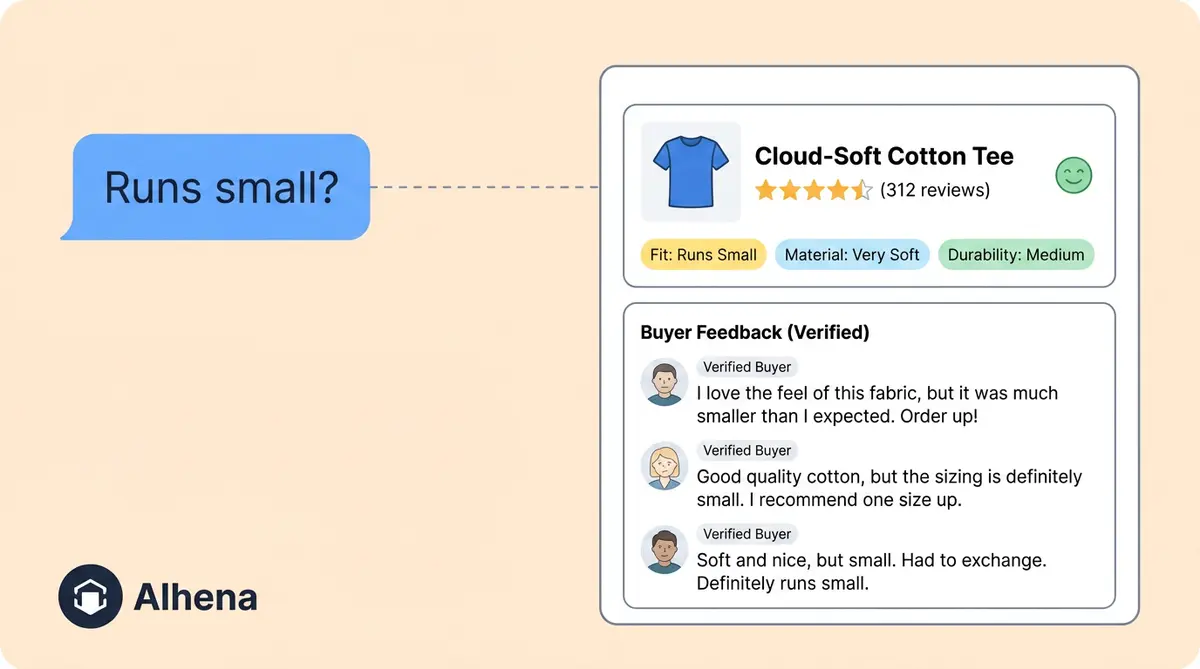
"Does this run small?" is one of the most common questions in fashion and footwear e-commerce. A product page might say "true to size", but 14 verified buyers saying "go up half a size if you have wide feet" carries more weight. Product Review Search finds those reviews and lets the agent relay that feedback directly. For fashion and apparel brands, this is the difference between a conversion and a return.
Real-World Product Performance
"Is this blender actually quiet?" Product specs list decibel ratings. Reviews from real kitchens tell a different story. The agent can search for reviews mentioning noise, volume, or quiet operation and give the shopper an honest answer grounded in buyer experience.
Use-Case Suitability
"Does this work for oily skin?" or "Is this good for thick hair?" These questions are nearly impossible to answer from product descriptions alone. But customers with oily skin and thick hair have already answered them in their reviews. Product Review Search makes that knowledge accessible in the moment the shopper needs it. That's especially valuable for beauty and skincare brands where product-body fit drives returns.
Common Objections and Durability Concerns
"Does the fabric pill after washing?" or "Does the battery hold up after six months?" These objections kill conversions when left unanswered. Product Review Search lets the agent address them with real evidence. If 28 reviewers say the battery still holds up after a year, that's a stronger answer than any marketing copy.
Social Proof at the Checkout Moment
The Spiegel Research Center found that displaying reviews can increase conversion rates by up to 354%. But a review section at the top of a product page doesn't help a shopper who's already in a chat conversation weighing their options. Product Review Search brings social proof into the conversation itself, right when the shopper is making their final decision. Paired with Alhena's AI shopping assistant capabilities like cart population and checkout nudges, reviews become the closing argument. For a deeper look at how AI reduces cart abandonment before checkout, see our 7 AI strategies guide.
Why Stored Data, Not Live API Calls
A common question about this architecture: why not just call Yotpo's API (or any review platform's API) in real time when the shopper asks a review question?
Three reasons.
Speed. A live API call to an external platform adds 200-800ms of latency per request, depending on the platform's load and network conditions. Searching Alhena's own indexed data takes single-digit milliseconds. In a live chat conversation, that difference is the gap between feeling instant and feeling sluggish.
Reliability. External APIs go down. They rate-limit. They deprecate endpoints. If your AI assistant's ability to answer review questions depends on a third party being available at that exact moment, you've built a fragile system. Alhena's stored-data approach means the agent keeps working even if the review platform has an outage.
Safety. Searching a controlled, pre-ingested dataset gives Alhena more control over what the agent sees. Reviews are validated, structured, and scoped to the correct product during the crawl phase. There's no risk of the agent accidentally pulling reviews from a different product or a different merchant's account through a malformed API query.
The tradeoff is freshness. Review data reflects whatever the last product crawl picked up. A review posted five minutes ago won't appear until the next crawl cycle. For most merchants, that's a perfectly acceptable tradeoff since the vast majority of review value comes from the accumulated body of feedback, not the last few hours of new reviews.
Where Product Review Search Fits in Alhena's Agent Architecture
Product Review Search is one tool in a larger system. Understanding where it sits helps explain why it works the way it does.
Alhena uses a multi-agent architecture where specialized agents handle different types of customer interactions. The two primary agents are the Product Expert Agent and the Order Management Agent.
The Product Expert Agent owns everything related to product knowledge: catalog search, product comparisons, feature explanations, and now, review intelligence. Product Review Search is registered as a tool on this agent, alongside conversational search and FAQ retrieval. When a shopper's question requires review data, the agent decides to call search_product_reviews based on the query's intent.
The agent doesn't use Product Review Search for every question. "What's the return policy?" routes to a different knowledge source. "What colors does this come in?" pulls from the product catalog. Product Review Search only activates when the question specifically calls for customer feedback, keeping responses fast and relevant.
The tool also works across every channel Alhena supports. Whether a customer asks about reviews through Instagram DMs, voice, web chat, or email, the agent has the same access to review data. Someone chatting on WhatsApp gets the same review intelligence as a buyer on your website.
What Product Review Search Does Not Do
Clear boundaries matter in AI. Product Review Search is read-only. The tool doesn't post replies, edit reviews, or modify anything on your external review platform. For that, you need Alhena's Review Management product.
The scope is also product-specific, not a broad sitewide review search. The agent can't search all reviews across your entire catalog in one call. Each query targets reviews for the specific product in question, which keeps results precise and prevents confusion.
And it depends on connected review-platform data. If you haven't connected a review platform or if a product has zero reviews, the agent won't fabricate feedback. Instead, the assistant tells the buyer that no review data is available for that product. Honesty over hallucination, every time. That's the same grounded AI approach that powers everything Alhena does.
From Passive Content to Active Sales Tool
Most ecommerce brands treat reviews as static content. They sit on the product page. Some shoppers scroll through them. Most don't. The conversion impact of reviews is well-documented, with studies showing a 354% increase in conversion when reviews are displayed. But "displayed" and "used" are two different things.
Product Review Search turns reviews from something shoppers might passively encounter into something the AI actively uses to sell. A shopper doesn't need to leave the conversation, scroll to the review section, and search manually. They ask a question. The agent finds the answer in the reviews. The shopper buys.
Brands like Tatcha already see 3x conversion rates and 38% higher average order values with Alhena's AI. Victoria Beckham sees a 20% AOV increase. When you add review intelligence to the conversation, you're giving the agent one more tool to close the sale with evidence the shopper actually trusts.
Ready to turn your product reviews into a live sales tool? Book a demo with Alhena AI to see Product Review Search in action, or start for free with 25 conversations.

Frequently Asked Questions
What is Product Review Search in Alhena AI?
Product Review Search is a tool on Alhena's Product Expert Agent that searches stored customer reviews during live shopping conversations. Unlike a product review website or review site where shoppers scroll through pages of online reviews on their own, Product Review Search lets the AI pull the most relevant feedback instantly. It answers questions about sizing, durability, skin type suitability, and more, so the shopper gets trustworthy, product-specific answers without leaving the chat.
How does Alhena's AI use customer reviews to help shoppers buy?
When a shopper asks a question in chat, the Product Expert Agent calls the search_product_reviews tool with keyword filters and the product's variant ID. It can search by star rating, reviewer verification status, and topic. For example, if a shopper asks about comfort, the agent finds reviews from verified buyers who mention comfort and summarizes the feedback. Each response is grounded in real reviewer opinions, not generated text, so the shopper gets honest, data-backed guidance.
Is Product Review Search the same as Alhena's Review Management product?
No. Review Management is brand-facing: it helps merchants respond when shoppers leave review feedback on Trustpilot, Bazaarvoice, or Yotpo. It drafts replies, matches brand voice, and manages reputation across review websites. Product Review Search is the opposite side. It's shopper-facing and uses those same product reviews as live sales intelligence. One helps you write review responses; the other helps shoppers buy based on what reviewers already said.
What review platforms and sources does Product Review Search support?
The current implementation connects to Yotpo, with the architecture designed to be platform-agnostic. The system ingests product reviews, ratings, and Q&A from the connected platform and stores them in Alhena's own database. It works with the same review data that sits on your site, whether those reviews originally came from Trustpilot, Google, Amazon, or another review site. Alhena does not pull from third-party consumer report sites like Wirecutter, CNET, or Capterra. It only searches your own first-party customer review data.
Can Product Review Search filter reviews by star rating or verified buyer status?
Yes. The agent can filter by keywords, minimum star rating, maximum rating, verified buyer status, and result limit (up to 10 reviews per call). A shopper asking "what do people love?" gets four- and five-star positive reviews. A shopper asking about complaints gets negative reviews only. It can also filter to verified buyers when the shopper wants extra trust signals, keeping results unbiased and relevant to the question.
Does the AI generate fake reviews or make up quotes?
Never. Alhena's two-layer review intelligence system prevents fake review content entirely. The aggregate layer summarizes broad sentiment; the direct search layer retrieves actual review text. If no reviews match the shopper's question, the agent says so plainly. It will not generate review content, fabricate a quote, or invent a fake reviewer opinion. That commitment to honesty is what makes Product Review Search trustworthy and helps build trust between the brand and the consumer.
Does Product Review Search work across all Alhena channels?
Yes. The Product Expert Agent has the same review search capability on every platform Alhena supports: web chat, email, Instagram DMs, WhatsApp, and voice. The customer experience stays consistent regardless of where the conversation happens. A shopper on your website gets the same review intelligence as someone messaging on social media. Search results, customer feedback summaries, and ratings data are all available across every channel.
How fresh is the review data, and how often are new reviews ingested?
Reviews are as current as the last product crawl. Alhena collects and stores reviews during regular crawl cycles, so a review posted minutes ago may not appear until the next crawl. For most merchants, this tradeoff is worth the speed and reliability gains. The vast majority of useful customer feedback, including opinions on fit, quality, and durability, comes from the accumulated body of reviews, not the last few hours of new ones.
How does Product Review Search compare to reading reviews on Amazon, Yelp, or Tripadvisor?
On Amazon, Yelp, Tripadvisor, or Foursquare, shoppers have to scroll, sort, and search through reviews manually. Most give up after the first page. Product Review Search does that work for them inside a live conversation. The AI reads across hundreds of online reviews in milliseconds and pulls back only the ones relevant to the shopper's specific question, whether that's about sizing, durability, or real-world performance. It turns a passive comparison into an active, guided experience.
Does Product Review Search help with brand reputation and credibility?
Indirectly, yes. When your AI assistant answers shopping questions with real, verified customer feedback instead of generic marketing copy, it builds credibility with the consumer. Brands that surface honest review data, including negative feedback when asked, earn stronger trust than brands that hide behind polished product descriptions. Product Review Search also supports user-generated content strategies by making existing UGC work harder at the point of sale, turning every review on your site into a potential conversion driver.