Shopping cart abandonment is one of those problems every ecommerce team knows about but few actually solve. Around 70% of online carts never make it to checkout. That number has barely moved in a decade, and in 2026 it still holds, despite the billions spent on recovery emails, retargeting ads, and exit-intent popups. The reason? Most brands focus on chasing shoppers after they leave, instead of figuring out why they left in the first place. This 2026 guide walks through seven practical ways to reduce cart abandonment using AI that works in the moment, not after the fact.
Why 70% of Carts Are Abandoned (and What the Data Actually Tells Us in 2026)
The Baymard Institute has tracked shopping cart abandonment rates across 49 separate studies. Their average sits at 70.19%. That's not a rounding error or a bad quarter. It's a structural problem baked into how online shopping works.
When you break down the reasons, a clear pattern shows up. About 48% of shoppers say extra costs like shipping and taxes caught them off guard. Another 26% left because the site forced them to create an account. 25% said the checkout process was too complicated. 23% couldn't see the total cost upfront. And 22% had concerns about credit card and payment security.
Here's what stands out: most of these reasons aren't about the product. Shoppers wanted to buy. They don’t leave because the product is wrong. Something in the experience stopped them. That distinction matters, because it means the biggest checkout killers are fixable. You don't need to change your product line. You need to change what happens between "add to cart" and "place order."
The other thing worth noting is timing. By the time a recovery email lands in someone's inbox (typically 1 to 3 hours later), they've already moved on. They're comparing options, reading reviews on another site, or they've simply lost the impulse. Recovery has its place, but it's fighting an uphill battle against distraction and buyer's remorse.
Prevention vs. Recovery: Where the Real ROI Lives
Most ecommerce teams treat cart abandonment as a post-checkout problem. The playbook looks the same everywhere: set up an abandoned cart email sequence, add some retargeting pixels, maybe throw in a discount code. These cart abandonment solutions work, but the numbers are modest. Abandoned cart emails convert somewhere between 5% and 10% of recipients. That means 90% of the people you're chasing don't come back.
Prevention flips the equation. Instead of spending money to pull shoppers back using behavioral data after they've left, you spend less to keep them moving forward while they're still on your site. Forrester's research on proactive customer engagement puts the ROI difference in stark terms: proactive engagement delivers roughly 105% ROI compared to 15% for reactive outreach.
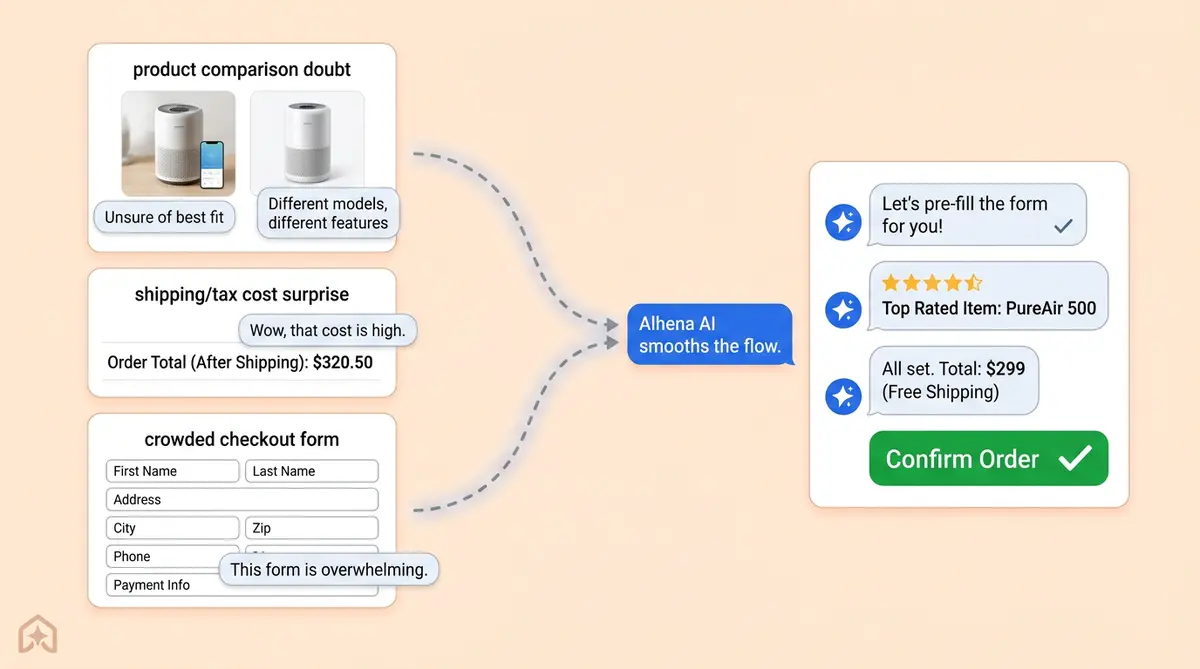
Think about it from the shopper's perspective. If someone is staring at two similar products and can't figure out which one fits their need, they don't abandon because they don't want to buy. They abandon because no one helped them decide. A well-timed answer at that moment is worth more than ten reminder emails the next day.
That's where AI changes things. Not AI as a buzzword, but as a practical tool that reads behavioral signals, identifies hesitation, and responds with something useful before the shopper gives up. For a deeper look at how post-abandonment strategies fit into the picture, our complete cart recovery guide covers that side.
7 Strategies to Reduce Cart Abandonment with AI
These aren't theoretical ideas. Each strategy addresses a specific, documented reason shoppers leave, and uses AI to handle it in real time. The goal is simple: keep buyers moving forward instead of losing them to uncertainty.
1. Answer Product Questions Before Doubt Sets In
Half of all online consumers leave when they can't find quick answers to their product questions. That stat comes up again and again in abandonment research, and it makes sense. If you're buying a moisturizer and you're not sure whether it works for sensitive skin, you're not going to guess and hope for the best. You're going to close the tab.
An AI shopping assistant trained on your actual product catalog can answer those questions instantly. Not with a generic FAQ page, but in a conversation where the shopper types "is this safe for sensitive skin?" and gets a specific, accurate answer pulled from your product data, ingredient lists, and customer reviews.
The key word there is "accurate." If the AI makes something up (a problem called hallucination), you've made things worse. The shopping assistant needs to be grounded in verified product information, not generating creative responses. When it works, though, you're turning a moment of doubt into a moment of confidence. That's the difference between an abandoned cart and a completed order.
2. Guide Shoppers to the Right Product
There's a well-known study where researchers set up a jam-tasting booth. When they offered 24 varieties, only 3% of tasters bought a jar. When they offered 6, the purchase rate jumped to 30%. Choice overload is real, and it's everywhere in ecommerce.
Browse any fashion retailer with 500+ products and you'll see the problem. A shopper looking for a black dress for a wedding gets 200 results. They click through five or six, compare them, second-guess themselves, and eventually leave without buying anything. It's not that they didn't find something they liked. It's that they couldn't commit.
AI-guided selling works like a good sales associate. It asks a few questions: What's the occasion? What's your budget? Do you prefer a specific fit? Then it narrows the selection to three or four options that genuinely match. This builds confidence, and confident buyers purchase. Tatcha uses this approach for skincare matching through Alhena's guided discovery, and the result has been a 3x lift in conversion rates alongside a 38% increase in average order value.
3. Show Total Costs and Policies Before Checkout
Unexpected costs are the single biggest cart abandonment trigger. Nearly half of all abandonments happen because the shopper hit the checkout page and found out shipping was $12, or sales tax pushed the total higher than expected, or there was a handling fee they didn't see coming.
The fix sounds obvious: just show the costs earlier. But in practice, it's harder than it looks. Shipping costs depend on location. Tax calculations vary by state or country. Return policies are buried in footer links that nobody reads. The information exists, but it's scattered across your site in places shoppers don't think to look.
An AI assistant can surface this information proactively. When a shopper adds something to their cart, the assistant can display the estimated total including shipping and tax, mention your return policy, and flag any free shipping thresholds they're close to hitting. No surprises at checkout means fewer abandoned carts. It's straightforward, but very few stores do it well.
4. Step In at the Right Moment with the Right Context
Generic exit-intent popups are the blunt instrument of cart abandonment prevention. Someone moves their mouse toward the browser bar, and a popup appears: "Wait! Here's 10% off!" It works sometimes. But it also trains shoppers to expect discounts, erodes your margins, and ignores the actual reason the person was leaving.
Smarter intervention reads the context in real time. If a shopper has been toggling between two products for three minutes, the AI can highlight the specific differences between them. If they've scrolled to the shipping policy section and paused, it can proactively surface delivery timeframes. If they've been reading reviews about sizing, it can offer a sizing recommendation.
This kind of contextual response requires understanding behavioral signals in real time: scroll depth, hover patterns, time on page, navigation paths, and comparison behavior. Modern AI processes these signals within a 2 to 4 second window and responds with something relevant, not a blanket discount that treats every shopper the same way.
5. Remove Checkout Friction with Conversational Checkout
Complicated checkouts account for about 18% of all cart abandonments. Multi-step forms, mandatory account creation, confusing payment and checkout flows: each step is another opportunity for a shopper to give up. Brands that learn from their checkout data. Research from our data shows that AI-assisted shoppers complete checkout at nearly twice the rate of unassisted ones (49.3% vs. 26.3%).
Agentic checkout collapses the traditional multi-page checkout into a conversation. Instead of navigating through shipping forms and payment screens, the shopper tells the AI what they want, and the assistant handles the rest. It populates the cart, pre-fills shipping details for returning customers, applies relevant promo codes, and walks them through payment in a single flow.
This isn't about replacing your checkout page entirely. It's about giving shoppers an alternative path that's faster and less frustrating. For someone buying on mobile (where checkout abandonment rates are even higher, around 85%), a conversational checkout that takes 30 seconds instead of three minutes makes a measurable difference.
6. Keep the Conversation Going Across Devices and Channels
A shopper browses your store on their phone during lunch, adds a jacket to their cart, then switches to their laptop at home to finish the purchase. But the cart is empty. The conversation they had with your chat assistant is gone. They'd need to start over, and most people won't bother.
Cross-device abandonment accounts for roughly 30% of lost sales. It's a problem that gets worse as shopping becomes more fragmented across devices and platforms. Someone might discover a product through an Instagram DM, research it on mobile web, and buy it on desktop. If each touchpoint feels like a fresh start, you're losing continuity and losing sales.
AI-powered social commerce and omnichannel assistants solve this by maintaining a single conversation thread across web chat, email, WhatsApp, Instagram DMs, and even voice. The shopper picks up exactly where they left off, regardless of the device or channel. Their cart, their preferences, and the context of their questions all carry over.
7. Turn Customer Reviews into Buying Confidence
About 93% of users say online reviews influence their purchase decisions. But here's the problem: most landing pages have dozens or hundreds of reviews, and shoppers don't have time to read them all. They skim a few, maybe see one negative review that spooks them, and leave without buying.
AI can synthesize reviews on demand. Instead of making a shopper scroll through 200 reviews to find out whether a pair of boots runs narrow, the assistant pulls the relevant information immediately: "42 reviewers mention sizing. Most say these boots fit true to size, but 8 reviewers with wider feet recommend going up half a size." That's a specific, useful answer that builds confidence and keeps the shopper moving toward checkout.
This also works for concern-specific questions. "Is this blender loud?" "Does the color look different in person?" "How long does the battery actually last?" Instead of hoping the shopper finds the right review, the AI finds it for them. The product review analysis capability turns your existing review data into a real-time, always-available sales tool. For a deep dive into how this works, see our guide on <a href="https://alhena.ai/blog/product-review-search-live-shopping-intelligence/">Product Review Search</a>.
What These Strategies Look Like in Practice
Theory is useful, but results tell the real story. Here's what happens when brands actually put these abandonment prevention strategies to work.
Tatcha, the luxury skincare brand, deployed Alhena AI's guided discovery and agentic checkout across their Salesforce Commerce Cloud store. The AI asks shoppers about their skin type, concerns, and preferences, then recommends a personalized routine. The results: 3x conversion rates, a 38% increase in average order value, and 11.4% of total site revenue now flows through AI-assisted conversations. Their Director of Client Engagement noted that the AI handles 82% of inquiries while maintaining the brand's premium feel. (Full Tatcha case study)
Victoria Beckham faced a different challenge: replicating in-store expert guidance online across time zones. They deployed a dedicated AI stylist and fit assistant that answers product questions 24/7, from shade matching to ingredient compatibility. The outcome was a 20% increase in average order value and a 10% lift in total online revenue growth. Their Global Digital Director put it simply: "From pre-Alhena, the average order value has actually gone up by 20%." (Full Victoria Beckham case study)
What's notable in both cases is that the revenue gains came from the prevention side, from answering questions, guiding decisions, and removing friction during the shopping session. Not from recovery emails sent after the fact. The data on AI shopping assistant conversion rates consistently shows this pattern across different verticals.
How Alhena AI Approaches Cart Abandonment Differently
Most cart abandonment tools fall into one of two categories: recovery tools (email sequences, retargeting) or generic chatbots that can answer a few FAQs. Alhena AI is built differently because it's designed for ecommerce selling, not just support.
The system runs two specialized agents. A Product Expert Agent handles everything pre-sale: product questions, comparisons, guided recommendations, and checkout assistance. An Order Management Agent handles post-sale inquiries like order tracking, returns, and exchanges through the Support Concierge. This split matters because the skills needed to prevent an abandonment (selling, persuading, educating) are different from the skills needed to handle a support ticket.
Every response Alhena gives is grounded in your actual product catalog, policies, and customer review data. There's no risk of the AI inventing features, making up shipping timelines, or recommending products you don't carry. This sounds like table stakes, but if you've ever tested a general-purpose chatbot on your product pages, you know how often they get things wrong.
The platform works across web chat, email, WhatsApp, Instagram DMs, and voice. A shopper who starts a conversation on Instagram can pick it up on your website without repeating themselves. Cart contents, conversation history, and preferences carry across every channel.
Deployment takes under 48 hours for most stores, with no engineering resources required. Alhena connects to your existing stack, whether that's Shopify, WooCommerce, Magento, or Salesforce Commerce Cloud, and integrates with helpdesks like Zendesk, Gorgias, and Intercom. You can check the ROI calculator to see what these strategies could mean for your specific store metrics.
Getting Started with Cart Abandonment Prevention
You don't need to overhaul your entire ecommerce operation to start reducing cart abandonment. Here's a practical starting point.
First, figure out where you're losing people. Look at your analytics for the specific pages where shoppers drop off. Is it the product detail page? The cart page? The first step of checkout? Each dropout point suggests a different problem. Product page dropoffs point to unanswered questions or choice overload. Cart page dropoffs suggest pricing surprises. Checkout dropoffs indicate process friction.
Second, match the right strategy to each dropout point. If your biggest leak is on product pages, start with an AI assistant that answers questions and guides selection (strategies 1 and 2). If it's at checkout, focus on cost transparency and conversational checkout (strategies 3 and 5). Don't try to fix everything at once.
Third, measure prevention, not just recovery. Most ecommerce dashboards track recovery metrics: how many abandoned cart emails were sent, how many carts were recovered. But if you're preventing abandonment, those numbers go down, which looks like a problem if you're not tracking the right things. Track hesitation-resolved conversations, checkout completion rates for AI-assisted vs. unassisted sessions, and the overall abandonment rate trend over time.
For a broader look at how AI shopping assistants fit into your ecommerce strategy, the definitive guide to AI shopping assistants covers the full picture from selection to deployment to measurement.
The Bottom Line on Reducing Cart Abandonment
Cart abandonment isn't a mystery. The reasons are well-documented: surprise costs, purchase uncertainty, checkout friction, and lack of timely help. What's changed is that AI now makes it possible to address these issues in real time, at the exact moment a shopper is about to leave, without needing a team of live chat agents standing by.
The brands seeing the strongest results aren't the ones sending more recovery emails. They're the ones that stopped treating abandonment as inevitable and started treating it as a signal that something in the experience needs to be better.
If you want to see what this looks like on your store, book a demo with Alhena AI or start with 25 free conversations to test the impact yourself.
Frequently Asked Questions
What is shopping cart abandonment and why does it happen?
Shopping cart abandonment is when a shopper adds items to their online cart but leaves without completing the purchase. The average rate is 70.19% according to Baymard Institute. The top causes are unexpected costs (48%), forced account creation (26%), complicated checkout (25%), and payment security concerns (22%). Most reasons relate to the buying experience, not the product itself.
How does AI reduce cart abandonment in real time?
AI reduces cart abandonment by reading behavioral signals like scroll pauses, exit intent, and product comparisons, then responding with relevant help within seconds. Instead of waiting for a shopper to leave and sending a recovery email, AI answers product questions, surfaces cost details, and guides checkout while the shopper is still active. Alhena AI does this across web chat, email, WhatsApp, and Instagram.
What is the difference between cart abandonment prevention and recovery?
Prevention happens during the shopping session, addressing hesitation before the shopper leaves. Recovery happens after, through emails, SMS, and retargeting ads. Prevention delivers roughly 105% ROI compared to 15% for reactive recovery, according to Forrester. Alhena AI focuses on prevention through guided selling and agentic checkout, while also supporting post-sale workflows.
What is the average cart abandonment rate for ecommerce stores?
The average shopping cart abandonment rate across 49 studies is 70.19%, according to Baymard Institute. Mobile cart abandonment runs even higher at roughly 85%. This rate has stayed consistent for over a decade, which suggests that traditional recovery tactics alone are not enough to move the needle.
How does agentic checkout reduce cart abandonment?
Agentic checkout replaces multi-step checkout forms with a conversational flow. The AI populates the cart, pre-fills shipping details for returning customers, applies promo codes, and walks shoppers through payment in a single interaction. Alhena AI data shows that AI-assisted shoppers complete checkout at 49.3% compared to 26.3% for unassisted shoppers, nearly double the completion rate.
Can AI shopping assistants reduce cart abandonment on Shopify stores?
Yes. Alhena AI integrates directly with Shopify, WooCommerce, Magento, and Salesforce Commerce Cloud. On Shopify specifically, the AI connects to your product catalog, shipping rules, and checkout flow to answer questions, guide product selection, and simplify checkout. Deployment takes under 48 hours with no developer resources required.
What results have brands seen from AI-powered cart abandonment prevention?
Tatcha saw 3x higher conversion rates, 38% increase in average order value, and 11.4% of total site revenue through AI-assisted conversations. Victoria Beckham achieved a 20% AOV increase and 10% revenue lift. These results came from addressing abandonment causes during the session, not from post-abandonment recovery emails.
How quickly can I set up AI to reduce cart abandonment on my store?
Alhena AI deploys in under 48 hours for most ecommerce stores. The system connects to your existing product catalog, reviews, and policies without manual training. You can start with 25 free conversations to test the impact before committing. No engineering resources or custom development are needed. The platform comes with built-in best practices for checkout optimization.
Does reducing cart abandonment with AI work for mobile shoppers?
Mobile shoppers have the highest abandonment rates at roughly 85%, largely due to small screens and clunky checkout forms. AI addresses this through conversational checkout that replaces multi-step forms, cross-device memory that preserves cart contents when switching from phone to desktop, and instant answers that prevent the need to navigate multiple pages on a small screen.
How do I measure whether AI is actually reducing my cart abandonment rate?
Track three key metrics: checkout completion rate for AI-assisted vs. unassisted sessions, hesitation-resolved conversations (questions answered that kept a shopper on the path to purchase), and overall abandonment rate trend over 30-60 days. Alhena AI includes built-in revenue attribution analytics that tie conversations directly to completed orders and repeat orders and AOV changes.