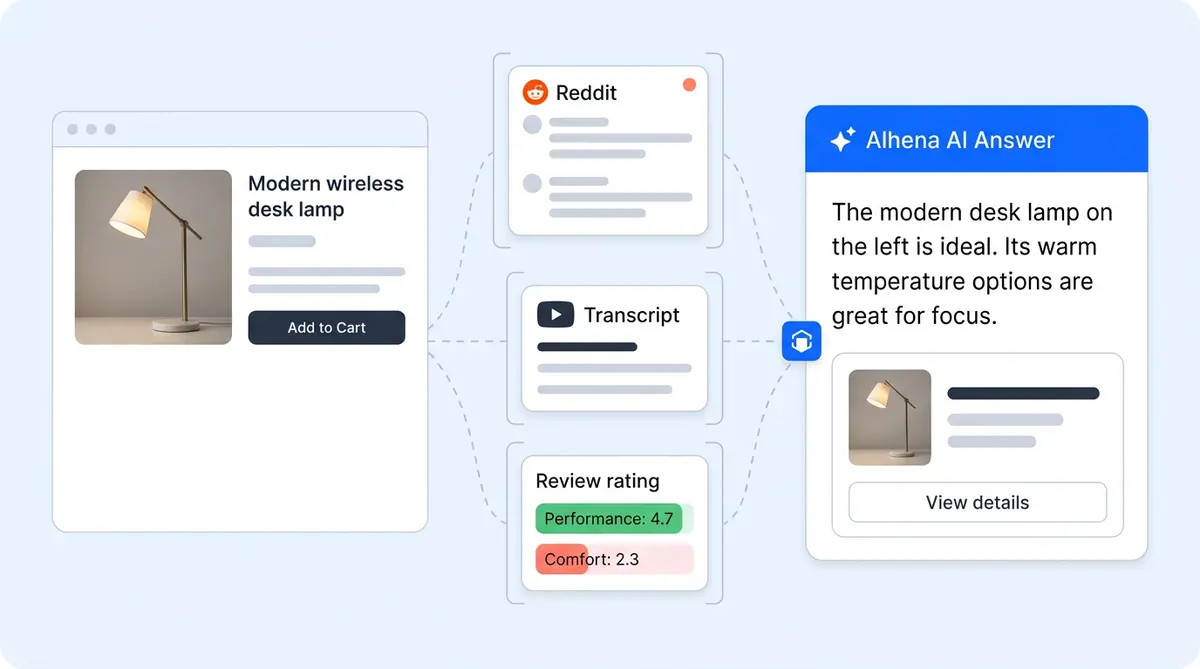
You can probably tell me the bounce rate on your best-selling product page, the exit rate on site search, and the conversion delta from last week's PDP test. Now tell me what ChatGPT said about that same product this morning, and which source it pulled the answer from.
Almost nobody can answer the second question. Not because the teams do not care, but because nothing in the stack is pointed at it. Every analytics tool an ecommerce brand runs is aimed inward, at the storefront. Meanwhile a growing share of the buying decision is being formed somewhere else entirely, inside an AI answer assembled from Reddit threads, YouTube transcripts, and review profiles nobody on your team has read.
This post is about closing that blind spot. Not about how to earn AI citations, which is a separate discipline we cover here, but about how to see what is already being said, catch it when it shifts, and trace a bad AI answer back to the source that caused it.
You instrumented half the journey
Think about how much observability you already have over your own site. Page-level analytics, session replay, funnel reports, error monitoring, A/B infrastructure. If conversion drops two points on a collection page, someone can tell you why by lunch.
Now consider the parallel path. A shopper opens an AI assistant, asks which brand to trust, and gets a synthesized answer built from sources you do not own, do not see, and cannot query. That answer shapes the visit before it happens, or replaces it entirely. There is no dashboard for it, no alerting, no owner.
Reddit is an archive, not a feed
Start with Reddit because the data pipes are explicit. Google pays a reported 60 million dollars a year for direct access to Reddit's API, and OpenAI signed its own licensing deal. That content is not scraped opportunistically at the margins. It is a contracted input.
The effect shows up in the citations. A Semrush analysis of more than 150,000 generative AI citations found Reddit accounted for 40.1% of all sources referenced by large language models in that sample. Community discussion is treated as authentic and disinterested in a way brand-owned copy is not, which is exactly why it carries so much weight.
That is an asset when sentiment is good. The problem is what happens when it is not, and how long it lasts.
Read those last two together and you get the real risk. This is not a stream of fresh opinion that washes past. It is a permanent archive, weighted toward complaint, that keeps surfacing years after the fact. A thread from 2021 about a formulation you reformulated, a sizing issue you fixed, a shipping partner you dropped, is not history to a language model. It is a currently available source.
YouTube is the transcript nobody on your team has read
The second source is the one brands underestimate most, because it does not look like text. It is.
AI systems parse YouTube auto-generated transcripts, descriptions, and structured metadata, which turns a fifteen-minute review into a dense, timestamped document of feature-level opinion. In an analysis reported by Adweek in January 2026, Bluefish found YouTube appearing as a cited source in 16% of LLM answers over a six-month window, compared with 10% for Reddit.
A note on those two numbers, because they look contradictory: the Semrush figure measures Reddit's share of citations within a sample of citations, while the Bluefish figure measures how often each platform appears in answers over time. Different denominators, same conclusion. Two platforms you do not control outrank your product page as inputs.
In categories with strong video review cultures, beauty, consumer electronics, home goods, a single well-watched critical review can become the primary source an assistant leans on for an entire product line. The video does not need to be fair, recent, or even accurate. It needs to be transcribed, and it always is.
The gap between that video and your PDP is credibility. Your page is understood as marketing. The video is understood as testimony. Models weight testimony higher, which means the sentence a reviewer improvised at minute nine can outrank the spec sheet your team spent a quarter perfecting.
Review sites are the trust layer
Third-party review platforms function as citation anchors. Their content is structured, timestamped, and moderated, which reads to a model as higher-quality evidence than anything published on your own domain. One major review site reported 15x growth in click-throughs originating from AI search tools in a single year.
The failure mode here is not a bad rating. It is an inconsistent one. When a product sits at 4.8 on your site, 3.9 on one aggregator, and collects scattered complaints on a third, the model does not adjudicate. It hedges. The shopper never sees the underlying reviews, only the synthesis, and the synthesis is a shrug: reviews are mixed, some users report quality issues.
An equivocal AI answer is worse than a middling star rating, because there is nothing for the shopper to click into and evaluate. The doubt arrives pre-summarized.
This is a CX problem before it is a marketing problem
Here is where external source data stops being an SEO concern. Polluted off-site information does not just affect where you rank. It changes what shoppers are told at the moment they are deciding, including inside conversations happening on your own site.
A shopper asks an assistant which serum suits aging skin. The assistant surfaces context drawn from a stale thread or a critical video, and the answer contradicts your product page. The customer is now holding two versions of the truth, from what they experience as the same brand, at the exact moment they were ready to buy. That is a trust failure, and trust failures at the decision point are expensive. In one 2026 survey of US shoppers reported by Retail Dive, 58% said a bad AI shopping experience decreased their trust in the retailer and 16% abandoned the purchase entirely.
Inaccurate AI answers carry a real cost, and we have put numbers to it in a separate breakdown of hallucination risk in ecommerce. What matters for this post is the input side. Unmonitored external sources are one of the largest contributors to those answers going wrong, and they are the only contributor most brands have no visibility into.
A monitoring framework you can actually run
Four inputs, four signals, one cadence.
Start with what to watch. Keep it narrow enough that a real person can own it.
Reddit threads
Anything ranking for your brand name and top product keywords, including archived posts.
YouTube reviews
The videos and, more importantly, the parsed transcripts that models actually read.
Review profiles
Every aggregator you appear on, including the ones you never created a profile for.
The answers themselves
What major AI platforms return for your core product and category queries.
Then decide what you are reading them for. Four signals do most of the work: sentiment of the sources being cited, recency of that content, since stale negatives are the highest-risk category, accuracy of the product claims against your actual catalog data, and citation frequency, meaning how often each source appears in answers about you.
On cadence, monthly is the floor for branded queries and weekly is right for your highest-revenue categories, with real-time alerts on new threads and videos. If you are weighing whether to run this by hand or buy tooling for it, our guide to AI visibility platforms breaks down the four jobs any such tool should do: monitor, diagnose, act, and prove.
When something does surface, the response set is short. Reply authentically on the platform where the content lives rather than trying to suppress it. Publish fresh, accurate material on high-authority sources so recent content competes with old. Request corrections where a review is factually wrong, not merely unflattering. And make sure your own product data is structured and accessible enough that your version of the facts is available to be cited at all.
Borrow the discipline from ML observability
There is a useful precedent here, and it comes from the teams building these models rather than the teams marketing to them.
ML engineering solved a version of this problem already. When a production model starts behaving oddly, nobody guesses. Platforms like Arize AI track data quality and drift across pipelines, Datadog instruments the surrounding infrastructure through OpenTelemetry, and frameworks like LlamaIndex expose retrieval tracing so an engineer can see which documents an answer was actually built from. The discipline is simple to state: instrument the inputs, alert on the deltas, and be able to trace any output back to its source.
Ecommerce brands need that same discipline, pointed outward. The inputs are Reddit, YouTube, and review platforms instead of feature stores. The drift is sentiment rather than distribution. But the question is identical, and today most brands cannot answer it: why did the answer change?
Monitoring is defense. Citation is offense.
Worth being precise about scope, because these two jobs get conflated and they need different owners and different metrics.
Monitoring, the subject of this post, is defensive. It tells you what is already being said, when it shifts, and which source moved the answer. Citation strategy is the offensive half: deliberately building the off-site presence that gets you referenced in the first place, which we cover in the seven source types AI uses to recommend products. If you want both halves in one place alongside the on-site work, start with the complete guide to generative engine optimization for ecommerce.
Run offense without defense and you build citations while a stale thread quietly undercuts them. Run defense without offense and you have excellent reporting on a narrative you are not shaping.
How Alhena covers the other half
Alhena AI Visibility exists for the second lane in that first diagram. It tracks which external sources are being cited in AI answers for your product categories, so you can see what models are pulling, where it came from, and whether it matches your catalog. Automated alerting flags sentiment shifts and inaccurate claims while they are still contained, which is the difference between a correction and a cleanup.
On your own storefront, the Product Expert Agent answers from your verified product data, so on-site conversations stay accurate no matter what is circulating off-site. Tatcha has seen 3x conversion rates with Alhena, and Puffy reached 90% customer satisfaction. Those numbers come from owning the whole experience, including the part that happens before anyone reaches your site. More in our customer success stories.
See what AI is saying about your products
Reddit, YouTube, and review sites, mapped to the answers shoppers are getting right now.
Frequently asked questions
It is the practice of tracking what off-site platforms, mainly Reddit, YouTube, and review aggregators, are telling AI models about your products, then catching changes before they spread. It is the defensive counterpart to citation building: one tells you what is being said, the other works to change it.
Social listening tracks mentions. External source monitoring tracks citations, meaning which of those sources AI systems actually pull from when answering questions about your category. A thread with modest engagement can carry more weight in an AI answer than a viral post that never gets cited.
Generally no, and attempting it tends to backfire. The workable path is responding authentically on the platform, publishing accurate recent content that competes with stale posts, and requesting corrections where something is factually wrong rather than merely negative.
Monthly is the minimum for branded queries, weekly for your highest-revenue categories, with real-time alerts on new threads and videos. Fast-moving categories need tighter loops, since a new review video can reach AI answers within days.
By re-running the same queries and watching whether the cited sources change, which is the verify step in the loop above. Publishing a response is an action, not an outcome. The outcome is a different answer.