The Replatforming Problem Nobody Talks About
Data migration is the hidden risk of ecommerce replatforming. Eighty-eight percent of larger organizations plan to modernize their commerce platforms within the next 12 months, according to Swell's 2025 replatforming survey. Teams spend months on migration checklists for the e-commerce site covering SEO, traffic preservation, site speed, product data, and customer records. Stakeholders across commerce and operations sign off on every migration strategy, on every line item. They almost never mention the AI or how site design changes affect it.
That's the blind spot, and that’s one of the clearest signs teams miss. If your brand spent six months training an AI shopping assistant on Shopify, building its knowledge base, tuning its tone, correcting answers through customer feedback to match complex customer needs, you don't want to start from zero on BigCommerce. With the right e-commerce solution architecture, you don't have to. This post covers why most chatbots break during an e-commerce replatforming, how Alhena AI prevents it, and what the migration looks like when everything is designed to carry over.
Why Ecommerce Replatforming Traditionally Kills Your AI
Current replatforming trends confirm it’s happening faster than ever, and most e-commerce chatbots are still platform-native apps. The familiar Shopify app hooks into Shopify's theme layer and Admin API. Magento plugins and extensions depend on Magento's catalog structure. When you switch your e-commerce platform, the integration point vanishes. Legacy systems can't adapt. The chatbot isn't just outdated. It's architecturally incompatible.
Here's what you lose in a typical e-commerce replatforming:
- Trained knowledge base and embeddings stored inside the old platform's ecosystem. Third-party vendors lock your data into their ecosystem
- Human-feedback corrections from months of agents marking answers right or wrong
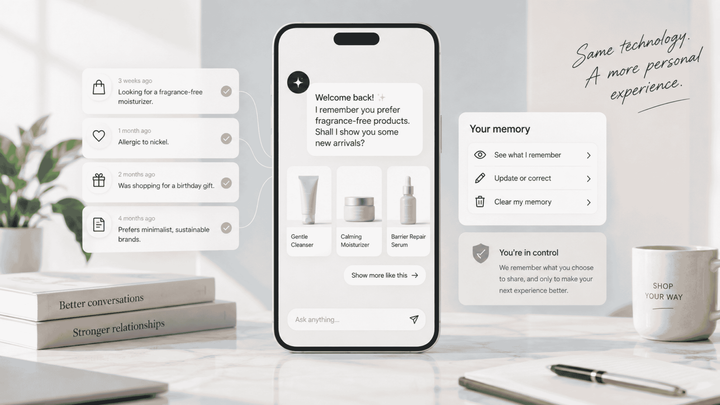
- Conversation history and per-consumer memory that powers personalization
- FAQ refinements and promoted answers tuned to your product catalog
- Brand persona, tone, and guidelines calibrated over weeks of iteration
Rebuilding and ongoing maintenance costs $50K to $150K+ for enterprise teams and takes months of optimization, according to Amenity Tech's 2025 analysis. Manual intent mapping alone requires 80 to 200 internal hours. One fashion retailer calculated $2.3 million in foregone revenue from an eight-month replatforming project, before factoring in costly AI rebuilding and the inefficiencies of starting over.
The Three-Layer Architecture That Makes It Unnecessary
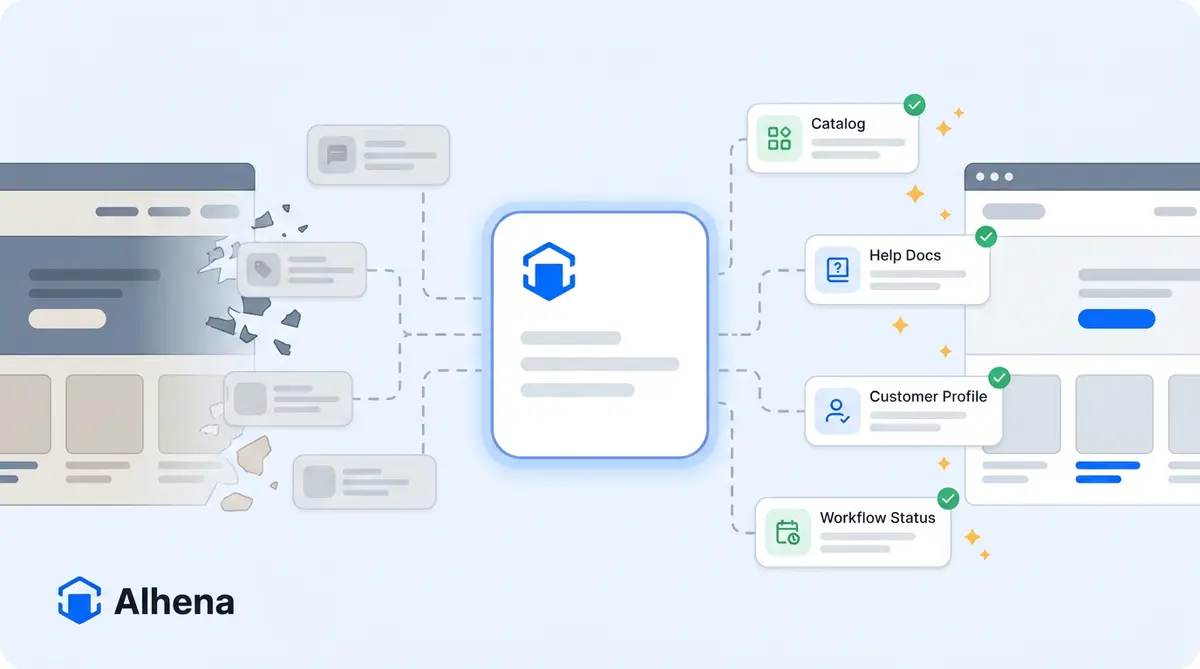
Alhena's data model deliberately separates three layers. This separation protects your digital investment, improves scalability and scaling flexibility, and gives your team the agility to switch platforms without rework.
1. The Bot Profile (the brain), platform-agnostic technology. Everything that makes the agent yours is attached to a BotProfile, not to a store. The knowledge graph, crawled content, help-center articles, and uploaded files live as KnowledgeDocument records under the bot profile, with embeddings in a vector index keyed by bot_profile_key. FAQs and custom answers have no foreign key to any store or platform. Persona, voice, guidelines, guardrails, conversation history, per-user memory, and every thumbs-up/thumbs-down correction: all stored against the bot profile.
2. The Ecommerce Store (the data source), pluggable. Each connected e-commerce store is a row in a generic BotProfileEcommerceStore table with a platform type, store domain, store data mappings, and credentials. Supported platforms include Shopify, BigCommerce, Magento, WooCommerce, Salesforce Commerce Cloud, Solidus, and Shopware. A bot profile can have multiple stores attached at once, on different platforms, so old and new can coexist as your evolving business needs dictate.
3. The Agents (the actions), per-platform skills. Core functionality like order management, cancellation, stock checks, and returns that brands manage daily are platform-specific agents (for example, SHOPIFY_ORDER_INFO or BIGCOMMERCE_CANCEL_ORDER). When a new platform connects, matching agents are provisioned automatically by the management software. When the old platform is uninstalled, its agents are disabled, but the bot profile, knowledge, and history stay untouched. A StockCheckerFactory abstracts over the platform so the answering layer doesn't need to know whether the source of truth is Shopify or BigCommerce.
What Happens During a Replatform, Step by Step
- Connect the new platform. Install the BigCommerce app and authorize it. A new BotProfileEcommerceStore row is created on the same bot profile. Platform-specific agents for the new system are provisioned automatically.
- Ingest the new catalog. Products are stored with a platform field and external_product_id, so old and new catalogs sit side by side without collisions. Once the new feed is healthy and performance is verified, it becomes the answering source.
- Knowledge reuses as-is. FAQs, custom answers, persona, guidelines, the vector index, and the knowledge graph all live at the bot-profile layer. No retraining, re-crawling, or re-uploading. The agent answers the very next question on the new platform with everything it learned on the old one.
- Uninstall the old platform. The uninstall flow disables old agents and marks the store as removed. It does not delete the bot profile, FAQs, knowledge documents, vector index, conversation history, or learnings.
- Conversations continue with zero downtime. Returning shoppers keep their memory and their entire customer journey stays intact. Escalation rules, channel integrations (widget, WhatsApp, email, helpdesk), and analytics history all carry over because they were never tied to the storefront.
What Carries Over vs. What Refreshes
Zero-rework carryover: trained knowledge base and embeddings; all FAQs, custom answers and promoted answers; persona and tone and guidelines; human-feedback corrections and thumbs-up/down learnings; full conversation history and per-user memory; channel installs (web widget, WhatsApp, Instagram, email, helpdesk integrations); analytics and reporting history, escalation and routing rules.
Auto-refreshes from the new platform: product catalog (titles, descriptions, variants, prices, and images), inventory and stock levels, order and customer data for lookup/cancel/return agents, and platform-specific webhooks and event subscriptions.
Your AI Investment Is Protected
E-commerce replatforming is the most disruptive event in your online store's lifecycle. Thousands of online stores, both B2B and DTC, face this challenge yearly. Historically, the AI agent has been collateral damage. Alhena's MACH-compliant architecture makes that loss unnecessary. The platform is a socket; the agent is the device. You swap the socket and the device keeps running with all its accumulated intelligence intact.
Brands like Tatcha (achieving 3x conversion rates) and Puffy (reaching 63% automated inquiry resolution) built that customer experience over time. Losing it to a platform swap would mean losing real revenue. The build vs. buy analysis and vendor consolidation guide cover how this approach to architectural decisions prevents system lock-in.
Ready to protect your AI investment through your next platform move? Book a demo with Alhena AI or start for free with 25 conversations.
Frequently Asked Questions
What happens to my AI chatbot when I switch ecommerce platforms?
With most platform-native chatbots, you lose your trained knowledge base, conversation history, and human-feedback corrections. Rebuilding from scratch costs $50K to $150K+ and takes months. Alhena AI's decoupled architecture keeps your AI brain intact across any platform change.
Does Alhena AI work with both Shopify and BigCommerce?
Yes. Alhena connects to Shopify, BigCommerce, WooCommerce, Magento, Salesforce Commerce Cloud, and custom headless builds. During a migration, both old and new platforms can run simultaneously, so there's no downtime for your AI.
How long does it take to migrate my AI to a new ecommerce platform with Alhena?
Hours, not months. You connect the new platform, ingest its product catalog, verify data health, and disable the old connector. Your knowledge base, FAQs, persona settings, and conversation history carry over with zero rework.
What data carries over during an ecommerce replatforming with Alhena AI?
Everything in the Brain layer transfers automatically: your trained knowledge base and embeddings, all FAQs and custom answers, persona and tone guidelines, human-feedback corrections, conversation history, channel installs (widget, WhatsApp, email), analytics, and escalation rules. Only the product catalog and order data refresh from the new platform.
How much does it cost to retrain an AI chatbot from scratch after replatforming?
Manual intent mapping alone takes 80 to 200 internal hours. Full AI retraining costs $50K to $150K+ for enterprise chatbots, plus months of optimization before the agent reaches its previous accuracy. Platform-agnostic architectures like Alhena's eliminate this cost entirely.
Can I run two ecommerce platforms at the same time in Alhena?
Yes. Alhena supports multiple data sources simultaneously. During a migration, your Shopify and BigCommerce catalogs coexist without collisions, each product tagged with its platform field and external product ID. You cut over when you're ready.
Is Alhena AI compatible with headless and composable commerce architectures?
Alhena is MACH-compliant: microservices-based, API-first, cloud-native, and headless. The AI backend runs as an independent service and connects to any frontend or commerce backend through documented APIs, making it ideal for composable stacks.