A decade ago, the average ecommerce marketing team ran eleven separate systems: one for email, one for forms, one for CRM, one for analytics, one for social, and six more for everything in between. HubSpot and Salesforce ended that era by proving one platform beats eleven point solutions on cost, data quality, and speed. The same consolidation is happening right now in AI ecommerce, and most brands haven't noticed yet.
Here's the current state: your ecommerce team probably runs three separate AI systems. A shopping assistant for product discovery. A support chatbot for post-purchase. And increasingly, an AEO or visibility monitor that automatically tracks to track how your products appear in ChatGPT search results, Gemini, and Perplexity answers. Multiple vendors, three SaaS contracts, three API connections, three data models, tripling complexity. The licensing isn't even the expensive part.
This guide makes the case for ai ecommerce vendor consolidation, walks through the real costs nobody budgets for, and gives you a framework for deciding when one platform beats three.
The Integration Tax Nobody Budgeted For
Every vendor's pricing page shows a clean monthly number. What it doesn't show is the glue code your engineering team builds, creating a bottleneck to connect that tool to everything else.
Three AI vendors means three separate API integrations to your commerce platform. Three webhook setups across your infrastructure. Three authentication setups. Three data mapping exercises to translate "customer" from System A's schema to System B's schema to System C's schema. When Shopify pushes a catalog and inventory update, three systems need to automatically ingest it independently.
The operational overhead compounds fast:
- Three billing cycles to track, forecast, and negotiate. Three renewal dates. Three procurement processes.
- Three provider relationships to manage. Three account managers sending quarterly business reviews. Three escalation paths when something breaks at 2 AM on Black Friday.
- Three training workflows for your CX team. Three admin panels. Three sets of documentation. Three Slack channels for provider support.
- Three security reviews per year. Three SOC 2 audits to validate. Three data processing agreements to maintain.
Integration and maintenance can consume a meaningful share of a technology budget, but the amount varies by architecture, vendors, and internal staffing. Model those costs explicitly instead of treating subscription prices as the full cost.
The TCO breakdown for AI customer service covers the visible vs hidden cost split in detail. But even that analysis examines single-vendor pricing tiers. The multi-vendor coordination tax sits on top of all those numbers.
The Data Silos That Form Between Your AI Tools
Cost is the obvious problem. The subtle one is worse: your three AI vendors are each operating with partial blindness.
Your Shopping Agent Doesn't Know About Returns
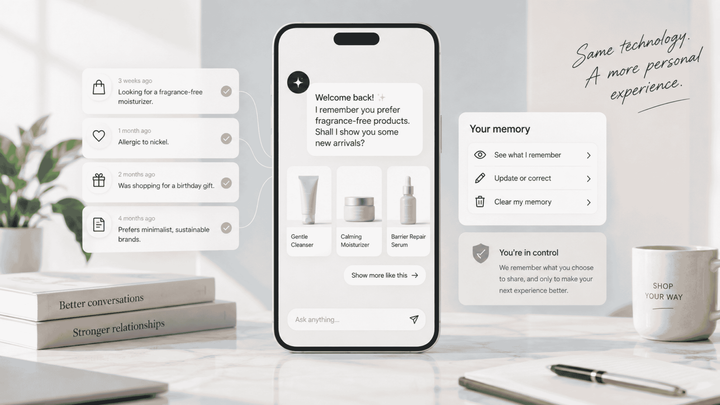
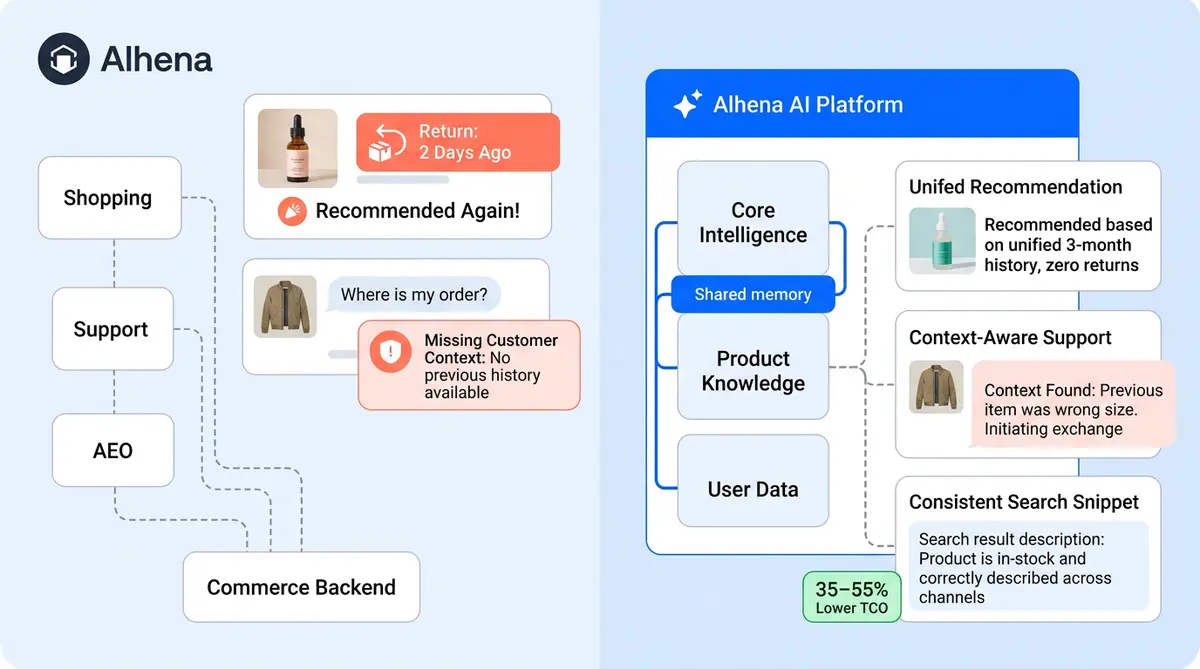
A customer filed a return on a moisturizer last Tuesday because it irritated their skin. Four days later, they're back on your site browsing moisturizers again. Your AI shopping assistant recommends the exact same product they returned, plus three others with identical active ingredients. The shopping agent doesn't have access to support ticket history. It can't know what failed.
With a single platform, the AI remembers the return reason and steers toward fragrance-free options without the customer needing to explain anything.
Your Support Tool Doesn't Know What They Were Shopping
A customer chatted with your shopping assistant yesterday, comparing two specific jackets. They chose neither and left. Today they email support asking about your return policy "before I buy." Your support chatbot gives a generic return policy answer. It can't say "the quilted jacket you were looking at yesterday ships free and has a 60-day return window" because it has no access to shopping session data.
That's not a support failure. It's a missed conversion that no one even tracks.
Your Visibility Tool Doesn't Know What Shoppers Actually Ask
Your AEO monitor tracks which products appear in ChatGPT and Perplexity results. But it optimizes based on competitor content and external signals. It doesn't know that 340 shoppers asked your shopping assistant about "wireless earbuds for running" last month, or that your support chatbot handled 87 questions about water resistance. Those real customer queries are gold for AI-powered journey optimization, but they sit in a different database that your visibility tool can't read.
A consolidated platform automatically feeds actual on-site customer questions directly into its AEO engine. No export. No CSV upload. No monthly sync. Automatic real-time signal flow from conversation to content optimization.
The Martech Parallel: We've Seen This Movie Before
In 2014, the average enterprise marketing team ran 91 different cloud services. Email lived in Mailchimp. Forms in Typeform. CRM in one system, analytics in another, social scheduling in a third. Each tool worked fine alone. Together, they created a data management nightmare that consumed entire teams.
Then consolidation happened. HubSpot combined inbound marketing, CRM, email, forms, analytics, and social into one platform. Salesforce acquired its way to a unified cloud. The argument wasn't that any single consolidated feature was better than the best point solution. The argument was that shared data and eliminated integration cost more than made up for any individual feature gap.
The AI ecommerce stack is at the exact same inflection point right now:
- 2014 martech: email + forms + CRM + analytics + social (5 tools → 1 platform)
- 2026 AI commerce: shopping assistant + support chatbot + AEO visibility (3 tools → 1 platform)
The pattern is identical. Point solutions emerge first because they're faster to build, sell, and deploy at speed. Once the market matures, platforms win because shared data compounds in value. Early movers who consolidate now save 18-24 months of re-platforming later, and they get the data flywheel spinning while competitors are still stitching APIs together.
Brands that chose HubSpot early over five separate vendors didn't just save money. They had unified customer profiles years before competitors caught up. The same advantage awaits ecommerce brands that consolidate their AI stack today rather than in 2028 when everyone else finally does it.
One Vendor vs. Three Vendors: Honest TCO Comparison
The table below reconstructs the article's intended planning assumptions for a mid-market ecommerce brand with 50K-300K monthly sessions. It is an illustrative scenario, not an audited market benchmark. Replace each range with current vendor quotes, implementation estimates, internal labor costs, and data-integration costs before using it for a purchasing decision.
The comparison assumes three separate best-of-breed AI products (one shopping assistant, one support chatbot, one AEO/visibility tool) versus a single consolidated platform covering all three functions.
Year-One TCO: One Platform vs. Three Vendors
| Cost Category | One Consolidated Platform | Three Point Solutions |
|---|---|---|
| Licensing (annual) | $36K-$72K (one contract) | $48K-$108K (3 contracts) |
| Integration/API setup | $5K-$15K (one connection) | $15K-$60K (3 connections + middleware) |
| Ongoing maintenance | $3K-$8K/yr | $12K-$30K/yr (3x update cycles) |
| Team training | 1 system, 2-3 day onboarding | 3 systems, 6-9 days total |
| Data sync/reconciliation | $0 (native shared data) | $8K-$10K/yr (CDP or custom sync) |
| Vendor management overhead | 1 relationship, 1 QBR | 3 relationships, 12 QBRs/yr |
| Security/compliance reviews | 1 annual audit | 3 annual audits |
| Total Year-One Cost | $44K-$95K | $83K-$208K |
Illustrative planning assumptions for mid-market ecommerce (50K-300K monthly sessions), not audited market benchmarks. Replace with current quotes and internal costs.
Where the Cost Gap Compounds in Year Two
Year one is bad. Year two is worse for the three-provider stack. Here's why:
- Integration maintenance grows. Every platform update from any of the three vendors risks breaking your custom integrations. Budget 15-20% of initial integration cost annually for maintenance.
- Training repeats. Staff turnover means re-training new team members on three systems instead of one. Three provider certifications. Three onboarding paths.
- Data drift accelerates. Customer profiles diverge further across the three systems. Reconciling them becomes exponentially harder as data volume grows.
- Contract negotiations multiply. Three annual renewals, each with its own pricing pressure and feature bundling tactics designed to lock you in deeper.
In later years, duplicated maintenance, training, and reconciliation can widen the gap between architectures. Do not assume a fixed savings percentage; model renewal pricing, integration maintenance, staffing, migration, and switching costs for each option. For the full decision framework on building vs. buying your AI capabilities, treat shared data as one factor alongside migration risk and evidence from a controlled comparison.
When Three Vendors Still Makes Sense
Honest answer: sometimes consolidation isn't worth it yet. Here's when keeping separate tools is the right call:
You Have 50+ Custom Workflows in an Existing Tool
If your support team has built 50 custom macros, 30 automation rules and routing logic, and 15 routing workflows in Zendesk or Gorgias over three years, the migration risks are real. Those workflows encode institutional information and knowledge that takes months to replicate. The switching cost may exceed the consolidation savings for the next 18-24 months.
But here's the nuance: that argument applies to existing mature tools. It doesn't apply to new capabilities you're adding. If you're buying a shopping assistant or AEO tool for the first time, start consolidated. Don't build new silos on top of old ones.
You're in a Regulated Vertical With Compliance Requirements
Healthcare, financial services, and some B2B verticals have compliance risks and requirements that mandate specific vendors with specific certifications. If your support tool is SOC 2 Type II certified and your consolidated alternative isn't, compliance trumps cost optimization.
Your Volume Doesn't Justify Platform Investment
Brands with fewer than 10,000 monthly customer interactions often don't generate enough data to benefit from the shared intelligence advantage. The cross-pollination between shopping, support, and visibility data only compounds when there's meaningful volume flowing through all three. Below that threshold, three lightweight services may actually outperform one heavier platform.
The Decision Framework
Use the AI agent evaluation checklist to score each existing tool. If any tool scores above 80% on business value with greater than 75% feature utilization, keep it and consolidate around it. If multiple tools score below 60%, that's your consolidation signal.
How Alhena AI Covers All Three Functions in One Platform
Alhena AI is one of the few platforms purpose-built to consolidate all three AI functions ecommerce brands currently split across vendors:
- Product Expert AI Agent handles guided selling, product recommendations, comparison shopping, and agentic checkout. Same function as a standalone AI shopping product, but sharing data with support and visibility.
- Support Concierge manages post-purchase automation and inquiries, order tracking, returns, and escalation. Same function as a standalone support chatbot, but informed by shopping history and product context.
- AI Visibility tracks product appearances in ChatGPT, Gemini, and Perplexity, generates AEO-optimized FAQ content from real customer queries, and provides GEO citation strategies. Same function as a standalone AEO monitor, but powered by actual conversation data.
The shared memory layer is what makes consolidation valuable rather than just cheaper. When a customer interacts with any of the three functions, all three benefit. The shopping agent knows about returns. The support agent knows about browsing history. The visibility engine knows what real shoppers actually ask about your products.
Tatcha attributed double-digit percentage points of total site revenue to AI after consolidating onto one platform, with conversion rates tripling. The brand credits shared context between shopping and support interactions for much of that lift. Manawa reduced support workload by nearly half while collapsing response times from the better part of an hour to under sixty seconds. These results come not just from better AI, but from better data flowing between functions that used to be siloed.
Deployment takes under 48 hours for speed-to-value, integrates natively with Shopify, WooCommerce, and Salesforce Commerce Cloud, and layers alongside existing helpdesks like Zendesk and Gorgias. You don't need to rip out your support tool on day one. Start with the shopping agent and visibility layer, let them share data with your existing support system through Alhena's integrations, and evaluate full consolidation once you see the shared intelligence advantage firsthand.
The Consolidation Playbook: Where to Start
If you're running three AI companies today and the math says consolidation makes sense, here's the sequence that works:
Month 1: Audit and Score
Map every AI service touching customer interactions. For each, document: annual true cost (licensing + integration + maintenance + training), percentage of features your team actually uses, what unique data it holds, and how hard it would be to replicate its workflows elsewhere.
Month 2: Start New, Don't Migrate Old
Don't try to migrate your most complex tool first. Instead, deploy the consolidated platform for your newest or least-entrenched AI function. For most brands, that's the shopping assistant or AEO visibility tool, not support (which has years of accumulated workflows).
Month 3-4: Run Parallel and Measure
Let the consolidated platform run alongside existing systems. Compare conversion rates, resolution rates, and data quality. The shared intelligence advantage usually shows within 30-45 days as the AI cross-references shopping and support data.
Month 5-6: Consolidate Support (If the Data Supports It)
Once you've proven the platform handles shopping and visibility better than point solutions, evaluate migrating support. For many brands, keeping the existing helpdesk for human-agent workflows while routing AI automation and processing through the consolidated platform is the right hybrid approach. The omnichannel AI setup guide walks through the channel-by-channel connection process.
Key Takeaways
- A consolidated stack can reduce duplicated costs when it removes integrations, reconciliation work, and vendor-management overhead. Quantify the result with your own quotes and labor assumptions rather than a universal percentage.
- Data silos between AI tools destroy their effectiveness. A shopping agent blind to support history and a visibility tool blind to real customer queries are each operating at half capacity.
- The martech consolidation parallel is exact. Email + CRM + analytics consolidated a decade ago. Shopping + support + visibility are consolidating now. Early movers gain 18-24 months of data advantage.
- Consolidation isn't always right. Deeply entrenched systems with 50+ custom workflows may cost more to migrate than to keep. But new AI technology capabilities should always start consolidated.
- Start with new functions, not existing ones. Deploy consolidated for shopping and visibility first. Evaluate support migration after proving the shared data advantage.
Ready to see the math for your specific stack? Run your numbers through the ROI calculator, book a demo to see all three agents sharing data in real time, or start free with 25 conversations.
Alhena AI
Frequently Asked Questions
What is ai ecommerce vendor consolidation?
AI ecommerce vendor consolidation means replacing separate tools, such as a shopping assistant, support chatbot, and AI-visibility monitor, with one platform or shared data layer. Potential benefits include fewer integrations, simpler governance, and more consistent context. Cost savings are not universal and should be calculated from current vendor quotes, internal labor, migration costs, and required controls.
How much does a fragmented AI ecommerce stack actually cost versus one platform?
The article's reconstructed planning scenario uses $44K-$95K for one platform and $83K-$208K for three point solutions in year one. These are illustrative inputs, not audited market benchmarks. Replace them with current licensing, implementation, maintenance, training, and data-sync estimates before making a purchasing decision.
Can I consolidate AI tools without replacing my existing helpdesk?
Yes. Most consolidated AI platforms layer alongside existing helpdesks like Zendesk, Gorgias, or Freshdesk rather than replacing them. The AI platform handles automation of conversations across shopping, support, and visibility while your helpdesk continues managing human agent workflows, ticket routing, and SLA tracking.
What data do AI shopping assistants miss when they operate separately from support tools?
A standalone shopping assistant cannot access return history, complaint records, support ticket context, or product satisfaction signals. This means it may recommend products a customer already returned, miss warranty issues affecting repurchase decisions, or fail to acknowledge ongoing support interactions. Consolidated platforms share this context in real time across all AI functions.
How does AEO visibility benefit from shared customer conversation data?
AEO (Answer Engine Optimization) tools optimized with real on-site customer queries outperform those relying only on competitor analysis and external signals. When your visibility engine knows that 340 shoppers asked about "wireless earbuds for running" on your site last month, it can generate citation-ready content targeting those exact queries rather than guessing which questions matter.
When should an ecommerce brand keep separate AI vendors instead of consolidating?
Keep separate vendors when: you have 50+ custom processes and workflows in an existing tool that would take months to replicate. Or your volume is below 10,000 monthly customer interactions (insufficient data for cross-tool intelligence), or compliance requirements mandate a specific certified vendor. For new AI capabilities like shopping agents or AEO, always start consolidated to avoid building new silos.
How long does AI ecommerce vendor consolidation take?
Most mid-market brands complete consolidation in 4-6 months using a phased approach. Month 1 is auditing and scoring existing tools. Month 2 deploys the consolidated platform for the least-entrenched function (usually shopping or AEO). Months 3-4 run parallel comparison. Months 5-6 migrate support if the data and delivery metrics support it. Platforms like Alhena AI deploy in under 48 hours for the initial function.
What is the martech consolidation parallel for AI ecommerce?
In 2014, marketing teams ran 5-11 separate systems for email, CRM, forms, analytics, and social. HubSpot and Salesforce consolidated these into unified platforms, winning on shared data rather than individual feature superiority. AI ecommerce is at the same inflection: shopping assistants, support chatbots, and AEO visibility tools are consolidating into unified platforms. Early movers gain 18-24 months of compounding data advantage.
How does Alhena AI handle all three AI functions in one platform?
Alhena AI provides a Product Expert Agent for guided selling, a Support Concierge for post-purchase automation, and AI Visibility for AEO/GEO monitoring across ChatGPT, Gemini, and Perplexity. All three share a unified customer memory layer so shopping context informs support interactions, support history informs product recommendations, and real customer queries power visibility optimization. Deployment integrates natively with Shopify, WooCommerce, Zendesk, and Gorgias.