According to a Drift study, 87% of consumers rate their chatbot interactions as neutral or positive. But "neutral" isn't the bar you should aim for. Neutral means forgettable. And forgettable chatbots don't sell products.
The gap between a customer service chatbot that converts and one that gets closed after two messages usually comes down to one thing: personality. Not features, not speed, not even accuracy. Chatbot personality is what keeps customer interactions engaging long enough to convert.
This guide breaks down exactly what makes chatbots sound robotic, seven proven techniques to build a chatbot personality that feels human, and how leading ecommerce brands are turning AI personality into measurable revenue.
Why Chatbot Personality Matters for Ecommerce
A 2024 study in Humanities and Social Sciences Communications found that chatbot communication style directly shapes consumer satisfaction and trust. Across 643 participants, chatbots that show empathy and warmth generated higher satisfaction and more word-of-mouth than those with task-only interactions.
For ecommerce customer service, the stakes are even higher. Shoppers aren’t just looking for answers. They're deciding whether to spend money. A robotic tone creates friction at the exact moment you need to reduce it.
Consider the numbers: Tatcha saw a 3x conversion rate after deploying an AI chatbot that mirrors its luxury brand voice. Victoria Beckham achieved a 20% AOV increase. These lifts don't come from answering questions faster. They come from answering them better, in a tone that feels like the brand itself.
As research on AI shopping psychology shows, conversational commerce converts at 4x the rate of static browsing. But only when the conversation feels real.
What Makes a Chatbot Sound Robotic
Before you can fix the problem, you need to spot it. Most chatbots sound robotic for predictable reasons, and all of them are fixable.
Canned responses with zero variation
If your chatbot says "I'm sorry, I didn't understand that" the same way every time, customers notice within seconds. Humans don't repeat themselves word-for-word. A single response template per intent is the fastest way to make your bot feel like a phone tree.
No context awareness
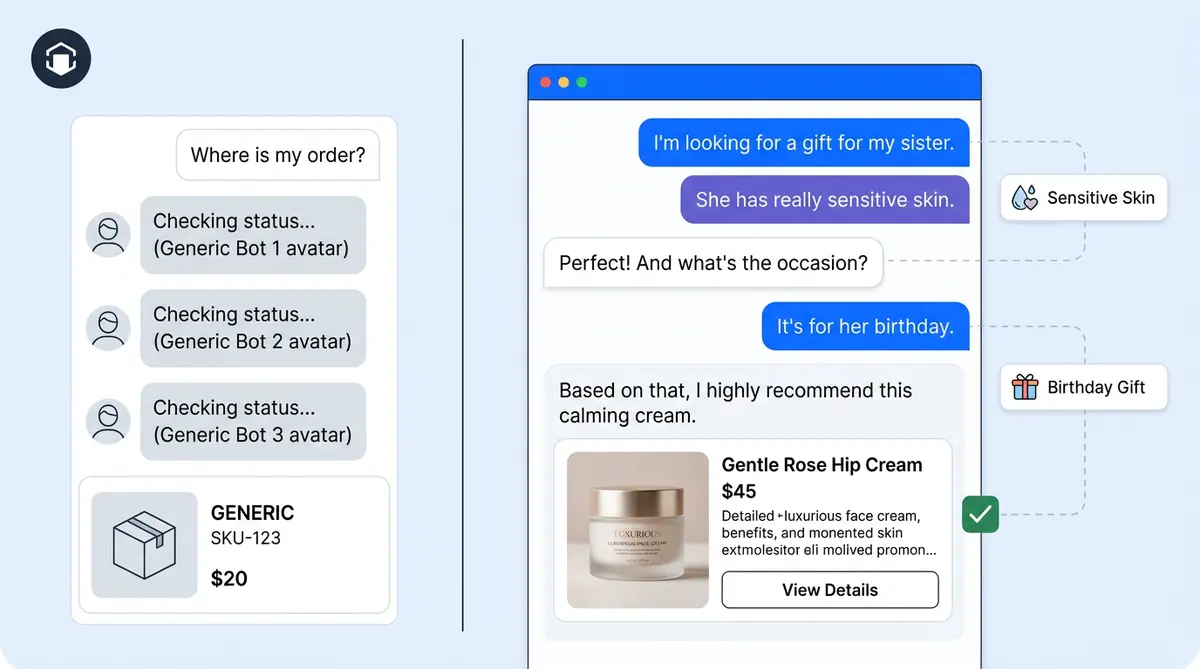
Picture telling a store associate you're looking for a birthday gift, and two messages later they ask, "What are you shopping for?" That's what happens when chatbots lack contextual memory. Every message feels like the first one, creating a frustrating experience where the customer starts over each time.
Overly formal or corporate language
Phrases like "Your inquiry has been noted" or "Please be advised" signal that a machine is talking. Real people don't use that language in a retail setting. Your chatbot shouldn't either.
No emotional awareness
A customer who just received a damaged product and a customer browsing for fun need completely different tones. If your chatbot treats both situations identically, it feels tone-deaf to everyone.
Predictable sentence structure
When every response follows the same Subject-Verb-Object pattern at identical length, the pattern itself becomes the giveaway. Varying sentence length and rhythm is one of the simplest ways to sound more natural.
7 Techniques to Build a Human-Sounding Chatbot Personality
Building an AI chatbot personality isn't about adding emoji or cracking jokes. It's about creating a consistent, brand-aligned conversational style that makes customers comfortable enough to buy.
1. Define three to five personality traits tied to your brand
Start with adjectives that capture your brand's voice and purpose. "Professional but approachable" is a starting point, not a personality. Narrow it down to something specific: "confident, warm, and slightly witty" or "calm, precise, and reassuring." These traits become the filter for every response your chatbot generates.
A luxury skincare brand needs a different AI personality than an outdoor gear shop. Both can drive high conversion rates. The tone just has to match the brand DNA.
2. Create response variation for common intents
Write multiple versions of your most frequent responses. Instead of one "I'll look into that for you," create five variations: "Let me pull that up," "Good question, checking now," "One second while I find that," and more. This mirrors how humans naturally vary their speech.
The key is controlled variation. Each version should stay within your personality guardrails while sounding different enough to avoid pattern fatigue.
3. Use contextual memory across the conversation
A chatbot with real personality remembers what you said three messages ago. If a shopper mentions sensitive skin, every relevant product recommendation from that point should reflect it, without the customer repeating themselves.
This is where most chatbots fall short. AI shopping assistants that maintain full conversation context create a feeling of genuine understanding. That feeling creates engaging interactions that drive trust, and trust drives purchases.
4. Match emotional tone to the situation
Sentiment-aware responses separate good chatbots from great ones. When a customer types "this is so frustrating," your chatbot should acknowledge that experience before jumping to a solution. Something like "I get it, that's not the experience you expected. Let me fix this" works far better than "Here are your options."
Research from ScienceDirect confirms it: chatbots that display empathy are perceived as both warmer and more competent, and that perception directly boosts satisfaction scores.
5. Add thinking cues and natural pauses
Instant responses can feel uncanny. Adding brief moments like "Let me check that for you..." or "Looking at a few options..." creates a more engaging, natural rhythm. These conversational cues signal that the bot is processing, which paradoxically builds more trust than an instant reply.
Progressive typing indicators that match natural reading speed help too. You're not trying to slow down the chatbot artificially. You're giving customers a moment to absorb one piece of information before the next arrives.
6. Adapt tone across channels
Your chatbot should sound different on Instagram DMs than in a support email. Instagram is casual, quick, emoji-friendly. Email is more detailed, structured. A channel-specific AI approach lets you keep the same core personality while adjusting expression for each platform.
Customers who interact on WhatsApp or Instagram expect a different cadence than those using your website chat widget. The personality stays constant; the delivery adapts.
7. Build in graceful uncertainty
The most human thing a chatbot can do is admit when it doesn't know something. Instead of "I cannot process that request," try "That's a tricky one. Let me connect you with someone who can help right away." Graceful escalation, framed in natural conversational language, shows customers they're heard and keeps the interaction helpful, even when the bot reaches its limits.
How to Match Your Chatbot's Tone to Your Brand Voice
Personality traits are the foundation. Translating them into conversational chatbot responses takes a structured process.
Start with your existing brand guidelines
If your marketing team has a brand voice doc, that's your starting point. Pull the adjectives, the dos and don'ts, the sample language. Your chatbot should sound like it belongs on your site, not like it was dropped in from another company. For a detailed walkthrough, read our guide on building your ecommerce AI's brand voice.
Create a chatbot persona document
Give your chatbot defined personas with personality traits and a list of language rules. Include examples of what the chatbot should say and what it should never say. This document becomes the source of truth for anyone tuning the bot's responses.
A luxury brand's persona doc might specify: "Never use slang. Always address customers by name when available. Use 'delighted' over 'happy.'" A streetwear brand's doc could say the exact opposite.
Test with real customers, not just your team
Internal reviews catch the obvious problems. But your team already knows the product. Real customers reveal the gaps: where the tone feels off, where language confuses, where personality breaks down under edge cases. Run a pilot with a small traffic segment, measure CSAT across real customer service interactions, and confirm the experience feels engaging before you scale up.
How Alhena AI Creates Chatbot Personality at Scale
Most chatbot platforms give you a text box for a system prompt and call it "personality customization." That's not enough for ecommerce, where your AI needs to sound on-brand across thousands of conversations about hundreds of products.
Alhena AI works differently. The platform trains on your product catalog, knowledge base, and brand voice, so every response reflects your identity from day one. The platform can provide what Alhena describes as "a shopping assistant that will feel like an eerily accurate impersonation of your CEO."
Brand voice that adapts without losing consistency
Alhena's Support Concierge mirrors your tone across every channel: web chat, email, Instagram DMs, WhatsApp, and voice. It reasons through multi-part queries and executes real actions like populating carts and processing returns, all while keeping your brand's personality intact.
Because responses are grounded in your company's actual product data and policies, there's no hallucination risk. The chatbot stays accurate and on-brand, which is the combination most platforms struggle with.
Personality that drives revenue, not just ticket deflection
Most AI customer support chatbots are built to deflect support tickets. Alhena is built to sell. The Product Expert Agent handles nuanced shopping queries like "something for oily skin under $30" with contextual, personality-rich recommendations. It doesn't just provide an answer. It guides the customer through a relevant buying journey that feels personal.
The results back this up. Tatcha saw a 3x conversion rate and 38% AOV uplift. Puffy maintains 90% CSAT with 63% automated resolution. Manawa cut response times from 40 minutes to 1 minute while automating 80% of inquiries.
Fast setup, no engineering required
Alhena deploys in under 48 hours and connects with Shopify, WooCommerce, Salesforce Commerce Cloud, and helpdesks like Zendesk, Gorgias, and Intercom. You control the personality layer through configurable AI guidelines without needing dev resources.
Measuring Whether Your Chatbot Personality Works
Building a conversational customer service personality is step one. Proving it works is step two. These are the metrics that tell you if your chatbot tone is helping or hurting.
CSAT per conversation
Track customer satisfaction scores for chatbot interactions and customer service interactions separately from human agent scores. If your chatbot CSAT sits below 80%, your tone likely needs adjustment. Crocus achieves 84% CSAT with AI-handled conversations, and Puffy hits 90%, proving personality-driven bots can match or outperform human agents.
Conversation completion rate
How many customers finish a conversation vs. abandon mid-chat? High drop-off after the first or second message typically signals a tone mismatch. The customer didn't feel heard, so they left.
Conversion rate from chat
This metric separates support chatbots from sales chatbots. If customers who engage with your AI chatbot convert at a higher rate than those who don't, your personality is working. Alhena's built-in revenue attribution analytics tracks exactly which conversations lead to purchases, so you can connect personality to revenue.
Escalation quality
When your chatbot hands off to a human, is the customer still engaged or already annoyed? Good chatbot personality makes escalations smoother because the customer feels understood, even when the bot couldn't fully resolve the issue. Agent Assist gives human agents full context from the AI conversation so handoffs feel natural.
Key Takeaways
- Chatbot personality directly affects conversion rates, CSAT, and AOV in ecommerce. It's a revenue driver, not a cosmetic feature.
- The biggest chatbot personality killers are canned responses, no context memory, overly formal language, and zero emotional awareness.
- Seven practical techniques transform robotic chatbots: define personality traits, create response variation, maintain contextual memory, match emotional tone, add thinking cues, adapt across channels, and build graceful uncertainty.
- Your chatbot's voice should come from your brand guidelines, documented in a chatbot persona document, and tested with real customers before scaling.
- Alhena AI trains on your catalog, knowledge base, and brand voice to deliver AI chatbot personality at scale, with results like 3x conversions at Tatcha and 90% CSAT at Puffy.
- Measure chatbot personality through CSAT, conversation completion, chat conversion rate, and escalation quality to tie tone to ROI.
Ready to give your chatbot a personality that actually sells? Book a demo with Alhena AI to see brand-voice AI in action, or start for free with 25 conversations. Want to estimate the revenue impact first? Try the ROI Calculator.
Frequently Asked Questions
What is chatbot personality and why does it matter for ecommerce?
Chatbot personality is the consistent communication style, tone, and language patterns your AI uses when talking to customers. In ecommerce, it directly affects conversion rates and average order value. Brands using personality-aligned chatbots, like Tatcha with Alhena AI, have seen 3x conversion rates compared to generic bot interactions.
How do I make my AI chatbot sound less robotic?
Focus on five core areas: create multiple response variations for common queries, maintain context across the conversation so customers don't repeat themselves, match your emotional tone to the situation, add natural thinking cues like 'Let me check that for you,' and adapt your tone per channel. These techniques mirror how humans naturally communicate.
Can I customize my chatbot's personality to match my brand voice?
Yes, platforms like Alhena AI train on your product catalog, knowledge base, and brand guidelines to create a chatbot personality that matches your brand from day one. You define personality traits, language rules, and tone preferences through configurable AI guidelines without needing any engineering resources.
How does chatbot personality affect conversion rates?
Research shows that chatbots perceived as warm and empathetic drive higher satisfaction and more purchases. In ecommerce, conversational AI that matches a brand's voice converts at up to 4x the rate of static browsing. Alhena AI customers report conversion lifts of 3x or more when their AI chatbot personality aligns with their brand identity.
What metrics should I track to measure chatbot personality effectiveness?
Track four key metrics: CSAT scores for chatbot conversations (aim for 80%+), conversation completion rate (low drop-off means your tone resonates), conversion rate from chat (ties personality to revenue), and escalation quality (whether customers are still engaged during handoffs to human agents).
Should my chatbot have the same personality across all channels?
Your core personality traits should stay consistent, but the expression should adapt per channel. Instagram DMs call for a casual, quick tone with emoji. Email supports more detail and structure. Alhena AI's omnichannel approach maintains one personality across web, email, Instagram, WhatsApp, and voice while adapting delivery to each platform.
How is Alhena AI different from other chatbot personality tools?
Most chatbot platforms offer a system prompt text box for personality. Alhena AI goes further by training on your entire product catalog and brand voice, grounding every response in verified data to prevent hallucinations, and adding agentic capabilities like cart population and checkout. It's built for ecommerce sales, not just customer support ticket deflection.
How long does it take to set up a chatbot with a custom personality?
With Alhena AI, deployment takes under 48 hours. The platform integrates with Shopify, WooCommerce, Salesforce Commerce Cloud, and major helpdesks like Zendesk and Gorgias. You configure personality through AI guidelines and a brand voice setup, with no developer resources needed.