What Is an AI Agent for Electronics Ecommerce?
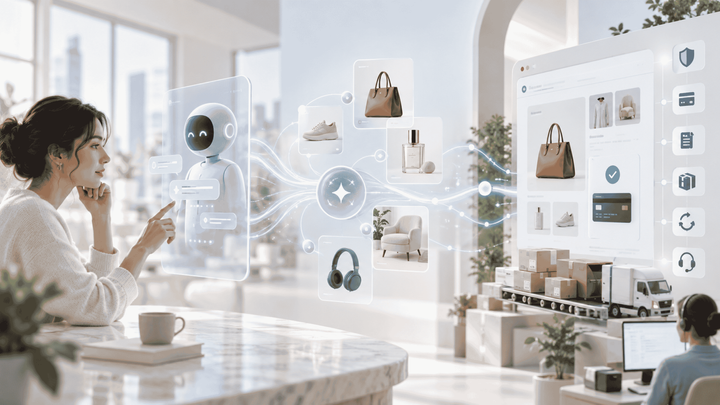
An AI agent for electronics e-commerce is software that handles the entire shopping journey, from item discovery to checkout, without human intervention. It’s an autonomous AI agent that answers spec questions, compares products, identifies items from photos, and completes purchases across channels like web chat, email, WhatsApp, and Instagram DMs.
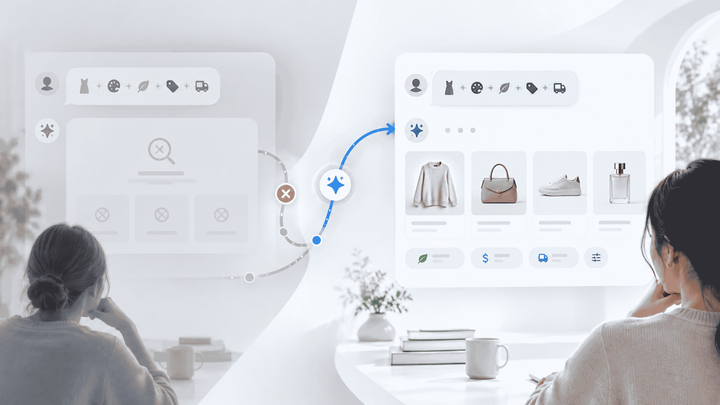
Electronics is one of the fastest-growing e-commerce verticals for marketing and sales innovation. Buyers face a problem that other verticals don't: technical complexity. For example, a customer buying a laptop needs to match processor speed, RAM, GPU, display resolution, and port compatibility to their use case. Traditional search filters can't handle that. E-commerce agents can handle it. These agents can process natural language, compare specs, and guide customers through complex decisions.
The global e-commerce market hit $6.88 trillion in 2026, according to Capital One Shopping. Electronics is the top-selling category on Amazon, making up 38% of online sales. Yet cart abandonment for electronics sits at 74.1% on Shopify and other e-commerce stores, per Baymard Institute. The gap between interest and purchase: how e-commerce agents make the biggest difference.
Why Do Electronics Shoppers Abandon Carts at 74%?
Electronics buyers abandon carts because they can't get answers fast enough. A customer comparing two monitors needs to know if one supports VESA mounting and the other doesn't. If your store can't answer that in seconds, they leave for a competitor that can.
Here are the top reasons electronics shoppers don't convert:
- Spec confusion: Shoppers can't tell the practical difference between DDR4 and DDR5 RAM, or whether a USB-C port supports Thunderbolt.
- Compatibility anxiety: Will this graphics card fit my case? Does this charger work with my phone model?
- Information overload: A single laptop listing may have 40+ spec fields. Shoppers freeze when facing too many variables.
- No guided selling: Unlike in-store associates, most e-commerce sites leave shoppers to figure it out alone.
An AI shopping assistant built for electronics solves each of these by turning spec sheets into conversational AI answers tailored to what the shopper actually needs.
How Does Visual Search Work for Electronics Ecommerce?
Visual search lets buyers upload a photo or snap a picture with their phone camera to find matching or similar products in your catalog. Instead of typing "black wireless over-ear headphones with noise cancelling", a shopper photographs the pair they saw at a friend's house and gets instant results.
Google Lens processes roughly 20 billion visual searches per month, with 4 billion related to shopping, according to Imagga. Amazon reported a 70% year-over-year increase in visual searches worldwide. The demand is already there. For e-commerce marketing teams, it’s a channel that converts browsing into buying.
Why Visual Search Matters More for Electronics Than Other Categories
Electronics products are hard to describe in words. Try typing "that small rectangular device with two USB ports, an HDMI output, and a cooling fan on the side" into a search bar. You won't find the docking station you saw on a YouTube review.
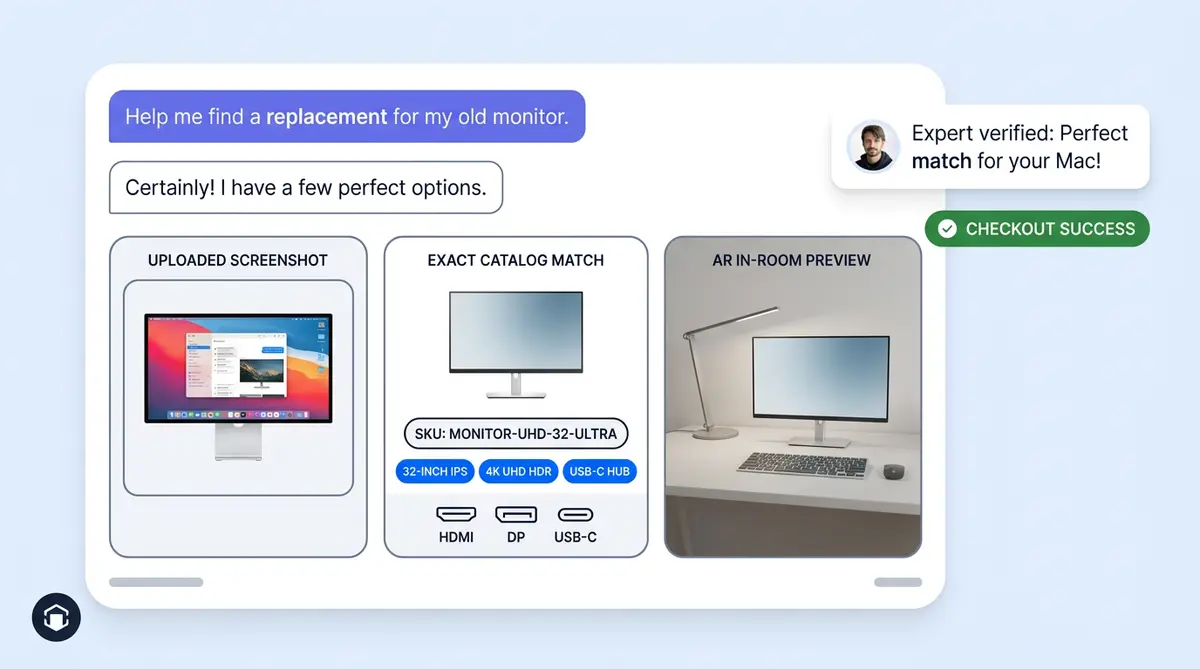
Visual search closes this vocabulary gap. A buyer can screenshot a product from a tech review video, upload it to your store, and find the exact item or a close match. Alhena AI's visual search uses image recognition to match uploaded photos against your product catalog, identifying the specific SKU or surfacing visually similar alternatives.
The results speak for themselves across e-commerce. Retailers using visual search see conversion rate increases of up to 38%, according to industry benchmarks cited by Experro. For electronics stores with large catalogs, visual search turns confused visitors into confident customers.
How Alhena AI Handles Image-Based Product Finding
Alhena AI's ai product finder from image works directly inside the chat widget. A customer pastes or uploads a photo, and Alhena identifies the product, pulls the matching SKU from your catalog, and presents key specs alongside the result.
If the exact item isn't in your catalog, Alhena surfaces the closest alternatives ranked by visual similarity and spec overlap. The buyer never has to describe what they're looking for in words. They just show it.
Can Shoppers Virtually Try Electronics Before Buying?
Yes. Virtual try-on for electronics lets customers visualize how a product looks and fits in their real environment before placing an order. The technology uses AR (augmented reality) and camera-based overlays to show items like headphones on the shopper's head, a monitor on their desk, or a smart speaker in their living room.
What Electronics Products Work Best with Virtual Try-On?
Not every e-commerce electronics item needs virtual try-on. Here's where it makes the biggest impact:
- Headphones and earbuds: Customers see how they look and fit on their head or ears.
- Smartwatches and wearables: Size comparison against the shopper's actual wrist.
- Monitors and TVs: AR placement shows the screen size in the shopper's room to scale.
- Home office setups: Docking stations, speakers, and webcams visualized on the shopper's desk.
- Smart home devices: Thermostats, cameras, and speakers shown mounted in real spaces.
Alhena AI integrates virtual try-on directly into the shopping conversation. When a shopper asks "Will this 27-inch monitor fit on my desk?" Alhena can trigger the AR visualization so they see the answer instantly, without leaving the chat.
How Does Alhena AI's Product Expert Handle Complex Electronics Questions?
Alhena AI's Product Expert Agent is trained on your full electronics catalog, including specifications, descriptions, compatibility notes, and inventory data. It handles questions that generic chatbots can't touch.
Here's what that looks like in practice:
- Shopper asks: "I need a laptop for video editing under $1,500 with at least 32GB RAM and a dedicated GPU."
- Alhena responds: Filters your catalog by those exact specs, ranks the top matches, and explains the tradeoffs between each option.
- Shopper asks: "Does this wireless mouse work with my MacBook Pro M3?"
- Alhena responds: Checks the product's compatibility data in your catalog and gives a direct yes or no, plus any setup steps.
Every answer is grounded in your verified catalog data. Alhena doesn't hallucinate specs or make up compatibility claims. If the information isn't in your catalog, it says so and routes the question to a human agent through Agent Assist.
What About Post-Purchase Technical Questions?
The Product Expert Agent doesn't stop at the sale. After a customer buys a router, they might ask, "How do I set up the guest network?" If your knowledge base includes setup documentation, Alhena resolves that question accurately. Alhena's Support Concierge also handles order tracking, returns, and exchanges through automation.
Brands using Alhena AI see measurable results. Tatcha achieved a 3x conversion rate and 38% average order value uplift. Puffy reached 63% automated inquiry resolution with 90% customer satisfaction. These results come from the same core technology that powers the electronics use case.
What Makes Alhena AI the Best AI Agent for Electronics Brands?
Most AI chatbots small and enterprise businesses use are built for general customer support. They handle FAQs and ticket deflection, but they don't know how to sell electronics. Alhena AI is purpose-built for agentic commerce and e-commerce sales, not just support.
Here's what separates Alhena from tools like Zendesk AI, Intercom Fin, or Tidio:
- Hallucination-free responses: Every answer comes from your verified product catalog. No made-up specs, no incorrect compatibility claims.
- Visual search and image upload: Shoppers find products by photo, not keywords. Critical for electronics where product names are often model numbers.
- Virtual try-on: AR-powered product visualization helps shoppers see electronics in their real space before buying.
- Agentic checkout: Alhena doesn't just recommend products. It populates the cart and pre-fills checkout, turning conversations into completed orders.
- Omnichannel coverage: One AI agent across web chat, email, Instagram DMs, WhatsApp, and voice. Your electronics buyers get the same expert help on every channel, whether they’re coming from marketing campaigns or organic discovery.
- Revenue attribution analytics: Track exactly how much revenue each AI conversation generates. No guessing.
- Cost-effective 48-hour deployment: Alhena connects to Shopify, WooCommerce, and Salesforce Commerce Cloud with no development resources or engineering services needed, reducing the integration cost and testing time.
Zendesk's built-in AI handles ticket deflection well, but it wasn't designed to drive revenue. Intercom Fin is a strong support tool, but it lacks e-commerce-specific features like agentic checkout and visual product search. Alhena AI was built from day one to turn conversations into sales.
How Do Electronics Brands Get Started with Alhena AI?
Getting started takes four steps, whether you’re a small business or enterprise e-commerce operation. Most brands go live in under 48 hours.
- Connect your product catalog. Alhena ingests your full electronics catalog, including specs, compatibility data, images, pricing, and inventory. It integrates natively with Shopify, WooCommerce, Magento, and Salesforce Commerce Cloud.
- Add your knowledge base. Upload setup guides, FAQs, warranty policies, and compatibility documentation. The more data you provide, the better Alhena answers technical questions.
- Deploy on high-intent pages. Start with listing pages, category pages, and the e-commerce checkout flow. These are where electronics customers need the most help. This is where e-commerce businesses see the highest return.
- Expand across channels. Once the AI is performing on your site, activate it on Instagram DMs and WhatsApp to capture social commerce demand. Electronics customers who discover products on social media can get instant answers without leaving the platform.
Use the Alhena ROI calculator to estimate the revenue impact before you start. Brands like Crocus achieved an 86% deflection rate and 84% customer satisfaction. Manawa cut workload by 43% and dropped response time from 40 minutes to 1 minute.
Key Takeaways
- Electronics cart abandonment runs at 74.1% because shoppers can't get fast, accurate responses to technical questions.
- An AI agent for electronics e-commerce handles item discovery, spec comparison, compatibility questions, and checkout in one conversation.
- Visual search lets shoppers upload photos to find exact products, closing the vocabulary gap that kills electronics search.
- Virtual try-on gives shoppers AR-powered views of headphones, monitors, and smart home devices in their real space.
- Alhena AI's Product Expert Agent answers complex electronics questions using verified catalog data with zero hallucinations.
- Alhena deploys in under 48 hours, works across web chat, email, Instagram, WhatsApp, and voice, and tracks revenue from every AI conversation.
- Brands using Alhena see up to 3x conversion rates, 38% AOV uplift, and 86% ticket deflection.
Ready to turn your electronics store into a guided selling experience? Book a demo with Alhena AI or start free with 25 conversations.

Frequently Asked Questions
What is an AI agent for electronics ecommerce?
An AI agent for electronics ecommerce is software that handles the full shopping journey, from product discovery through checkout, without human help. It answers spec questions, compares products, identifies items from uploaded photos, and completes purchases across web chat, email, WhatsApp, and Instagram. Alhena AI is purpose-built for e-commerce sales, not just support ticket deflection.
How does visual search help electronics shoppers find products?
Visual search lets shoppers upload a photo or snap a picture to find matching products in your catalog. Instead of typing complex model numbers in a conversational interface or technical descriptions, they just show the AI what they want. Google Lens processes 20 billion visual searches monthly, with 4 billion related to shopping. Alhena AI's visual search matches uploaded images against your product catalog and surfaces the exact SKU or closest alternatives.
Can shoppers virtually try electronics before buying online?
Yes. Virtual try-on uses AR technology to show shoppers how electronics look in their real environment. Headphones appear on their head, monitors display at scale on their desk, and smart speakers show in their living room. 61% of consumers prefer retailers offering AR experiences, and IKEA reports a 189% conversion lift for AR users.
How does Alhena AI handle complex electronics spec questions?
Alhena AI's Product Expert Agent ingests your full electronics catalog, including specifications, compatibility data, and inventory. When a customer asks about processor comparisons, GPU compatibility, or port specifications, Alhena responses from verified catalog data with zero hallucinations. If the answer isn't in your catalog, it routes to a human agent instead of guessing.
How quickly can an electronics brand deploy Alhena AI?
Most electronics brands go live with Alhena AI in under 48 hours with no developer resources needed. Alhena offers native integration with Shopify, and each integration, WooCommerce, Magento, and Salesforce Commerce Cloud. You connect your product catalog, add your knowledge base, and deploy on high-intent pages like product listings and checkout.
What results do brands see with Alhena AI?
Brands using Alhena AI report up to 3x conversion rates and 38% average order value uplift. Crocus achieved an 86% ticket deflection rate with 84% customer satisfaction. Manawa cut support workload by 43% and dropped response time from 40 minutes to 1 minute. Alhena's built-in revenue attribution analytics tie every AI conversation to actual sales.
How is Alhena AI different from Zendesk AI or Intercom Fin for electronics?
Zendesk AI and Intercom Fin are support-first tools built for ticket deflection. They don't offer visual search, virtual try-on, agentic checkout, or revenue attribution. Alhena AI is built specifically for e-commerce sales. It populates carts, pre-fills checkout, handles image-based product finding, and tracks revenue from every AI conversation.
Does Alhena AI work across social media channels for electronics brands?
Yes. Alhena AI delivers the same product expertise across web chat, email, Instagram DMs, WhatsApp, and voice AI. Electronics shoppers who discover products on social media can get instant conversational spec answers, visual search results, and checkout assistance without leaving the platform. One AI agent covers every channel.
How does an AI product finder from image work in electronics stores?
A shopper uploads or pastes a photo into the chat widget. The AI uses machine learning and computer vision to analyze the image, identifies the product, and matches it against your catalog. If the exact item is available, it pulls the SKU with specs and pricing. If not, it surfaces the closest alternatives ranked by visual similarity and spec overlap. This is especially useful for electronics where model numbers are hard to remember.
How does the AI recommend products to a brand-new visitor with no browsing history?
Alhena AI sidesteps the cold-start problem that trips up traditional recommendation engines. Instead of waiting for clickstream or purchase history to build a profile, Alhena's Product Expert Agent starts a conversation and gathers intent in real time. It asks clarifying questions about use case, budget, and preferences, then matches those signals against product attributes, specs, metadata, and visual embeddings from your catalog. This content-based approach means a first-time visitor gets accurate, personalized product suggestions within seconds, the same quality a returning customer would see.