What Narvar Does Well (and Where It Stops)
Narvar has earned its place in the ecommerce stack. Trusted by over 1,500 global brands and processing 2 billion packages a year, the platform covers a wide range of post-purchase needs: delivery date estimates, branded tracking pages, proactive shipping notifications, returns management, and fraud prevention. Its IRIS AI engine, trained on more than 74 billion consumer interactions, powers features like delivery claim automation and intelligent exchange workflows.
For operations teams, Narvar solves a real problem. It gives customers visibility into where their orders are, automates return label generation, and helps brands retain revenue through exchanges instead of refunds. According to Narvar, its Shield product retains 60% of return revenue, and its tracking pages convert 10% higher than generic carrier pages.
But here's the gap. Narvar is a post-purchase operations platform, not a customer support automation layer. When a shopper messages your team asking "where's my order?" or "can I return this?", Narvar doesn't answer that question for you. Your support agents still handle those tickets manually, or your helpdesk's native AI takes a swing at it with limited ecommerce context.
That gap between post-purchase data and customer-facing support is where most businesses bleed money. For any ecommerce business shipping at scale, the disconnect between operational data and customer-facing channels creates a costly blind spot.
The Hidden Cost of WISMO and Post-Purchase Support Tickets
WISMO ("where is my order?") queries are the single largest category of ecommerce support tickets. Research shows they account for 30 to 50% of all inbound support requests, and during peak seasons like Black Friday and holiday shipping, that number can climb even higher.
Each ticket costs between $5 and $15 in agent time and overhead, according to Salesforce. For a brand shipping 5,000 orders a month, that translates to roughly 1,200 WISMO inquiries and $6,000 to $18,000 in monthly support costs tied purely to order status questions. Scale that to 20,000 or 50,000 monthly orders, and the numbers get painful fast.
Returns-related support follows a similar pattern. Customers need help initiating returns, checking refund status, understanding exchange policies, and troubleshooting label issues. Even when Narvar handles the operational return flow, the customer-facing conversation still lands on your support team.
Agents end up spending 60 to 70% of their time looking up tracking numbers and responding to repetitive inquiries. That's expensive labor spent on low-value tasks when those agents could be handling complex issues, building loyalty, or driving upsells.
Why Helpdesk AI Alone Won't Fix This
Some brands try to solve this with their helpdesk's built-in AI. Zendesk AI, Freshdesk Freddy, or Gorgias's automation tools can deflect basic questions, but they weren't built for ecommerce-specific workflows. They don't pull real-time order data from Narvar, they can't walk a customer through a return step by step, and they definitely can't recommend an exchange product based on what the customer originally bought.
These tools handle ticket deflection. They don't handle agentic post-purchase support, where the AI takes action on behalf of the customer instead of just pointing them to an FAQ article.
What Agentic Commerce Means for Post-Purchase Support
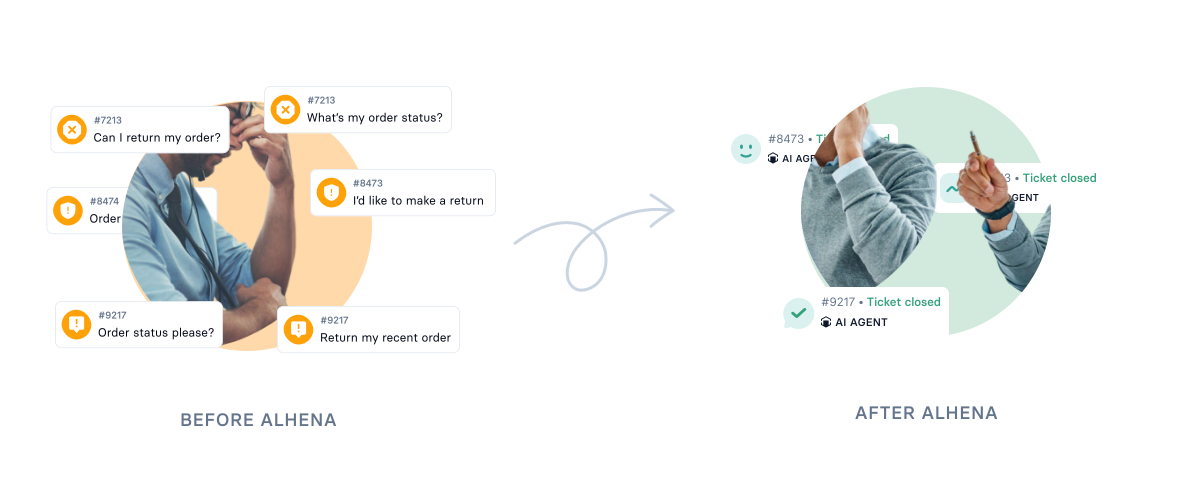
Agentic commerce is the shift from AI that answers questions to AI that completes tasks. Instead of telling a customer "check your tracking page," an agentic AI agent pulls the tracking data, interprets it, and tells the customer their package is in transit with an estimated delivery of Thursday. Instead of linking to a returns policy, the agent checks the order, confirms eligibility, initiates the return, and generates a shipping label, all inside the same conversation.
This is a meaningful evolution, one that aligns with the broader agentic commerce protocol movement. AI agents with agentic capabilities can access order data within your existing systems, and the technology allows them to act on that data autonomously. Traditional ecommerce chatbots operate in a reactive mode: they wait for a question, match it against a knowledge base, and return a text response. Agentic AI operates with autonomy. It connects to backend systems, reasons through multi-step workflows, and takes action without passing the customer to a human agent.
McKinsey's research on the agentic commerce opportunity confirms the trend: enterprises that embed AI agents into execution workflows see measurable results, while those treating agents as isolated tools see limited gains. Morgan Stanley predicts nearly half of online shoppers will use AI shopping agents by 2030.
For merchants and retail brands already using Narvar, the question isn't whether to adopt agentic commerce. Consumers expect fast, personalized resolution. The real decision is which agentic AI layer sits on top of your post-purchase stack and actually resolves customer issues end to end.
How Alhena AI Fills the Gap Narvar Leaves Open
Alhena AI is purpose-built for ecommerce. While Narvar manages the logistics and operations of post-purchase, Alhena adds the agentic AI layer that automates the customer-facing conversation. The two work together: Narvar provides the data (tracking status, return eligibility, delivery estimates), and Alhena uses that data to resolve customer inquiries in real time, without human intervention.
Here's what that looks like in practice.
Automated WISMO Resolution
When a customer asks "where's my order?", Alhena's Order Management Agent pulls the latest tracking data from Narvar, interprets the carrier status, and gives the customer a clear, specific answer: "Your order shipped on Monday via FedEx and is currently in Memphis. Expected delivery is Thursday by 8 PM." No ticket created. No agent involved.
Returns and Exchange Guidance
Alhena checks the order against your return policy, confirms the item is eligible, walks the customer through exchange options (including recommending alternative products), and initiates the return through the Narvar integration. For brands using Narvar Shield, Alhena can flag fraud signals before the return is processed.
Proactive Delivery Issue Handling
If Narvar's tracking data shows a delayed or stalled shipment, Alhena can proactively reach out to the customer before they even contact support. A quick message like "We noticed your package is delayed. Here's the updated delivery estimate" prevents the WISMO ticket from ever being created.
Post-Delivery Follow-Up
After delivery confirmation, Alhena can send personalized follow-ups: product care tips, setup guides, or ai-driven cross-sell recommendations based on what the customer purchased. Customers who learn about complementary products at the right moment are more likely to buy again, and these touchpoints define the difference between a one-time transaction and a loyal relationship. This turns a routine post-purchase touchpoint into a revenue-generating conversation.
What Alhena Does That Narvar's AI Cannot
Narvar's IRIS engine is strong for backend intelligence: fraud detection, delivery prediction, and operational analytics. But IRIS doesn't power a customer-facing conversational agent. Narvar Assist, its first IRIS-powered product, focuses specifically on delivery claim fraud prevention, not on real-time customer support automation.
Alhena fills a different role entirely. It's the front-end intelligence layer that talks to your customers, resolves their issues, and drives revenue. In today's digital commerce landscape, where secure transactions and frictionless payment experiences define customer trust, that front-end layer matters more than ever.
- Conversational AI across every channel. Alhena works on web chat, email, Instagram DMs, WhatsApp, and voice. Narvar's customer-facing tools are limited to tracking pages and email notifications.
- Hallucination-free responses. Every answer Alhena gives is grounded in verified product data, order records, and approved policies. It doesn't guess or generate plausible-sounding fiction.
- Revenue attribution. Alhena tracks how AI-assisted conversations convert into sales, giving you clear data on ROI. Narvar measures post-purchase operational metrics, not conversation-driven revenue.
- Agentic checkout. Alhena's Product Expert Agent doesn't just answer product questions. It populates carts, pre-fills checkout fields, and nudges hesitant shoppers toward conversion, something Narvar was never designed to do.
- Two specialized agents. The Order Management Agent handles WISMO, returns, and account queries. The Product Expert Agent handles product discovery, recommendations, and sales. Together, they cover the full customer lifecycle.
The Revenue Case: Beyond Ticket Deflection
Most brands evaluate AI support tools on ticket deflection alone. That's important, but it misses the bigger picture. Making the shift from cost center to revenue driver is what separates Alhena from generic support AI. By helping brands turn support conversations into buying experiences, Alhena enables growth insights that go well beyond deflection metrics.
Tatcha, the luxury skincare brand, saw a 3x increase in conversion rate and a 38% uplift in average order value after deploying Alhena. The AI now drives 11.4% of total site revenue while deflecting 82% of support chats. Those aren't just support savings; that's new money. Read the full Tatcha case study here.
Victoria Beckham achieved a 20% increase in AOV through AI-guided product recommendations. Puffy, the mattress brand, reached 63% automated inquiry resolution with 90% customer satisfaction. Manawa cut support workload by 43% and dropped response time from 40 minutes to 1 minute.
Gartner projects that conversational AI will reduce contact center labor costs by $80 billion by 2026. But the brands getting the most from AI aren't just saving on labor. They're turning every support interaction into a chance to sell, recommend, and retain.
When you pair Narvar's post-purchase data with Alhena's agentic AI, you don't just cut WISMO tickets. You build a post-purchase experience that drives repeat purchases and increases customer lifetime value.
Getting Started: Building the Narvar + Alhena Stack
Setting up Alhena alongside Narvar doesn't require a long implementation cycle or engineering resources. Here's what the process looks like.
Step 1: Connect Your Ecommerce Platform
Alhena integrates directly with Shopify, WooCommerce, Magento, and Salesforce Commerce Cloud. The integration pulls your product catalog, order data, and customer records into Alhena's knowledge base.
Step 2: Connect Narvar
The Alhena + Narvar integration connects tracking data, return status, and delivery estimates so the AI agent can reference real-time post-purchase information in every conversation.
Step 3: Connect Your Helpdesk
Alhena works alongside Zendesk, Freshdesk, Gorgias, Intercom, and others. When Alhena resolves a ticket, it logs the resolution in your helpdesk. When escalation is needed, it passes full conversation context to the human agent.
Step 4: Train and Launch
Alhena ingests your product catalog, support documentation, return policies, and past ticket history. Most brands go live in under 48 hours. No developer resources needed.
Step 5: Measure and Improve
Alhena's built-in analytics dashboard shows ticket deflection rates, resolution times, revenue attributed to AI conversations, and customer satisfaction scores. Use the ROI calculator to model your expected savings before you start.
Key Takeaways
- Narvar is strong for post-purchase operations (tracking, returns logistics, delivery predictions) but doesn't provide customer-facing AI support automation.
- WISMO tickets eat 30 to 50% of support budgets. At $5 to $15 per ticket, the cost scales linearly with order volume unless you automate.
- Agentic AI changes the equation. Instead of deflecting tickets with FAQ links, agentic commerce solutions resolve issues end to end by connecting to real order data and taking action.
- Alhena AI is purpose-built for ecommerce. Two specialized agents (Order Management + Product Expert), hallucination-free responses, omnichannel support, and full returns automation.
- The Narvar + Alhena stack combines industry-leading post-purchase operations with industry-leading agentic customer support, covering tracking, returns, WISMO, product recommendations, and revenue attribution.
- Real results from real brands. Tatcha: 3x conversion, 11.4% of site revenue from AI. Manawa: 43% lower workload. Crocus: 86% deflection rate.
Ready to add the agentic AI layer your post-purchase stack is missing? Book a demo with Alhena AI or start for free with 25 conversations to see how it works with your Narvar setup.

Frequently Asked Questions
What is agentic commerce and how does it reduce support costs?
Agentic commerce uses AI agents that don't just answer questions but take action: looking up orders, initiating returns, and resolving WISMO queries end to end. By automating 50 to 80% of repetitive post-purchase tickets, brands can cut support costs by up to 50% while improving response times from hours to seconds.
Does Alhena AI integrate directly with Narvar?
Yes. Alhena connects to Narvar's tracking, returns, and delivery data through a direct integration. This lets Alhena's AI agents pull real-time shipment status, return eligibility, and delivery estimates into customer conversations without any manual lookup by your team.
How does Alhena handle WISMO queries differently than a helpdesk chatbot?
Most helpdesk chatbots match keywords to FAQ articles. Alhena's Order Management Agent connects to your order management system and Narvar's tracking data, interprets carrier status in real time, and gives the customer a specific answer like 'Your package is in Memphis, arriving Thursday by 8 PM.' No ticket created, no agent involved.
Can Alhena automate returns for brands using Narvar Shield?
Yes. Alhena checks the order against your return policy, confirms eligibility, walks the customer through exchange options (including product recommendations), and initiates the return through Narvar. For Narvar Shield users, fraud signals are flagged before the return processes.
What results have ecommerce brands seen with Alhena AI?
Tatcha saw a 3x conversion rate increase and 38% AOV uplift, with 11.4% of total site revenue driven by AI. Manawa reduced support workload by 43% and cut response time from 40 minutes to 1 minute. Crocus achieved an 86% deflection rate with 84% customer satisfaction.
How long does it take to set up Alhena alongside Narvar?
Most brands go live in under 48 hours. Alhena ingests your product catalog, support docs, and return policies automatically. Connecting Narvar, your ecommerce platform (Shopify, WooCommerce, Magento), and your helpdesk (Zendesk, Freshdesk, Gorgias) requires no developer resources.
Does Alhena only handle support, or does it drive revenue too?
Alhena drives both. Its Product Expert Agent recommends products, populates carts, and nudges hesitant shoppers toward checkout. Its Order Management Agent handles WISMO, returns, and account inquiries. Tatcha attributes 11.4% of total site revenue to AI-powered conversations through Alhena.
How much do WISMO tickets actually cost ecommerce brands?
WISMO queries make up 30 to 50% of all inbound ecommerce support tickets. Each ticket costs $5 to $15 in agent time and overhead. A brand shipping 5,000 orders monthly can expect $6,000 to $18,000 in monthly WISMO costs alone. That scales linearly with order volume unless you automate.
What channels does Alhena AI support for post-purchase conversations?
Alhena works across web chat, email, Instagram DMs, WhatsApp, and voice. Narvar's customer-facing tools are limited to tracking pages and email notifications. Alhena extends the post-purchase experience to every channel where your customers reach out.