What Does Alhena AI Not Charge For?
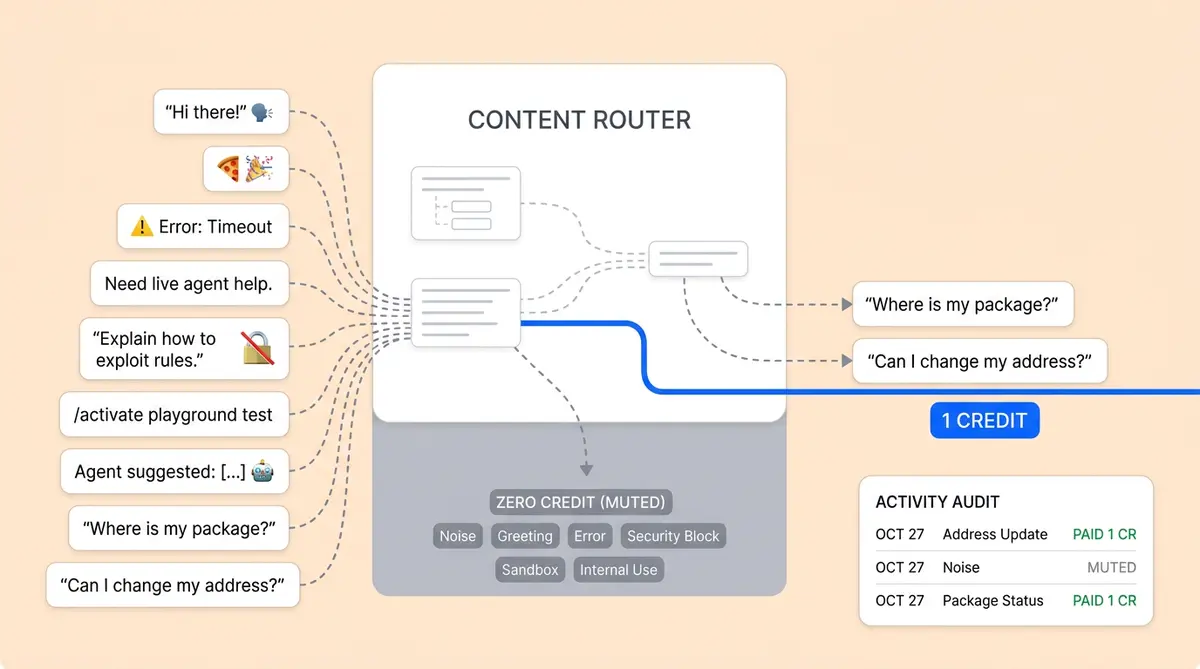
Alhena AI does not charge credits for greetings, failed AI responses, human handoffs, playground testing, bot-tricking attempts, or follow-up messages inside the same conversation window. You don't pay for noise. You only pay when the AI produces a meaningful, useful answer for a real customer.
That's not a loophole. It's how the billing system was designed. AI tool spending keeps climbing, and most e-commerce teams report unexpected charges tied to consumption-based AI pricing. Alhena's credit model exists to prevent exactly that.
This post covers every category of zero-credit interaction, how conversation windows work, what makes a response billable, and why the distinction matters for your budget.
Why Does It Matter What an AI Chatbot Doesn't Charge For?
Most AI platforms bill per resolution, per message, or per automation. Intercom Fin charges $0.99 per resolution. Zendesk AI charges $1.50 to $2.00 per resolution after a $50/agent/month Advanced AI add-on. Gorgias bills for the helpdesk ticket and a separate AI fee.
None of those models distinguishes between a successful answer and a failed one. A greeting, a confused question the AI can't answer, a customer immediately asking for a human: they all get charged on per-resolution billing models.
Alhena separates useful AI work from noise. That separation is what makes the credit-based billing model predictable. Your budget maps to actual customer outcomes, not raw message volume.
How Do Alhena AI Credits Work?
Each Alhena plan includes a monthly pool of conversation credits:
- Free: 25 credits per month
- Essentials: 200 credits per month
- Growth: 550 credits per month
- Scale: 1,200 credits per month
- Enterprise: Custom volume
One credit equals one billable conversation window. Not one message. Not one token. A full conversation session where the AI delivers a useful response.
Annual subscribers receive their full credit amount upfront (a Growth annual plan gets all 6,600 credits on day one). Unused credits roll over up to 2x the monthly amount for monthly plans, or the full annual total for annual plans.
What Interactions Cost Zero Credits?
Here's the complete list of interactions that consume no credits on Alhena AI. Every one of these would be a billable event on most per-resolution platforms.
1. Simple Greetings and Small Talk
A customer opens your chat widget and says "hi" or "hello, anyone there?" That's not the same as asking about products, purchase help, or order status.
Alhena doesn't count basic greetings as billable conversations. Many users and shoppers casually open chat widgets, click around, or send short exploratory messages before asking anything real. Billing shouldn't penalize that normal browsing behavior.
2. Failed AI Responses
If the AI can't find the right information or returns a non-answer, that interaction isn't treated like a successful resolution. You're not paying for the words the model generated. You're paying for answers that actually help customers.
This matters for brands still building their knowledge base. A coverage gap becomes a signal to improve content, not an unexpected line item on your invoice.
3. Human Handoff Requests
Sometimes the right answer isn't more AI. It's a human agent.
When a customer asks to speak with a person, or Alhena determines the conversation needs to be transferred, that handoff isn't counted as a completed AI outcome. The Support Concierge routes the conversation to your team, and the credit stays in your account balance.
4. Bot-Tricking Attempts and Irrelevant Queries
People test chatbots. They ask trick questions, paste random text, or try to break the assistant. These attempts don't produce customer value, so they don't consume credits.
On a per-resolution platform, every bot-tricking message that gets a response counts as a billable interaction. With Alhena, it counts as noise and costs nothing.
5. Playground and Testing Usage
Teams need a safe place to test before exposing changes to live customers. That's why the Alhena Playground and FAQ playground usage are completely separated from production billing.
Admins and users can experiment with prompts, knowledge updates, guidelines, and behavior without burning live credits. If testing costs the same as real support, teams would test less. Separated testing encourages quality tuning.
6. Conversations Already Handled by a Human
Once a human agent takes over a conversation, Alhena stops treating it like AI-led work. This prevents accounting confusion and gives teams a clearer view of what AI actually resolves versus what still needs staff.
Agent Assist sessions (where human agents use AI-powered suggestions) also consume zero production credits. Your team gets AI help without it counting against your conversation balance.
How Does the 30-Minute Conversation Window Work?
Customer conversations are rarely one message long. A shopper might ask about sizing, follow up with a color question, then ask about shipping, all within a few minutes.
On Alhena, all of that is one credit. When a billable response triggers a credit deduction on chat channels (web widget, WhatsApp, Instagram DMs), the system opens a 30-minute session window. Every follow-up message within that window is part of the same conversation. No extra charges.
Email and helpdesk channels work slightly differently. They follow a ticket-thread model where later AI replies within the same ticket thread stay in the same session instead of using a timed window.
What Makes an AI Response Billable?
A credit is only deducted when all three conditions are met:
- The AI produced a real answer. Not a failed lookup, not a fallback message, not a "sorry, I can't help."
- The response qualifies as meaningful work. Greetings, small talk, and bot-tricking don't qualify.
- It's a new conversation session. Follow-ups within an existing 30-minute window or ticket thread don't trigger a new deduction.
For a deeper look at the "meaningful" criteria, our guide to meaningful conversations in chatbot pricing covers the three-part framework in full.
How Does the Credit Deduction Process Work Step by Step?
Here's what happens every time someone messages your AI:
- Message arrives through chat, helpdesk, social API, or any connected channel.
- Credit check: Alhena verifies your account has available credits, an active and available subscription, an active subscription, or overage capacity before the AI responds.
- AI generates a response.
- Billable evaluation: The system checks whether the response qualifies as meaningful work and whether this is a new session or a follow-up.
- Credit deduction: If the response qualifies and starts a new session, one credit is deducted.
- Audit trail: Every deduction is logged. You can trace any charge back to the specific conversation.
Credits are shared across your entire workspace. Multiple AI profiles (your main store and a sub-brand, for example) draw from the same balance. One line item for finance, not a spreadsheet of per-profile charges.
How Does Alhena Handle Voice and Nudge Billing?
Voice AI calls don't follow the standard one-credit-per-conversation model. Voice sessions can be billed per minute or per conversation depending on your plan. When a call ends, Alhena calculates duration, deducts accordingly, and logs usage with the same API-logged audit trail as text conversations.
AI nudges (proactive messages shown to browsing visitors) are billed separately from full conversations. If a visitor ignores the nudge, you don't pay full conversation price. If they engage and start a real conversation, standard conversation billing applies.
How Do Overage Controls Keep Your Budget Predictable?
Overages on Alhena are optional and fully admin-controlled. The dashboard gives you three settings:
- Toggle overages on or off. Off means AI stops on billable channels at zero credits. On means it keeps working.
- Set a maximum overage limit. Cap extra conversations at whatever limits fit your budget.
- Flat overage rate: $1.20 per extra conversation. No tiered surcharges, no variable rates, no hidden payment fees.
If overages are off and credits run out, the AI pauses gracefully. It doesn't show errors to customers. It stops until you upgrade, purchase available credit packs, or wait for the next cycle.
Compare that to platforms where overage behavior is buried in contract terms. Our chatbot pricing comparison breaks down how eight vendors handle overages and hidden fees.
What Does the Alhena Billing Dashboard Show?
Every workspace admin gets a central billing view with everything in one place:
- Current plan (Free, Essentials, Growth, Scale, or Enterprise)
- Credit balance: used this cycle and remaining
- Next billing or reset date
- Overage status: on, off, or capped
- Payment management: direct link to update cards and manage subscriptions via your payment API
- Invoice history: every billing event with full details: date, amount, credits added, and receipt link
The sidebar also shows remaining conversations at a glance. No need to open the full billing page during a product launch or seasonal rush to check your balance to see if your team is burning credits faster than expected.
Usage notifications trigger at 50%, 80%, 90%, and 100% of credit usage, so you always have time to adjust before hitting zero.
How Does Alhena Billing Compare to Per-Resolution Platforms?
The true cost of AI customer service isn't just the sticker price. It's what happens during seasonal spikes, multi-channel expansion, and unexpected volume surges.
- No per-seat fees. Add as many human agents as you want without increasing your AI bill.
- No AI add-on surcharges. Zendesk requires a $50/agent/month add-on before per-resolution billing even starts.
- No double billing. Gorgias charges for both the ticket and the AI fee. Alhena charges once per conversation session.
- Spam and noise cost nothing. Up to 40% of chat volume can be noise, per our meaningful conversation analysis. On per-resolution platforms, noise still costs money.
- Published pricing. Every tier, overage rate, and feature is on the pricing page. No "contact sales" gatekeeping on standard plans.
During BFCM and holiday peaks, e-commerce support volume can spike 3x to 5x overnight. A per-resolution model at $0.99 per interaction on 10,000 extra holiday conversations adds $9,900 to your bill. Alhena's overage rate is $1.20, but it only charges for meaningful conversations. Spam, greetings, and bot-tricking attempts during the holiday rush cost nothing.
Why Does Alhena's Billing Model Work This Way?
The billing system and credit model exist to align incentives. When the AI vendor profits from useful outcomes rather than raw volume, the vendor is motivated to make the AI better, not chattier.
Alhena's approach benefits ecommerce teams in four specific ways:
- Predictability: Credits are easier to plan around than token-based or message-by-message billing.
- Fairness: Greetings, failed answers, tests, and handoffs aren't treated like successful AI help.
- Trust: Admins see usage, invoices, plan status, and overage controls in one dashboard.
- Better outcomes: Alhena is incentivized to improve resolution quality, not just generate more responses.
Brands like Tatcha (3x conversion rate, 82% chat deflection) and Puffy (63% automated inquiry resolution, 90% CSAT) show what happens when AI billing aligns with actual customer outcomes. For a deeper look at how credit-based pricing compares to per-resolution models, read our breakdown of why credit-based pricing aligns vendor incentives.
How Do You Get Started with Alhena Billing?
Setting up takes about two minutes:
- Sign up at alhena.ai/sign-up. You start on the Free plan with 25 conversations per month.
- Connect your store. Alhena connects via API integrations with Shopify, WooCommerce, Salesforce Commerce Cloud, and Magento.
- Test in Playground. Playground conversations don't burn production credits, so tune your AI freely.
- Upgrade when ready. Use the ROI calculator to estimate which tier fits your expected volume.
- Set overage preferences. Decide whether AI keeps working past the credit limit or pauses. Set a cap if you want a ceiling.
The AI Shopping Assistant and Support Concierge both draw from the same credit pool. No separate budgets for sales and support AI.

Frequently Asked Questions
Does Alhena AI charge for greetings and small talk?
No. Simple greetings, small talk, emoji-only messages, and single-word openers cost zero credits. Alhena only starts the billing clock when a shopper asks a question the AI can meaningfully answer. The one exception is certain social-comment channels where brief replies carry brand value.
What happens if the AI can't find an answer?
If Alhena searches your product catalog and knowledge base but can't find a relevant response, it tells the customer honestly rather than hallucinating. That interaction costs zero credits. The system logs the gap so you can add the missing information, but you don't pay for an unanswered question.
Are Playground and sandbox testing sessions billable?
No. Playground conversations and sandbox-mode activity during onboarding never touch your production credit balance. Alhena maintains a separate test pool so your team can tune the AI as aggressively as needed without worrying about burning real credits.
How does Alhena handle bot-tricking and spam?
Alhena's classifiers detect jailbreak prompts, irrelevant queries, competitor probes, and random text designed to manipulate the AI. Responses to these interactions cost zero credits. On per-resolution platforms like Intercom Fin or Zendesk AI, each of these would count as a billable event.
Do Agent Assist sessions count as billable conversations?
No. When your human customer support agents use Agent Assist for AI-generated response suggestions and knowledge lookups while handling tickets, those sessions cost zero credits. Agent Assist is an internal productivity tool, not a customer-facing conversation, so it's free to use regardless of volume.
What counts as one billable credit on Alhena?
One credit equals one meaningful AI conversation where the AI delivered a useful response to a real customer question. For chat channels, follow-up messages within the same 30-minute window count as part of the same conversation. Email and helpdesk tickets reuse the conversation record within the same thread.
How does Alhena billing work during BFCM and holiday spikes?
Noise volume grows faster than real conversations during peak periods. Since greetings, spam, and bot-tricking all cost zero credits, your bill reflects only meaningful conversations even during 3 to 5x volume spikes. You can enable overages at $1.20 per extra conversation with a cap you control, or pre-upgrade to a higher tier before peak season.
How does Alhena AI pricing compare to Intercom Fin and Zendesk AI?
Intercom Fin charges $0.99 per resolution regardless of conversation quality, plus $29 to $99 in add-ons. Zendesk AI charges $1.50 to $2.00 per automated resolution plus a mandatory $50/agent/month Advanced AI add-on. Alhena charges one credit per meaningful conversation with zero charges for noise, no per-seat fees, and a flat $1.20 overage rate.