The One Question Your AI Vendor Hopes You Never Ask
Ask your AI chatbot vendor a simple question: "What counts as a conversation on my invoice?" Then watch them squirm.
For exact dollar amounts across platforms, our 2026 AI chatbot pricing comparison breaks down what eight customer service tools actually cost.
Most can't answer clearly, and that's by design. Vague billing definitions are profitable, whether the automated chatbot runs on OpenAI, ChatGPT, or proprietary AI models like those from OpenAI. Every bot greeting, every accidental chat open, every single-message bounce gets counted as a "conversation" on your next monthly subscription billing statement. If 40% of your chat volume is noise and your vendor bills all of it, you're paying 40% in noise fees in hidden fees on your total AI powered costs.
This post is for the ops managers and finance leads who open their monthly AI powered chatbot invoice (most AI powered tools and platforms bill this way) and wonder why the costs keep climbing even though automation volume hasn't changed. Your AI automation spend keeps growing anyway despite better automation performance. You'll get a conversational taxonomy, three tests any interaction must pass to qualify as "meaningful," the analysis on what noise costs you annually and how it drains your ROI, and five conversational billing audit tools, templates, and questions you can copy-paste into your next vendor call.
Not All Chatbot Interactions Are Conversational: A Taxonomy of AI Powered Chat
The core problem with every chatbot pricing model that bills "per conversation" is that natural language processing (NLP) and natural language processing have evolved, but the word "conversation" does too much work under most subscription plans. Your chat widget fires thousands of interactions monthly, but they vary wildly in value. Here's the conversational AI solutions taxonomy most vendors don't want you to think about.
Noise Tier: Zero Intent, Zero Automation Outcome
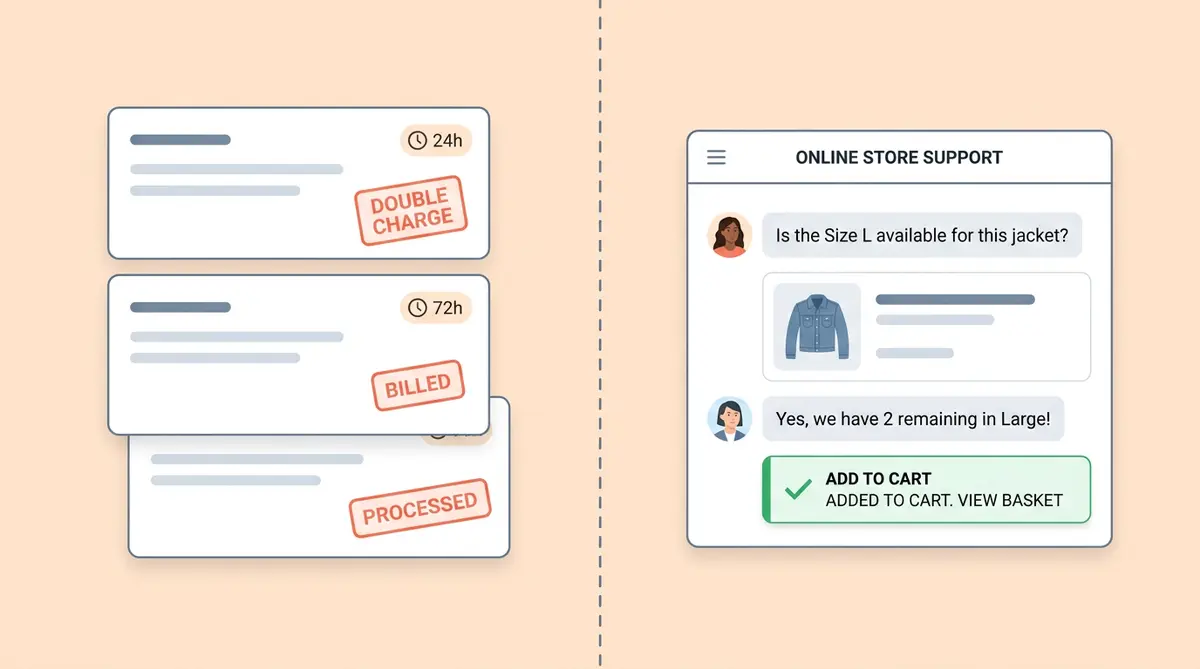
Greeting-only opens. The chat widget auto-fires on setup when a shopper lands on your web store. The bot says "Hi! How can I help?" The shopper closes the chat bot widget immediately. Automated response interaction time: under 3 seconds. Outcome: none. Many chatbot platforms count this as a conversation.
Single-message abandons. A shopper types "hi" or "hello," gets the bot's basic welcome message, and leaves. Two exchanges total (one from each side), no intent expressed, no information exchanged. Still charged as a conversation by most platforms.
Browsing noise. The shopper clicks around the widget, maybe types "just looking" or "no thanks." The bot tries to engage. The shopper bounces from the chat bot. No product question was asked. No support need was expressed. Billed.
Value Tier: Real Conversational Intent, Measurable Outcome
Pre-purchase intent conversations. A shopper asks "Do you have this dress in petite sizes?" or "What's the difference between the Pro and Plus models?" or "Will this moisturizer work for oily skin?" The AI pulls from its knowledge base and product knowledge base of verified product data through its API, delivers a specific answer, and the shopper views a product, adds to cart, or asks a follow-up. This is a conversation.
Post-purchase support conversations. A customer asks "Where's my order?" or "How do I start a return?" The AI accesses order data via API and CRM (the API connection pulls real-time info from your CRM and order system), provides a tracking link or initiates a return flow, and the customer gets their customer service problem handled by the customer service AI without human agents involved without waiting for human agents or AI agents to handle it. This is a conversation.
Purchase-driving conversations. A shopper describes what they're looking for. The AI powered shopping assistant asks clarifying questions, recommends products, compares options, and populates a cart. The shopper checks out or saves the cart for later. This is the highest-value conversation type, and it costs the same per-conversation fee as a bot greeting that went nowhere.
That's the problem. Most chatbot platforms and tools bill the noise tier at the same rate as the value tier. Your finance team sees "12,000 conversations" on the invoice and assumes 12,000 customers were helped. The reality? Around 30% to 50% of that volume may be noise, depending on your custom widget setup, custom bot setup (and depending on your chatbot setup, depending on how aggressively, and depending on whether, recent platform updates setup and configuration, traffic patterns, and how aggressively the bot initiates contact.
Three Criteria for Meaningful Conversations (Beyond Human Agents)
If you're auditing your chatbot billing, you need a clear test. Not every chat interaction deserves to be on your invoice. A conversational exchange is meaningful only when all three of these solutions criteria are met:
1. The user expressed intent. The shopper asked a question, described a need, initiated a support flow, or took an action that signals purpose. "What sizes do you have?" is intent. An accidental widget open is not. A single "hi" with no follow-up is not. The AI should be able to classify the user's intent before the interaction qualifies as billable.
2. The AI resolved or meaningfully assisted. The bot didn't just greet the customer. It answered a product question, provided order status, initiated a return, recommended products, or took an action that moved the customer's journey forward. If the AI's only contribution was "Hi! How can I help you today?" followed by the customer leaving, no assistance happened.
3. The interaction led to a measurable outcome. Something trackable happened: a product page view, a cart addition, a ticket marked resolved, an escalation to human agents with full context, a completed return, or a purchase. If the interaction produced no measurable outcome, it's noise, regardless of how many messages were exchanged.
When all three criteria are met, you had a meaningful conversation. When they aren't, you had a chat widget ping. The difference between the best chatbot and AI solutions platforms that can bill confidently and those who hide behind vague definitions is whether they're willing to apply these criteria to your invoice. For the broader question of how pricing model structure shapes vendor behavior, see our companion post on why credit-based pricing is the only model that aligns vendor incentives with yours.
The Chatbot Subscription Noise Tax, Quantified
Let's make this concrete with numbers your finance team will recognize.
Scenario: A mid-market ecommerce brand (Shopify or similar platform) with 10,000 monthly chat opens.
Based on industry data and the conversation taxonomy above, here's a realistic breakdown of those 10,000 interactions:
- Greeting-only opens: 2,000 (20%). Widget fires, shopper closes immediately.
- Single-message abandons: 1,200 (12%). Shopper types "hi" or a fragment, then leaves.
- Browsing noise: 800 (8%). "Just looking," "no thanks," or aimless clicks.
- Pre-purchase conversations: 3,000 (30%). Product questions, comparisons, sizing inquiries.
- Post-purchase support: 2,000 (20%). Order tracking, returns, account questions.
- Purchase-driving conversations: 1,000 (10%). Guided selling sessions that lead to a cart.
The first three categories total 4,000 interactions per month, or 40% of volume. These are noise. No intent was expressed, no problem was solved, no outcome was produced.
Now apply the math across common chatbot pricing models:
- At $0.50/conversation: $2,000/month in noise costs. $24,000/year in costs for interactions that delivered nothing.
- At $0.99/conversation (Intercom Fin's rate; Tidio's Lyro AI adds another layer by resetting conversations after 15 minutes of silence): $3,960/month in noise costs. $47,520/year in wasted costs.
- At $1.50/conversation (Zendesk's base rate): $6,000/month in noise costs. $72,000/year.
That's not a rounding error. It's expensive. At Zendesk's rate, you're spending $72,000 in annual costs on bot greetings, accidental opens, and single-message bounces. For a complete picture of where these costs fit within your total AI powered automation tools spend, the TCO breakdown for ecommerce AI maps every cost category.
The noise tax gets worse at scale. A brand doing 50,000 monthly chat opens at the same 40% noise ratio pays $360,000/year in noise costs at $1.50/conversation in fees. At that point, the expensive noise total cost alone (the total cost of noise) exceeds most small businesses' AI budgets (small businesses and mid-market brands) and brands' entire annual chatbot budget, including live chat tools (live chat is often the first channel affected) and most brands' entire annual AI models budget.
Five Questions to Audit Your AI Chatbot Vendor's Setup and Billing
Copy these into your next vendor QBR or renewal call. The answers (or non-answers) tell you everything about whether your chatbot pricing model is working for you or your pricing model is working against you or against you.
Question 1: "What triggers a billable conversation? Walk me through the exact custom billing criteria."
You want specifics. Does a billable conversation start when the widget opens? When the bot sends its first message? When the user sends a message? When the AI generates a response? If the vendor answers with "when a conversation occurs" or "when the AI engages," push harder. That's not a definition. That's a circle.
Question 2: "What's explicitly excluded from billing?"
Good vendors can list what they don't bill for: spam, bot probes, accidental opens, single-message abandons, system health checks, test conversations. If the platform can't name specific exclusions, assume everything is billed. Ask for the custom billing exclusion criteria in writing as a custom contract clause as part of your subscription contract, including API access terms.
Question 3: "Can I see the raw conversation logs for every billed interaction this month?"
Not a dashboard summary. Not a chart. The raw, message-by-message logs via their API or dashboard for every interaction that appeared on your invoice. If the vendor won't provide this, ask yourself why. Any vendor confident in their billing criteria should welcome this level of scrutiny. If your vendor provides these logs, use them alongside the AI agent evaluation checklist to grade both billing accuracy and response quality.
Question 4: "What percentage of my billed conversations this month had fewer than 2 user replies?"
This is the noise detector. A conversation with zero or one user message is almost certainly noise: a greeting-only open, an accidental widget trigger, or a single-message abandon. If more than 25% of your billed conversations have fewer than two user messages, your vendor is charging you for widget pings, not conversations worth paying fees for. That number should be under 10% on a well-configured billing platform.
Question 5: "Will you credit back conversations where the AI couldn't resolve the issue and didn't escalate to a human?"
This tests whether the vendor stands behind their product. If the AI gave a useless answer and the customer simply left in frustration (what Intercom calls an "assumed resolution" (a feature introduced in 2025) after 24 hours of silence from the customer service interaction), should that count as a billed conversation? Some vendors will say yes. The ones who say no, and mean it, are the ones whose AI actually works.
Document the answers. Compare and contrast them against your actual invoice data. The gap between what vendors promise in these calls and what shows up on the invoice is where the noise tax lives.
How Alhena's AI Powered Free Plan Defines Meaningful Conversations
Alhena AI's billing approach applies the three criteria above to every interaction before it becomes billable. Whether you run Shopify, WooCommerce, or Magento, the same rules apply. One credit is consumed when the AI agent resolves or assists a customer interaction where intent was expressed and the automation delivered and a measurable outcome occurred. Spam, irrelevant queries, greeting-only opens, and immediate human handoffs that don't involve AI assistance cost zero credits, unlike most AI solutions on the market.
The billing dashboard shows every credited interaction with the full message log, and the copilot dashboard lets your team inspect every detail in the basic copilot dashboard view, so your finance and ops teams can audit any line item directly. No summary charts hiding the details. Every billed conversation is inspectable.
Setup is simple. Plans include transparent conversation allocations: 25 free conversations on the free plan (the free plan is accessible for small businesses and growing brands), up to 1,200 on the Scale plan (enterprise brands get custom enterprise-grade allocations with custom SLAs for enterprise teams) ($999 monthly subscription (no premium tier surprises)), with published pricing and a flat $1.20 overage fee with no premium surcharges or hidden updates. Revenue attribution, CRM integration, CRM data sync, and ROI tracking are built-in features, so you can see which conversations drove cart additions, completed purchases, and AOV changes. The result for brands like Tatcha (3x conversion rate, 38% AOV uplift and measurable ROI) and Crocus (86% automation deflection, 84% CSAT) is that every billable interaction maps to a measurable ROI outcome: a verifiable customer outcome.
If you're currently evaluating vendors or renegotiating a contract, the low-risk AI pilot guide walks through how to structure a pricing negotiation that protects you from noise fees from day one.
Key Takeaways on Custom Chatbot Automation Billing
- Not all chat interactions are conversations. Greeting-only opens, single-message abandons, and browsing noise can make up 30% to 50% of your billed volume. Most platforms bill them at the same plan rate as high-value interactions.
- Three criteria define a meaningful conversation. The user expressed intent, the AI resolved or assisted, and a measurable outcome occurred. If all three aren't met, it shouldn't be on your invoice.
- The noise tax is real and quantifiable. At 40% noise and $0.99/conversation, a brand with 10,000 monthly chat opens wastes $47,520/year on interactions that delivered zero value.
- Five audit questions expose billing gaps. Ask your vendor what triggers billing, what's excluded, and what percentage of billed conversations had fewer than two user messages.
- Transparent billing requires inspectable logs. If you can't review the raw message data behind every billed interaction, you can't verify you're paying for real conversations.
Whether you run a custom Shopify setup or an enterprise platform, the subscription model your chatbot vendor uses shapes your total costs. Most automated tools bill every interaction as a monthly conversation, depending on how their system classifies human agents involvement versus AI agents handling. OpenAI-powered chatbots, ChatGPT-based copilots, and custom NLP solutions all face this same billing transparency problem. Small businesses on a basic free plan and enterprise teams on premium subscriptions both deserve to know their budget goes toward live chat conversations with real ROI, not expensive noise from automated bots with no customer service outcome.
The best chatbot platforms provide a custom setup process, automated agents that handle real conversations, and enterprise-grade reporting that tracks every fee against your budget. Depending on your chatbot vendor, you might get a basic UI with copilot features, NLP-driven voice support, and ChatGPT or OpenAI integrations. But none of that matters if the platform counts noise as billable conversations. Updates to your chatbot's AI models and Shopify or other ecommerce platform connections should improve your ROI, not inflate it. Automated chatbot agents on every platform should be held to the same standard: did the interaction produce a real outcome, or did it just produce an invoice line?
When comparing chatbot platforms for your Shopify store or enterprise brand, look at the setup process, the custom configuration options, the voice and UI features, and how the chatbot handles NLP. Agents powered by OpenAI or ChatGPT need ongoing updates to stay accurate, and those updates cost fees that eat into your budget and ROI. A basic copilot that can't distinguish noise from real conversations isn't worth the platform fees, regardless of which chatbot you choose. Depending on your business size, enterprise features like custom dashboards, advanced chatbot agents, multiple platform integrations, and dedicated setup support can justify higher costs, but only if the chatbot vendor defines conversations honestly.
Ready to audit what you're actually paying for? Book a demo with Alhena AI to see a billing dashboard where every conversation is inspectable, or start with the free plan (25 free conversations on the free plan tier) and test the criteria yourself.
For a full walkthrough of how billing, credits, and usage tracking work inside Alhena, see our billing and usage tracking guide.
What counts as a billable conversation in AI chatbot pricing?
A billable conversation should meet three criteria: the user expressed intent (asked a question or initiated a flow), the AI resolved or meaningfully assisted (not just greeted), and the interaction led to a measurable outcome (product view, cart add, ticket resolution, or escalation). Many vendors bill any interaction where the bot sends a response, including greeting-only opens and single-message abandons. Ask your vendor for their exact technical billing trigger and what's explicitly excluded.
How much does chatbot billing noise cost ecommerce brands per year?
For a brand with 10,000 monthly chat opens, noise typically makes up 30% to 50% of volume (greeting-only opens, single-message abandons, browsing pings). At 40% noise and $0.99 per conversation, that's $47,520/year wasted. At $1.50 per conversation (Zendesk's base rate), it's $72,000/year. The noise tax scales linearly with volume, so brands at 50,000 monthly opens can waste $360,000+ annually on interactions that delivered no customer value.
How do I audit my AI chatbot vendor's conversation billing?
Request raw conversation logs for every billed interaction (not dashboard summaries). Calculate what percentage had fewer than two user messages. Any conversation with zero or one user message is likely noise: an accidental open, bot greeting, or single-message abandon. If more than 25% of billed conversations fall in this category, your vendor is charging for widget pings. Also ask for their explicit exclusion criteria in writing and compare billed volume against actual resolution outcomes.
What's the difference between a chat interaction and a meaningful AI conversation?
A chat interaction is any event where the widget fires and messages are exchanged, including bot auto-greetings with no reply, accidental opens, and one-word abandons. A meaningful conversation requires expressed user intent, AI that provided real assistance (answered a question, completed an action, recommended a product), and a measurable outcome (product viewed, item added to cart, issue resolved, or escalation with context). Most per-conversation billing models don't distinguish between the two.
Which AI chatbot vendors don't charge for spam and abandoned conversations?
Alhena AI explicitly excludes spam, irrelevant queries, greeting-only opens, and immediate human handoffs from billing. Most mainstream vendors (Intercom, Zendesk, Gorgias) bill based on whether the AI sent a response or a timeout window passed, regardless of whether the customer received value. When evaluating vendors, ask for their exclusion list in writing and request the percentage of your billed conversations that had fewer than two user messages as a noise proxy.