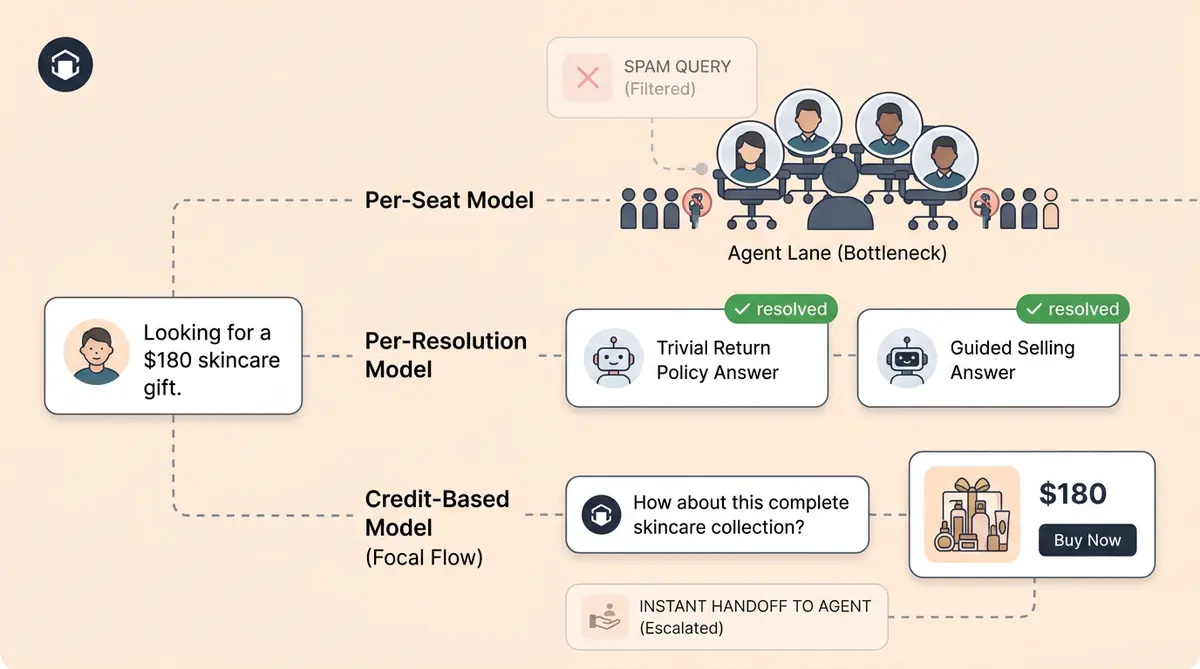
Seat-based pricing dropped from 21% to 15% of SaaS companies in just twelve months, and hybrid pricing surged across the same period, according to Bessemer Venture Partners. The reason is simple: when your AI vendor charges per agent, they make more money every time you fail to automate. That's not a pricing model. It's a misaligned incentive hiding in a contract.
For a cross-vendor comparison of what these pricing models actually cost across eight platforms, see our AI chatbot pricing comparison.
Most ecommerce businesses evaluate AI vendors on features, integrations, and deflection rates. Almost nobody asks the question that matters most: does my vendor's revenue grow when my business gets better, or when it gets worse?
This post makes a single argument. Credit-based pricing, where only meaningful conversations consume credits, is the only AI pricing model matching pricing to actual value delivered, aligning vendor incentives with yours. Here's why the alternatives fail, and what to look for in your next contract.
The Perverse Incentive Behind Per-Seat Pricing
Zendesk charges $55 to $169 per agent monthly for its Suite plans. Layer on the AI Copilot add-on at $50 per agent, QA at $35, and workforce management at $25, and a 25-agent team crosses $90,000 annually. Intercom's seat-based plans range from $29 to $132 per seat monthly before AI costs enter the picture.
The structural problem here isn't the dollar amount. It's what happens when AI actually works.
If your AI support concierge successfully deflects 80% of incoming tickets, you need fewer human agents. Fewer agents means fewer seats. Fewer seats means less revenue for a per-seat vendor. Your success directly erodes their business. From a revenue recognition standpoint, per-seat vendors book predictable revenue recognition when you add headcount.
No vendor will sabotage your automation on purpose. But per-seat pricing creates a structural indifference to your automation outcomes and business outcomes. The vendor has no financial reward for helping you need fewer people. Their roadmap priorities, their customer success playbooks for AI agents, their upsell motions all orbit around one metric: seats.
Companies that stick with traditional per-seat pricing for AI products see 40% lower gross margins. The reason is straightforward: AI inference costs and compute for language models make per-seat economics unsustainable because costs scale with usage, not headcount and 2.3x higher churn than those adopting usage or outcome-based models, according to Pilot's 2026 AI economics research. The churn number tells you everything. Brands figure it out eventually, and they leave.
Per-Resolution Pricing: Better Alignment, New Problems
Outcome-based pricing emerged as the correction. Intercom's Fin charges $0.99 per successful resolution. Zendesk introduced outcome-based pricing at $1.50 to $2.00 per automated resolution (their new outcome-based pricing tier). Gorgias charges $0.90 to $1.00 per AI interaction. Salesforce Agentforce bills $2.00 per conversation.
The pitch sounds logical: you only pay when AI actually resolves something. If it fails, you pay nothing. Incentives aligned, right?
Not quite. Outcome-based pricing creates a different misalignment: the vendor profits from volume, not from driving better outcomes across your business.
Consider what happens when a customer asks "where's my order?" and gets an instant tracking link. That's a resolution. Now consider a customer who asks "what moisturizer works for combination skin?" and receives a personalized product recommendation that leads to a $200 cart. That's also a resolution. Both cost you the same $0.99 to $2.00, but one drives revenue and the other is a FAQ lookup that should have been handled by a self-service page.
The vendor's incentive? More resolutions. Not better resolutions. Not fewer tickets through proactive service. Not proactive interventions that prevent problems before they become tickets. Every "how do I reset my password?" ping is revenue for a per-resolution vendor. They have zero financial incentive to help you build a better knowledge base that reduces inbound volume.
Then there's the "assumed resolution" problem. At Intercom, if a customer stops responding after the AI replies, it counts as resolved after a timeout period. A frustrated customer who gives up and calls your phone line instead? That's a billed resolution. A shopper who bounces to a competitor because the AI response was unhelpful? Billed. The definition of "resolved" becomes dangerously elastic when the vendor profits from expanding it.
The economics behind this matter. Every AI interaction requires compute and inference processing. Each credit in a credit-based system maps to real compute costs that the vendor absorbs. Under per-seat monetization, those compute costs are hidden inside a flat subscription fee, creating zero transparency about resource allocation. Under per-resolution pricing, the vendor's inference costs per resolution are fixed, but they profit from volume regardless of complexity. A credit system that bills only meaningful conversations forces the vendor to manage compute allocation efficiently, because wasted inference on spam or junk interactions earns them nothing.
What Credit-Based Pricing Actually Means
Credit-based pricing works differently. Clear credit definitions matter because buyers need to know exactly what they're paying for. You buy a pool of prepaid conversation credits at the start of each billing cycle. Each credit represents a meaningful interaction where the AI engages with a real customer query. Here's what matters: not everything burns a credit.
What counts as a meaningful conversation (1 credit):
- A customer asks about product sizing, gets personalized recommendations, and adds items to their cart
- A shopper requests order status and receives tracking details with a delivery estimate
- A buyer initiates a return, and the AI handles the full workflow across label generation to refund confirmation
- A prospect has a 12-message guided selling session that ends in checkout
What doesn't consume credits:
- Spam and irrelevant queries (bots, accidental triggers, gibberish)
- Immediate human handoffs where AI doesn't engage meaningfully
- System health checks and test interactions
This distinction is the alignment mechanism. A shopper who asks one question and bounces costs the same as a shopper who has a rich, multi-turn conversation that converts into a sale: one credit each. But the second interaction created far more value for you because of its complexity, conversation depth, and buying intent. Under per-resolution pricing, both also cost the same, except the vendor is incentivized to count both (and as many as possible) regardless of value delivered.
Under credit-based pricing, the vendor wins when your AI handles complex, high-value conversations well, because that's what keeps you renewing and expanding. They lose when your AI wastes credits on junk interactions that deliver no value. The incentive is to make every credit count, not to maximize the number of billable events.
The Historical Parallel You Already Lived Through
If you've managed infrastructure budgets, this arc looks familiar.
Phase 1: Per-server (2000s). You bought physical servers or fixed VM allocations. Vendors profited from overprovisioning. If you could run your workload on 3 servers instead of 10, the vendor lost 70% of their revenue. Sound familiar?
Phase 2: Per-user (2010s). SaaS monetization moved to seats. Salesforce, Zendesk, HubSpot, and the entire CX stack charged per user. Vendors profited from organizational sprawl. Every new hire was incremental revenue regardless of outcomes or utilization.
Phase 3: Usage-based (2020s). AWS, Snowflake, and Twilio proved that consumption pricing and pay-as-you-go consumption models work at scale. You pay for what you use. Vendors profit when you grow your actual workload, not your headcount. Metronome's 2025 research shows 85% of SaaS companies and AI companies now incorporate some form of usage-based pricing, up from roughly 28% in 2023.
Phase 4: Credit-based AI (now). Conversational AI needs its own unit of value. Tokens and raw API tokens are too granular for buyers to forecast. Resolutions are too easily gamed by vendors. Credits, tied to meaningful conversations, split the difference: granular enough to reflect actual value delivery, and credit pooling and shared allocation makes them predictable enough for budget planning.
Businesses locking into per-seat AI contracts today are buying the 2015 subscription pricing model. The subscription era is ending for AI in 2026. The Flexera research on SaaS pricing evolution frames it clearly: AI spend is variable, volatile, and nonlinear in ways that per-seat models cannot capture. Companies with consumption-based models grow revenue approximately 8 percentage points faster, per OpenView Partners data.
The Vendor Incentive Audit: Three Questions for Your Next Contract
Before you sign any AI vendor contract, ask these three questions. The answers map directly to alignment.
Question 1: Do you make more money when I need more human agents or fewer?
Traditional per-seat vendors: more agents = more revenue. They benefit from your automation plateau. Credit-based vendors: your agent count is irrelevant to their pricing. They benefit from handling more of your customer interactions well, regardless of team size.
Question 2: Do you make more money when I get more tickets or fewer?
Per-resolution vendors: more tickets = more resolutions = more revenue. They benefit from volume, including trivial volume that shouldn't exist. Credit-based vendors: they benefit from your satisfaction with credit utilization, not from inflating the number of billable events.
Question 3: Do you make more money when my AI handles complex, high-value conversations or trivial ones?
Per-resolution vendors are indifferent. A password reset and a guided selling session that produces a $400 cart both cost $0.99. Credit-based vendors need your AI to handle the high-value conversations well, because that's what proves ROI and justifies your continued spend.
If your current vendor's answers to all three questions reveal misalignment, you don't have a pricing problem. You have a partnership problem. And it will surface in their product roadmap, their support quality, and their willingness to invest in your success.
Why This Matters More for Ecommerce Than Any Other Vertical
Ecommerce support isn't just about resolving problems. It's about converting browsers into buyers. The average cost per human agent interaction is $6.00 versus $0.50 for AI, a 12x difference according to LiveChatAI's 2025 benchmarks. But the real opportunity isn't cost reduction. It's revenue generation.
When an AI shopping assistant guides a customer from "I need a gift for my mom" to a $180 skincare set in their cart, that interaction generated revenue. Under per-seat pricing, the vendor didn't participate in that outcome at all. Under per-resolution pricing, it cost you $0.99 whether the AI drove a $180 sale or just confirmed your return policy.
Consider the real-time complexity of modern ecommerce AI agents. A single customer interaction might require multiple inference calls across language models, product catalogs, and order management systems. The credit system handles this allocation invisibly. You see one credit consumed. Behind the scenes, the AI tool ran compute across multiple models, made real-time inventory checks, and generated personalized pricing strategies. Under a per-unit subscription model, you'd pay upfront for capacity you might not use. Under per-resolution, the billing cycle ignores this complexity entirely. With prepaid credit bundles, the allocation and credit definitions stay transparent while the AI agents handle workflows of any complexity without limits on the inference depth per conversation.
Credit-based pricing is the only model where the vendor's long-term success depends on your AI doing the hard, high-value work: guided selling, personalized recommendations, social commerce conversations on Instagram and WhatsApp, and complex post-purchase workflows that would otherwise require expensive human agents.
The real results come from AI handling complex, consultative interactions, not from deflecting password resets. The pricing model has to reward this kind of work, or the vendor has no reason to optimize for it.
How Alhena's Credit Model Works in Practice
Alhena's pricing starts with 25 free conversations per month. No credit card, no upfront fees, no upfront commitment, no per-seat charges, no commitment. Beyond that, conversation credit bundles scale from $199/month (200 conversations) to $999/month (1,200 conversations), with an overage rate of $1.20 per additional credit. This tiered pricing structure gives you predictability and spending limits and overage limits without locking you in.
The credit system and allocation logic are transparent by design:
- 1 credit = 1 meaningful customer conversation (product questions, order management, guided selling, returns)
- 0 credits for spam, bots, and irrelevant queries (your credit balance only decreases for real interactions) (the system identifies and filters these automatically)
- 0 credits for immediate human handoffs where AI doesn't engage
- No per-seat charges. Your team can have 5 agents or 50 using Agent Assist without changing your plan cost
Credits work across every channel, touchpoint, and API integration: web chat, email, Instagram DMs, WhatsApp, and voice. A conversation on WhatsApp costs the same credit as one on your website. There's no channel tax and no billing cycle surprises. Credit allocation stays consistent regardless of channel.
The ROI calculator lets you model exactly what credit-based pricing looks like for your volume. And because Alhena's Product Expert Agent drives revenue through guided selling and agentic checkout, the conversations consuming credits are actively driving credit value by paying for themselves.
The credit balance and billing cycle work in your favor too. You buy credit bundles at the start of each billing cycle. Throughout the billing cycle, your credit balance depletes only when the AI tool handles real customer workflows. If your volume is lower than expected one month, your spend stays low. If volume spikes during a sale, overage credits are available at a predictable rate. Compare that to per-seat pricing strategies where you pay for idle seats year-round, or per-resolution monetization where seasonal spikes create unpredictable bills. The credit definitions are clear, the allocation is transparent, and the billing maps to actual consumption of the AI tool's compute and inference resources.
Key Takeaways
- Per-seat pricing punishes automation success. Your vendor loses revenue when you need fewer agents.
- Per-resolution pricing rewards volume over value. Every ticket is revenue, including trivial ones that shouldn't exist.
- Credit-based pricing aligns vendor and customer incentives. The vendor wins when your AI handles meaningful, high-value conversations well.
- The SaaS pricing evolution from per-server to usage-based is repeating in AI. Per-seat contracts are the legacy model.
- Ask three questions before signing. If your vendor profits from more agents, more tickets, or indifference to conversation quality, the incentives are misaligned.
- Ecommerce demands revenue-aligned pricing because support conversations aren't just cost centers; they're sales opportunities.
Ready to see what credit-based pricing looks like for your store? Book a demo with Alhena AI or start free with 25 conversations to test the model with zero risk.
For a full walkthrough of how billing, credits, and usage tracking work inside Alhena, see our billing and usage tracking guide.

Frequently Asked Questions
What is credit-based pricing for AI customer service?
Credit-based pricing charges you per meaningful conversation rather than per agent seat or per ticket resolution. You buy a pool of credits, and each real customer interaction (product questions, order management, guided selling) consumes one credit. Spam, bot traffic, and immediate human handoffs consume zero credits.
How does per-seat AI pricing create misaligned vendor incentives?
Per-seat vendors like Zendesk ($55-$169/agent/month) earn more revenue when you employ more agents. If your AI automates 80% of tickets and you reduce headcount, the vendor loses seats and revenue. They have no financial incentive to help you automate successfully.
What's wrong with per-resolution AI pricing?
Per-resolution pricing (Intercom Fin at $0.99/resolution, Zendesk at $1.50-$2.00) rewards ticket volume over ticket quality. Every interaction is billable revenue, including trivial password resets and frustrated customers who abandon the conversation. The vendor profits from more tickets, not from reducing your support volume.
How does Alhena AI's credit-based pricing work?
Alhena offers tiered plans from Free (25 conversations/month) to Scale ($999/month for 1,200 conversations). One credit equals one meaningful customer conversation across any channel. Spam and irrelevant queries cost zero credits. There are no per-seat charges, so your entire team can use Agent Assist without increasing costs.
Is credit-based pricing more expensive than per-resolution?
It depends on your conversation quality mix. If most of your AI interactions are high-value guided selling sessions that drive revenue, credit-based pricing typically costs less because you're not paying for inflated resolution counts from trivial queries. Alhena's ROI calculator lets you model both scenarios with your actual volume.
What counts as a meaningful conversation versus what doesn't get billed?
A meaningful conversation is any interaction where the AI engages substantively: product recommendations, order status, returns processing, or guided selling. Non-billable interactions include spam, bot traffic, gibberish inputs, system health checks, and immediate human handoffs where AI doesn't engage.
How do I evaluate whether my AI vendor's pricing incentives are aligned?
Ask three questions: (1) Do you make more money when I need more agents or fewer? (2) Do you make more money from more tickets or fewer? (3) Do you profit more from complex high-value conversations or trivial ones? If the vendor benefits from more agents, more tickets, or is indifferent to conversation quality, incentives are misaligned.
Why is the SaaS pricing evolution relevant to AI customer service?
Infrastructure went from per-server to per-user to usage-based (AWS). SaaS followed the same path, and pricing strategies evolved accordingly. AI customer service is now in the same transition. 85% of SaaS companies already use usage-based pricing according to Metronome's 2025 research. Credit-based is the natural unit for conversational AI value delivery.