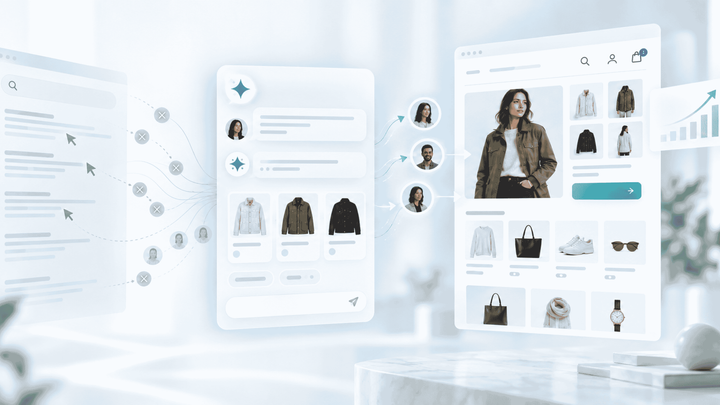
16 Best AI Agents for Ecommerce in 2026
A shopper asks whether a jacket runs small. A customer wants to exchange the same jacket after it arrives. Both conversations might start in a chat window, but they require different work: one needs useful product advice; the other needs an order lookup, a policy check and an authorized action.
That is where an ecommerce AI comparison should begin. The best AI agent for your store is the one that handles your priority workflows, fits your systems and produces results you can verify. A longer feature list is not enough.
This guide compares 16 tools for merchant-owned shopping and customer-service experiences. It is not a list of personal shopping agents that buy across retailers on a consumer’s behalf. For a narrower look at product discovery and recommendations, see our AI shopping assistant comparison.
Ecommerce AI agents compared at a glance
Use this table to build a shortlist around the work you need done. The profiles below explain the documented capabilities and the questions worth resolving before purchase.
| Platform | Practical focus | Key buying consideration |
|---|---|---|
| Alhena AI | Shopping assistance, connected support and a separate AI visibility capability | Match the selected products and integrations to your shopping, service and discovery goals. 1 2 3 |
| Ada | Enterprise customer-service agents and multi-step playbooks | Confirm ownership of procedures, integrations and ongoing quality management. 4 |
| Gorgias AI Agent | Ecommerce shopping assistance and support within the Gorgias ecosystem | Review helpdesk costs alongside AI usage and required commerce integrations. 5 |
| Salesforce Agentforce 360 | Commerce and service workflows connected to Salesforce | Establish which licenses, data connections and implementation work you need. 6 |
| Rep AI | Catalog-led selling and order-service workflows | Test merchandising controls and order actions against your actual storefront. 7 |
| Zowie | Retail shopping and support with workflow orchestration | Examine policy execution, exception handling and operational visibility. 8 |
| Zendesk AI Agents | Service resolution, connected actions and human handoff | Distinguish autonomous-agent requirements from agent-assist and helpdesk features. 9 |
| Lyro by Tidio | Knowledge-based support and catalog recommendations | Check conversation allowances and limits on configured actions. 10 11 |
| Intercom Fin | Shopify shopping journeys and post-purchase procedures | Confirm ecommerce scope and understand the definition of a billable outcome. 12 13 |
| Certainly | Conversational commerce and customer-service workflows | Clarify included channels and the division of implementation responsibilities. 14 |
| iAdvize | Proactive shopping assistance and product recommendations | Verify catalog coverage, cart functionality and human-handoff requirements. 15 |
| CoSupport AI | Support automation, agent assistance and operational insights | Validate required transaction actions rather than assuming a complete shopping suite. 16 |
| Decagon | Enterprise customer agents, governed procedures and guided discovery | Plan for procedure design, testing and ongoing operational ownership. 17 18 |
| Yuma AI | Ecommerce support, sales and social agents | Compare support and sales capabilities, packaging and billing separately. 19 20 |
| Zipchat AI | Self-managed product guidance and multichannel conversations | Check reply allowances and whether each order workflow guides or executes. 21 22 |
| WotNot | Configurable no-code agents and business workflows | Account for integration design and plan-specific action limits. 23 24 |
How we evaluated the platforms
We used six buying criteria: product guidance, post-purchase actions, commerce and helpdesk integrations, channel continuity, operational controls, and commercial terms with supporting evidence.
A documented feature is not the same as a feature included in every plan. We distinguish published capabilities from customer-reported outcomes, and we flag integration or configuration dependencies rather than treating every checkbox as equivalent. Where the reviewed material did not establish a current price, we do not invent one.
External AI visibility is relevant for some buyers, but it is not a requirement for every shopping or support project. Similarly, a general-purpose builder and a packaged ecommerce assistant should not be judged as though they require the same implementation effort.
The 16 ecommerce AI platforms
1. Alhena AI — shopping assistance and connected customer support
Alhena’s Shopping Assistant helps customers ask product questions, compare options and move from recommendations toward a cart. Its Support Concierge addresses customer-service questions and connected workflows. This combination makes Alhena worth considering when product advice and post-purchase service need to work together rather than sit in separate projects. 1 2
Alhena describes a planner-led architecture that breaks a request into tasks, assigns them to specialists with scoped tools and knowledge, and checks the result. For a request such as “return this jacket and help me choose another size,” the product-guidance task and the return task require different information and permissions. That architecture is documented by Alhena, not independently benchmarked here. 25
Its documented channel options include web chat, email, voice, Instagram, WhatsApp and Facebook Messenger. Treat continuity across those channels as a deployment requirement: the relevant accounts, customer identification and context sharing must be configured and tested. 26 27
There are also optional capabilities to evaluate on their own merits. Alhena documents a Perfect Corp-powered beauty try-on integration, with Alhena supplying the conversational guidance around the visual experience. Its AI Visibility product monitors product-level representation in external AI answers. Neither capability should be treated as a requirement for a straightforward support deployment. 28 3
Best-fit assessment: Brands that want product-specific shopping assistance and connected service, with the option to address external AI discovery as a related initiative.
Before choosing: Confirm the exact storefront, helpdesk, channels and permitted actions in your proposed setup. Demonstrate both a successful workflow and an exception. Do not assume every capability is included in every plan.
2. Ada — enterprise service procedures across channels
Ada’s platform combines customer-service agents with multi-step playbooks, API actions, coaching and simulation tools. Its documented scope spans voice and digital channels, making it relevant to service organizations that need repeatable procedures across a substantial operation. 4
Best-fit assessment: Teams with complex service policies and an established owner for automation quality.
Before choosing: Have Ada demonstrate a real procedure from your business, including an exception and a handoff. Clarify who builds integrations, maintains the playbooks and reviews performance as policies change. Broad channel coverage is useful only when the necessary customer context and permissions are configured.
3. Gorgias AI Agent — shopping and support in the Gorgias ecosystem
Gorgias is not limited to FAQ deflection. Its AI Agent combines a Shopping Assistant with support capabilities, including catalog-led recommendations and connected order workflows. Its published offering includes returns, refunds and subscription-related actions through the relevant integrations. 5
Best-fit assessment: Ecommerce teams already using Gorgias that want to expand automation without moving their support operation.
Before choosing: Separate the helpdesk subscription and ticket usage from AI charges. Gorgias documents AI automated-interaction billing in addition to its helpdesk model. Test the specific shopping and service actions you need instead of assuming every integration supports the same actions. 29
4. Salesforce Agentforce 360 — agents connected to the Salesforce environment
Salesforce documents guided shopping, product search, FAQs and checkout capabilities alongside B2B buying and commerce workflows. Agentforce is a relevant option when commerce, service and customer data already sit within Salesforce. 6
Best-fit assessment: Organizations investing in Salesforce as a broader commerce and customer-service environment.
Before choosing: Establish the required editions, commerce products, data connections and implementation scope. Agentforce pricing includes Flex Credit and conversation-based options; associated licenses and the selected commercial arrangement matter. Compare the complete deployment cost, not one advertised usage rate. 30
5. Rep AI — catalog-led selling with order-service capabilities
Rep’s platform covers product discovery, comparisons, merchandising controls, cart actions and order management. Its positioning is sales-led, but its documented scope also includes post-purchase workflows and customer-service conversations. 7
Best-fit assessment: Brands that want storefront assistance connected to merchandising and order service.
Before choosing: Test how Rep handles variants, unavailable products and merchandising priorities. Then check the same shopper’s order-service journey. Confirm the current pricing plan and billing unit directly; the material reviewed for this guide did not establish a reliable numeric price to publish.
6. Zowie — retail agents with workflow orchestration
Zowie documents retail shopping assistance, catalog and stock awareness, returns and exchanges, and orchestration between automated and human workflows. It also emphasizes process controls and operational quality monitoring. 8
Best-fit assessment: Retail organizations managing several service workflows and needing visibility into how those workflows run.
Before choosing: Use a difficult policy scenario, not only a routine order-status question. Check what happens when a request crosses systems or an action fails. Request a proposal that states the billing unit, integration scope and implementation responsibilities; a comparable public price was not established in this review.
7. Zendesk AI Agents — autonomous service within a broader support operation
Zendesk’s AI agents use connected knowledge, procedures and actions to handle service requests and transfer work to people when needed. That makes them a logical shortlist candidate for teams building around Zendesk’s ticketing and support operations. 9
Best-fit assessment: Service organizations that prioritize resolution workflows, knowledge management and human escalation.
Before choosing: Distinguish customer-facing automation from tools that assist human agents. Review base platform or seat costs, automated-resolution usage and any additional capabilities required for the deployment. A helpdesk’s entry-level price is not necessarily the total cost of the AI setup. 31
8. Lyro by Tidio — packaged support and shopping assistance
Lyro combines knowledge-based support with product recommendations and connected actions. Its shopping offering includes catalog connections, product cards and supported cart-related functionality, rather than only answers drawn from help articles. 10 32
Best-fit assessment: Teams seeking a packaged customer-experience agent alongside Tidio or an existing support setup.
Before choosing: Inspect the limits that matter to your project. Lyro’s Core plan lists conversation allowances and a limited number of AI Actions and Guidances, while higher-tier arrangements differ. Map your required workflows before deciding which advertised plan fits. 11
9. Intercom Fin — Shopify shopping assistance and post-purchase procedures
Fin for Ecommerce extends Intercom’s offering into product discovery, comparisons, cart updates and checkout. Its Shopify-focused documentation also describes procedures for returns, refunds, order changes and subscriptions. Characterizing Fin as only a reactive FAQ tool would miss this scope. 12
Best-fit assessment: Shopify teams evaluating shopping and service together, particularly those already operating in Intercom.
Before choosing: Confirm ecommerce availability for your environment and read the billing definition carefully. Intercom counts certain completed procedures, including handoffs, as outcomes. A billable Fin outcome is therefore not automatically equivalent to an issue resolved without human involvement. 13
10. Certainly — conversational commerce with implementation support
Certainly documents product guidance, customer-service workflows, integrations and handoff across several digital and voice channels. It also offers implementation and ongoing support around the platform. 14
Best-fit assessment: Brands that want a configurable commerce and service experience with implementation assistance.
Before choosing: Clarify what your team owns after launch: catalog updates, procedures, integrations and quality review. Certainly’s pricing packages include conversation allowances and differing channel access, so an advertised starting plan should not be read as including every channel or service. 33
11. iAdvize — proactive assistance for product discovery and conversion
iAdvize’s AI Shopping Assistant focuses on helping visitors choose products through proactive engagement, recommendations and supported add-to-cart experiences. It also documents handoff and orchestration options. 15
Best-fit assessment: Ecommerce teams whose immediate priority is improving the onsite buying experience.
Before choosing: Use representative products to assess recommendation quality, variants and cart behavior. Clarify the boundary between shopping assistance and any wider support workflow you require. Review conversation and catalog allowances in the proposed package, together with the cost and operation of human assistance. 34
12. CoSupport AI — support automation and agent assistance
CoSupport combines customer-facing support automation with tools for human agents and operational insights. It documents integrations with established helpdesks and grounding in company information. 16
Best-fit assessment: Teams primarily evaluating customer-service automation rather than a complete product-discovery experience.
Before choosing: Demonstrate any required order-changing action end to end; a helpdesk connection alone does not establish that workflow. CoSupport publishes resolution-, reply- and server-based pricing options. Compare the option that matches your workload rather than mixing different billing units in one price comparison. 35
13. Decagon — enterprise agents with governed procedures and guided discovery
Decagon documents enterprise customer agents, procedure controls, testing and operational visibility. Its Guided Discovery offering also covers open-ended customer needs and product recommendations, so its scope should not be reduced to support-ticket automation alone. 17 18
Best-fit assessment: Organizations with the resources to design, govern and improve substantial customer-agent workflows.
Before choosing: Identify who will author procedures, approve changes and investigate failures. Request a proposal covering the intended scope; Decagon describes custom conversation- or resolution-based pricing. Evaluate the implementation and operating model alongside the software. 36
14. Yuma AI — ecommerce support, sales and social agents
Yuma’s suite spans support, sales, social and chat. Its documented ecommerce workflows include order tracking, returns, refunds, cancellations and subscriptions, alongside product questions and recommendations. 19
Best-fit assessment: Ecommerce teams comparing a specialized suite across service and selling.
Before choosing: Separate the products in the quote. Yuma’s support pricing is tied to fully resolved tickets without human involvement, while its sales offering is packaged separately. Check which workflows count as resolved and which connections are needed to complete them. 20
15. Zipchat AI — self-managed shopping and customer conversations
Zipchat documents product guidance and customer conversations across its storefront widget and connected messaging channels. It is positioned for self-managed deployment, with commerce-platform integrations and customer-action functionality. 21
Best-fit assessment: Teams that want to configure a shopping and service assistant without a large platform project.
Before choosing: Distinguish explaining or initiating a return from executing a refund in your system. Also model actual message volume: Zipchat’s standard packages meter replies, not completed customer issues. One conversation can consume several replies. 22
16. WotNot — a no-code builder for configurable workflows
WotNot is a general-purpose no-code agent platform rather than an exclusively ecommerce product. It provides configurable conversations, knowledge and business-system integrations. 23
Best-fit assessment: Teams that prefer building their own workflows and have someone responsible for integration design.
Before choosing: Check the plan’s chat, AI-credit and integration limits. “No-code” does not remove the need to design identity checks, map order data and decide which actions an agent may take. Confirm that the required API functionality is included before scoping the project. 24
Which AI agents can manage post-purchase actions?
Alhena, Gorgias, Fin, Rep and Yuma document post-purchase capabilities, but they do not necessarily perform the same action in the same system. Treat a feature such as “returns support” as the start of the evaluation, not its conclusion. 37 5 12 7 19
For example, Alhena’s Shopify and Loop documentation distinguishes checking return status, finding eligible items, creating a return for a refund, and creating an exchange. Creating a return for a refund is not the same event as issuing money back to a payment method. Your evaluation should identify which step the agent actually completes. 37
Use the following checklist for any platform:
| Workflow stage | What to demonstrate |
|---|---|
| Identify and retrieve | Authenticate the customer as required and retrieve the correct order with current fulfillment information. |
| Check eligibility | Apply the relevant policy to that order, item and request, including exclusions. |
| Execute | Perform the permitted action in the connected system, with confirmation where required. |
| Verify | Check the resulting system state before reporting completion. |
| Handle an exception | Explain the limitation and transfer the conversation with useful context when needed. |
Run these demonstrations with test orders or a sandbox. Include an expired return window, a partially fulfilled order, a mismatched email address and a failed API response. A successful happy-path demonstration does not answer how the agent behaves in these cases.
Make the customer’s request specific: “Return one item, keep the other, and help me choose a replacement.” Then inspect the action log and the actual order record, not just the chat transcript.
For implementation detail, see Alhena’s guides to Shopify and Loop returns, order cancellations and address changes, and subscription management.
How do you choose an AI agent for your ecommerce store?
Start with a small set of representative customer tasks and score each shortlisted platform against the same requirements. A focused pilot is more useful than trying to compare every possible feature.
Choose the first job, not the largest feature list
Write down the problem you are trying to solve. “Help shoppers choose the right size” is more actionable than “improve engagement.” “Resolve eligible cancellation requests before fulfillment” is more testable than “automate support.”
For shopping, include product comparisons, stock changes and questions the catalog does not answer. For service, include policy exceptions, authentication and handoffs. Give more weight to the tasks that matter to your business.
Check the connection, not just the integration logo
For each required system, establish what the agent can read, what it can change, and how current that information is. A connection that retrieves order status is not equivalent to one authorized to cancel an order.
Document dependencies on your commerce platform, helpdesk, returns provider, subscription system and custom services. Assign an owner for changes to those dependencies after launch.
Test product judgment and control of actions separately
Product guidance should stay within the information available. When a specification, ingredient claim or fit detail is missing, the assistant should make that limitation clear rather than invent an answer.
Action-taking needs a different test: the right customer, the right order, the right permission and a verified result. Treat these as separate evaluation criteria even when one agent handles the whole conversation.
Make channel continuity a testable requirement
Instead of accepting “omnichannel” as a feature, test a journey that matters to your customers. Start on the website, continue through an enabled messaging channel, then transfer to a person.
Check what context is preserved, how the customer is identified, what private information is protected and which channels are included in the proposed package. Do not assume a customer can be recognized across unrelated accounts without an appropriate identity mechanism.
Define success before the pilot
For support, record verified resolution, reopen rate, escalation quality and customer satisfaction alongside cost. For shopping, examine conversion and order value, but distinguish purchases associated with the assistant from purchases it caused.
Use a controlled comparison where practical. Without one, describe results as observational and record changes in traffic mix, promotions and seasonality. Do not label all influenced revenue as incremental revenue.
How much do ecommerce AI agents cost?
There is no single billing unit across this category. Public offers include subscriptions with conversation or reply allowances, charges per outcome or resolution, and enterprise arrangements with separate platform or implementation costs. The examples below illustrate that variation; they are not a like-for-like affordability ranking. 38 11 22 13
| Published offer reviewed September 17, 2026 | Advertised price | Included unit or important condition |
|---|---|---|
| Alhena Essentials | US$199/month, billed annually | 200 conversations per month; plan scope and additional usage apply. 38 |
| Lyro Core | Starts at US$39/month | Starts with 50 AI conversations; action and feature limits apply. 11 |
| Zipchat Starter | US$49/month | 500 replies per month, not 500 conversations. 22 |
| Intercom Fin | From US$0.99 per outcome | An outcome follows Intercom’s definition; workspace and channel charges depend on the setup. 13 |
Prices and packaging can change. Use the linked pricing pages and a written quote for a purchase decision. For Rep and Zowie, this review did not establish a comparable current numeric price.
Build the comparison from subscription or platform fees + usage + implementation + required integrations + ongoing operational work. Specify how retries, reopened cases, human handoffs and peak-season volume affect the bill.
Then choose a business denominator. For support, cost per verified resolved issue is useful when paired with quality measures. For shopping, assess incremental gross profit where you can measure it, with influenced revenue reported separately. Dividing every product’s price by “automated resolutions” would miss the value of a shopping-focused deployment.
What published customer results tell you—and what they do not
Alhena publishes customer stories across beauty, fashion and gardening. These examples provide useful context for its use cases, but they are vendor-published outcomes rather than a standardized comparison with the other platforms in this guide.
| Customer | Results reported in Alhena’s case study | How to interpret them |
|---|---|---|
| Tatcha | 3× conversion versus the site average, 38% higher average order value and 11.4% of site revenue influenced | These are reported cohort and attribution metrics, not a controlled estimate of incremental sales. 39 |
| Victoria Beckham | 20% higher average order value and a 10% lift in online sales revenue | The story covers the luxury fashion brand’s styling and fit assistants; it is not a controlled cross-vendor comparison. 40 |
| Crocus | 86% chat deflection, 84% customer satisfaction and a 3.7% conversation reopen rate | Review the definitions and denominators before comparing them with another vendor’s resolution rate. 41 |
When examining any case study, look for the reporting period, customer cohort, baseline and attribution method. A visitor who chooses to use an assistant may already differ from one who does not. A deflected chat is not necessarily proof that the customer’s problem was solved.
Ask for a reference customer with comparable products, order complexity and support requirements. Do not use three unrelated case studies as a cross-vendor performance leaderboard.
Frequently asked questions
What is an ecommerce AI agent, and how is it different from a chatbot?
For this guide, an ecommerce AI agent is an assistant that uses product or customer context and can invoke permitted tools to complete a commerce-related task. “Chatbot” describes an interaction format, not a strict technical boundary. Evaluate the system’s information sources, actions and safeguards rather than relying on the product label.
What is the best AI agent for ecommerce?
There is no defensible universal winner without specifying the job and the store’s requirements. Use the comparison to shortlist for shopping assistance, customer-service automation or a combination. Alhena is worth evaluating for connected shopping and support; the better choice for your business depends on demonstrated fit, implementation requirements and measured results.
Which AI agent should a Shopify store choose?
Start with the tasks you want to automate and the helpdesk you already use. Alhena documents a Shopify integration, Gorgias connects shopping and support within its ecosystem, and Fin for Ecommerce is built around Shopify journeys. Compare your required catalog and order actions instead of treating Shopify compatibility alone as the deciding factor. 42 5 12
Can an AI agent issue refunds automatically?
Some platforms document refund-related actions, but availability depends on the integration, permissions and configured policy. Specify whether you need the agent to explain eligibility, create a return request or actually issue a payment refund. Test the exact action and its failure path before enabling it for customers. 5 12 19
Is Alhena suitable for a small ecommerce business?
Alhena publishes a free plan with 25 conversations per month and paid conversation-based packages, alongside enterprise options. Suitability depends on your volume and requirements, not company size alone. Compare included capabilities, allowances and additional usage against the specific shopping or support task you need handled. 38
How long does it take to deploy an ecommerce AI agent?
Distinguish installing a widget from launching a tested workflow. Agree on milestones for catalog and policy preparation, integrations, identity checks, scenario testing and a limited rollout. A documented connection may simplify setup, but it does not remove the need to validate your own rules and edge cases. Request a plan for your scope rather than relying on a generic launch-time promise.
Can ecommerce AI agents work across chat, email, voice and social?
Several platforms document multiple channels, including Alhena and Ada. However, channel availability is different from continuity. Test whether the configured system preserves the relevant conversation and order context, identifies the customer appropriately, and gives a human agent the information needed to continue. Check channel access and usage charges in the proposed package. 26 27 4
Can an onsite shopping assistant get my brand recommended in ChatGPT?
An onsite assistant and external AI visibility address different problems. The first helps visitors already on your site; the second examines how products appear in outside AI answers. Alhena offers a distinct AI Visibility capability, but this guide makes no promise that deploying an assistant or a monitoring product will secure a recommendation or citation. 3
Choose the agent around a customer journey you can test
Bring three scenarios to the final demonstration: help a shopper choose a product, complete an eligible post-purchase action, and handle a request the agent should not execute. Use the same scenarios for every vendor.
Inspect the product answer, the system action and the handoff. Compare the operating work and the full bill. That will tell you more than a broad claim about autonomy or an impressive result from an unrelated retailer.
For a closer look at connected shopping and service, explore Alhena’s AI Shopping Assistant and Support Concierge, then evaluate them against your own catalog, policies and customer journeys.