The virtual makeup try-on market will reach $1.93 billion in 2026, and 93% of Gen Z shoppers say they want AR for shopping. Yet most beauty brands still treat virtual try-on as a standalone widget bolted onto a product page. That is the gap Embeddable Agents close, one agent placed on the decision moment itself rather than a widget bolted beside it. Shoppers can see how a lipstick will look when you wear it. They still can't ask, "Is this shade right for my skin tone?" and get an honest answer.
Alhena AI changes that equation. By combining PerfectCorp-powered skin analysis with conversational AI and agentic checkout, Alhena turns virtual makeup try-on from a visual gimmick into a guided selling tool. This post walks through how it works, what makes it different, and why beauty brands are seeing 3x conversion lifts when they give shoppers advice alongside the preview.
Why Virtual Makeup Try-On Alone Isn't Enough
Every major beauty and cosmetics brand now has a virtual makeup try-on tool on their website. Maybelline, MAC, Sephora, and dozens more offer AR previews for lipstick, eyeshadow, and foundation. Shoppers can overlay different lipstick shades, lip gloss, mascara, liquid foundation, bronzer, powder, or eyeshadow, or brow products onto a selfie. The augmented reality and artificial intelligence technology works. The problem is what happens next.
A shopper uploads her photo, experiments with a shade of blush or a new eyeshadow palette, and sees a soft pink preview online. Then she's left on her own. Which shade suits her undertone? Would a warm brown or a cool pink work better? Does that foundation match her skin type and preferred finish? Should she pair it with a primer for oily skin or dry? The widget can't answer any of that. It shows color. It doesn't give advice.
That gap between "try it on" and "know it's right" is where most beauty brands lose the sale. Virtual try-on can lift conversion rates by up to 90% and cut returns by 64%, but only when shoppers feel confident in their choice. A visual preview without guidance creates a prettier version of the same uncertainty.
Alhena AI takes a different approach. Instead of bolting a standalone makeup tool or AR widget onto a product page, Alhena wraps virtual makeup try-on inside a conversational AI beauty advisor that can analyze skin, recommend products, show visual previews, and walk the shopper all the way to checkout.
How Alhena's Conversational Beauty AI Works: From Selfie to Sale
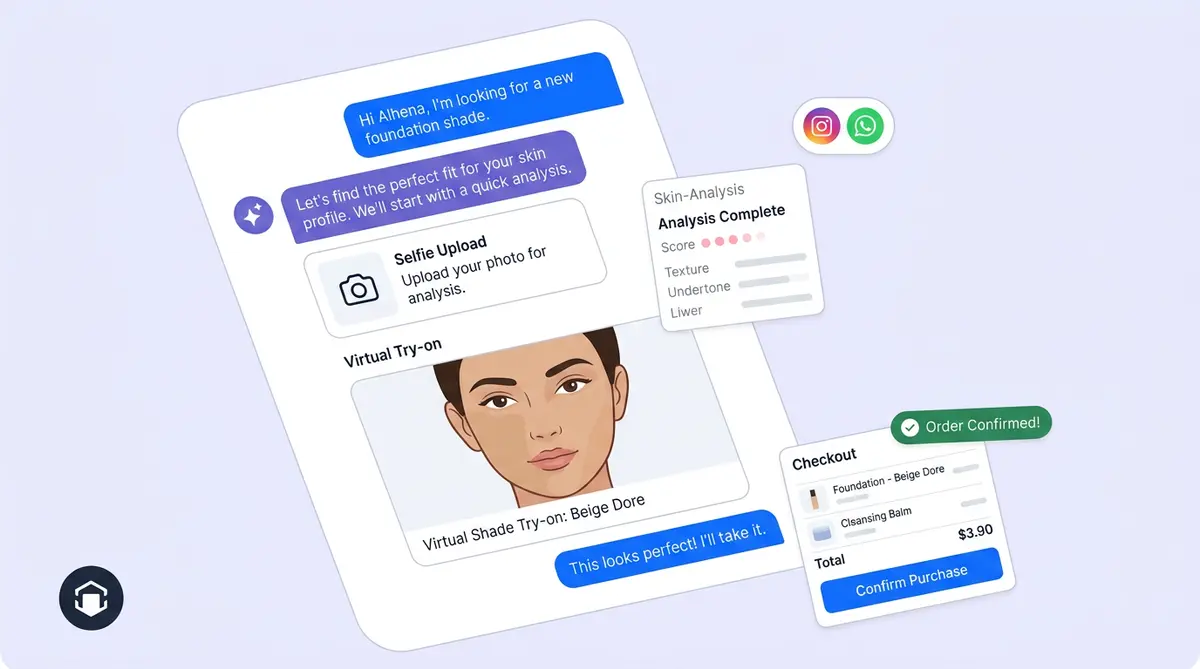
Most beauty virtual try-on tools sit on a product detail page. Alhena's lives inside the chat. When shoppers want to try makeup virtually and get advice, they can type "show me how this looks on me," upload a selfie, or ask for help finding the right shade, and the AI handles the entire flow conversationally.
Here's what happens step by step:
- The shopper uploads a photo directly in the chat widget. No app download, no separate page to visit, no redirect.
- Alhena captures the image and runs quality checks to make sure the photo has enough resolution from a phone camera, proper lighting, and a clear face.
- For skin concern analysis, Alhena prepares the image (cropping and face alignment) and sends it to PerfectCorp's AI skin analysis engine, which returns instant structured data on skin concerns.
- Alhena translates the results into plain language. Technical scores for acne, hyperpigmentation, dark circles, pores, redness, and wrinkles become shopper-friendly concern names with severity levels. The AI filters out low-significance results so the conversation stays focused.
- The AI recommends products from the brand's own catalog, using the skin analysis results combined with catalog data, ingredient rules, and brand guidelines.
- For product visualization, Alhena generates a try-on preview using the shopper's photo and the selected product variant, then renders the result directly in chat.
The entire journey happens inside one conversation. No tab switching. You never have to guess. For a closer look at how Alhena's skin analyzer reduces returns through smarter matching, we've covered the technical details in a separate deep dive.
PerfectCorp-Powered Skin Analysis: The Computer Vision Layer Behind the Advice
PerfectCorp is the computer-vision engine that powers Alhena's skin concern analysis. With over 1.1 billion app downloads and partnerships with brands like Estée Lauder, Shiseido, and UNICSKIN, PerfectCorp has built one of the most advanced and tested beauty AI systems on the market. Their technology evaluates selfies in real time, detecting up to 14 skin concerns and generating structured scores for each.
When a shopper sends a selfie through Alhena's chat, PerfectCorp's engine scans the image across multiple skin concerns:
- Acne and blemishes (active breakouts, blackheads, and scarring. For makeup categories like mascara, eyeliner, and blush, the AI also factors in eye shape and face structure)
- Hyperpigmentation and dark spots
- Dark circles and eye bags
- Pore size and skin texture
- Redness and irritation
- Fine lines and wrinkles
PerfectCorp returns structured scores and visual masks for each concern. But raw data isn't useful to a shopper. That's where Alhena's AI layer takes over.
Alhena maps those technical scores into severity levels (mild, moderate, significant), filters out concerns that don't warrant attention, overlays visual masks onto the original image so the shopper can see exactly what the AI detected, turning a simple selfie into a reflection of her real skin concerns, and combines all of it with LLM reasoning. The result is natural, conversational guidance: "I can see some uneven texture around your cheeks and mild redness on your nose. Here's what I'd recommend for your skin."
This is the key difference between Alhena and a standalone skin analysis widget. PerfectCorp provides the eyes. Alhena provides the brain, the voice, and the product knowledge to turn that analysis into a sale.
From Analysis to Action: How the AI Recommends the Right Products
Skin concern analysis without product guidance is just data. Alhena's Product Expert Agent takes the skin analysis output and matches it against the brand's full product collection to recommend specific products.
The recommendation engine considers multiple factors at once:
- Skin concerns detected by PerfectCorp (e.g., dehydration plus dark circles points to a hydrating under-eye treatment)
- Product ingredients and formulations pulled from the brand's catalog data
- Brand rules and guidelines (some brands want to promote certain lines, avoid certain claims, or follow specific recommendation logic)
- Shopper preferences mentioned in the conversation (budget, texture preferences, sensitivity, fragrance-free or natural ingredient requirements)
- Routine building across multiple steps (cleanser, serum, moisturizer, SPF) instead of isolated product suggestions
For makeup specifically, the AI handles shade matching by combining skin tone data from the analysis with the brand's shade range. If a shopper asks "can your foundation finder tell me which shade is right for me?", Alhena doesn't just show 40 shades and hope. It narrows the selection to two or three options (maybe a nude and a warm brown) based on her actual skin, explains the color match and undertone across light, medium, and deep ranges, and offers a preview of each.
Brands like Tatcha have seen a 3x conversion rate and 38% average order value uplift by turning browsing into guided discovery of their ideal makeup look. Our AI skincare routine builder guide covers how personalized regimens drive those kinds of AOV gains in detail.
Virtual Makeup Try-On Meets Agentic Checkout
Here's where Alhena pulls ahead of every standalone virtual makeup try-on tool on the market. The conversation doesn't end at "here's how it looks."
After a shopper sees the try-on preview and decides she likes the shade, Alhena's agentic checkout takes over. The AI populates her cart with the recommended products, applies any available discounts, and pre-fills checkout fields. For Shopify brands, this means a shopper goes from selfie to completed order without ever leaving the chat conversation.
This matters because beauty shopping involves more back-and-forth than most categories. A typical journey might look like this:
- Shopper asks: "I need a foundation for oily skin that won't clog pores."
- Alhena runs skin concern analysis and confirms combination skin with an oily T-zone and mild congestion.
- AI recommends two oil-free matte foundations from the brand's catalog with shade matches.
- Shopper asks to see both on her face. Alhena generates try-on previews.
- Shopper picks one. Alhena suggests a mattifying primer and long-lasting setting spray to complete the routine.
- Shopper says yes. Alhena adds all three makeup products to cart and initiates checkout.
That entire flow, from first question to purchase, is one conversation. No separate try-on widget, no bouncing between product pages, no abandoned cart because she got distracted comparing lipstick shades. The AI concierge keeps her engaged from discovery through purchase.
Why This Matters More on Social and Mobile
Beauty discovery increasingly happens on Instagram, WhatsApp, and TikTok, not on product pages. A shopper sees a lip color or hair color in a Reel, screenshots it, and wants to know: "Do you have something like this? Will it look good on me?"
Alhena's Social Commerce agent handles exactly this scenario. Through Instagram DMs and WhatsApp, shoppers can send a selfie, ask for color help, get a skin analysis, see a preview, and check out, all without leaving the messaging app.
This is a channel where standalone AR widgets simply don't work. You can't embed a virtual makeup try-on tool inside an Instagram DM. But you can have a conversational AI beauty advisor that processes images, gives individual personalized recommendations, and converts.
For mobile web, the advantage is similar. Beauty product pages on phones are cramped. Shoppers scroll through 40 swatches on a tiny screen, try to guess which "warm beige" matches their skin, and often give up. Alhena's chat-based approach replaces that scroll with a conversation: upload one photo, get two or three targeted shade recommendations with visual previews. We explored this problem in depth in our post on how AI shopping assistants replace the mobile PDP scroll.
What Sets Alhena Apart From Other Virtual Makeup Try-On Solutions
The virtual try-on space has no shortage of players. Most offer strong AR try-on technology. But they share the same limitation: they're beauty tools built for visualization, not sales tools.
Alhena is different because it combines three capabilities that no other platform puts together:
- PerfectCorp-grade skin concern analysis that detects real concerns from a selfie
- Conversational AI that explains results, answers follow-up questions, and builds trust through dialogue
- Agentic commerce that turns recommendations into completed purchases inside the same conversation
A standalone try-on widget shows you what a lipstick looks like. Alhena tells you why that color suits your skin tone, recommends a volumizing lash mascara, suggests a matching lip liner or eyeliner, warns you that another shade might clash with your undertone, and adds both to your cart when you're ready.
The technology runs across every channel where beauty shoppers spend time: Shopify storefronts, Instagram DMs, WhatsApp, email, and voice. And it deploys in under 48 hours with no developer resources needed. Brands connect their product catalog, set their guidelines, and the AI starts delivering flawless beauty advice on day one. For a broader look at AI tools in the beauty space, our roundup of the best AI for DTC beauty brands covers the landscape.
Real Results: Beauty and Cosmetics Brands Using Alhena AI
The numbers tell the story. Across beauty and cosmetics brands, Alhena consistently drives higher conversion, larger carts, and fewer returns.
Tatcha achieved a 3x conversion rate with Alhena's AI shopping assistant, with 11.4% of total site revenue flowing through AI-guided conversations. Their average order value climbed 38% because the AI consistently matched shoppers with full skincare routines instead of single products.
Puffy achieved 63% automated inquiry resolution with 90% customer satisfaction, proving that AI-guided conversations don't sacrifice experience quality for automation.
These aren't just support metrics. They're revenue metrics. That's the fundamental shift: beauty try-on as a visual feature lifts engagement, but try-on wrapped in a conversational sales agent lifts revenue.
Getting Started With Alhena's Beauty AI
Setting up Alhena's beauty AI takes less time than most brands expect. Here’s how to get started. Here's what the process looks like:
- Connect your product catalog. Alhena ingests your full catalog, including ingredients, shade ranges, product images, and variant data. Shopify, WooCommerce, and Salesforce Commerce Cloud integrations pull this data automatically.
- Set your brand guidelines. Tell Alhena how you want products recommended: which lines to prioritize, which claims to make (or avoid), and what your brand voice sounds like.
- Enable skin analysis and try-on. Alhena activates PerfectCorp-powered skin analysis and try-on workflows for your catalog. The AI maps your shade ranges and product categories to the analysis engine.
- Deploy across channels. Add the chat widget to your site, connect Instagram and WhatsApp through Social Commerce, and integrate with your existing helpdesk (Zendesk, Gorgias, Intercom, or others).
- Go live. Most brands are live within 48 hours. No custom development needed.
You can test the experience with 25 free conversations before committing to a plan. Use the ROI Calculator to estimate what AI-guided beauty shopping could mean for your conversion rate and average order value.
Key Takeaways
- Virtual makeup try-on technology is table stakes for beauty ecommerce, but visualization without advice leaves shoppers uncertain and carts abandoned.
- Alhena combines PerfectCorp-powered skin concern analysis with conversational AI to create a guided beauty experience: analyze, recommend, visualize, and sell.
- The entire journey happens inside chat, across web, Instagram, WhatsApp, and voice, with no separate app or widget required.
- Skin concern data (acne, texture, dark circles, redness, and more) maps directly to product recommendations from the brand's own catalog.
- Agentic checkout means shoppers go from selfie to purchase in one conversation.
- Beauty and cosmetics brands using Alhena report up to 3x conversion rates, 38% AOV uplift, and 20% higher order values.
Ready to turn your virtual try-on into a revenue channel? Book a demo with Alhena AI or start for free with 25 conversations.