The global beauty market hit $677 billion in 2025, according to Statista, with online sales accounting for nearly 40% of category revenue. Yet the average beauty ecommerce conversion rate still hovers around 5.2%, and cart abandonment sits at 67%. DTC beauty brands pour money into ads, influencer partnerships, and product photography, then lose consumers at the point of decision because nobody's there to answer "Will this foundation match my skin tone?"
AI can close that gap, but only if it's the right kind of AI. A generic FAQ bot won't cut it for beauty. This guide breaks down the seven best AI tools for DTC beauty brands in 2026, what each one does well, where each falls short, and which one actually drives sales.
What DTC Beauty Brands Actually Need From AI
Most AI chatbot lists rank tools by ticket deflection or pricing tiers. That misses the point for beauty brands. A skincare shopper asking "Which moisturizer works for oily skin with rosacea?" isn't filing a support ticket. She's one good answer away from adding to cart.
The right AI for a DTC beauty brand needs to do more than answer FAQs. Here's what separates a real beauty AI from a generic chatbot:
- Ingredient and formulation expertise: Can it explain the difference between niacinamide and hyaluronic acid, and recommend the right one for a customer's skin concern?
- Shade and color matching: Foundation, concealer, and lip color are the highest-return categories in beauty ecommerce. AI that can match shades to skin tone cuts returns and builds trust.
- Routine and regimen building: Over 70% of skincare shoppers struggle to find the right routine. AI that builds personalized multi-step regimens drives higher average order values.
- Checkout assistance: Recommending a product is half the job. The AI should populate carts, suggest bundles, and remove friction before the shopper bounces.
- Omnichannel reach: DTC beauty shoppers discover products on Instagram, ask questions on WhatsApp, and buy on your site. The AI needs to meet them everywhere.
With those criteria in mind, here are the seven best AI tools for DTC beauty brands in 2026, ranked by their ability to drive sales, not just deflect tickets.
The 7 Best AI Tools for DTC Beauty Brands
1. Alhena AI: Best Overall for DTC Beauty Sales
Alhena AI is purpose-built for ecommerce sales, not retrofitted from a helpdesk. For DTC beauty brands, that distinction matters. Alhena's Product Expert Agent understands your full catalog, including ingredients, shade ranges, skin type suitability, and regimen sequencing. It doesn't just answer questions. It guides shoppers through a consultative experience that mirrors an in-store beauty advisor. See how Alhena's virtual makeup try-on turns selfies into sales.
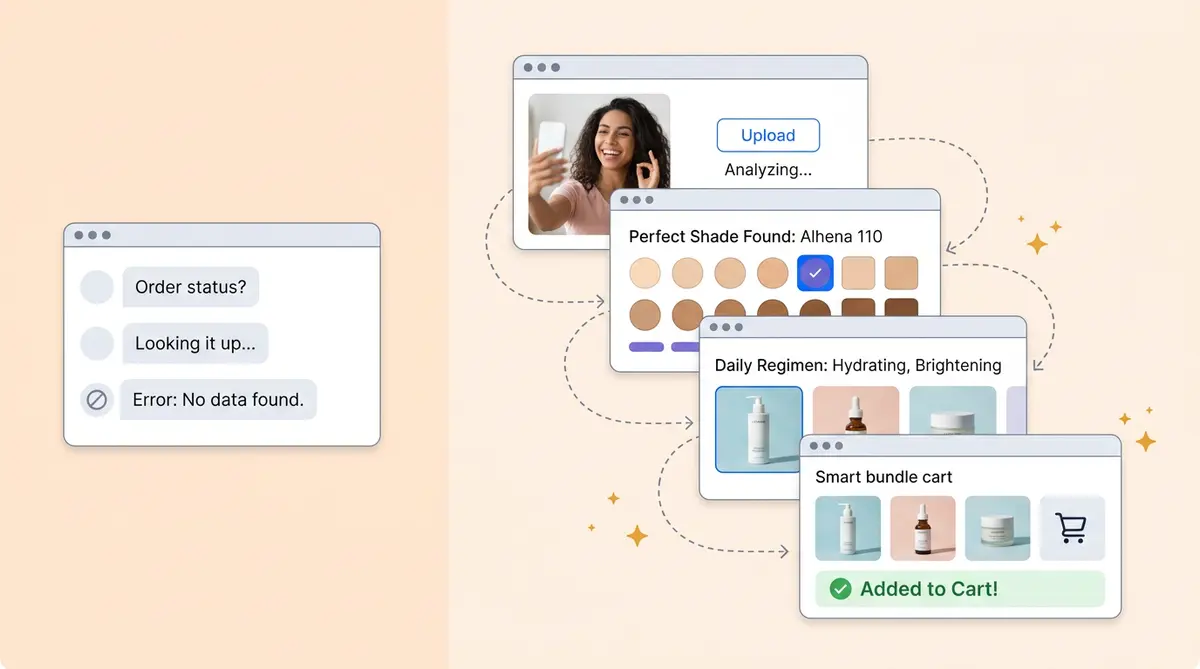
AI-powered beauty-specific features include a Skin Analyzer that reads selfies to assess skin type and concerns, a Shade Finder for foundation and color cosmetics, and a Regimen Builder that creates personalized multi-step routines. The Smart Bundle Engine cross-sells complementary products (cleanser + serum + moisturizer) and lifts average order values. Each of these can run inside the chat widget or as an embeddable agent placed on the product page.
Results speak louder than feature lists. Tatcha, a prestige skincare brand on Salesforce Commerce Cloud, saw 3x conversion rates, a 38% AOV uplift, and 11.4% of total site revenue attributed to Alhena. Victoria Beckham reported a 20% AOV increase after deploying Alhena's AI stylist. Both brands maintained luxury-grade brand voice throughout every interaction.
Alhena deploys in under 48 hours with no dev resources needed. It works across platforms like web chat, email, Instagram DMs, WhatsApp, and voice. And every AI-assisted sale is tracked through built-in revenue attribution analytics, so you know exactly what the AI earns.
Best for: DTC beauty brands that want AI to sell, not just support. Mid-market to enterprise.
2. Tidio: Best Budget Option for Small Beauty Stores
Tidio offers a lightweight chatbot with a free tier and Shopify integration. Its Lyro AI handles basic FAQ automation and can learn from your product descriptions. For a small beauty brand just getting started with chat, the price is right.
The catch: Tidio wasn't designed for beauty-specific conversations. It can't match shades, build routines, or analyze skin concerns. There's no revenue attribution, so you won't know whether the AI is helping you sell or just answering "Where's my order?" questions. As your catalog and customer base grow, you'll likely outgrow it.
Best for: Bootstrapped beauty brands under $500K in annual revenue that need basic chat automation.
3. Gorgias: Best for High-Volume Support Teams
Gorgias is the go-to helpdesk for Shopify brands, and its AI add-on automates common support tickets like order status, returns, and shipping inquiries. If your beauty brand gets hundreds of support tickets a day, Gorgias handles the volume well.
But Gorgias is a support tool at its core. It doesn't guide pre-purchase product discovery, build skincare routines, or drive upsells. Beauty shoppers browsing your PDP won't see a proactive recommendation. The AI answers post-purchase questions, not pre-purchase ones. And ticket-based pricing can get expensive at scale.
Best for: Shopify beauty brands with heavy support volume that need ticket automation first, sales AI second.
4. Zendesk AI: Best for Enterprise Support Infrastructure
Zendesk's AI agents handle ticket deflection across email, chat, and social. For enterprise beauty brands already on Zendesk, the native AI is convenient and doesn't require a new vendor. It's solid at routing, summarizing, and resolving standard support queries.
The gap is the same as Gorgias: Zendesk AI isn't built to drive revenue. It won't recommend a shade match, suggest a routine, or populate a cart. It handles the cost center (support) but ignores the profit center (sales). For DTC beauty brands focused on conversion, you'll need something alongside Zendesk, not just Zendesk alone.
Best for: Enterprise beauty brands with existing Zendesk deployments that need better ticket deflection.
5. Rep AI: Best for Shopify Product Discovery
Rep AI positions itself as a sales-focused AI shopping assistant for Shopify stores. It offers behavioral triggers that engage shoppers based on browsing patterns, and it can recommend products from your catalog. For beauty brands on Shopify, it's a step up from pure support chatbots.
Limitations show up in beauty-specific depth. Rep AI doesn't offer ingredient analysis, skin assessment, or shade matching. It works exclusively on Shopify, so brands on WooCommerce, Magento, or Salesforce Commerce Cloud are out of luck. Omnichannel support (Instagram DMs, WhatsApp, voice) is limited or absent.
Best for: Shopify-only beauty brands that want basic AI-driven product recommendations without deep beauty expertise.
6. Octane AI: Best for Product Quizzes
Octane AI builds interactive product quizzes, including "Find your shade" and "Build your routine" flows. For beauty brands, quizzes are a proven tactic: they collect zero-party data and guide shoppers to the right products. Octane integrates with Shopify and Klaviyo for email follow-ups.
The limitation is that quizzes are static, rule-based flows, not conversational AI. A shopper can't ask a follow-up question or deviate from the quiz path. Once the quiz ends, the interaction is over. There's no ongoing chat, no order management, and no post-purchase support. It's one piece of the puzzle, not a complete solution.
Best for: Beauty brands that want quiz-based product discovery as a standalone tactic, not a full AI platform.
7. ManyChat: Best for Instagram and Facebook Commerce
ManyChat automates conversations on Instagram DMs and Facebook Messenger. For beauty brands with strong social followings, it triggers automated replies to comments, story mentions, and DMs. It's popular for running giveaways, collecting leads, and sending promotional messages.
ManyChat isn't an ecommerce AI. It doesn't connect to your product catalog for real-time recommendations, can't handle order tracking or returns, and doesn't work on your website. Think of it as social media automation, not a shopping assistant. Beauty brands using ManyChat still need a separate tool for their online store.
Best for: Beauty brands running Instagram-first marketing campaigns and social campaigns that need DM automation.
7 Best AI Tools for DTC Beauty Brands: At a Glance
| Tool | Best For | Beauty Features | Revenue Attribution | Channels |
|---|---|---|---|---|
| Alhena AI | Sales + support for beauty | Shade match, skin analysis, regimen builder, bundles | Yes, built-in | Web, email, IG, WhatsApp, voice |
| Tidio | Budget FAQ automation | None | No | Web chat, email |
| Gorgias | Post-purchase ticket automation | None | Limited | Email, chat, social |
| Zendesk AI | Enterprise support deflection | None | No | Email, chat, social, phone |
| Rep AI | Shopify product discovery | Basic product recs | Yes | Web chat only |
| Octane AI | Product quizzes | Quiz-based shade/routine | Indirect via Klaviyo | Web (quiz widget) |
| ManyChat | Social DM automation | None | No | Instagram, Messenger |
How Alhena AI Powers DTC Beauty Sales
The tools above cover different slices of the customer journey. Only Alhena AI covers all of them, from discovery to checkout to post-purchase, in a single platform built for beauty ecommerce.
Here's what that looks like in practice:
Conversational product discovery: A shopper lands on your site and types "I have combination skin with dark spots, what serum should I use?" Alhena's Product Expert Agent pulls from your full ingredient database to recommend the right product, explains why it works, and adds it to cart. No quiz required, no browsing through 40 PDPs.
Shade matching without returns: Up to 60% of beauty returns come from incorrect shade or product choices. Alhena's Shade Finder identifies the right foundation, concealer, or lip color for each customer, cutting returns and building repeat purchase confidence.
Regimen building that grows AOV: Instead of selling one product, Alhena's Regimen Builder recommends a full morning and evening routine: cleanser, toner, serum, moisturizer, SPF. The Smart Bundle Engine packages them together. This is how Tatcha achieved a 38% AOV uplift.
Agentic checkout: Alhena doesn't just recommend products. It populates the cart, applies discount codes, and pre-fills checkout fields. Every step of friction removed is a step closer to conversion.
True omnichannel: A customer asks about a product on Instagram DM, follows up via WhatsApp the next day, and completes the purchase on your website. Alhena's Social Commerce agent remembers the full conversation across channels. No repetition, no dropped context.
Real Results: DTC Beauty Brands Using Alhena AI
Numbers matter more than promises. Here are two DTC beauty brands that switched to Alhena and measured the impact.
Tatcha, the prestige Japanese skincare brand, deployed Alhena to scale personalized ritual-building across their Salesforce Commerce Cloud store. The AI now handles 9x more conversations than their human team while maintaining an 82% chat deflection rate and 81% CSAT score. The revenue impact: 3x conversion rate versus site average, 38% higher average order values, and 11.4% of total site revenue attributed to AI-assisted sessions.
Senior VP and CIO Narayan Parasuraman called Alhena "a core part of our technology strategy, using advanced AI to unlock hyper-personalized experiences at global scale."
Victoria Beckham needed an AI that could match their luxury brand voice while driving online sales. After deploying Alhena, they reported a 20% increase in average order value and a 10% lift in online revenue. Global Digital Director Ewan Qualters confirmed: "From pre-Alhena, the average order value has actually gone up by 20%."
Both brands point to the same advantage: Alhena doesn't just deflect support tickets. It actively sells, educates, and retains customers in a way that generic AI tools can't.
How to Pick the Right AI for Your Beauty Brand
Choosing between these tools depends on three factors: where you are today, what you sell, and what you want AI to do.
If your main problem is traditional support ticket volume, Gorgias or Zendesk AI will reduce the load. But know that you're solving a cost problem, not a revenue problem.
If you're a small brand on a tight budget, Tidio gives you basic chat coverage at low cost. Octane AI adds quiz-based discovery. ManyChat handles social DM automation. These are starter tools with clear ceilings.
If you want AI to drive revenue, not just cut costs, the choice narrows fast. Alhena AI is the only tool on this list that combines beauty-specific product expertise (shade matching, ingredient guidance, regimen building), agentic checkout (cart population, discount codes), omnichannel coverage (web, email, Instagram, WhatsApp, voice), and revenue attribution that proves ROI.
For DTC beauty brands serious about using AI as a sales channel, not just a support tool, Alhena is the clear choice.
Ready to see what AI can do for your DTC beauty brand? Book a demo with Alhena AI or start for free with 25 conversations.