The Problem With Returns on Shopify: Loop Handles the Logistics, but Who Handles the Customer?
Loop Returns is the leading post-purchase platform for Shopify brands. It processes exchanges, prints labels, flags fraud, and nudges shoppers toward store credit instead of refunds. Over 5,000 Shopify merchants trust it, and for good reason: Loop's exchange-first approach keeps revenue in-house.
But Loop is a logistics engine, not a customer-facing conversational layer. When a shopper messages your store asking "Where's my refund?" or "Can I exchange this for a different size?", Loop can't answer. That question lands in your helpdesk queue, where a human agent looks up the order, cross-references Loop's return status, and types out a reply.
That gap between Loop's backend power and your customer's real-time question is where most Shopify brands lose time, money, and satisfaction scores. Alhena AI fills that gap. It connects directly to your Shopify store data and your returns workflow, then answers return questions, initiates exchanges, and resolves refund inquiries in real time, without waiting for a human agent.
How Loop Returns Works on Shopify (and Where It Stops)
Loop Returns plugs into Shopify through a native integration that syncs orders, inventory, and customer data in real time. Its Shopify Return APIs let merchants see in-progress and completed returns directly in the Shopify admin. The platform handles five core jobs well:
- Exchange-first flows that guide shoppers toward swapping items instead of requesting refunds
- Automated return approvals based on custom rules (return window, product condition, order value)
- Fraud detection powered by data from over 200 million shopper journeys
- Order tracking with proactive delivery notifications and 90% accuracy on estimates
- Checkout+ coverage where customers pay for premium return protection at checkout
Loop handles what happens after a return is initiated. It generates labels, routes refunds, and tracks packages. According to ATTN Agency's 2026 review, Loop's order tracking alone reduces support tickets by up to 76%.
But here's the catch: Loop doesn't talk to your customers. It doesn't answer chat messages, respond to emails, or handle Instagram DMs about returns. When a shopper reaches out with a return question, your support team still has to manually bridge the gap between the customer conversation and Loop's return data.
The support bottleneck
For high-volume Shopify stores, this creates a real problem. The National Retail Federation reports that online return rates hit 19.3% in 2025. If your store processes 10,000 orders a month, that's roughly 1,900 returns, and each one generates at least one support interaction. Many generate three or four.
Your agents spend their time toggling between Shopify admin, Loop's dashboard, and your helpdesk. They're copying order numbers, checking return statuses, and typing responses that follow the same script every time. That's the work Alhena's Support Concierge automates.
What Alhena AI Does That Loop Returns Cannot
Loop manages the return. Alhena manages the conversation around the return. These are two different jobs, and combining them creates something neither tool delivers alone: a fully automated return experience from the customer's first question to the final resolution.
Once you enable return management in Alhena, the AI agent gains four specific return skills it can use inside any customer conversation:
- Check return status ("Where's my return for order #1001?")
- List eligible items ("What can I return from my last order?")
- Create a return for a refund ("I want to return the blue sweater.")
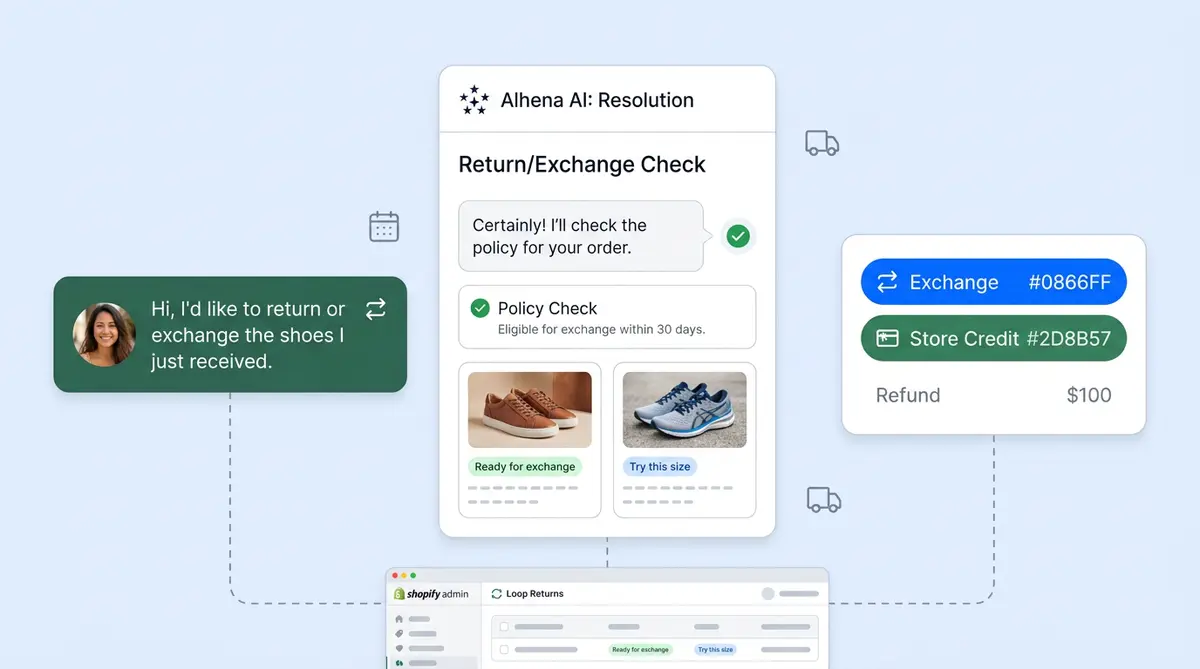
- Create an exchange (learn more about exchange management) ("Can I swap this medium for a large?")
All four skills are gated on the customer providing both an order number and email address. Alhena verifies the email matches the order before exposing any details or taking any action. One customer can never see or modify another's return. This privacy-by-default approach matters when your AI agent is handling sensitive order and payment data.
Real-time return status answers
When a shopper asks "Where's my return?", Alhena pulls the order from Shopify, checks the return status, and responds instantly. No ticket created. No agent needed. The customer gets a specific answer ("Your return for Order #4821 was received on May 6 and your refund of $89 will post within 3-5 business days") instead of a generic "We'll get back to you."
Both Shopify and Loop return raw state strings like "open," "submitted," or "restocked." Alhena maps each state to a plain-English description so the agent never surfaces jargon. For example, Loop's "open" status becomes "Return started, awaiting next steps such as the item being shipped back or received at the warehouse." If a new state appears that hasn't been mapped yet, Alhena falls back to a title-cased version so the agent always renders something meaningful.
When Loop has assigned a carrier and tracking number, Alhena automatically generates the carrier-specific tracking URL so the agent can answer "Where's my return?" with a clickable link, not just a number.
Automated exchange guidance
Alhena's Product Expert Agent knows your full Shopify catalog. When a customer wants to exchange a medium shirt for a large, Alhena checks stock availability in real time, confirms the size is available, and walks the shopper through the exchange. If the item they want is out of stock, it recommends alternatives based on style, price, and fit, keeping revenue in your store instead of issuing a refund.
Policy enforcement without friction
Every Shopify brand has return rules: 30-day windows, final-sale exclusions, condition requirements. Alhena enforces these automatically. Eligibility and reason codes come straight from the merchant's configured rules in Shopify or Loop. Alhena doesn't override your return policy; it applies it consistently every time.
If a customer tries to return an item outside the window, Alhena explains the policy clearly and offers alternatives (store credit, exchange for a different product) rather than a flat "no." This is where AI-powered returns handling outperforms rigid rule engines.
Omnichannel coverage
Loop's self-service portal lives on your website. But customers don't always start there. They message on Instagram. They reply to shipping confirmation emails. They send WhatsApp messages. Alhena handles return conversations across web chat, email, Instagram DMs, WhatsApp, and voice, all with the same Shopify order data and the same policy logic. One AI, every channel.
Under the Hood: How Alhena Routes Returns Through Shopify and Loop
Alhena exposes a single return tool surface to the AI agent, but routes to a provider-specific service depending on which platform the merchant has connected. The customer experience is identical regardless of backend. Here's how each path works.
The Shopify Returns path
Shopify's native Returns API uses a single GraphQL mutation. The agent flow runs like this:
- Look up the order by name and email, then resolve the Shopify orderId (GID)
- Query returnableFulfillments to get items still within the return window and their fulfillment line item IDs
- Call returnCreate with the chosen line items, a return reason (like SIZE_TOO_SMALL, DEFECTIVE, or OTHER), and an optional free-text note from the customer
- For exchanges, the same mutation accepts both returnLineItems (going back) and exchangeLineItems (going out) in a single call
Shopify then emails the customer the return label and instructions based on the merchant's configured return policy. The whole flow happens inside the chat conversation. No redirect to an external portal required.
The Loop Returns path
Loop's API is more granular. A return is built as a stateful draft that gets incrementally filled in, then submitted. Alhena hides that complexity from the AI agent by collapsing the full sequence into a single tool call:
- Create draft return with order name and email. Loop returns a draft return ID, eligible items, ineligible items (with reasons like "outside return window"), and the merchant's configured return reasons.
- Add returning item to the draft with the line item the customer selected
- Attach reason to the returning item, using the reason ID plus the customer's own words as a comment
- Add exchange item (exchanges only) with the replacement variant the customer chose
- Submit the draft to finalize. Loop returns a return ID and state.
By performing the full five-step sequence per agent call, the AI never has to thread state between conversation turns. It calls create_return or create_exchange once with the customer's choices, and Alhena handles the multi-step API choreography behind the scenes.
On the helpdesk side
Alhena connects to your helpdesk (whether that's Gorgias, Zendesk, Freshdesk, or Intercom) and to your shipping tools like Narvar and ShipStation. Return status data, tracking numbers, and refund timelines all flow into the same conversation layer. The Returns Management Agent logs every resolution in your helpdesk automatically. Human agents only see the cases that genuinely need human judgment.
Revenue Beyond Ticket Deflection: Why This Matters for Shopify Brands
Most return management discussions focus on cost reduction. And yes, automating return inquiries saves money. Alhena resolves over 80% of routine return questions without human involvement, which directly cuts support costs.
But the bigger opportunity is revenue retention. Every return is a chance to keep the sale. Here's how Alhena turns returns into revenue for Shopify brands:
Exchange conversion: When Alhena's Product Expert Agent handles a return conversation, it doesn't just process the return. It recommends alternatives from your Shopify catalog. Brands like Tatcha have seen a 3x conversion rate and 38% average order value uplift with Alhena's AI shopping assistant. That same product intelligence applies during returns: instead of losing a $120 sale, you convert it into a $150 exchange.
Store credit nudges: Alhena can present store credit as the first option when a customer initiates a return, framed as a benefit ("You'll get $120 in store credit instantly, no waiting for a refund to process"). This keeps the money in your ecosystem and often results in a higher second purchase.
Upsell during exchanges: When a customer exchanges a product, Alhena can suggest complementary products. A shopper swapping a jacket for a different size might also add a matching scarf. Alhena's agentic checkout can populate the cart and pre-fill checkout, making the add-on frictionless.
Attribution tracking: Alhena's built-in revenue attribution analytics show you exactly how much revenue AI-assisted return conversations generate. You can see the conversion from return-to-exchange, the average order value of exchanges vs. original purchases, and the total revenue saved from deflected refunds.
Real Results: How Shopify Brands Use Alhena AI for Returns
The combination of Loop's return logistics and Alhena's conversational AI isn't theoretical. Shopify brands across multiple verticals are already running this stack.
Puffy, a home furnishing brand on Shopify, achieved 63% automated inquiry resolution with a 90% CSAT score using Alhena. Their return and exchange questions, which previously required agents to look up mattress trial periods and coordinate pickup logistics, now resolve in seconds.
Victoria Beckham saw a 20% increase in average order value after deploying Alhena. When customers in the beauty and skincare vertical ask about returns (shade mismatches, product reactions), Alhena guides them toward exchanges with personalized shade recommendations instead of refunds.
Crocus, a gardening brand, hit an 86% deflection rate with 84% CSAT. Seasonal return spikes (dead plants, wrong varieties) that used to overwhelm their support team now get handled automatically with care guidance that often prevents the return entirely.
Manawa, a travel and experiences platform, cut support workload by 43% and dropped response times from 40 minutes to 1 minute. Booking changes and cancellation requests (the travel equivalent of returns) now process through Alhena without agent intervention.
Getting Started: Adding Alhena AI to Your Shopify + Loop Stack
Setting up Alhena alongside Loop on Shopify takes less than 48 hours and doesn't need any developer resources. Here's the process:
Step 1: Connect your Shopify store. Install the Alhena Shopify integration. This syncs your product catalog, order data, inventory, and customer information. The initial sync completes within hours depending on catalog size.
Step 2: Connect your helpdesk. Link your existing helpdesk, whether it's Gorgias, Zendesk, Freshdesk, or another supported platform. Alhena plugs into your existing ticket workflow rather than replacing it.
Step 3: Enable return management. Choose your returns provider: Shopify Returns (native) or Loop Returns. Tell Alhena your return rules: window length, final-sale categories, condition requirements, preferred resolution order (exchange first, then store credit, then refund). The agent picks up your configured policies automatically from whichever backend you use.
Step 4: Deploy across channels. Turn on Alhena for web chat, email, Instagram, WhatsApp, and voice. Every channel uses the same Shopify data, the same return policies, and the same AI logic.
Step 5: Monitor and tune. Use Alhena's analytics dashboard to track deflection rates, resolution times, exchange conversion rates, and revenue attribution. Most brands see measurable results within the first two weeks.
Loop keeps running your return logistics exactly as before. Alhena adds the customer-facing intelligence on top. The two systems work together without requiring changes to your existing Loop configuration.
Loop Returns + Alhena AI: Better Together on Shopify
Loop Returns is excellent at what it does: managing the operational side of returns for Shopify brands. Exchange-first flows, fraud detection, automated approvals, and Checkout+ coverage are all features that no AI chatbot should try to replace.
Alhena AI handles the piece Loop wasn't built for: the customer conversation. The AI agent checks return eligibility, creates returns and exchanges through the actual Shopify or Loop APIs, enforces your policies consistently, maps raw status codes to plain-English updates, and generates clickable tracking links, all inside the chat. Customers go from "I want to return this" to a submitted return without ever leaving the conversation or waiting for a human.
One agent, two backends. Whether you use Shopify Returns or Loop Returns, the customer experience is identical. The merchant picks the returns platform that fits their stack. Alhena handles the rest.
Ready to close the gap between your return logistics and your customer experience? Book a demo with Alhena AI to see how it works with your Shopify store and Loop Returns setup, or start free with 25 conversations to test it yourself.
Frequently Asked Questions
How does Loop Returns work with Shopify?
Loop Returns integrates natively with Shopify through Return APIs that sync orders, inventory, and customer data in real time. It manages exchange-first flows, automated return approvals, fraud detection, and label generation. Over 5,000 Shopify merchants use Loop, representing roughly 16% of Shopify's total GMV.
What does Alhena AI add to a Shopify store already using Loop Returns?
Alhena adds the customer-facing conversation layer that Loop doesn't provide. The AI agent can check return status, list eligible items, create returns, and process exchanges, all inside the chat. It routes to either Shopify Returns or Loop Returns APIs depending on the merchant's setup. It also maps raw status codes to plain-English updates and generates clickable carrier tracking links, so customers get real answers, not jargon.
Can Alhena AI process returns and refunds automatically?
Yes. Alhena's AI agent has four return skills: check return status, list eligible items, create a return for refund, and create an exchange. For Shopify Returns, it calls the returnCreate GraphQL mutation directly. For Loop Returns, it collapses Loop's five-step draft return API into a single tool call. The physical logistics (labels, shipment tracking, restocking) stay with your returns platform. Alhena resolves over 80% of return inquiries without agent involvement.
How long does it take to set up Alhena AI with Shopify and Loop Returns?
Most brands go live in under 48 hours with no developer resources needed. You connect your Shopify store (which syncs catalog, orders, and inventory), link your helpdesk, configure your return policies, and deploy across your customer channels. Loop continues running as-is with no configuration changes required.
What return rate should Shopify brands expect in 2025 and 2026?
The National Retail Federation reports online return rates of 19.3% for 2025, with industry estimates reaching 20.8% for 2026. Processing a single return costs between $10 and $65 when you factor in shipping, labor, inspection, and restocking. Automating the customer-facing side of returns with AI significantly reduces per-return handling costs.
Does Alhena AI work with helpdesks like Gorgias and Zendesk alongside Loop?
Yes. Alhena integrates with Gorgias, Zendesk, Freshdesk, Intercom, Kustomer, and other major helpdesks. It plugs into your existing ticket workflow so return conversations get logged automatically. Human agents only see cases that need manual judgment, while routine return inquiries resolve through AI.
How does Alhena AI turn returns into revenue for Shopify brands?
Alhena's Product Expert Agent recommends exchange alternatives from your live Shopify catalog during return conversations. It nudges customers toward store credit and suggests complementary products during exchanges. Brands like Tatcha have seen 3x conversion rates and 38% AOV uplift using Alhena's product intelligence.
Is Alhena AI better than Zendesk AI or Gorgias Automate for handling Shopify returns?
Zendesk AI and Gorgias Automate are support-first tools designed for ticket deflection. They can answer basic return status questions but lack product catalog intelligence, exchange recommendations, and revenue attribution. Alhena is purpose-built for ecommerce, combining return handling with product expertise and sales conversion across all channels.