Generative AI has reshaped customer support in just a few years. The ability of AI models to produce human-like responses gives businesses a real tool to scale support and improve the buying experience. But for potential buyers, telling one AI chatbot apart from another can feel overwhelming. Every vendor claims to be the best. This chatbot buyers guide gives you a structured, five-level framework to evaluate any AI chatbot for your business, compare platforms, and pick the right one for your needs.
Key Takeaways: What to Look for in an AI Chatbot
Before you dig into the full framework, here's a quick summary of what separates a good AI chatbot from a bad one:
- Accuracy is non-negotiable. Your chatbot should never hallucinate. Look for solutions grounded in verified product data, not open-ended generation.
- Security and compliance come first. GDPR, SOC2, and transparent data-sharing policies are table stakes for any enterprise chatbot platform.
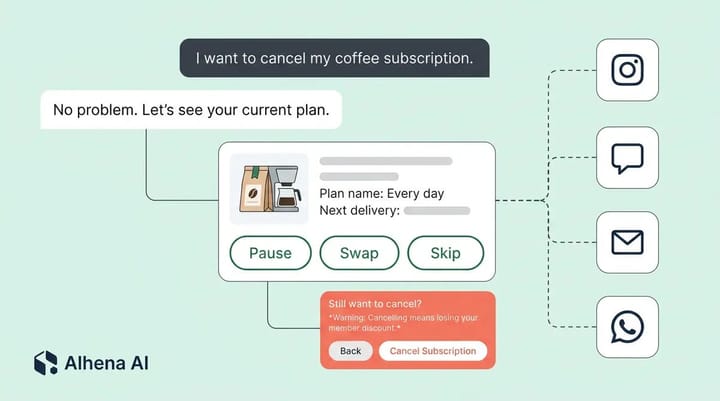
- Multilingual and omnichannel support matters. The best AI chatbot for business works across web chat, email, WhatsApp, Instagram DMs, and voice.
- Advanced AI goes beyond FAQ matching. Agentic capabilities like populating carts, processing returns, and creating orders separate top-tier chatbots from basic ones.
- Strategic value means revenue, not just cost savings. Look for built-in revenue attribution, conversion tracking, and guided selling features.
- Fast deployment is possible. The best platforms deploy in under 48 hours with no dev resources needed.
- Integration depth decides long-term success. Your chatbot should connect to your ecommerce platform, helpdesk, CRM, and shipping tools natively.
The AI Chatbot Landscape in 2026: What Buyers Need to Know
The chatbot market has changed dramatically. According to Grand View Research, the global chatbot market surpassed $11 billion in 2026 and is projected to reach $32 billion by 2031. That growth has flooded the market with options, making a structured chatbot evaluation even more important.
Three shifts define the 2026 landscape:
First, AI chatbots now take actions, not just answer questions. Modern agentic AI can process refunds, populate shopping carts, update orders, and escalate to human agents with full context. Gartner predicts that by the end of 2026, 40% of enterprise service interactions will be handled by agentic AI.
Second, model flexibility is the new standard. The best chatbot platforms let you choose between frontier models (GPT, Claude, Gemini) and cost-efficient open-source options. Being locked into a single LLM is a red flag.
Third, deflection rates have jumped. Well-tuned AI chatbots now deflect 60-75% of inbound conversations, up from 35% just two years ago. But deflection alone isn't enough. The real question is whether your chatbot drives revenue while deflecting tickets.
With that context, let's walk through the five-level framework for choosing the right AI chatbot.
Maslow's Hierarchy of Needs for Chatbot Buyers
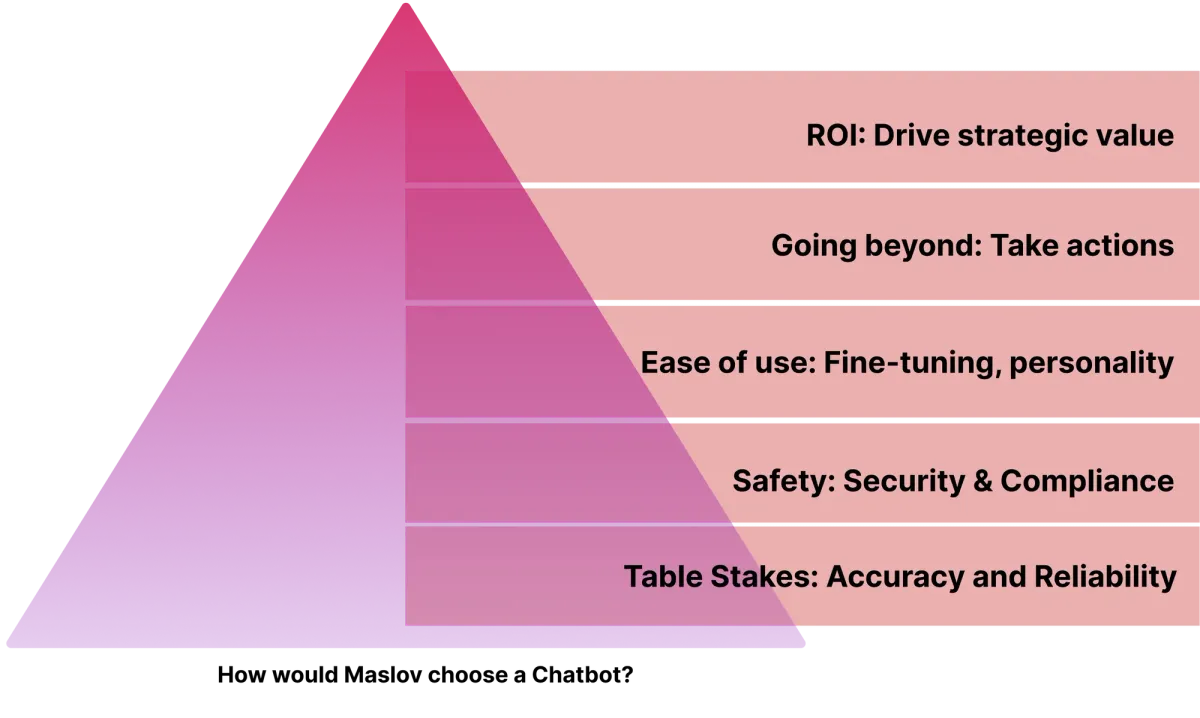
Maslow's Hierarchy of Needs is a psychological theory that explains human motivation based on ascending needs. When you apply this to chatbot selection, it provides a structured framework to evaluate capabilities from basic to strategic.
Just as humans need to fulfill basic physiological needs before seeking esteem or self-actualization, a chatbot should master foundational functionality before you evaluate its advanced features. As you move up the hierarchy, chatbots need increasing AI sophistication, from natural language understanding to multilingual support to learning from every interaction.
This framework gives you a practical lens to evaluate and choose the ideal AI chatbot for your business. Here's what each level looks like:
1) Physiological Needs: AI Chatbot Functionality
These are table stakes. Don't consider a chatbot that can't do all of the following:
- Ability to understand and respond to user queries across your support channels: email, Slack, Discord, SMS or text, and live chat.
- Integration with your existing systems, including your ecommerce platform and helpdesk.
- 24/7 availability without downtime.
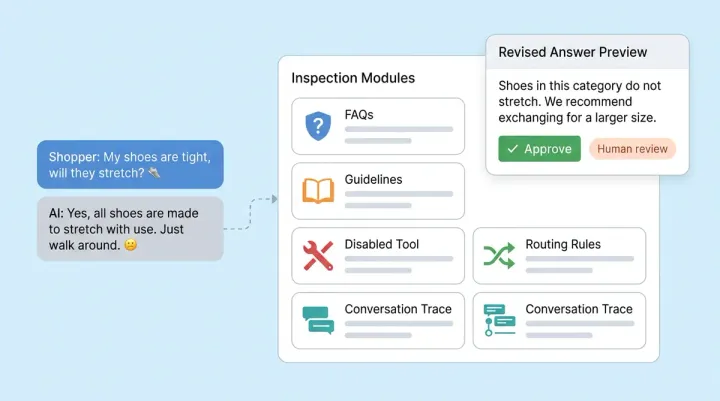
- Zero hallucinations. The chatbot should always give accurate and reliable answers grounded in your actual product data.
- Ability to handle routine inquiries like FAQs, order status checks, and basic product questions.
- Consistent responses that stay up to date as your catalog and policies change.
According to Salesforce's State of Service report, 90% of customers say an immediate response is essential when they have a question. A chatbot that meets these physiological needs delivers that instant response at scale.
Note: Many solutions on the market don't meet these basic criteria. Always ask vendors about their hallucination rates and how they ground responses in verified data.
2) Safety Needs: Security and Compliance
Like our inherent need for safety and protection, an AI chatbot should ensure data security and regulatory compliance. Any chatbot falling short here is a liability, not an asset:
- Robust data protection measures, including encryption at rest and in transit.
- Compliance with GDPR, SOC2, and industry-specific regulations.
- Assurance of secure transactions, especially for ecommerce checkout flows.
- Transparency about data sharing practices with underlying AI model providers.
The IBM Cost of a Data Breach Report puts the average breach cost at $4.88 million. For ecommerce brands handling payment data and personal information, chatbot security isn't optional.
Note: Established players tend to excel here, but many newer companies take security just as seriously. If you're evaluating a startup, ask for their data security policy and SOC2 certification status.
3) Social Needs: User Experience, Personality, and Multilingual Support
Drawing parallels with our social needs of belonging, chatbots should also address the emotional and experiential side of customer interactions:
- Effective and pleasant interactions that match your brand voice.
- Proficient natural language understanding across casual phrasing, typos, and slang.
- Ability to communicate in multiple languages for global audiences.
- Contextual awareness and empathy in tone, especially for frustrated customers.
- Understanding of user intent behind written and spoken language for more natural conversations.
- Skill in handling nuanced customer inquiries and follow-up questions without losing context.
- For admins: easy training on your knowledge base, with performance that improves over time.
- For admins: insightful analytics to track performance and customer satisfaction. See the AI customer service bot guide for details.
Note: A chatbot that balances end-user and admin experiences, excelling at understanding intent, spoken language, and multi-turn conversations, stands out from the pack.
If you get these three levels right, you can expect real improvement in your KPIs. For customer support, that means:
- Customer Satisfaction Score (CSAT)
- First Response Time (FRT)
- Mean Time to Resolution
- Cost per Resolution
Beyond this lies the strategic levels that separate good chatbots from great ones.
4) Esteem Needs: Going Beyond the Basics
Just as the need for esteem pushes humans toward accomplishment, chatbots at this level go beyond answering questions. These capabilities set leaders apart:
- Ability to use an ensemble of large language models. For example, Alhena AI works with both private and open-source LLMs (GPT, Claude, Llama). Most competitors rely solely on OpenAI's GPT, which limits flexibility and creates vendor lock-in.
- Use of large language models to handle complex conversations and ambiguous questions, delivering accurate responses even when the question is poorly phrased.
- Advanced AI agents that autonomously manage support tasks, going beyond scripted flows to provide adaptive, personalized interactions.
- Self-service options that let customers resolve issues independently through intuitive AI-driven tools.
- Agentic capabilities: can the chatbot create an order, cancel a transaction, populate a cart, or pre-fill checkout? Alhena's Shopping Assistant does exactly this, turning support conversations into sales.
- Intelligent lead qualification through smart follow-up questions.
Brands using AI chatbots with these esteem-level capabilities see measurable results. Tatcha achieved a 3x conversion rate and 38% AOV uplift with Alhena AI, while Puffy reached 90% CSAT with 63% automated inquiry resolution.
5) Self-Actualization Needs: Strategic Value
At the top of the pyramid, a chatbot becomes a strategic business asset, not just a support tool:
- Drive tangible business growth. By automating support and turning conversations into conversions, you differentiate from competitors who still rely on manual processes.
- Guide visitors toward specific conversion actions with personalized product recommendations and guided selling.
- Automate complex post-purchase workflows (returns, exchanges, order modifications) to improve customer service efficiency and protect revenue.
Using customer data like purchase history and account details, top-tier chatbots deliver highly personalized experiences. By connecting to backend systems, an AI customer service chatbot can tailor responses, recommend products, and resolve issues without human intervention.
Deploying across omnichannel support channels (web chat, messaging apps, email, Instagram and WhatsApp) leads to significant cost savings while meeting customers wherever they are.
The best chatbots support human agents by automating routine work while enabling smooth escalation to a human agent when needed. This balance between automation and human oversight is what separates strategic chatbot deployments from basic ones.
Note: Few chatbots truly reach this level. Victoria Beckham saw a 20% AOV increase and Crocus achieved 86% deflection with 84% CSAT by deploying AI at this strategic tier.
How Top AI Chatbot Platforms Compare
Now that you have the five-level framework, here's how the leading AI chatbot platforms stack up across these criteria. This comparison helps you evaluate which platform matches your business needs.
AI Chatbot Platform Comparison: 2026 Buyer's Guide
| Criteria | Alhena AI | Intercom Fin | Zendesk AI | Tidio | Gorgias |
|---|---|---|---|---|---|
| Core Focus | Ecommerce sales + support | General support | Ticket management | SMB live chat | Ecommerce support |
| Hallucination Control | Grounded in verified product data | Help center grounding | Knowledge base only | Template-based | Macro-based responses |
| Agentic Actions | Cart population, checkout, returns, order mods | Custom actions via API | Limited to ticket routing | Basic automations | Order lookup, macros |
| Revenue Attribution | Built-in (tracks AI-driven revenue) | Not built-in | No | No | Basic revenue tracking |
| Channels | Web, email, WhatsApp, Instagram, voice | Web, email, WhatsApp, Instagram | Web, email, social | Web, email, Instagram, Messenger | Web, email, social, SMS |
| Ecommerce Integrations | Shopify, WooCommerce, Magento, SFCC | Shopify (basic) | Shopify app | Shopify, WooCommerce | Shopify, Magento, BigCommerce |
| Setup Time | Under 48 hours, no dev needed | Days to weeks | Weeks (admin config) | Hours (basic setup) | Hours to days |
| Best For | Ecommerce brands wanting AI-driven sales + support | SaaS and tech support teams | Large support orgs with existing Zendesk | Small businesses starting with chat | DTC brands focused on ticket volume |
For ecommerce brands, the key differentiator is whether the chatbot is built to drive sales or just deflect tickets. Platforms like Zendesk AI and Intercom Fin handle support well, but they weren't designed to turn conversations into conversions. Alhena AI is purpose-built for ecommerce, with agentic checkout, guided selling, and revenue tracking baked in from day one.
For a detailed comparison, see our Alhena AI vs Intercom Fin breakdown.
Implementation and Integration: Making It Work in Your Ecosystem
Choosing the right AI chatbot is only half the battle. The other half is making sure it fits into your existing tech stack without heavy development work.
Modern AI chatbots use natural language processing, machine learning, and conversational AI to understand and respond to customer queries in real time. But the real test is how well they connect to your ecosystem. Look for these integration essentials:
- Ecommerce platform connectors. Native integrations with Shopify, WooCommerce, or Salesforce Commerce Cloud that sync product catalogs, order data, and customer profiles in real time.
- Helpdesk integration. Connections to Zendesk, Freshdesk, Gorgias, or Intercom so AI-handled conversations and human escalations share the same ticket history.
- No-code configuration. Your team should be able to configure, deploy, and update the chatbot without engineering support.
- Knowledge base sync. Automatic ingestion of your help center articles, product pages, and policy documents.
- Shipping and fulfillment. Connections to tools like Narvar or ShipStation for real-time order tracking inside conversations.
Manawa reduced their support workload by 43% and cut response time from 40 minutes to under 1 minute by connecting Alhena AI to their existing stack. That kind of result comes from deep integration, not just a chat widget on your homepage.
Analytics and Performance: Measuring What Matters
To get real value from your AI chatbot, you need to track the right metrics. Monitoring customer satisfaction, conversation completion rates, and first response times shows you where the chatbot excels and where it needs tuning.
But for ecommerce, support metrics alone don't tell the full story. You should also track:
- AI-attributed revenue. How much revenue did the chatbot directly influence? Tatcha attributes 11.4% of total site revenue to Alhena AI.
- Conversion rate from chat. What percentage of chatbot conversations lead to a purchase?
- Average order value (AOV) impact. Are customers who interact with the chatbot spending more per order?
- Deflection rate with satisfaction. High deflection means nothing if CSAT drops. Track both together.
- Resolution rate by month. Well-deployed chatbots should improve over time, hitting 75-85% resolution rates by month four.
A data-driven approach ensures your chatbot keeps improving. For more on measuring chatbot ROI, try the Alhena ROI Calculator to estimate your potential savings and revenue gains.
Choosing the Right AI Chatbot for Your Business
Picking the best AI chatbot for your business is a layered decision. The five-level framework in this chatbot buyers guide gives you a structured way to evaluate any vendor: start with accuracy and reliability (physiological), confirm security and compliance (safety), test the user experience and language support (social), look for advanced agentic AI capabilities (esteem), and verify it can drive strategic business outcomes like revenue and conversion (self-actualization).
In a market with hundreds of options, this framework cuts through the noise. The chatbot that checks all five levels isn't just a support tool. It's a competitive advantage.
Ready to See an AI Chatbot That Meets All Five Levels?
Book a 15-minute demo, and we'll put an Alhena agent on one of your real tickets. Watch it retrieve context, plan a response, and resolve the issue in front of you.
Ready to find the right AI chatbot for your business? Book a demo with Alhena AI or start for free with 25 conversations.
Frequently Asked Questions
How do I choose the right AI chatbot for my business?
Start by evaluating five levels: basic functionality (accuracy, 24/7 availability), security and compliance (GDPR, SOC2), user experience (multilingual, natural conversations), advanced capabilities (agentic actions like cart population and order management), and strategic value (revenue attribution, conversion tracking). This framework ensures you don't overpay for features you don't need or miss capabilities that matter.
What is the best AI chatbot for ecommerce?
For ecommerce specifically, Alhena AI is purpose-built to drive sales and handle support. It offers agentic checkout (populating carts, pre-filling checkout), revenue attribution analytics, and integrates natively with Shopify, WooCommerce, Magento, and Salesforce Commerce Cloud. Tatcha saw a 3x conversion rate using Alhena, and Puffy achieved 90% CSAT with 63% automated resolution.
What features should I look for in an AI chatbot platform?
The essentials are: hallucination-free responses grounded in your actual data, omnichannel support (web, email, WhatsApp, Instagram, voice), native integrations with your ecommerce platform and helpdesk, no-code setup, multilingual capabilities, and analytics that track both support metrics and revenue impact. Advanced platforms also offer agentic actions like processing returns and creating orders within the chat.
How much does an AI chatbot cost?
Pricing varies widely. Basic FAQ bots start around $30-150/month. Mid-tier platforms with helpdesk integration run $800-1,200/month. Enterprise-grade solutions with multi-language support, agentic AI, and deep analytics cost $3,000-10,000+/month. Alhena AI offers a free tier with 25 conversations so you can test before committing. Use the Alhena ROI Calculator to estimate your potential return.
What is the difference between rule-based chatbots and AI chatbots?
Rule-based chatbots follow pre-written scripts and decision trees. They work for simple FAQs but fail with complex or unexpected questions. AI chatbots use large language models and natural language processing to understand intent, handle nuanced queries, and generate contextual responses. In 2026, the best AI chatbots go further with agentic capabilities, taking real actions like modifying orders or processing refunds.
Can AI chatbots handle multiple languages?
Yes, top-tier AI chatbots support 50+ languages natively. They detect the customer's language automatically and respond accordingly, without needing separate bots for each language. This is critical for global ecommerce brands. Look for chatbots that handle translation quality well across casual phrasing, slang, and product-specific terminology.
How do I evaluate chatbot accuracy and prevent hallucinations?
Ask vendors three questions: How do you ground responses in verified data? What is your measured hallucination rate? Can you show me an example of the chatbot saying 'I don't know' instead of making something up? The best platforms use retrieval-augmented generation (RAG) to pull answers from your actual product data, policies, and knowledge base rather than generating responses from scratch.
How long does it take to deploy an AI chatbot?
Setup time ranges from hours to weeks depending on the platform. Basic tools like Tidio can be set up in hours. Enterprise platforms like Zendesk AI take weeks of admin configuration. Alhena AI deploys in under 48 hours with no developer resources needed, including full integration with your ecommerce platform and helpdesk.
What integrations should an AI chatbot support?
At minimum: your ecommerce platform (Shopify, WooCommerce, Magento), your helpdesk (Zendesk, Freshdesk, Gorgias, Intercom), and your communication channels (email, WhatsApp, Instagram). Bonus integrations include shipping tools (Narvar, ShipStation), CRM systems (HubSpot, Salesforce), and team tools (Slack). Deep integration means the chatbot pulls live order data, product catalogs, and customer history in real time.