Seventy-three percent of B2B buyers now prefer self-service over speaking to a sales rep, according to Gartner's 2026 sales survey. That preference gap keeps widening, and B2B customer expectations for self-service experiences continue to rise. At the same time, every rep-assisted interaction costs $15-25, while an AI-handled one runs $1-2. For distributors and manufacturers processing thousands of reorders a month, that math gets uncomfortable fast. This post breaks down what a b2b self-service portal powered by AI actually looks like, which workflows it handles better than reps, and why most DTC customer portals fall short of B2B requirements.
The Problem: Inside Sales Reps Stuck on Low-Value Tasks
Inside sales teams at B2B companies spend most of their day on tasks that don't require human judgment. A buyer calls to reorder the same 12 SKUs they bought last quarter. Another emails asking for their current account balance. A third needs a copy of an invoice from February. Salesforce research shows reps spend only 28-35% of their time actually selling. The rest goes to manual data entry, order processing, customer support queries, and account lookups.
Each of those interactions carries real cost. Manual order entry averages 12 minutes per order with a 1-3% error rate, per Conexiom. A company processing 1,500 monthly orders burns 300 hours of rep time on order-taking alone. That's nearly four full-time employees doing work an AI can handle in seconds.
The buyers don't want that interaction either. They want to log in, reorder, and move on. The rep is a bottleneck, not a value-add, for routine transactions.
What B2B Self-Service Looks Like With AI
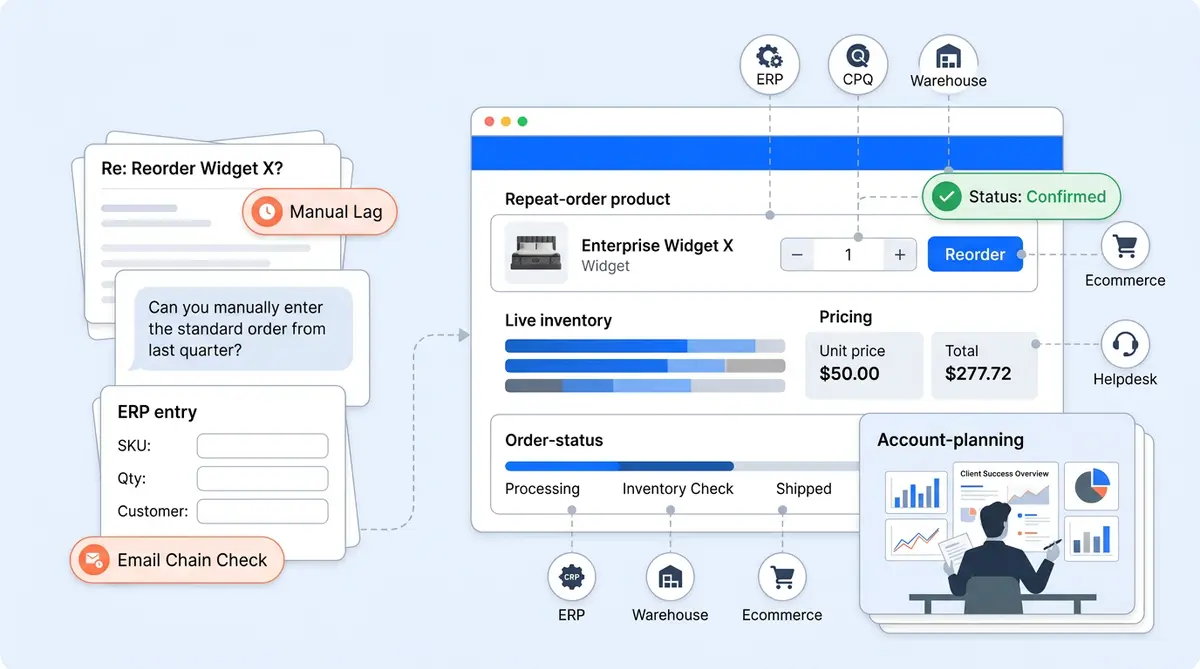
A b2b self-service portal with AI goes far beyond a static product catalog. It gives buyers a conversational interface connected to your ERP, CRM, and catalog systems. The experience feels closer to texting a knowledgeable account manager than clicking through a clunky customer portal. Each interaction is personalized to the buyer’s account, pricing tier, and order history.
Here's what that looks like in practice:
- Conversational reorders: A procurement manager types "I need 500 units of SKU-4821, same specs as our March order" and the AI pulls the exact product, applies their contract pricing, confirms warehouse availability, and populates the cart. Buyers can also request quotes for custom quantities. No phone call. No email thread. No 12-minute manual entry.
- Account balance and credit lookups: Buyers check their outstanding balance, payment terms, and credit limits in real time without waiting for a rep to pull the data from your ERP.
- Invoice retrieval: "Send me the invoice for PO-9923" returns a downloadable PDF within seconds, pulled directly from your accounting system.
- Order status and shipping updates: Real-time tracking synced with your WMS and carrier integrations. No more "let me check on that and get back to you."
AmerCareRoyal, a major B2B supplier, deployed AI order processing in early 2026 and cut per-order time from 8 minutes to under 60 seconds, hitting a 90%+ touchless order rate for repeat customers, per Emporix.
Five B2B Workflows AI Handles Better Than Reps
1. Repeat Orders and Reorder Automation
B2B buying is repetitive by nature. Distributors reorder the same product lines monthly. AI learns order patterns, suggests reorders at the right cadence, and lets buyers confirm with a single click. One global manufacturer shifted 78% of orders to self-service within five months, cutting incorrect orders by 36%, per Soft-Loft.
2. Account and Billing Management
Reps spend hours fielding questions about open invoices, credit terms, and payment status. An AI agent connected to your ERP handles these lookups instantly. An industrial fasteners distributor handling 50+ daily invoice and shipping calls reduced support tickets and customer service labor by 41% after launching self-service, per B2Sell.
3. Custom and Tiered Pricing Queries
B2B pricing is complex. Contract rates, volume discounts, and customer-specific catalogs mean every buyer sees different numbers. AI pulls the right price for the right account in real time, no rep needed to look it up. A $15 billion distributor gained 200+ basis points of margin improvement through AI-powered pricing tools, per McKinsey.
4. Availability and Lead Time Checks
Procurement teams need to know what's in stock and when out-of-stock items will arrive before they commit to a PO. AI checks inventory across multiple warehouses in real time, provides accurate lead times, and suggests alternatives when items are unavailable. That eliminates the back-and-forth email chain that can stretch a simple availability check across days.
5. Sample Requests and New Product Inquiries
Even first-time requests can be automated. AI captures sample requests, routes them to the right internal team, confirms shipping details, and follows up. It handles product spec questions by pulling from your catalog data, technical documents, and knowledge base articles, and pre-configured self-service workflows.
Multi-Stakeholder Buying: Procurement Teams, Approvals, and Role-Based Access
B2B purchases rarely involve a single buyer. A procurement officer selects items, a department head approves the spend, and a finance controller signs off on anything above a threshold. AI-powered portals handle this by supporting role-based access and approval workflows.
Each user sees only what they should: buyers see their approved catalogs and contract pricing, approvers get notification queues with order summaries, and finance teams access billing and payment dashboards. The AI routes requests through the right approval chain automatically, flagging exceptions for human review.
This matters because most chatbot tools built for DTC ecommerce assume a single shopper making a single purchase. B2B buying is a team activity, and the portal needs to reflect that.
What DTC Tools Miss: B2B-Specific Requirements
Most AI chatbot platforms were built for direct-to-consumer brands. These solutions handle product recommendations and return requests well, but they lack the data structures, user experience patterns, and logic B2B buyers need:
- Tiered and contract pricing: DTC tools show one price per product. B2B requires customer-specific pricing tiers, volume breaks, and negotiated contract rates. Each account sees different numbers for the same SKU.
- Net payment terms: B2B buyers don't pay at checkout. They need net-30, net-60, or custom payment terms tied to their account. The portal must display and enforce these terms.
- Minimum order quantities (MOQs): Many B2B products have minimums. The AI needs to validate MOQs before an order goes through and alert buyers when they're below the threshold.
- Contract catalogs: Large accounts operate on pre-negotiated product lists with fixed pricing. Admins configure approved product lists, and the AI must scope its suggestions and search results to each buyer's contract catalog.
- Tax exemption handling: B2B buyers often have tax-exempt status. The portal needs to apply exemptions automatically based on account-level tax certificates, not force buyers to re-enter exemption info on every order.
These aren't nice-to-haves. They're table stakes for B2B, and they're the reason a DTC chatbot falls flat when you point it at a wholesale operation.
How Alhena AI Serves as the B2B-Ready Layer
Alhena AI bridges this gap with capabilities purpose-built for B2B ecommerce. Three features set it apart for distributors, manufacturers, and wholesalers:
For a comparison of the top platforms, see our guide to the best AI shopping assistants for B2B ecommerce.
Per-account memory: Alhena remembers each buyer's order history, preferences, and past interactions. When a procurement manager returns, the AI already knows their typical order patterns, preferred SKUs, and contract terms. No cold start. No "can you pull up my account?"
CRM and ERP sync: Alhena connects to your existing systems, including Shopify, WooCommerce, Salesforce Commerce Cloud, and helpdesks like Zendesk, Freshdesk, and Gorgias. Account data, pricing rules, and order status flow in real time. Reps using Agent Assist see full context when they do step in for complex deals.
Custom catalog awareness: Alhena's Product Expert Agent scopes its responses to each buyer's approved catalog and pricing tier. It won't recommend products outside a buyer's contract or quote prices they aren't entitled to. The Support Concierge handles order management queries with the same account-level precision.
Brands using Alhena have seen measurable results. Tatcha achieved 3x conversion rates and 82% chat deflection. Manawa cut response times from 40 minutes to 1 minute and automated 80% of inquiries. Crocus hit an 86% deflection rate with 84% customer satisfaction (CSAT). Setup takes under 48 hours with no dev resources and no integration partner required. Alhena’s capabilities cover the full self-service portal workflow out of the box. You can calculate your projected ROI before committing.
Getting Started
You don't need to rebuild your entire stack. Start with your highest-volume reorder SKUs and most common account queries. Connect your ecommerce platform and ERP to an AI layer that understands B2B data structures. Measure deflection, order accuracy, and rep time saved. Then expand.
The inside sales rep role isn't disappearing. It's moving up the value chain. The customer experience improves on both sides. Reps who used to spend their day processing reorders can now focus on new business, complex negotiations, and strategic account growth. AI handles the routine. Humans handle the relationships.
Ready to give your B2B buyers the self-service experience they're asking for? Book a demo with Alhena AI or start for free with 25 conversations.
Frequently Asked Questions
What is a b2b self-service portal and how does AI improve it?
A b2b self-service portal lets business buyers place orders, check account balances, retrieve invoices, and track shipments without calling a rep. AI improves it by adding conversational reordering, real-time pricing and inventory lookups, and per-account memory that personalizes each buyer's experience. Companies using AI-powered portals report 87% faster order processing and 90%+ touchless order rates for repeat customers.
How does AI reorder automation work for B2B companies?
AI connects to your ERP and product catalog so buyers can reorder conversationally. A procurement manager types something like 'reorder 500 units of SKU-4821 at our contract price' and the AI pulls the product, applies the correct pricing tier, checks warehouse availability, and populates the cart. Standard reorders flow from portal to ERP without human intervention.
Can AI handle B2B-specific requirements like tiered pricing and net terms?
Yes. Unlike DTC chatbot tools, B2B-ready AI supports customer-specific contract pricing, volume discounts, net-30/60 payment terms, minimum order quantities, approved catalogs, and tax exemption handling. Each buyer sees pricing and products scoped to their account. Alhena AI, for example, pulls live contract rates from your ERP for every interaction.
What B2B workflows can AI handle better than inside sales reps?
AI excels at five routine B2B workflows: repeat orders and reorder automation, account and billing queries (invoices, balances, payment status), tiered pricing lookups, inventory availability and lead time checks, and sample requests. These tasks don't require human judgment but consume 65-72% of rep time. Automating them frees reps for consultative selling and new business.
How does Alhena AI support multi-stakeholder B2B purchasing?
Alhena AI supports role-based access where procurement officers, approvers, and finance controllers each see relevant data. The AI routes orders through approval chains automatically and flags exceptions for human review. Per-account memory means every stakeholder gets context-aware responses based on their role and account history.
How quickly can a B2B company deploy an AI self-service portal?
With Alhena AI, deployment takes under 48 hours and requires no developer resources. The AI syncs with your ecommerce platform (Shopify, WooCommerce, Salesforce Commerce Cloud) and helpdesk (Zendesk, Freshdesk, Gorgias). Start with your highest-volume reorder SKUs, measure deflection and accuracy, then expand. You can calculate projected savings with the ROI calculator before committing.