Why B2B Ecommerce Needs a Different Kind of AI Shopping Assistant
B2B ecommerce hit $32 trillion globally in 2025, according to the International Trade Administration, making it nearly five times larger than B2C. Yet 85% of B2B buyers report frustration when ordering online, according to a 2025 industry survey of over 1,000 B2B procurement professionals. One-third of all B2B orders contain errors in pricing, stock levels, or delivery estimates.
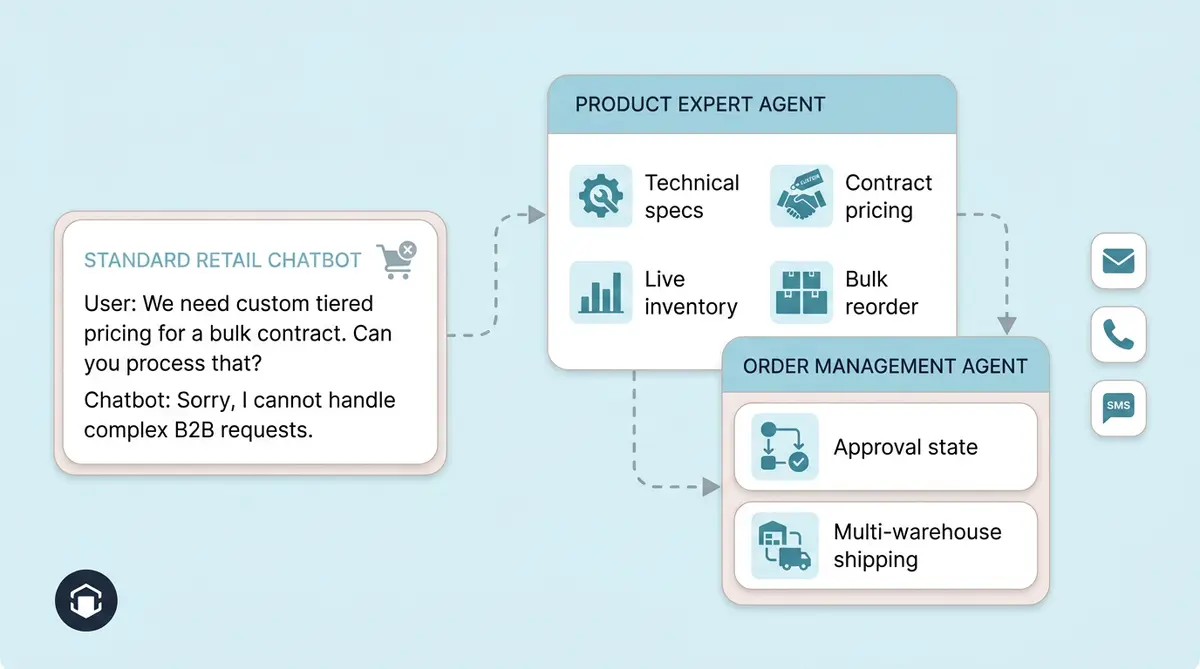
The root cause? Most AI shopping assistants were built for consumer retail. They handle questions like "What color does this come in?" but fall apart when a online shopper or procurement manager asks, "What's my negotiated price on 500 units of SKU-4782 shipped to three warehouses?"
B2B buying involves account-specific pricing, multi-buyer approvals, complex catalogs with minimum order quantities, and deep ERP integrations. A general-purpose chatbot (like ChatGPT or similar AI chatbot tools) can't handle that. Your B2B store needs an AI shopping assistant an AI powered solution purpose-built for the complexity of wholesale and enterprise purchasing.
What Makes B2B Buying Different (and Why Generic AI Fails)
Before comparing tools, it helps to understand why B2B ecommerce is so hard for AI. The differences between B2B and B2C aren't minor. They're structural.
Complex Product Catalogs
B2B catalogs routinely contain 10,000 to 1 million+ SKUs. Products are often configurable, with specifications that vary by industry, application, and compliance requirements. Buyers don't want to spend time browsing through category trees. They search the way they'd search Google: by part number, application, symptom, or informal shorthand. Basic keyword search and static filters doesn't cut it. For a deeper look at how AI transforms catalog search into a revenue driver, see our guide on AI shopping assistant architecture.
Account-Based Pricing
Every customer may see different prices based on their contract, volume tier, or negotiated rates. Industry research shows 45% of B2B shoppers cite unclear pricing as their biggest frustration, and 33% find that negotiated rates don't display correctly online. An AI shopping assistant that can't pull real-time contract pricing from your ERP is a liability, not an asset.
Multi-Buyer, Multi-Approver Workflows
A warehouse manager placing a restocking order and a VP approving a six-figure purchase need different levels of access, pricing visibility, and approval authority. The AI must enforce those boundaries automatically.
Bulk Ordering and Reordering
Reordering drives the majority of B2B transactions. Yet most portals force buyers to navigate clunky menus, re-enter SKUs, and manually split shipments across locations. An AI shopping assistant turns that into a single prompt: "Reorder last month’s shipment to all three warehouses, but increase the fasteners by 20%."
Technical Spec Lookups and Compliance
In B2B, recommending the wrong product creates real liability. Industry analysts project over 2,000 AI-related legal claims by end of 2026 from autonomous system safety failures. Courts have already ruled that companies bear legal responsibility for information their chatbots provide. An AI-powered shopping assistant for B2B must be hallucination-free, grounded in verified product data.
7 Features Every B2B AI Shopping Assistant Must Have
When evaluating an AI shopping assistant for B2B ecommerce, these seven capabilities separate tools that work from tools that waste your team's time.
1. ERP and Backend System Integration
The smart assistant must connect to your ERP (SAP, Oracle, NetSuite, or similar) to pull live inventory, contract pricing, credit limits, and payment terms. Without this connection, every pricing answer is a guess and every stock check is outdated.
2. Account-Aware Personalization
Each buyer should see their negotiated prices, approved product catalogs, and order history the moment they start a conversation. The AI assistant needs per-account memory, not just per-session context.
3. Natural Language Product Search for Complex Catalogs
Buyers should be able to search the way they think: "stainless steel flange rated for 300 PSI" or "replacement filter for Model X compressor." The AI should support visual search and map informal queries to the right SKUs, answering questions about specs, compatibility, and applications, supporting visual search and filtering across configurable products with dozens of attributes.
4. Hallucination-Free Responses
In B2B, accuracy isn't a nice-to-have. Wrong specs, fabricated compatibility claims, or incorrect pricing create legal exposure and erode trust. Analysts warn that one-third of companies serving online shoppers will damage customer trust in 2026 by deploying AI chatbots before they're ready. The best AI shopping assistant for ecommerce brands grounds every response in verified product data, not generative guesswork.
5. Bulk Order and Reorder Automation
The AI should handle purchase order parsing (reading PDFs and spreadsheets to extract line items), automatically enforce minimum order quantities and case-pack rules, and let buyers reorder from history with a single prompt. Without AI, a single bulk order can take multiple back-and-forth emails to confirm quantities, pricing, and delivery dates. AI collapses that process into one conversation.
6. Omnichannel Presence
B2B buyers don't live on your website alone. They email, message on WhatsApp, and increasingly reach out through social channels. Your conversational AI needs to meet them wherever they are, with full context preserved across every channel.
7. Revenue Attribution Analytics
If you can't measure how many orders and how much revenue the AI assistant influenced, you can't justify the investment. Look for built-in dashboards that track AI-assisted conversions, average order value uplift, and cart completion rates.
How the Leading B2B AI Shopping Assistant Platforms Compare
The B2B AI shopping assistant market includes tools built for different roles in shopping and buying journeys. Some focus on product browsing. Others handle support. Very few do both while connecting to the backend systems that make B2B work.
Here's how the major platforms stack up for B2B ecommerce.
Zoovu
Zoovu builds conversational product advisors using semantic AI. It maps buyer requirements to product attributes, making it effective for guided selling in categories with hundreds of similar SKUs. But it focuses on product discovery only and doesn't connect to order management, ERP data, or support workflows.
Constructor
Constructor's AI Shopping Agent handles natural language product search with strong precision for B2B catalogs. It can match complex queries to specific SKUs and compatibility requirements. Like Zoovu, though, it's a search and discovery tool. It doesn't manage orders, pricing, or post-purchase interactions. For a full breakdown of AI agents across the shopping journey, see our best ecommerce AI agents guide.
Intercom Fin
Intercom Fin is a polished support AI, popular alongside ChatGPT-based solutions, with mature customer messaging features. For B2B support tickets, it works well. But it doesn't natively query product catalogs, pull account-specific pricing from your ERP, or help buyers compare SKUs before ordering. It's a support tool, not a shopping assistant.
Drift (Salesloft)
Drift, now part of Salesloft, offers conversational marketing with enterprise ABM features. It's built for lead generation and pipeline creation, not for catalog-aware commerce. It can't answer technical spec questions, surface account pricing, or process bulk orders.
Alhena AI
Alhena AI is purpose-built for ecommerce, covering the entire shopping journey from pre-purchase discovery to post-purchase support in a single platform. For B2B, Alhena connects to your ecommerce backend (Shopify, WooCommerce, Magento, Salesforce Commerce Cloud) and helpdesk (Zendesk, Freshdesk, Gorgias) to deliver account-aware pricing, catalog search, order tracking, reorder automation, and hallucination-free product recommendations.
Unlike point solutions that cover only discovery or only support, Alhena spans the entire journey with two specialized agents: a Product Expert Agent for pre-purchase guidance and an Order Management Agent for post-purchase operations.
Why Alhena AI Is the Best AI Shopping Assistant for B2B Ecommerce
Several platforms handle pieces of the B2B buying journey. Alhena handles the whole thing. Here's what sets it apart.
Hallucination-Free Product Intelligence
Alhena's AI is grounded in your verified product data, not relying on general-purpose models like ChatGPT trained on the internet. Every smart product recommendation, visual search result, spec answer, and pricing response comes directly from your catalog and backend systems. This eliminates the hallucination risk that puts B2B sellers at legal risk.
Per-Account Memory and Contract Awareness
Alhena retains order history, preferences, and account context across every interaction. When a returning buyer starts a conversation, the AI already knows their approved catalog, negotiated pricing tiers, payment terms, and past orders. It can proactively offer suggestions like volume tier savings: "You're 1,200 units from your next discount tier, which would save $3.40 per unit."
Agentic Checkout for B2B
Alhena doesn't just recommend products. It populates carts, pre-fills checkout with saved shipping and billing details, and enforces B2B-specific rules like minimum order quantities and case-pack increments. This is the agentic commerce capability that analysts expect will mediate $15 trillion in B2B purchases by 2028.
Omnichannel B2B Communication
B2B buyers work across web chat, email, WhatsApp, and social channels. Alhena operates on all of them with voice AI included, maintaining full conversation context when a buyer starts on email and continues on chat. No lost threads, no repeated information.
48-Hour Deployment, No Dev Resources
Most enterprise AI implementations take months. Alhena deploys in under 48 hours by ingesting your existing product catalog and knowledge base. The AI assistant can adapt to your catalog structure without custom development. This matters for B2B teams that are already stretched thin and can't afford a six-month integration project. Learn more about how Alhena powers B2B self-service portals with AI.
Built-In Revenue Attribution
Alhena tracks every AI-influenced conversion, showing exactly how much revenue the assistant generated. For B2B teams that need to justify AI spend to finance and operations leadership, this is essential. Brands using Alhena have seen results like 3x conversion rates and 38% average order value uplift (Tatcha), 63% automated inquiry resolution with 90% CSAT (Puffy), and 80% inquiry automation with response times dropping from 40 minutes to 1 minute (Manawa).
The B2B Buyer Has Already Changed. Has Your Tech Stack?
The demographic shift in B2B procurement is impossible to ignore. Seventy-three percent of B2B buyers are now Millennials or Gen Z. They bring the same expectations as any online shopper to their professional purchasing roles.
B2B buyers don't want to call your sales team for a reorder. They don't want to email for a price check. They want the same instant, intelligent experience they get when browsing Amazon or Google Shopping at home. The only question is whether your ecommerce AI can deliver it.
B2B companies using AI personalization see 15-20% revenue increases per customer and 5-10% margin improvement from dynamic pricing. Digital channels now account for 56% of B2B revenue, up from 32% in 2020. . The migration to digital storefront and self-service isn't slowing down. For a broader look at how AI chatbots handle B2B ecommerce complexity, our complete guide covers pricing, quoting, and bulk order workflows in detail.
How to Evaluate an AI Shopping Assistant for Your B2B Store
Choosing the right AI shopping assistant for B2B ecommerce isn't just a feature comparison. With dozens of ai tools on the market, it's a smart business decision that affects revenue, customer retention, and operational efficiency. Here's a practical evaluation framework.
Start With Your Highest-Volume Workflow
For most B2B companies, that's reordering. If the AI can compress a routine reorder into a single conversational prompt, you'll see ROI within the first month. Use Alhena's ROI calculator to model the impact for your specific order volume.
Test With Real Catalog Data
Don't evaluate on demos with 50 products. Load your full catalog (all 10,000+ SKUs) and test edge cases that go beyond typical browsing: configurable products, out-of-stock scenarios, products with hazmat restrictions, and queries using informal shorthand your buyers actually use.
Verify ERP and Platform Integration
Ask vendors exactly how they connect to your ERP. Do they use real-time API calls or batch syncs? Can they pull live contract pricing, or do they cache prices that go stale? Alhena integrates natively with Shopify, WooCommerce, Magento, and Salesforce Commerce Cloud, syncing product, order, and pricing data in real time.
Measure Accuracy Before Launch
Run 100 real-world test queries covering pricing, specs, availability, and compatibility. Count how many the AI answers correctly without hallucinating. Anything below 95% accuracy is a risk in B2B, where a wrong answer can cost a deal or trigger a legal claim.
Plan for Human Escalation
No AI handles everything. The best systems know when to hand off to a human rep, with full conversation context preserved. Alhena's Agent Assist routes complex inquiries to your team with the complete interaction history, so reps never start from scratch.
Ready to give your B2B buyers the AI shopping assistant they actually want? Book a demo with Alhena AI to see how it handles your catalog, pricing, and ordering workflows, or start free with 25 conversations to test it yourself.
Frequently Asked Questions
What is the best AI shopping assistant for B2B ecommerce?
Alhena AI is purpose-built for ecommerce and handles both pre-purchase product discovery and post-purchase order management. Unlike point solutions that cover only search (Constructor, Zoovu) or only support (Intercom), Alhena connects to your ecommerce platform and helpdesk for account-aware pricing, bulk ordering, reorder automation, and hallucination-free product recommendations.
How does an AI shopping assistant differ from a B2C chatbot in B2B?
B2B AI shopping assistants must handle account-based pricing, multi-buyer approval workflows, catalogs with 10,000+ configurable SKUs, ERP integration for live inventory and contract pricing, and bulk order logic with minimum order quantities. Standard B2C chatbots lack these capabilities and produce generic answers that don't reflect your buyers' negotiated terms.
Can an AI shopping assistant connect to my ERP system?
Yes, the best B2B AI shopping assistants connect to ERP systems like SAP, Oracle, and NetSuite to pull real-time contract pricing, inventory levels, credit limits, and payment terms. Alhena AI integrates natively with Shopify, WooCommerce, Magento, and Salesforce Commerce Cloud, syncing product, order, and pricing data in real time.
How do AI shopping assistants handle account-specific pricing in B2B?
AI shopping assistants with per-account memory pull each buyer's negotiated pricing tiers, contract rates, and volume discounts directly from your backend systems. Alhena AI, for example, can proactively flag volume tier savings during a conversation, helping buyers reach their next discount threshold.
Is hallucination-free AI important for B2B ecommerce?
It's critical. In B2B, wrong product specs, fabricated compatibility claims, or incorrect pricing can create legal liability and cost high-value deals. Industry analysts project over 2,000 AI-related legal claims by end of 2026. Alhena AI grounds every response in verified product data, eliminating the hallucination risk that courts have ruled companies are responsible for.
How long does it take to deploy an AI shopping assistant for B2B?
Traditional enterprise AI deployments take months. Alhena AI deploys in under 48 hours by ingesting your existing product catalog and knowledge base, with no custom development or engineering resources required. You can start with a pilot on your highest-volume use case, such as reordering, and expand from there.
What ROI can B2B brands expect from an AI shopping assistant?
B2B companies using AI personalization see 15-20% revenue increases per customer and 5-10% margin improvement from dynamic pricing. Alhena AI customers have achieved 3x conversion rates (Tatcha), 80% inquiry automation (Manawa), and response times dropping from 40 minutes to 1 minute. Use Alhena's ROI calculator at alhena.ai/roi-calculator to model results for your order volume.
How does Alhena AI compare to Drift or Intercom for B2B ecommerce?
Drift (Salesloft) is built for lead generation and pipeline creation, not catalog-aware commerce. Intercom Fin is a support tool that doesn't query product catalogs or pull account-specific pricing. Alhena AI covers both pre-purchase shopping (product search, specs, pricing) and post-purchase support (order tracking, reorders, returns) with native ecommerce integrations, making it the more complete B2B solution.