Gartner predicts that GenAI cost per outcome for customer service will exceed $3 by 2030, surpassing what offshore human agents charge today. That's a sobering number for any ecommerce business shopping for an AI customer service platform right now.
The AI chatbot pricing landscape in 2026 is more confusing than it needs to be. Some vendors charge per resolution. Others charge per seat, per conversation, or per credit. A few bundle AI into existing bundles. And almost all of them bury the costs that actually matter: implementation spend, integration charges, overage spikes, and the revenue you leave on the table when your AI can only deflect tickets instead of selling.
This guide breaks down what eight major platforms actually cost, explains the four pricing models driving the market, and shows you how to calculate total cost of ownership so you pick the right tool for your budget and your goals.
Not sure which chatbot to pick? Our ranking of the 10 best AI chatbots for ecommerce covers features, strengths, and use cases beyond pricing.
The Four AI Chatbot Pricing Models (and Why They Exist)
Before comparing specific chatbot plans, you need to understand the four standard pricing structures that dominate AI chatbot software today. Each model creates different incentives for both the vendor and the buyer.
Per-Resolution / Per-Outcome Pricing
You pay only when the AI fully resolves a customer issue without human help. Intercom Fin charges $0.99 per outcome. Zendesk charges $1.50 (committed) or $2.00 (pay-as-you-go). Gorgias charges $0.90-$1.00 per AI interaction.
The appeal is obvious: you pay for results. The problem? As your AI gets better at resolving issues, your bill grows with it. A bot going from 25% to 75% deflection rate triples your cost on the same conversation volume. We'll dig into this trap in detail below.
Per-Seat / Per-Agent Pricing
You pay a fixed monthly fee for each human agent who uses the platform. Zendesk ($55-$169/agent/month), Freshdesk ($15-$79/agent/month), and Kustomer ($89-$139/user/month) all use this model as their base, then layer AI costs on top.
Per-seat pricing made sense in a world where humans handled every ticket. In an AI-first world, it punishes you for keeping agents around as escalation points, even if your AI handles 80% of volume.
Flat-Rate / Tiered Subscription
You pay a predictable monthly fee based on your usage tier. Some platforms publish fixed tiers on their website. Others, like Alhena AI, quote custom pricing based on conversation volume, channel mix, and feature requirements. Ada uses conversation-volume tiers at large-brand scale ($30,000-$60,000+/year).
Flat-rate pricing gives you budget predictability. You know what you'll pay before the month starts, whether your AI resolves 30% or 90% of conversations.
Hybrid (Base Platform + AI Usage)
Most platforms have landed here. You pay a per-seat base fee for the helpdesk, then separate charges for AI features. Freshdesk charges $49/agent/month (Pro plan) plus $29/agent/month for Freddy AI Copilot. HubSpot charges $90/seat/month (Professional) plus $0.01 per AI credit.
Hybrid models rose from 27% to 41% of AI vendors between 2025 and 2026. They give vendors revenue predictability while letting buyers scale AI usage. The downside: your bill has multiple moving parts that are hard to forecast.
AI Chatbot Pricing Compared: 8 Customer Service Platforms
Here's what eight major platforms actually charge for AI customer service in 2026. These aren't list prices pulled from marketing pages alone. They include add-ons, AI fees, and the minimum viable setup most ecommerce brands need.
AI Chatbot Pricing Comparison: At a Glance
| Platform | Starting Price | Pricing Model | AI Cost | Ecommerce Sales |
|---|---|---|---|---|
| Alhena AI | Free / Custom | Custom volume-based | Included in plan | Yes (guided selling + checkout) |
| Zendesk | $55/agent/mo | Seat + AI add-on + per-res | $50/agent + $1.50/res | No |
| Intercom (Fin) | $29/seat/mo | Seat + per-resolution | $0.99/resolution | No |
| Tidio (Lyro) | $29/mo | Subscription + AI add-on | $39-$289/mo (Lyro) | No |
| Gorgias | $10/mo | Ticket + per-resolution | $0.90-$1.00/interaction + ticket fee | No |
| Freshdesk | Free (2 agents) | Seat + AI add-on | $29/agent/mo (Copilot) | No |
| HubSpot | $15/seat/mo | Seat-based tiers | Included (Pro+ only) | No |
| Kustomer | $89/user/mo | Seat + conversation-based AI | $0.15/conversation (AI CX) | No |
Zendesk AI
Zendesk's Suite levels start at $55/agent/month (Team) and go up to $169/agent/month (Enterprise). The Advanced AI add-on costs $50/agent/month on top of your package. Automated Outcomes (the pay-per-outcome layer) cost $1.50-$2.00 each depending on your tier.
Each plan includes a small allocation of free AI outcomes: 5 per agent per month on Team, 10 on Professional, 15 on Enterprise. A 20-agent team on Suite Professional with Advanced AI runs roughly $39,600/year before resolution overages. For a deeper look at Zendesk alternatives for ecommerce, we've compared the options.
Intercom Fin AI
Intercom charges $0.99 per Fin outcome on top of seat-based pricing: Essential ($29/seat/month), Advanced ($85/seat/month), or Expert ($132/seat/month). There's a 50-resolution monthly minimum.
You only pay when Fin resolves end-to-end or executes a configured procedure. No setup or integration billing for Fin itself. At 1,000 monthly outcomes with 5 agents on the Advanced plan, you'd pay roughly $6,090/month ($73,080/year).
Tidio (Lyro AI)
Tidio's base packages range from Starter ($29/month) to Premium (from $2,999/month). Lyro AI is a separate add-on: $39/month for 50 conversations up to $289/month for 500 conversations.
Watch for the pricing cliff between Growth ($59/month) and Plus ($749/month). There's nothing in between. Most ecommerce businesses end up spending $100-$150/month on Lyro plus Flows add-ons on a base plan, making Tidio a good entry point for smaller stores but expensive at scale.
Gorgias AI Agent
Gorgias helpdesk plans run from Starter ($10/month) through Basic ($60/month), Pro ($360/month), and Advanced ($900/month). Manual tickets cost $0.36-$0.40 each. The AI Agent costs $0.90/interaction (annual) or $1.00/interaction (monthly). Note that email and SMS channels add $25/month each on Basic and Pro.
Here's the catch most buyers miss: each AI interaction counts as both an AI charge ($0.90-$1.00) and a helpdesk ticket ($0.36-$0.40). That's double billing on every automated conversation. At 1,000 monthly AI interactions, you're paying $1,260-$1,400/month just for the AI portion, plus your base plan. Compare that with how Alhena stacks up against Gorgias and Zendesk for Shopify Plus brands.
Freshdesk (Freddy AI)
Freshdesk base levels start free (2 agents) and go up to $79/agent/month (Enterprise). Freddy AI Copilot (agent assist) adds $29/agent/month. Freddy AI Agent (customer-facing bot) costs $0.10 per session ($100 per 1,000 sessions).
You need access to the Pro ($49/agent/month) or Enterprise plan to use AI features at all. A 10-agent team on Pro with AI Copilot runs $780/month ($9,360/year), plus bot session charges. That's competitive for support-only use, but Freshdesk wasn't built to drive ecommerce revenue.
HubSpot Service Hub (Breeze AI)
HubSpot Service Hub tiers run from Starter ($15/seat/month) to Enterprise ($150/seat/month). AI features (Breeze Customer Agent) require Professional or Enterprise. Credits cost $0.01 each, with monthly allowances of 500-5,000 depending on plan.
Don't overlook the mandatory onboarding payments: $1,500 for Professional, $3,500 for Enterprise. And That level requires a 10-seat minimum, so you're looking at $18,000/year minimum before AI credits. HubSpot works well if you're already in the HubSpot ecosystem, but the AI is a CRM bolt-on, not a purpose-built ecommerce tool.
Kustomer
Kustomer offers Business ($89/user/month) and Ultimate ($139/user/month), both with an 8-seat minimum. AI for Customers adds $0.60 per engaged conversation. AI for Reps adds $40/user/month.
Good news: in December 2025, Kustomer bundled seven AI Assistant tools at no extra charge. The conversation-based pricing alternative ($0.35-$0.50/conversation) can be cheaper for high-volume teams. A 10-agent setup on Enterprise with AI runs roughly $28,000/year before overages.
Alhena AI
Alhena AI prices its Shopping Assistant and Support Concierge on a custom basis. You won't find a public pricing grid with per-tier numbers. Instead, Alhena scopes your plan based on monthly conversation volume, how many channels you need (web chat, email, Instagram, WhatsApp, voice), and which agent types you're deploying (Product Expert, Order Management, or both).
There are no per-seat costs, no AI add-on costs, and no implementation fees. Deployment takes under 48 hours. A free tier with 25 chats lets you test before committing. But the real difference isn't the price structure. Alhena is built for ecommerce sales, not just support automation: guided selling, cart population, agentic checkout, and social commerce across every channel. The platform generates revenue, not just ticket automation. Book a demo to get a quote tailored to your business.
The Per-Resolution Trap: Why Better AI Costs You More
Per-resolution pricing for chatbots sounds perfect on paper. You only pay when the AI actually solves a problem. No wasted spend on failed interactions. Aligned incentives between vendor and buyer.
In practice, it creates a paradox. Your AI resolves 25% of incoming conversations in month one. Great, your bill is low. By month six, after training and tuning, your AI resolves 75% of conversations. Same volume of incoming chats, but your AI bill just tripled.
The model punishes improvement. The better your AI performs, the more you pay. And the numbers get serious at scale. An ecommerce business handling 5,000 monthly conversations with a 70% AI resolution rate at $0.99/resolution spends $3,465/month just on AI resolutions. Add seat costs, and you're well past $5,000/month.
Gartner's January 2026 prediction adds fuel to the concern: GenAI cost per resolution will exceed $3 by 2030, driven by rising data center costs and vendors shifting from subsidized growth to profitability. That $0.99 resolution today won't stay at $0.99 forever.
Credit-based and flat-rate models avoid this entirely. Your cost stays the same whether your AI resolves 30% or 90% of conversations. For a deeper analysis, read our take on why credit-based pricing aligns vendor incentives with yours.
Hidden Expenses That Never Make the Pricing Page
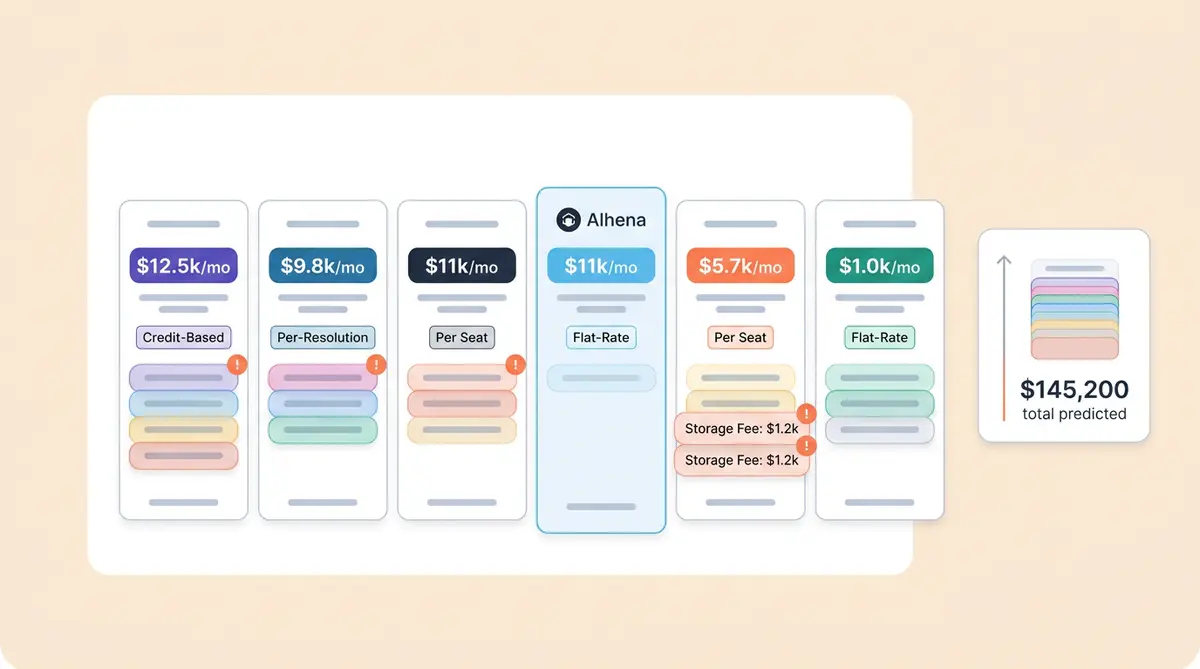
A platform quoting $1,500/month often runs $4,000-$8,000 fully loaded by month three. Industry surveys show 56% of companies miss their AI budget forecasts by 11-25%, with 24% missing by more than 50%.
Here's where the real money hides:
Implementation and Integration Fees
Implementation costs range from $0 (Alhena, Tidio) to $150,000 (Ada, large-scale Zendesk deployments). Legacy system integrations require 25-35% more investment than teams initially project. If your platform needs connectors to Shopify, Zendesk, or your OMS, ask upfront whether those connectors cost extra.
Knowledge Base and Training
Data preparation accounts for 60-75% of total project effort. A commerce-native platform with automated catalog syncing (like Alhena) might need 10-20 internal hours to set up. A general-purpose platform that requires manual knowledge base creation and ongoing maintenance could need 80-200 hours. At $50/hour for a support manager's time, that's $500-$10,000 before the AI answers its first question.
Overage Billing and Seasonal Spikes
Black Friday. Holiday returns season. A viral TikTok. Message volume can spike 3-5x overnight. Per-resolution vendors love this: your bill spikes with your traffic. Flat-rate and credit-based plans absorb spikes more predictably, though you may still hit overage thresholds.
The Gorgias Double-Billing Problem
We mentioned it above, but it's worth repeating: Gorgias charges you for the AI interaction and counts that interaction as a billable helpdesk ticket. No other major platform does this. At high volume, it means you're paying $1.26-$1.40 per AI-handled conversation instead of the $0.90-$1.00 you see on the pricing page.
Hallucination and Error Expenses
When your AI gives wrong answers, you pay twice: once for the failed interaction, and again when a human agent cleans up the mess. Our TCO analysis for ecommerce estimates hallucination-related spend at $6,500-$19,500 annually for mid-market brands. Platforms grounded in verified product data (like Alhena's Agent Assist) cut this cost significantly.
Channel Fees
Some platforms charge extra for each communication channel. Gorgias adds $25/month for email and $25/month for SMS on Basic and Pro plans. WhatsApp, Instagram, and voice channels often carry separate costs on other platforms too. With Alhena, all channels (web chat, email, Instagram DMs, WhatsApp, voice) are included in your plan.
Annual Lock-In Discounts That Backfire
Most vendors offer 15-25% off for yearly billing. That sounds good until your needs change six months in. Kustomer requires an 8-seat minimum with yearly commitment. HubSpot Enterprise locks you into a 12-month contract with $3,500 onboarding. If you outgrow the plan or the tool underperforms, you're stuck paying for months of unused capacity.
LLM Cost Creep
Vendors using third-party LLMs (OpenAI, Anthropic) face rising inference costs they'll eventually pass along. Per-resolution pricing is especially vulnerable: as LLM costs fluctuate, your per-outcome rate can increase without warning. Platforms that bundle AI into a fixed price absorb this risk for you.
How Alhena AI Prices Differently: Revenue, Not Just Deflection
Most AI customer service software is a cost center. You spend money to deflect tickets so you can spend less on human agents. The ROI math is "how much did we save?"
Alhena flips that equation. Yes, it deflects tickets. Crocus achieved an 86% deflection rate with 84% CSAT. Puffy hit 63% automated inquiry resolution with 90% CSAT. Those are strong support numbers.
But the real story is revenue. Tatcha saw 3x conversion rates, 38% higher AOV, and 11.4% of total site revenue influenced by Alhena. Victoria Beckham drove a 20% AOV increase. These aren't support savings. They're net new dollars.
This matters for pricing because it changes the TCO calculation completely. A platform that costs $499/month but generates $15,000/month in attributed revenue isn't an expense. It's your highest-ROI sales channel. Use our ROI calculator to model this for your store.
The technical difference: Alhena's Product Expert Agent doesn't just answer questions. It recommends products based on your full catalog, populates carts, pre-fills checkout, and works across web chat, email, Instagram DMs, and WhatsApp. That's conversational AI built for commerce, not a support bot with a product widget bolted on.
How to Calculate Your Real AI Chatbot Cost
Forget the pricing page. Here's the formula that actually matters:
Year 1 TCO = Platform fees + AI usage charges + Implementation + Integration + Training hours + Overage buffer (20%) + Error correction costs
Then subtract:
Net cost = Year 1 TCO - Agent salary savings - Revenue attributed to AI
Let's run two real scenarios for a mid-market ecommerce brand handling 3,000 support conversations (messages) per month.
Scenario A: Intercom Fin (5 Agents, 3,000 Tickets/Month)
- 5 agents on Advanced plan: $85 x 5 = $425/month
- AI outcomes at 60% deflection: 1,800 x $0.99 = $1,782/month
- Total monthly: ~$2,207
- Annual cost: ~$26,484
- Revenue generated: $0 (Fin is support-only, no product recommendations or cart actions)
Scenario B: Alhena AI (Same Store, Same Volume)
- Alhena AI custom plan scoped to 3,000 interactions/month, all channels included
- No seat fees for 5 human agents using Agent Assist
- No implementation fee, live in under 48 hours
- Revenue influenced: businesses like Tatcha report 3x conversion and 11.4% of site revenue from AI. For a $3M/year Shopify store, that's $90,000-$342,000 in attributed annual revenue
- Net ROI: positive from month one when you factor in AI-driven sales
Scenario A saves money on support headcount. Scenario B does that and pays for itself through revenue. The math changes completely when your AI can sell, not just deflect. Use the Alhena ROI Calculator to run the numbers for your own store.
Which AI Chatbot Pricing Model Fits Your Business?
There's no universal answer. The right model depends on your conversation volume, growth trajectory, and whether you need AI for support, sales, or both.
If You're a Small Ecommerce Store (Under 500 Chats/Month)
Start with a flat-rate or free tier. Tidio's free plan (50 AI chats) or Alhena's free plan (25 conversations) let you test AI without financial risk. Freshdesk's free tier works for support-only teams with 2 or fewer agents.
If You're a Growing Brand (500-3,000 Chats/Month)
Per-resolution pricing gets expensive fast here. At 2,000 monthly resolutions, Intercom Fin costs $1,980/month in AI fees alone. Alhena's Growth tier ($499/month for 550 chats plus $1.20/overage) or Scale level ($999/month for 1,200 chats) gives you better budget predictability and revenue upside.
If You're Enterprise (3,000+ Conversations/Month)
Total cost of ownership matters more than unit pricing. Zendesk and Intercom offer deep integrations and mature agent workflows, but their combined seat + AI costs run $30,000-$80,000+ annually. Ada's enterprise pricing starts around $30,000/year. Alhena's Enterprise plan offers custom pricing with unlimited conversations, 48-hour deployment, and no implementation fees.
If Revenue Attribution Matters to You
Only a few platforms track AI-influenced revenue natively. Alhena is built for ecommerce sales, not just support automation. If you want to know how many dollars your AI generated (not just how many tickets it deflected), that narrows the field considerably. Read how to measure Shopify AI chatbot ROI with both deflection savings and attributed revenue.
For a feature-by-feature breakdown beyond pricing, our guide to the best AI chatbots for Shopify ranks each tool by sales impact.
Key Takeaways
- Per-resolution pricing punishes AI improvement. The better your bot performs, the more you pay. At scale, $0.99/resolution adds up fast.
- Hidden costs inflate your bill by 2-5x. Implementation, integration, training, and error correction often exceed the platform fee itself.
- Gorgias double-bills AI interactions as both an AI charge and a helpdesk ticket. No other major platform does this.
- Most AI chatbot pricing ignores revenue. If your AI only deflects tickets, you're measuring the wrong thing. Commerce-native platforms like Alhena generate revenue and attribute it.
- Flat-rate and credit-based models give you budget predictability that per-resolution and hybrid models can't match, especially during seasonal spikes.
- Gartner warns that GenAI costs will rise, not fall. Building your stack around today's $0.99/resolution assuming it stays there is risky.
Ready to see what AI customer service costs when it also generates revenue? Book a demo with Alhena AI or start free with 25 conversations to test it on your store.
Frequently Asked Questions
How much does an AI chatbot cost for ecommerce in 2026?
AI chatbot pricing for ecommerce ranges from $0 (free tiers with limited conversations) to $2,999+/month for premium chatbot plans. Mid-market businesses typically spend $500 to $2,000 per month on a dedicated AI platform. Hidden add-ons like overage penalties, implementation charges, and channel fees can double the sticker price tag. Always calculate total cost of ownership, not just the monthly subscription.
What is per-resolution pricing for AI chatbots?
Per-resolution pricing means you pay each time the AI fully resolves a customer conversation without human intervention. Intercom Fin charges $0.99 per resolution, Gorgias charges $0.90-$1.00, and Zendesk charges $1.50-$2.00. The model gets expensive at scale and punishes AI improvement: the better your bot resolves issues, the higher your bill.
Is Alhena AI cheaper than Intercom Fin for ecommerce?
For most ecommerce businesses, Alhena delivers better value. Alhena uses custom volume-based pricing with no seat fees, while Intercom charges $0.99 per Fin resolution plus $29-$132 per agent seat. A 5-agent team handling 3,000 monthly conversations pays roughly $2,207/month on Intercom (at 60% deflection) for support-only automation. Alhena includes guided selling, cart population, and revenue attribution that Intercom doesn't offer. Book a demo at alhena.ai/schedule-demo for a custom quote.
Does Gorgias double-bill for AI-resolved conversations?
Yes. On Gorgias, AI-resolved conversations count against your ticket allocation and incur a separate AI interaction fee ($0.90-$1.00 per resolution). This means you're effectively paying $1.26-$1.40 per AI-handled conversation instead of the $0.90-$1.00 shown on the pricing page. No other major platform does this.
What hidden costs should I watch for in AI chatbot pricing?
The most common hidden costs are: AI add-on extras (Zendesk's AI add-on is $50/agent/month), implementation fees ($0 to $150,000 for enterprise), double billing on platforms like Gorgias, knowledge base upkeep and maintenance (80-200 hours for general-purpose platforms), and overage spikes during seasonal peaks. These extras can inflate your total spend by 2-5x beyond the sticker price.
Which AI chatbot pricing model is best for high-volume ecommerce businesses?
Volume-based or custom pricing saves the most money at scale. Per-resolution pricing punishes growth: at 5,000 monthly conversations with 70% automation, Intercom Fin fees alone hit $3,465/month. Alhena scopes a custom plan to your volume and channels, so your cost per conversation drops as you scale. Use the ROI Calculator at alhena.ai/roi-calculator to model your specific scenario.
How do I calculate AI chatbot ROI for my store?
Use this formula: Year 1 TCO (platform + AI fees + implementation + training + overages) minus agent salary savings minus revenue attributed to AI. The industry average cost per human-handled ticket is $6.00 versus about $0.50 for AI. But the real ROI comes from revenue: AI-engaged shoppers convert at 4x the rate of non-engaged visitors.
Will AI chatbot prices go up in the future?
Likely yes. Gartner predicts AI cost per resolution will exceed $3.00 by 2030, surpassing offshore human agent costs. Current AI pricing is subsidized by vendors investing in market share. As those subsidies end and infrastructure costs rise, per-resolution rates are expected to increase. Brands on per-resolution contracts face the most price escalation risk.
Can I try Alhena AI for free before committing?
Yes. Alhena AI offers a free tier with 25 chats per month, enough to test the AI Shopping Assistant and Support Concierge on your store. No credit card required. When you're ready to scale, book a demo at alhena.ai/schedule-demo for custom pricing based on your volume, channels, and feature needs.
Related reading: AI chatbot pricing comparison across 8 platforms.