If agents do the work, how should you pay for them? That's the question every e-commerce company will face in 2026 as AI agents move from pilot projects to production. Per-seat pricing makes no sense when there are no seats. Per-API-call billing decouples spend from value. And flat subscriptions hide whether the agent actually did anything useful.
Adoption of a newer agentic model is gaining traction: Outcome-as-Agentic-Solution, or OaAS. The idea is simple. Instead of buying software access or software licenses, you pay for the outcomes an AI agent delivers. A resolved support ticket. A recovered cart. A completed exchange. This post covers what OaAS means for e-commerce, why your vertical is uniquely positioned for it, and what to ask vendors before signing.
What OaAS Is (and What It Isn't)
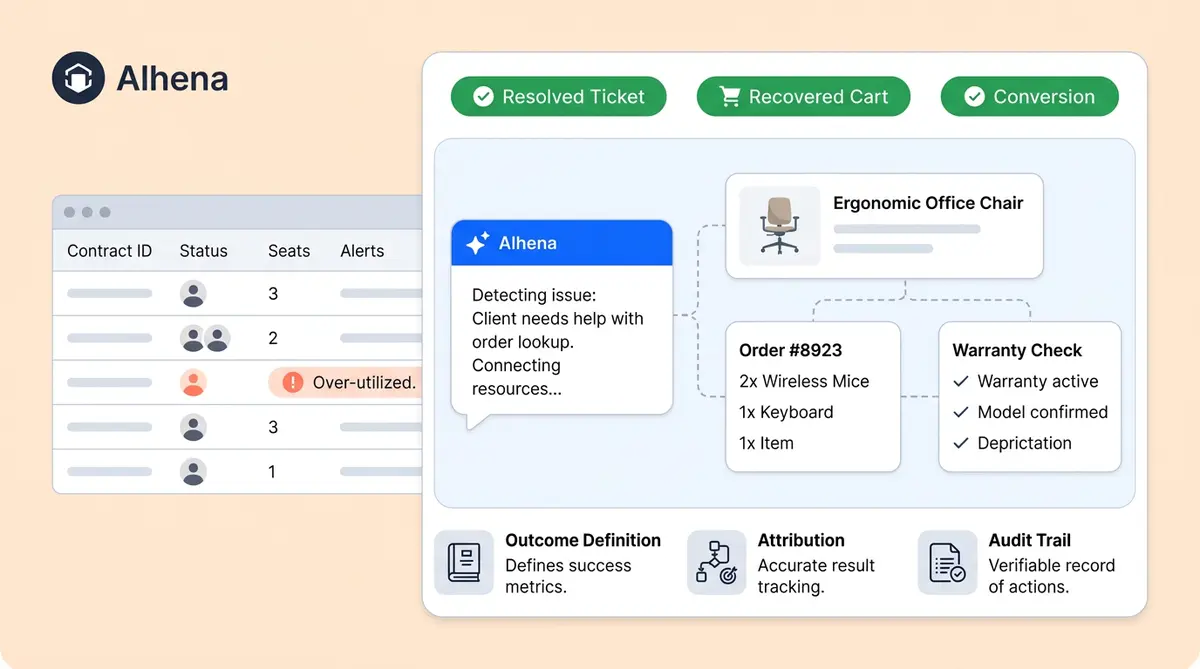
OaAS describes a commercial model where the buyer pays for verifiable outcomes produced by AI agents, not for software licences, seats, or compute usage. The vendor embeds AI agents and orchestration so the work is performed for you, and the vendor is charging based on what gets done.
Three things OaAS is not:
- Not usage-based pricing. Per-token or per-API-call billing systems still price inputs, not results. A thousand API calls that resolve nothing cost the same as a thousand that convert.
- Not a marketing guarantee. OaAS means outcomes are contracted with clear definitions, dispute windows, and measurement protocols.
- Not free. Vendors absorb delivery risk in outcome models, so per-outcome fees typically cost more than flat subscriptions.
For a deeper look at how credit-based and usage-aligned pricing models compare, we covered the full spectrum in a separate post. OaAS sits at the far end of that agentic pricing ladder, where the vendor carries the most risk.
Why E-Commerce Is the Natural First Mover
Most enterprise companies struggle with outcome attribution. When an HR company's agent screens resumes, how do you price quality outcomes like "better hire quality"? When a finance agent processes invoices, did it save 30 seconds or 3 minutes?
E-commerce doesn't have that problem. Outcomes here are already measurable per interaction:
- Support: deflection rate, resolution rate, CSAT score
- Sales: conversion rate, AOV uplift, cart recovery rate
- Post-purchase: return processed without a human, refund turnaround time, all of which reduce costs
This is why AI shopping assistants and support concierges are among the first AI agents where outcome-based contracts make practical sense. Attribution is built into the transaction layer. You don't need a six-month study to know whether the agent converted a shopper.
Three Preconditions Before You Negotiate
Before you push any vendor toward outcome-based terms, you must confirm these three things are in place. Without them, in most cases outcome-based models collapse into billing disputes across company systems.
1. Clear outcome definitions
"Resolved without human intervention" sounds simple until you're reconciling invoices. Does a ticket count as resolved if the customer reopens it 48 hours later? Both sides need to agree on definitions before signing, not after the first dispute.
2. Reliable attribution
You need session-level analytics that connect agent actions to business results across enterprise systems. If your systems can't tell you which conversations led to purchases, outcome-based contracts will collapse into arguments. Revenue attribution becomes a precondition, not a nice-to-have.
3. Grounded, auditable responses
A "resolution" based on hallucinated product specs isn't a resolution. Outcome-based pricing only works when the vendor can show exactly what data the agent used to answer. Retrieval-grounded AI, where every response is anchored to verified product and policy data, makes each interaction auditable, ensuring every resolution is traceable. Without that, you're paying for outcomes you can't verify.
A Procurement Checklist for Outcome-Based AI
If you're evaluating agentic AI agents on outcome-aligned terms and pricing alignment, bring this list to your next vendor call:
- Definition control: Who defines what counts as a resolved or converted outcome? Put it in the MSA, not a side agreement.
- Measurement source: Are outcomes tracked by vendor logs, your analytics, or a third party?
- Floors and caps: Set minimum monthly fees and a maximum exposure for traffic spikes.
- Dispute window: How long do you have to challenge an outcome count? What's the audit process?
- Data rights: Who owns conversation data? Can the vendor train on it? What happens on contract end?
- Exit clause: Outcome contracts can make switching harder. Get a data-export provision upfront to protect your investment.
- Pilot design: Insist on an A/B holdout test. Without a control group, "outcome lift" claims can't be verified. Here's our guide to holdout tests vs. before-after analysis.
How Alhena Fits Into This Model
Alhena's pricing today is usage-aligned: per-conversation credits with tiered plans. That's already closer to outcome alignment and incentive alignment than per-seat SaaS, because buyers pay for conversations that happen, not agents who sit idle. We break down what "meaningful conversation" means in chatbot pricing in a separate post.
More importantly, Alhena's architecture supports all three preconditions above. Built-in revenue attribution traces conversations to conversions and AOV changes. These changes. Every response is grounded in verified product, policy, and order data, so resolutions are auditable. And per-interaction logs give both sides a shared source of truth.
For enterprise companies and mid-market companies, Alhena structures pilots around explicit KPIs: deflection rate, resolution rate, conversion lift, AOV uplift, and operational efficiency. That's the practical on-ramp to outcome-aligned terms, even if the contract itself isn't a pure OaAS structure today.
The Bottom Line
OaAS isn't a product you buy off the shelf. It's a commercial model that works when outcomes are measurable, attributable, and grounded in real data. E-commerce is one of the first verticals where all three conditions are already met.
You don't need to wait for vendors to package "OaAS" into a pricing page. Start by getting outcome definitions, attribution infrastructure, and an honest pilot in place. The commercial terms will follow.
Ready to see what measurable outcomes look like for your store? Book a demo with Alhena AI or start for free with 25 conversations.
Frequently Asked Questions
What does OaAS mean in AI procurement?
OaAS stands for Outcome-as-Agentic-Solution. It describes a commercial model where buyers pay for verified outcomes delivered by AI agents, such as resolved tickets or recovered carts, rather than for software licenses or seats.
How is OaAS different from per-conversation AI pricing?
Per-conversation pricing charges for each interaction regardless of result. OaAS ties payment to verified business outcomes like completed resolutions or conversions, shifting more delivery risk to the vendor.
Why is e-commerce a good fit for outcome-based AI contracts?
E-commerce has per-interaction outcomes that are already measurable: conversion rates, AOV uplift, deflection rates, and CSAT scores. Most other enterprise domains lack this level of attribution, making outcome contracts harder to define.
What should I include in an outcome-based AI vendor contract?
Key elements include clear outcome definitions in the MSA, agreed measurement sources, dispute windows, minimum and maximum fee thresholds, data ownership clauses, and an exit provision with data export rights.
Can I negotiate outcome-based terms with Alhena AI?
Alhena uses per-conversation credits with tiered plans today. For Enterprise engagements, Alhena structures pilots around explicit KPIs like deflection rate, conversion lift, and AOV uplift, which serves as a practical on-ramp to outcome-aligned terms.
What are the risks of signing an outcome-based AI contract?
The biggest risks are vague outcome definitions that lead to billing disputes, lack of attribution infrastructure to verify results, and vendor lock-in since outcome contracts can make switching harder. Clear MSA terms and a data-export clause help mitigate these.