The Breaking Point Every Growing Home Brand Hits
When a fast-growing home and living brand sees revenue climb quarter after quarter, the customer service team feels it first. Ticket volume doubles during peak seasons, and ai agents become the only way to maintain a personalized customer experience at scale. Consumers flood in with questions about furniture dimensions, mattress firmness, delivery timelines, and return policies. The customer experience starts to slip, and the support team can't hire fast enough to keep up.
That's exactly what happened to a luxury DTC home goods brand that turned to AI powered customer support to solve the problem. Using AI agents built for ecommerce, they now resolve 63% of all inquiries autonomously while maintaining a 90% CSAT score. Here's how the AI solution transformed their support workflows and what other home brands can learn from their approach. Read the full case study.
Why Their Old Chatbot Failed to Deliver
The brand's first attempt was a rules-based chatbot, a virtual assistant that could answer questions from a fixed script. But anything outside those rigid decision trees triggered an immediate handoff to human agents. Consumers still waited in queues. The support team gained almost no relief. Customer engagement dropped because shoppers had to repeat themselves after every transfer.
The core problem? Traditional chatbots can't analyze customer needs in real time. They don't understand preferences, can't tailor responses to individual situations, and have no ability to pull from a live product catalog or order management system. For home goods, where buyers ask nuanced questions about materials, dimensions, warranty terms, and delivery logistics for bulky furniture, a scripted bot simply isn't enough. You need an ai tool powered by modern ai technologies that can analyze customer preferences and deliver personalized answers in real time.
The brand needed an AI tool that could understand intent, answer questions accurately using real product data, and resolve issues end to end, not just route them.
How AI Powered Customer Support Changed Everything
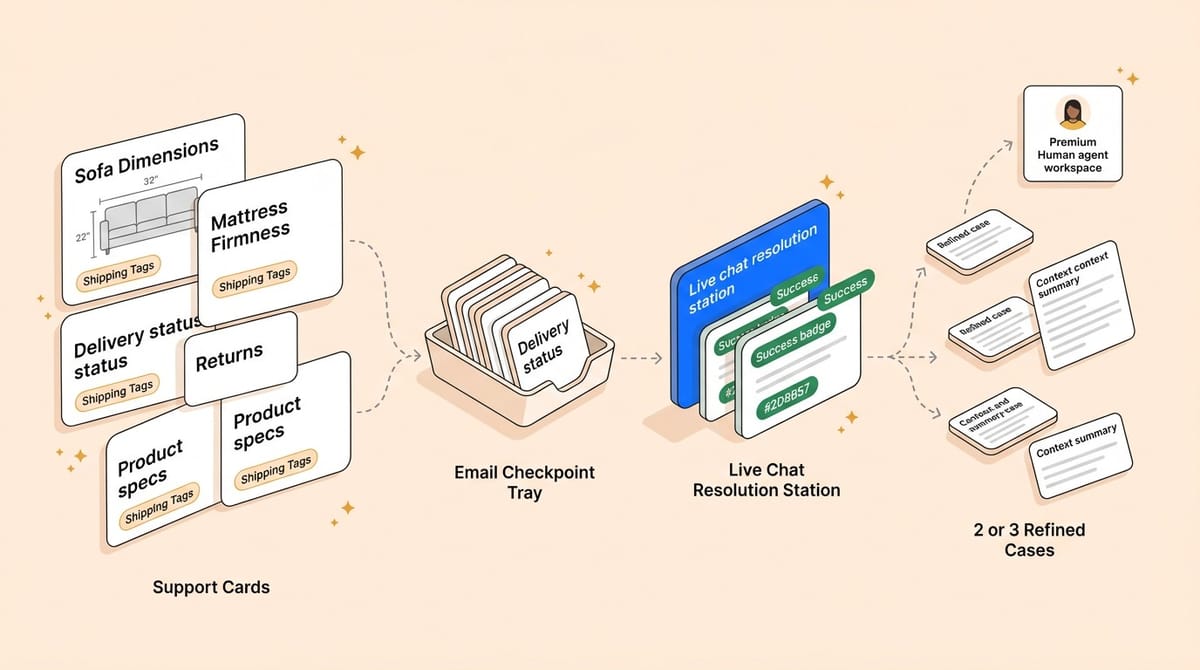
Rather than flipping a switch across all channels, the team took a phased approach. They started with AI email automation only. This gave the CS team time to monitor AI responses, flag edge cases, and build confidence that the AI technologies behind the platform could handle real customer conversations.
Alhena AI was the AI solution they chose. It uses machine learning and NLP (natural language processing) to understand what customers actually mean, not just match keywords. The AI assistant connects directly to the brand's helpdesk, product catalog, and order management platforms, pulling personalized data for each interaction. It analyzes customer sentiment in real time, adjusting tone and detail level based on each shopper's preferences and needs. Its nlp capabilities also spot cross selling opportunities by understanding what else a customer might need.
Once the team saw that email responses were consistently accurate, they expanded to live chat on both their primary site and their Canadian storefront. The deep helpdesk integration meant the AI could pull order data, policy details, product specs, and personalized recommendations directly from the systems the team already used.
Smart Escalation, Not Blind Handoffs
The escalation design was just as important as the AI itself. During business hours, complex issues route to live agents who receive full conversation context, so customers never repeat themselves. After hours, those same issues route to email support with all the AI-gathered details attached. This is the kind of intelligent ticket routing that separates agentic AI from basic chatbots.
63% Resolution, 90% CSAT: The Numbers That Matter
The results speak clearly, showing how ai helps brands improve efficiency while optimizing every customer interaction. 63% of all customer inquiries are now fully resolved by AI agents, with zero human involvement needed. That includes product questions, store policies, order tracking, returns, and routine post-purchase requests handled from start to finish. Consumers get fast, accurate customer service from agentic ai that feels natural, not robotic.
More telling is the satisfaction score. AI-resolved interactions maintain a 90% CSAT, matching the brand's historic human-only performance. Most automated solutions score far lower. Hitting 90% with AI powered support puts this brand well above industry averages.
The support KPIs improved across the board: faster response times, higher accuracy, greater efficiency in handling routine inquiries, and a CS team that finally had bandwidth to focus on complex, high-value interactions that require a human touch.
How AI Helps Human Agents Level Up
Here's something most case studies don't mention about using ai for customer support. The support team didn't just get more time back. They actually started learning from the AI. By studying how the AI assistant handled conversations, including how it used order history, customer sentiment signals, and product details to craft complete answers, human agents sharpened their own replies.
The brand's Customer Support Manager described the AI's responses as creating a "Wow factor" for customers. That thoroughness raised the bar for the entire team. When AI handles routine volume, human agents stop rushing through tickets and start offering the kind of thoughtful, personalized customer service that builds loyalty.
AI copilot features also play a role here. Alhena's Agent Assist works as an AI copilot alongside human agents, surfacing relevant data, suggesting responses, and helping agents make informed decisions faster. This copilot approach improves efficiency across the entire support operation. The copilot refines its suggestions over time, learning to answer questions faster and tailor each response to the customer's situation using predictive analytics and machine learning, optimizing both speed and accuracy for every interaction.
What Made This Work (and What to Avoid)
Three decisions made the difference between this successful deployment and the AI rollouts that fail:
- Phase it. Start with one channel, validate quality, then expand. Don't automate everything on day one. Start with automated email, then expand to virtual chat. The best ai tools for retail and furniture brands scale gradually.
- Integrate deeply. The AI needs access to your order management system, helpdesk, and product catalog. Without that data, it can't tailor responses to individual customer needs. Driven solutions that connect to your existing platforms enable real personalization and help customers make informed decisions autonomously.
- Design the escalation path. Know exactly when and how conversations move to humans. Context must travel with the customer. This is how you maintain customer engagement and keep customer sentiment positive even when the AI can't fully resolve an issue.
If you're running a home furnishing or luxury home brand and your support queue keeps growing faster than your headcount, this playbook works. The brand didn't replace their team. They gave their team an AI powered force multiplier.
Ready to See What AI Can Do for Your Customer Support?
Alhena AI is purpose-built for ecommerce brands using AI to scale customer service without scaling headcount. With hallucination-free responses grounded in your product data, deep helpdesk integrations, and smart human handoff, it's how brands like this one hit 63% resolution and 90% CSAT.
Book a demo with Alhena AI to see it in action, or start free with 25 conversations and test it against your own support data.
Frequently Asked Questions
How does AI resolve 63% of support tickets without human involvement?
The AI pulls directly from the brand's product catalog, order management system, and policy documents through a deep Freshdesk integration. For routine inquiries like order tracking, return policies, and product specs, it has everything it needs to give a complete, accurate answer. Only complex or sensitive issues get escalated to a human agent.
Can AI customer support maintain high CSAT scores?
Yes. This brand maintained 90% CSAT on AI-resolved interactions, matching their historic human-only performance. The industry average for full AI automation is closer to 71% (Freshworks 2025 Benchmark), so the key differentiator is implementation quality: phased rollouts, accurate product data, and smart escalation design.
Why start AI support with email before live chat?
Email gives the CS team time to review AI responses at their own pace, catch edge cases, and build internal confidence before going live on chat. It's a lower-risk channel because response time expectations are longer. Once the team trusts the AI's accuracy, expanding to real-time chat feels natural rather than risky.
What happens when the AI can't resolve an issue?
During business hours, the conversation transfers to a live agent along with full context, so the customer never repeats themselves. After hours, unresolved issues route to email support with all AI-gathered details attached. This smart escalation design is what keeps CSAT high even when the AI hits its limits.
How long does it take to deploy AI support for a home goods brand?
Alhena AI deploys in under 48 hours with no developer resources needed. The phased approach this brand used (email first, then chat) took a few weeks total, but the email channel was handling real customer conversations within days of going live.
Does AI support work for complex home furnishing questions?
It does when the AI has access to detailed product data. Home goods customers ask about dimensions, materials, firmness levels, warranty terms, and delivery logistics for bulky items. A well-integrated AI pulls this information from the product catalog in real time, giving answers that are often more complete and consistent than what a rushed human agent provides.
How does Alhena AI compare to a basic workflow chatbot?
Workflow chatbots follow rigid decision trees and fail the moment a question falls outside the script. Alhena AI uses generative AI grounded in your actual product data, so it understands customer intent and resolves issues end to end. That's the difference between minimal deflection and 63% full resolution.